

Most product development teams treat invention pipeline management as a straight line: idea comes in, patent goes out, product hits market. That mental model breaks down fast. Invention pipeline management explained properly looks more like a living system with feedback loops, stage gates, and cross-functional handoffs that require active coordination. Structured processes guide ideas from ideation through development to market launch, with screening, prototyping, and commercialization checkpoints built in. This guide covers every stage, the best practices that separate high-output teams from stalled ones, and the tools changing how pipelines get managed today.
Table of Contents
- Key Takeaways
- Invention pipeline management explained: the core stages
- Best practices for managing and optimizing your pipeline
- Integrating legal, business, and innovation functions
- Leveraging AI tools in your invention pipeline
- My take on what actually makes pipelines work
- Take your invention pipeline further with Inventifystudios
- FAQ
Key Takeaways
| Point | Details |
|---|---|
| Pipeline stages require gates | Each invention development stage needs a defined go/no-go checkpoint to prevent wasted resources on weak ideas. |
| Visibility drives engagement | Making your pipeline transparent with clear ownership keeps inventors engaged and leadership informed. |
| WIP limits prevent bottlenecks | Controlling work-in-progress mathematically sustains flow and protects your highest-value projects. |
| Cross-functional alignment matters | Legal, R&D, and commercialization teams must coordinate early to prevent broken handoffs and costly delays. |
| AI enhances, not replaces, judgment | AI tools accelerate prior art search and patent analysis, but human oversight remains non-negotiable for inventorship documentation. |
Invention pipeline management explained: the core stages
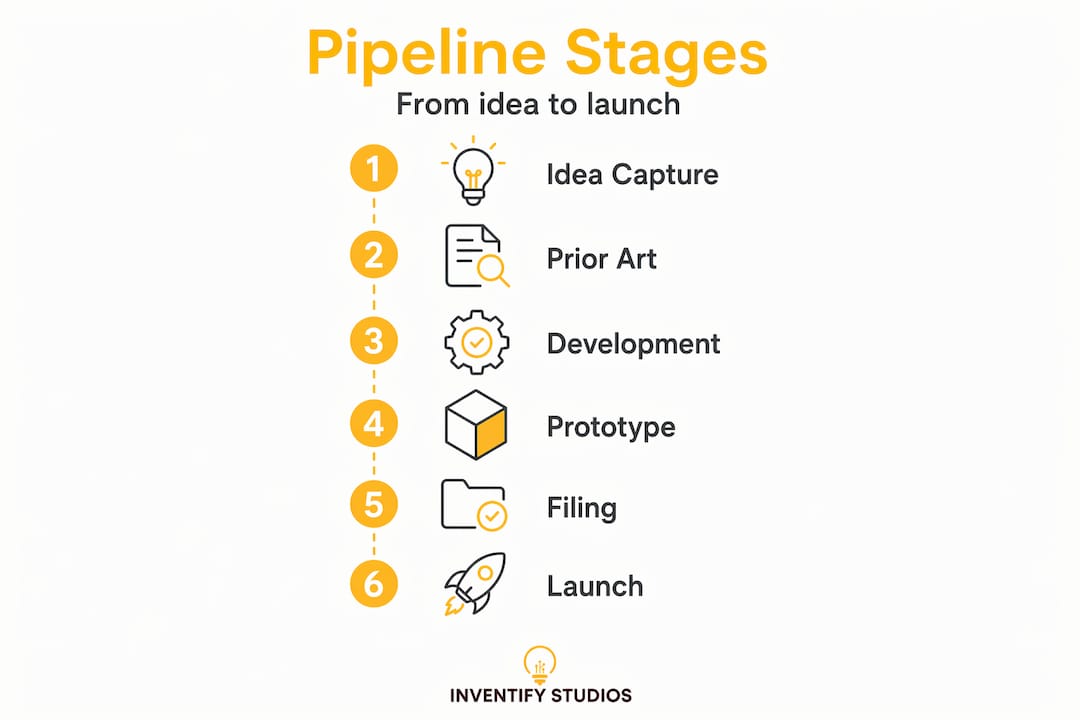
Every well-run invention pipeline follows a recognizable arc, even if the specifics vary by industry or team size. Knowing what happens at each stage, and what can go wrong, gives you the foundation to manage the whole system.
-
Idea capture and intake. This is where most pipelines leak. Without a structured disclosure process, good ideas get lost in email threads or Slack channels. High-performing teams use formal invention disclosure forms with fields for technical description, potential applications, and initial prior art awareness. The goal is continuous idea flow, not a once-a-year innovation sprint.
-
Validation and prior art search. Before committing development resources, you need to know whether the idea is novel. AI-assisted search tools have dramatically shortened this step. The USPTO's ASAP! program delivers up to 10 AI-generated prior art documents before examination begins, giving applicants early data to decide whether to amend, continue, or abandon a filing.
-
Concept development and prototyping. Once an idea clears initial validation, it moves into concept development. This stage involves translating a raw disclosure into a working model, whether digital or physical. Speed matters here. The faster you can generate a testable prototype, the faster you can identify technical gaps before they become expensive patent prosecution problems.
-
Patent filing and prosecution. Filing strategy should align with where the invention sits in its development arc. Provisional patents buy you 12 months of priority date protection while development continues. When filing, practitioners must prepare documentation for long-term judicial scrutiny, especially as AI-assisted inventorship guidance continues to evolve at the USPTO.
-
Market readiness and commercialization. The final stage connects IP to business outcomes. This means licensing discussions, product launch timelines, and competitive positioning. Teams that treat this as an afterthought often find their patents expire before generating revenue. Build commercialization criteria into your stage-gate reviews from day one.
Best practices for managing and optimizing your pipeline
Knowing the stages is one thing. Running them without bottlenecks is another. These are the pipeline management techniques that actually move the needle.
-
Create a visible, trackable pipeline. High-performing IP teams establish transparency with clear stages and defined ownership at every step. Use a shared dashboard or project management tool that shows every active invention, its current stage, the responsible owner, and the next action required. When inventors can see their idea progressing, engagement stays high. When leadership can see the full portfolio, prioritization decisions get easier.
-
Apply WIP controls. Governance breaks when innovation workflow is overloaded. Frameworks like AcceleTrak use automated WIP limits to sustain flow and keep teams focused on high-value projects. The math is straightforward: if your team can realistically advance five inventions per quarter, having twenty active projects guarantees all twenty move slowly. Cap the active queue and let completed work pull new items in.
-
Use structured evaluation frameworks. Not every idea deserves the same level of investment. Build a scoring rubric that weighs technical feasibility, market size, IP strength, and strategic fit. Engage multi-disciplinary reviewers, not just engineers or just attorneys, to get a complete picture before committing to full development.
-
Automate manual tasks with AI. Prior art searches, patentability assessments, and competitive landscape scans are time-consuming when done manually. AI tools cut that time significantly. Embed AI outputs directly into your stage-gate decision points so reviewers have data in front of them when they vote.
-
Prune your portfolio regularly. Organizations let weaker patents expire or withdraw filings that do not meet cost-benefit thresholds. A bloated portfolio drains maintenance fees and attorney time. Schedule quarterly reviews to assess which patents are generating value and which ones are dead weight.
Pro Tip: Set a hard rule that no new invention enters active development until it clears a documented prior art search and a brief business case review. This single gate eliminates roughly 30 to 40 percent of low-potential projects before they consume real resources.
Integrating legal, business, and innovation functions
One of the most common reasons invention pipelines stall is not a lack of ideas. It is a lack of coordination between the teams responsible for advancing them. Effective IP operations require breaking down silos between legal, business, and innovation teams early in the process.
Here is what that integration looks like in practice:
-
IP and R&D working in parallel. When patent attorneys only see an invention after development is complete, they are often forced to file narrow claims around a product that has already been built. Bringing IP counsel in during the concept development stage allows claims to be drafted around the broadest defensible scope.
-
Early inventorship documentation. Aligning legal and innovation teams early prevents broken handoffs and speeds decision-making. Robust inventorship records, with dated lab notes, version-controlled design files, and clear contributor documentation, protect you in prosecution and litigation.
-
Business goals driving patent strategy. Not every invention needs a patent. Some innovations are better protected as trade secrets. Others are worth patenting purely for licensing revenue rather than product protection. Your IP strategy should map directly to your business model, not exist as a separate function.
-
Continuous feedback loops. Pipeline health monitoring means tracking metrics like average time per stage, abandonment rate by stage, and ratio of filings to granted patents. These numbers tell you where the system is breaking down before a backlog becomes a crisis.
"Innovation pipelines succeed when IP is handled as an interconnected system rather than fragmented steps." — Inspire IP
When legal, R&D, and business teams share the same pipeline view and review cadence, decisions that used to take weeks get made in days.
Leveraging AI tools in your invention pipeline
AI is no longer a future consideration for invention pipeline management. It is a present-day operational advantage for teams willing to use it deliberately.
| AI Application | Pipeline Stage | Primary Benefit |
|---|---|---|
| Prior art search automation | Validation | Faster novelty assessment with broader coverage |
| Patent landscape analysis | Concept development | Identifies white space and competitive risk early |
| Stage-gate decision support | All stages | Data-driven go/no-go recommendations |
| Inventorship documentation review | Patent filing | Flags gaps before prosecution begins |
| Competitive IP monitoring | Commercialization | Tracks competitor filings in real time |
AI patent landscape analysis embedded at each R&D decision point improves timing, risk management, and competitive forecasting. That is not a marginal gain. Teams that wait until late-stage development to run competitive analysis routinely discover blocking patents after they have already committed significant resources.

The USPTO's current guidance treats AI as a tool analogous to lab equipment, with human inventorship presumed throughout. This means your AI-assisted workflows need clear documentation showing where human creative judgment was applied. Keep records of which AI outputs were reviewed, what decisions were made based on them, and who made those decisions.
Pro Tip: Do not use AI outputs as final answers. Use them as starting points for human review. An AI-generated prior art search that your attorney reviews and annotates is far stronger than one that goes directly into a filing without scrutiny.
The most forward-thinking teams are also using AI for continuous monitoring of competitive IP landscapes, setting automated alerts for competitor filings in their technology space. This turns patent intelligence from a reactive exercise into a proactive one.
My take on what actually makes pipelines work
I have reviewed a lot of invention pipelines, and the ones that fail share a common trait: they were built as checklists instead of systems. Teams complete each stage and move on, never looking back at how earlier decisions are affecting later outcomes.
What I have found is that the most effective pipelines treat every stage as connected to every other stage. A weak inventorship record at disclosure creates problems at prosecution. A patent filed without commercialization criteria creates an asset that never generates revenue. These are not isolated failures. They are system failures.
The other thing I keep seeing is underinvestment in early inventor engagement. When inventors submit a disclosure and hear nothing for three months, they stop submitting. The pipeline dries up at the source. The fix is simple: acknowledge every disclosure within 48 hours, give inventors a visible timeline, and close the loop when a decision is made.
On AI, I think the risk is not that teams will use it too much. The risk is that they will use it without governance. AI-generated prior art searches are genuinely useful. But I have seen teams treat an AI output as a clearance opinion, which it is not. Build review checkpoints into every AI-assisted step, and document who reviewed what and when.
Finally, portfolio pruning is the practice most teams resist and most teams need. Letting go of a patent feels like admitting failure. In reality, pruning portfolios to maintain funding focus is what mature organizations do to stay competitive. A lean, high-quality portfolio beats a bloated one every time.
— Hua
Take your invention pipeline further with Inventifystudios
Managing an invention pipeline from ideation to patent-ready documentation takes the right tools at every stage. Inventifystudios is built specifically for that workflow.

With Inventifystudios, you can start building your invention from a raw concept and move through AI-generated 3D prototypes, patentability assessments, and provisional patent drafts without the overhead of traditional consulting fees. The platform supports every stage covered in this guide, from initial validation to patent-ready documentation. You can also review your invention portfolio to track progress across multiple projects and make smarter prioritization decisions. For product development teams that want to move faster and protect ideas more effectively, Inventifystudios removes the barriers that slow most pipelines down. Explore what is possible at Inventifystudios.
FAQ
What is invention pipeline management?
Invention pipeline management is the process of tracking and advancing ideas through defined stages from ideation to commercialization. It includes structured intake, validation, prototyping, patent filing, and market readiness reviews with stage-gate decision points at each transition.
How many stages does a typical invention pipeline have?
Most invention pipelines include five to six core stages: idea capture, prior art validation, concept development, prototyping, patent prosecution, and commercialization. The exact number varies by organization, but each stage should have clear entry criteria and a defined owner.
What causes bottlenecks in invention pipelines?
Bottlenecks most often result from overloaded work-in-progress queues, poor cross-functional communication, and delayed patent reviews. Managing WIP with defined limits and embedding AI-assisted analysis at stage gates are the two most direct fixes.
How does AI fit into invention pipeline management?
AI accelerates prior art searches, patent landscape analysis, and competitive monitoring. The USPTO's current guidance confirms AI functions as a tool supporting human inventors, not replacing them, so all AI outputs require documented human review before use in patent filings.
When should legal teams get involved in the pipeline?
Legal teams should engage at the concept development stage, not after a product is built. Early involvement allows broader patent claims, better inventorship documentation, and alignment between IP strategy and business goals before resources are fully committed.