

Most people assume a public domain invention is either worthless or legally murky. Neither is true. Understanding what is public domain invention status actually means gives you legal freedom to build, sell, and modify existing technology without paying licensing fees or asking anyone's permission. That's a significant advantage for creators, entrepreneurs, and DIY inventors who want to start from proven foundations rather than scratch. This guide breaks down exactly how public domain works for inventions, what qualifies, and how you can put that knowledge to work.
Table of Contents
- Key takeaways
- What is a public domain invention, exactly?
- Real examples of public domain inventions
- How to legally use public domain inventions
- Public domain vs copyright: what actually governs inventions
- My take on public domain and why creators underestimate it
- Build your next invention with Inventifystudios
- FAQ
Key takeaways
| Point | Details |
|---|---|
| Public domain means free to use | Once an invention enters the public domain, anyone can use, modify, or sell it without permission. |
| Patents expire after 20 years | Most U.S. utility patents last 20 years from the filing date, then the invention becomes publicly accessible. |
| Early expiration is common | Roughly 60% of patents lapse before their full term due to unpaid maintenance fees. |
| Trademark rights can still apply | Even public domain inventions may carry active trademarks that restrict how you brand your product. |
| Verification is non-negotiable | Always confirm patent expiration through official databases before building a business around a public domain invention. |
What is a public domain invention, exactly?
A public domain invention is any invention that is no longer protected by a patent, or was never patented in the first place. No single person or company holds exclusive rights to it. You can manufacture it, sell it, improve it, or incorporate it into your own product without seeking a license or paying royalties.
The confusion often comes from mixing up different types of intellectual property. Patents, copyrights, and trademarks each work differently. A patent grants an inventor exclusive rights for 20 years from the earliest effective filing date. Once that term ends, the invention belongs to everyone. Copyright, by contrast, protects creative expression like books, music, and software code. Trademark protects brand names and logos. None of those automatically expire when a patent does.
Here is a quick comparison to keep things clear:
| IP Type | What it protects | Duration | Public domain entry |
|---|---|---|---|
| Utility patent | Functional inventions | 20 years from filing | After expiration or lapse |
| Design patent | Ornamental product designs | 15 years from grant | After expiration |
| Copyright | Creative works | Life of author + 70 years | After term ends |
| Trademark | Brand names and logos | Indefinite (with renewal) | Rarely enters public domain |
| Trade secret | Confidential business info | Indefinite | If publicly disclosed |
Pro Tip: Check the filing date, not the grant date, when calculating patent expiration. The 20-year term counts from the earliest effective filing date, and long patent prosecution can eat into your protection window significantly.
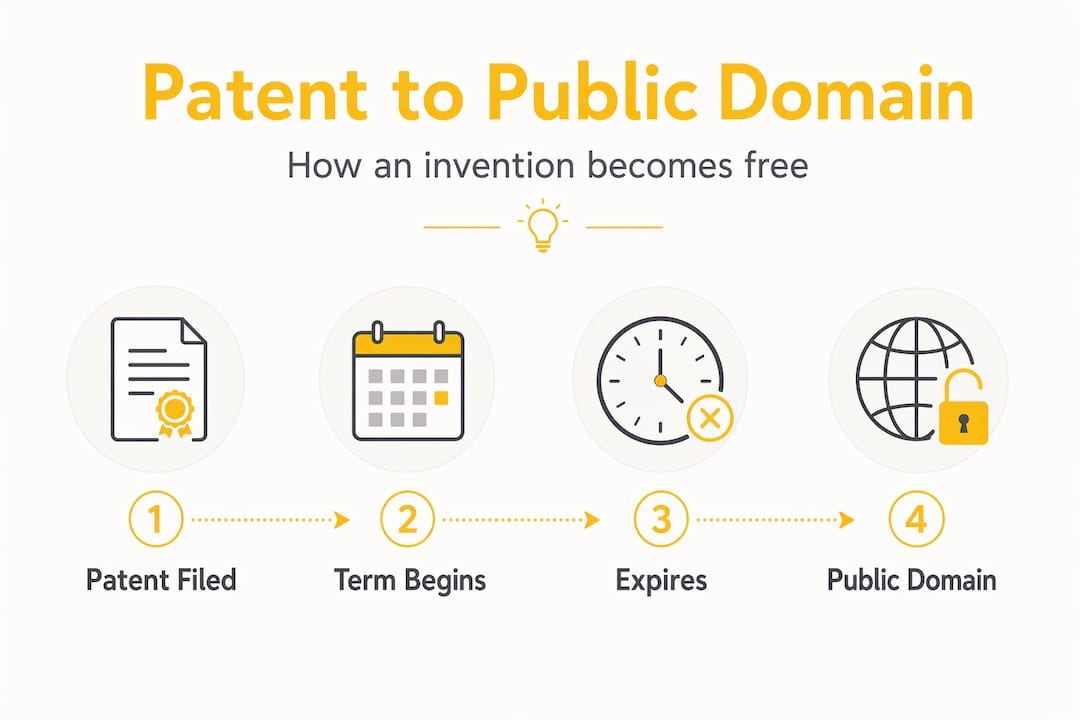
An invention can also enter the public domain before its 20-year term ends. If the patent holder fails to pay maintenance fees at the 3.5, 7.5, and 11.5 year marks, the patent lapses. The invention becomes publicly accessible immediately. This happens more often than most people realize.
Real examples of public domain inventions
History is full of inventions that started as protected patents and eventually became public property. Understanding these examples makes the concept concrete and shows you the scale of what's actually available to build on.

The aspirin formula is one of the most cited cases. Bayer held the original patent, but once it expired, generic manufacturers worldwide began producing acetylsalicylic acid freely. The same happened with countless pharmaceutical compounds. Early versions of the telephone, the original Wright Brothers aircraft designs, and foundational radio transmission technologies are all in the public domain today.
Here are more examples worth knowing:
- Early computing algorithms: Many foundational algorithms from the 1970s and 1980s have long since passed their patent terms and are now freely usable in software development.
- Velcro-style fastener mechanisms: The original hook-and-loop fastener patents expired decades ago. Manufacturers worldwide now produce compatible products without licensing.
- Basic LED technology: Core light-emitting diode patents from the mid-20th century are fully public domain, enabling today's affordable LED lighting market.
- Expired pharmaceutical compounds: Drugs like ibuprofen and many antibiotics are now produced generically because their original patents expired.
- U.S. government inventions: Works and inventions created by federal government employees as part of their official duties generally enter public domain immediately, with no exclusivity period at all.
Inventors can also voluntarily place their work in the public domain. Creators using tools like Creative Commons Zero (CC0) explicitly waive all rights, making their work available for unrestricted use. While CC0 is more common for creative works, the principle applies to any intellectual property a creator chooses to release.
One important distinction: public domain inventions and public domain creative works follow different legal paths. A novel enters the public domain when copyright expires. An invention enters the public domain when its patent expires or lapses. They are governed by entirely separate bodies of law.
Pro Tip: Accidentally disclosing your own invention before filing a patent can void your patent rights and force it into the public domain prematurely. File first, disclose second.
How to legally use public domain inventions
Freedom to use a public domain invention is real, but it comes with responsibilities. You need to verify status, check for overlapping rights, and understand the limits of what "public domain" actually covers in practice.
Here is a step-by-step process to use public domain inventions without legal risk:
-
Search the USPTO patent database. Go to patents.google.com or the USPTO's Patent Full-Text Database. Search by keyword, inventor name, or patent number to find relevant patents and their filing dates.
-
Calculate the expiration date accurately. Remember that the 20-year clock starts from the earliest effective filing date, not the grant date. A patent filed in 2001 and granted in 2004 expired in 2021, not 2024.
-
Check for maintenance fee lapses. The USPTO's Patent Center shows maintenance fee payment history. If fees were missed, the patent may have lapsed years before its standard expiration.
-
Search for active trademarks. Even when a patent expires, trademark or publicity rights may still restrict commercial use. You can manufacture the product, but you cannot sell it under a protected brand name.
-
Look for continuation patents. Original patents sometimes have continuation or improvement patents filed later. Those newer patents may still be active and cover specific improvements to the original invention.
-
Consult a patent attorney for commercial use. If you plan to build a business around a public domain invention, a one-time legal review is worth the cost. It confirms your analysis and flags any issues you may have missed.
The opportunities here are real. Startups regularly build products on expired pharmaceutical patents. DIY inventors use expired mechanical patents to manufacture and sell hardware. Entrepreneurs license expired technology concepts as the foundation for updated, improved products they then patent themselves.
Pro Tip: You can patent your own improvements to a public domain invention. The original invention stays free for everyone, but your specific improvement can be protected. This is how many modern products are built.
Public domain vs copyright: what actually governs inventions
This is where many creators get confused, and the confusion is understandable. Both copyright and patents eventually lead to public domain status, but they govern completely different things.
Copyright protects creative expression. It covers novels, films, music, photographs, and software code as a form of expression. Copyright applies automatically when a work is created and lasts for the author's lifetime plus 70 years. When copyright expires, the creative work enters the public domain.
Patents protect functional inventions. They cover how something works, what it does, or how it is made. Patents require an application, examination, and grant by the USPTO. They last 20 years from filing, not from grant.
Here is where the overlap happens: a product can carry both. A piece of software might have patented algorithms and copyrighted code. When the patent expires, the functional method becomes public domain. The specific code may still be copyrighted. You can replicate the function without copying the code.
| Protection | Governs | Automatic? | Expiration |
|---|---|---|---|
| Patent | How an invention works | No, requires filing | 20 years from filing |
| Copyright | Creative expression | Yes, at creation | Life + 70 years |
| Trademark | Brand identity | No, requires registration | Indefinite with renewal |
| Public domain | No protection applies | N/A | After above terms end |
Public domain status is a deliberate feature of the IP system, not a flaw. It balances the incentive to invent with the public's right to eventually access and build on that knowledge. Every patent that expires enriches the public pool of available technology.
My take on public domain and why creators underestimate it
I've watched creators and early-stage entrepreneurs spend months and significant money trying to build something from scratch when a perfectly good foundation already exists in the public domain. The assumption that public domain means "old" or "inferior" is one of the most expensive misconceptions in the inventor community.
In my experience, the most practical use of public domain knowledge is not copying an expired invention wholesale. It's using it as a verified starting point. You know the core mechanism works because it was tested, patented, and used commercially. Your job is to improve it, adapt it to a modern context, or combine it with another technology.
I've also seen the opposite mistake. Creators assume something is public domain without verifying it, then build a product only to receive a cease-and-desist letter because a continuation patent or an active trademark was still in force. The verification process is not optional. It's the difference between a solid business foundation and a legal liability.
The future of public domain access looks genuinely promising. As AI tools make patent searching faster and more accessible, more creators will be able to identify and leverage public domain inventions without needing expensive legal counsel for every search. That's a real shift in who gets to participate in the invention process.
— Hua
Build your next invention with Inventifystudios
Understanding public domain inventions is the first step. Knowing what to build next is where Inventifystudios comes in.

Inventifystudios gives creators and entrepreneurs the tools to take any invention concept, including those built on public domain foundations, and develop it into a fully validated product concept. You can explore public domain inventions directly on the platform, then use AI-powered tools to generate 3D prototypes, run patent analysis, and draft provisional patent narratives for your improvements. The platform's invention detail tools show you exactly where an invention sits in its IP lifecycle. Ready to build? Start creating your invention today and turn your idea into a protected, market-ready concept without the traditional consulting costs.
FAQ
What is a public domain invention?
A public domain invention is any invention no longer protected by a patent, meaning anyone can use, manufacture, or sell it freely without permission or licensing fees.
How long before an invention enters the public domain?
Most U.S. utility patents expire 20 years from the earliest effective filing date, at which point the invention enters the public domain. Some patents lapse earlier due to unpaid maintenance fees.
Can I patent improvements to a public domain invention?
Yes. You can file a patent on your specific improvements or modifications to a public domain invention. The original invention remains free for all to use, but your improvement can be protected.
Are there risks to using public domain inventions commercially?
Yes. Even when a patent expires, active trademarks or trade secrets associated with the invention may still restrict certain commercial uses. Always verify all IP rights before building a business around a public domain invention.
How do I check if an invention is truly in the public domain?
Search the USPTO patent database or Google Patents for the patent, confirm the filing date, calculate the 20-year term, and check the maintenance fee payment history to see if the patent lapsed early.