

Most inventors don't quit because their ideas were bad. They quit because the process defeated them. Understanding why inventors abandon good ideas means looking past the concept itself and examining the structural, financial, and strategic traps that intercept even promising inventions before they reach the market. Funding gaps, patent missteps, and the failure to validate real market demand are among the most common reasons inventors give up. This article breaks down exactly what stops inventors at each stage and what you can do to stay in the game.
Table of Contents
- Key takeaways
- Why inventors abandon good ideas: the core reasons
- Common inventor pitfalls that lead to abandonment
- Iteration speed and failure velocity
- Navigating patents and commercialization
- My perspective on what inventors actually get wrong
- How Inventifystudios helps inventors stay on track
- FAQ
Key takeaways
| Point | Details |
|---|---|
| Market validation comes first | 42% of inventions fail because no viable customer problem was confirmed before development began. |
| Pro se filings carry high risk | Independent inventors filing without professional help face a 76% abandonment rate versus 35% for professionally drafted patents. |
| Prototype failure is not idea failure | Inventors who conflate execution problems with concept problems prematurely abandon ideas that could still succeed with a different approach. |
| Patents don't commercialize themselves | A patent is a legal right, not a revenue source. Active licensing, partnerships, and enforcement strategies are required. |
| Iteration speed separates survivors | Inventors who run rapid, low-cost experiments preserve their core idea while discarding failing methods faster than the competition. |
Why inventors abandon good ideas: the core reasons
Good inventions get abandoned every day. The ideas weren't flawed. The execution pipeline was. Several systemic forces work against inventors, and most of them operate invisibly until it's too late to course-correct.
No confirmed market need. 42% of startup and invention failures trace back to solving a problem nobody actually has, or at least not one they'd pay to solve. Inventors often build solutions for hypothetical users rather than real ones, and no amount of technical polish fixes a product that solves the wrong problem.
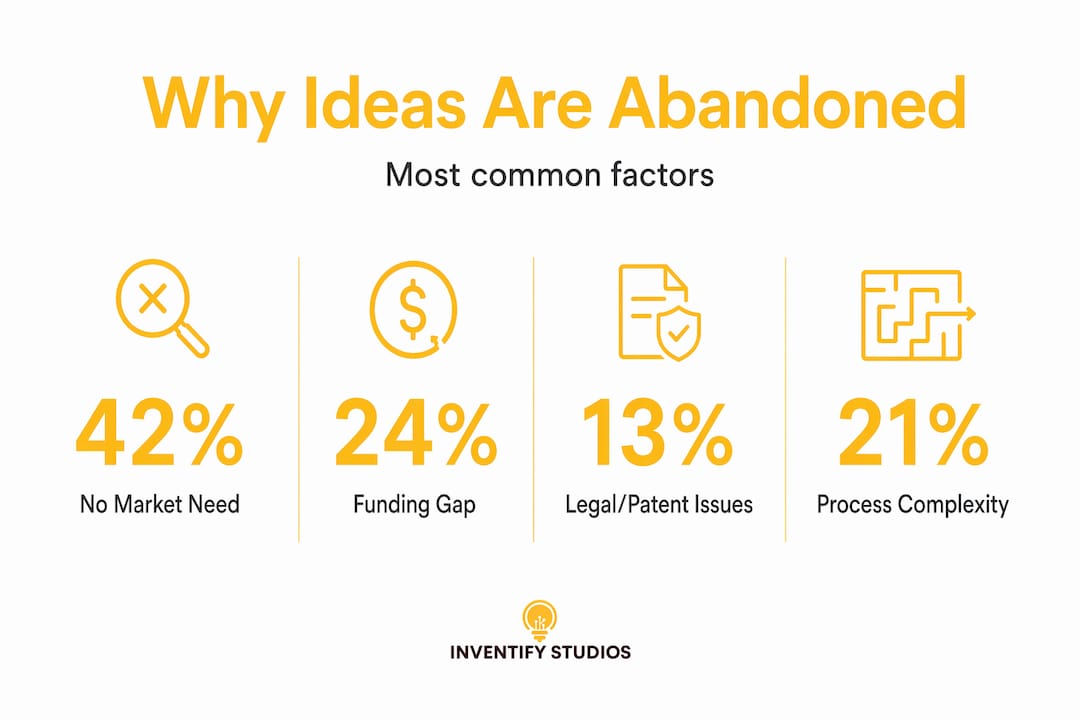
The funding gap nobody talks about. Mid-scale inventions are particularly vulnerable. They're too developed for philanthropic grants but too early and unproven for venture capital. Many inventions stall in this "missing middle" between funding stages, quietly abandoned when the inventor runs out of personal capital with no institutional bridge in sight.

Patent strategy disconnected from business goals. Patents created without strategic alignment to business objectives become expensive documents with no commercial leverage. Inventors secure patents for credibility rather than competitive advantage, then wonder why nothing converts.
Passive ownership. Holding a patent is not the same as commercializing one. Many inventors file, receive approval, and then wait. The patent doesn't generate calls from licensees. It doesn't attract partners. Nothing happens because nothing was initiated.
- Lack of market validation before significant investment
- Underfunded mid-development phases with no bridge funding
- Patents filed for optics rather than strategic business leverage
- No active commercialization plan post-filing
- Emotional burnout from process complexity without visible progress
Pro Tip: Before spending a dollar on patent filing, test your core value proposition with at least 20 potential customers. If fewer than half would pay for the solution, you need a different problem framing, not a different invention.
Common inventor pitfalls that lead to abandonment
Understanding the systemic barriers is one thing. Recognizing the specific, avoidable mistakes that accelerate abandonment is another. These are the common pitfalls for inventors that show up repeatedly across every stage of the process.
-
Delaying patent filing until "the idea is perfect." The U.S. patent system rewards the first to file, not the best inventor. Every week you delay is a week someone else could file on a similar concept and take priority. Proper invention documentation practices and provisional filings preserve your priority date without requiring a fully developed product.
-
Confusing inventorship with ownership. These are legally distinct concepts, and many inventors misunderstand inventorship versus ownership. When co-inventors refuse to sign declarations over ownership fears, patent filings get delayed. That delay can mean losing rights entirely to a faster competitor.
-
Treating prototype failure as idea failure. A prototype tests one method of solving a problem. When that method fails, inventors often mistake prototype failure for idea failure and abandon the entire concept. The problem worth solving didn't disappear. Only the approach did.
-
Starting without a clear problem definition. If you can't articulate the specific problem your invention solves in one sentence, you don't have a product concept yet. You have a technology looking for an application. Without that foundation, market validation is impossible and commercialization is guesswork.
-
Underestimating ongoing costs. Filing a patent is the beginning of the expense, not the peak. Maintenance fees, enforcement costs, and commercialization spending continue for years. Inventors who budget only for filing often abandon their patent mid-life simply because they couldn't sustain the financial commitment.
Pro Tip: Treat your provisional patent filing as a 12-month clock, not a finish line. Use that year to validate demand, find licensing partners, and build your commercialization case before the full application deadline arrives.
Iteration speed and failure velocity
Here's something most inventors get wrong about failure: the goal isn't to avoid it. The goal is to fail faster than your budget runs out.
Inventors forced by resource constraints to iterate rapidly consistently outperform better-funded peers who move slowly. Edison's famous line about finding 10,000 ways something won't work wasn't pessimism. It was a description of high failure velocity. Each failed method wasn't a loss. It was data that eliminated a dead end and pointed toward something that could work.
"Successful inventors maintain high failure velocity by decoupling core problems from specific execution methods, discarding inefficient approaches quickly." — Inventorspot
The contemporary version of this is the lean startup methodology. You build a minimum viable prototype, expose it to real conditions, collect feedback, and either adjust or discard the approach. Not the idea. The approach. This distinction is what separates inventors who persist from those who abandon.
What slows iteration and accelerates abandonment:
- Emotional attachment to a specific execution method
- Treating any failure as a signal to stop rather than redirect
- Over-engineering early prototypes instead of testing core assumptions
- Waiting for perfect information before running the next experiment
- Quick failure velocity reduces development costs and compresses the timeline to a viable product
The inventors who stay in the game the longest aren't the ones with the best first idea. They're the ones who treat each failed attempt as cheaper tuition than the alternative of giving up and starting over years later with a different concept.
Navigating patents and commercialization
Patents are widely misunderstood as the finish line of invention. They're actually the starting gun for commercialization. And the failure to pursue ideas through that commercialization phase is where most barriers to innovation actually live.
| Passive patent ownership | Active patent strategy |
|---|---|
| File and wait for licensing inquiries | Proactively identify and approach potential licensees |
| Use patent for credibility only | Align patent claims to specific competitor technology gaps |
| Ignore enforcement until infringement is obvious | Monitor market and enforce selectively to create leverage |
| No partnerships or co-development deals | Build licensing, cross-licensing, and partnership pipelines |
| Single patent with no portfolio strategy | Build claims that are hard to design around |
A patent is, in practical terms, a license to litigate. That's it. Patent enforcement carries high cost and low guaranteed return, which is why many inventors opt out of enforcement entirely and let valuable IP expire unused. The cost of a single infringement lawsuit can run well into the hundreds of thousands of dollars, which makes enforcement prohibitive for independent inventors without backing.
The strategic answer is to write patents that competitors actually need and that are difficult to design around. When your claims cover the core functionality competitors must use, the leverage shifts. Licensing becomes attractive to them, not just to you. That's when passive ownership becomes active value.
Innovation today also requires commercialization acceleration support to move from prototype to scalable market impact. Inventors who build licensing relationships, seek co-development partners, and connect with startup resources through platforms like inventor community programs are far more likely to convert their patents into real outcomes than those working in isolation.
My perspective on what inventors actually get wrong
I've spent years watching inventors at every stage of the process, and the pattern that frustrates me most isn't the big failures. It's the quiet ones. The inventor who filed a solid provisional patent, then spent a year waiting for the market to come to them. The entrepreneur who scrapped a genuine product after one failed prototype because they thought the idea itself was broken.
What I've learned is that the failure to pursue ideas is almost never about the quality of the idea. It's about misunderstanding what the next step actually is. Inventors treat patent filing as a conclusion when it's a foundation. They treat prototype failure as a verdict when it's feedback. These aren't small perspective shifts. They're the difference between giving up and staying in the fight.
My honest take: most inventors abandon too early because they're solving the wrong problem at the wrong level. They redesign the product when they should be reframing the customer problem. They double down on one execution method when they should be running three parallel experiments with a fraction of the budget.
If I could give one piece of advice to every inventor reading this, it would be: don't confuse process difficulty with idea weakness. The process is hard for everyone. That's not a signal. Persistence with strategic iteration, not stubborn attachment to a single approach, is what separates the inventions that make it from the ones that don't.
— Hua
How Inventifystudios helps inventors stay on track
The gap between a promising idea and a protected, market-ready product is where most inventions quietly disappear. Inventifystudios exists to close that gap. The platform gives inventors AI-generated 3D prototypes in minutes, patent patentability assessments, and provisional patent drafting tools that remove the cost and complexity that typically force abandonment.

Whether you're validating your first concept or refining an existing idea for market, start building your invention with tools built specifically for independent inventors and entrepreneurs. From AI prototype generation to patent-ready documentation, Inventifystudios puts the full invention pipeline in your hands without the fees that traditionally push good ideas out of reach. See how other inventors are progressing and find the plan that fits your stage of development.
FAQ
Why do inventors abandon good ideas so often?
The most common reasons inventors give up include lack of market validation, funding gaps, and process complexity. 42% of inventions fail due to no confirmed market demand, while underfunded mid-stage inventors frequently run out of resources before reaching commercialization.
What is the biggest patent mistake independent inventors make?
Filing without professional guidance dramatically increases abandonment risk. Independent pro se filings have a 76% abandonment rate compared to 35% for professionally drafted applications, making the quality of the filing strategy a critical factor in whether an invention survives.
Does getting a patent mean your invention will succeed?
No. A patent protects an idea but does not commercialize it. Patents require active enforcement and strategic alignment with business objectives to generate value. Passive ownership rarely leads to commercial outcomes.
How does iteration speed affect invention success?
Faster iteration reduces costs and accelerates learning. Rapid experiments and high failure velocity allow inventors to discard failing methods quickly while preserving the core problem they're solving, which keeps development momentum alive.
What is the difference between inventorship and ownership?
Inventorship refers to who created the invention, while ownership refers to who holds legal rights to it. Confusing the two causes delays and disputes that can result in missed filing deadlines and loss of patent priority to competitors.