

Most inventors assume AI is a sophisticated search engine for their ideas. That framing undersells what's actually happening. The role of AI in invention development has shifted from background tool to active creative partner, and that shift carries real consequences for how you file patents, protect IP, and generate genuinely novel concepts. This guide covers the full picture: how AI methodologies have matured, what the USPTO's current stance means for your inventorship claims, how multi-agent frameworks produce patent-ready ideas at scale, and where human judgment remains non-negotiable.
Table of Contents
- Key takeaways
- The role of AI in invention development
- Multi-agent frameworks and invention quality
- Legal framework for AI-assisted inventions in 2026
- Balancing AI efficiency with creative originality
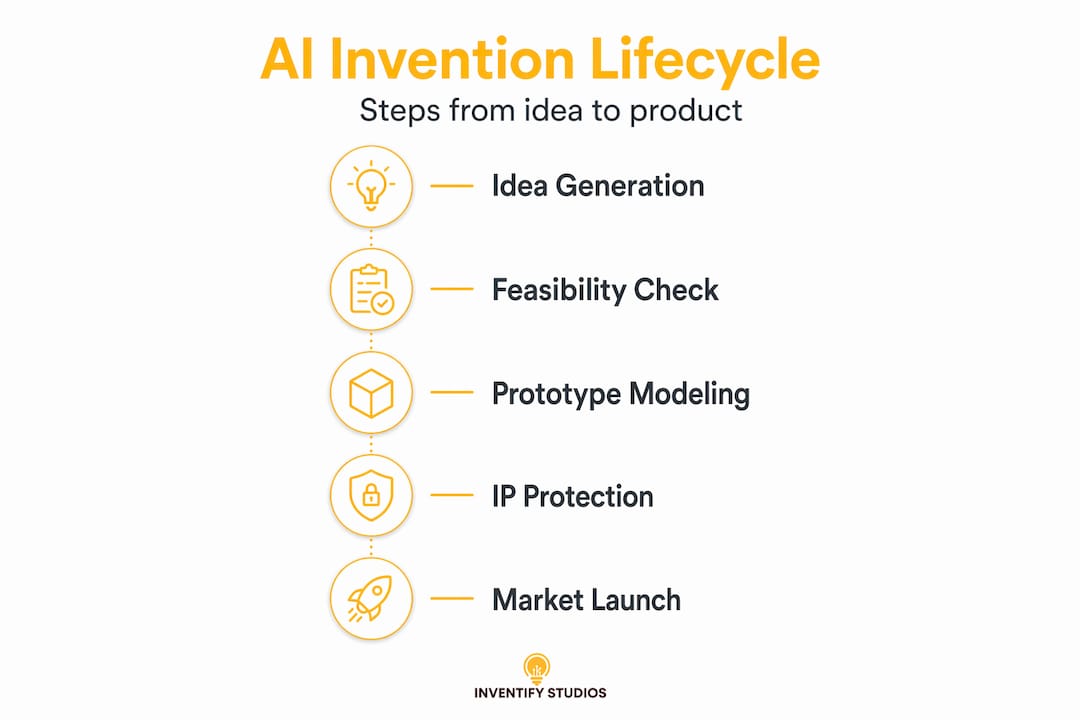
- Integrating AI across the invention lifecycle
- My take on AI as a true creative partner
- Build your invention with Inventifystudios
- FAQ
Key takeaways
| Point | Details |
|---|---|
| AI is more than automation | Modern AI systems generate structured, patent-worthy invention concepts, not just task shortcuts. |
| USPTO treats AI as a tool | Under 2025 revised guidance, a human must still be the named inventor for any U.S. patent. |
| Multi-agent frameworks outperform single prompts | Systems combining TRIZ, Design Thinking, and SCAMPER produce more novel, verifiable invention claims. |
| Confidentiality risks are real | Inputting sensitive invention details into public AI tools can create prior art and void patent rights. |
| Documentation protects your IP | Recording which humans framed problems and validated AI outputs is your strongest legal defense. |
The role of AI in invention development
Artificial intelligence has not simply gotten faster at filling out templates. It has crossed a threshold into what innovation researchers call AI-assisted invention, a term that better captures the current reality than the older "automation" framing. Since 2014, AI patent filings have surged, with over 11,400 AI-related applications submitted in 2023 alone.
That surge reflects something qualitative, not just quantitative. Early AI tools could mine prior art or format claims. Today's frontier models do something different: they generate novel technical combinations, run simulations, and produce structured invention disclosures that a human expert would have taken weeks to draft.
Consider what this means practically. Frontier models like Gemini 3.5 Flash can complete complex coding and technical development tasks at four times the speed and under 50% of previous costs. That same agentic capability applies directly to invention tasks: rapid prior art synthesis, technical feasibility modeling, and claim drafting that once required a full engineering team.
The USPTO's position is equally clear. Its 2025 revised guidance treats AI strictly as a tool, analogous to laboratory equipment. A human being must still frame the inventive concept, validate the output, and take legal responsibility for the claims. The law has not caught up to the technology, but knowing where that boundary sits protects you.
Pro Tip: Before you use any AI model in your invention workflow, write down the specific questions you are asking it to answer. That documentation habit doubles as legal evidence of human intellectual contribution.
Multi-agent frameworks and invention quality
The standard way most teams use AI for invention is sequential and single-threaded. They prompt a model, get an idea, refine it, prompt again. That approach works, but it has a ceiling. Each prompt inherits the framing of the one before it, which means you keep circling the same conceptual territory.
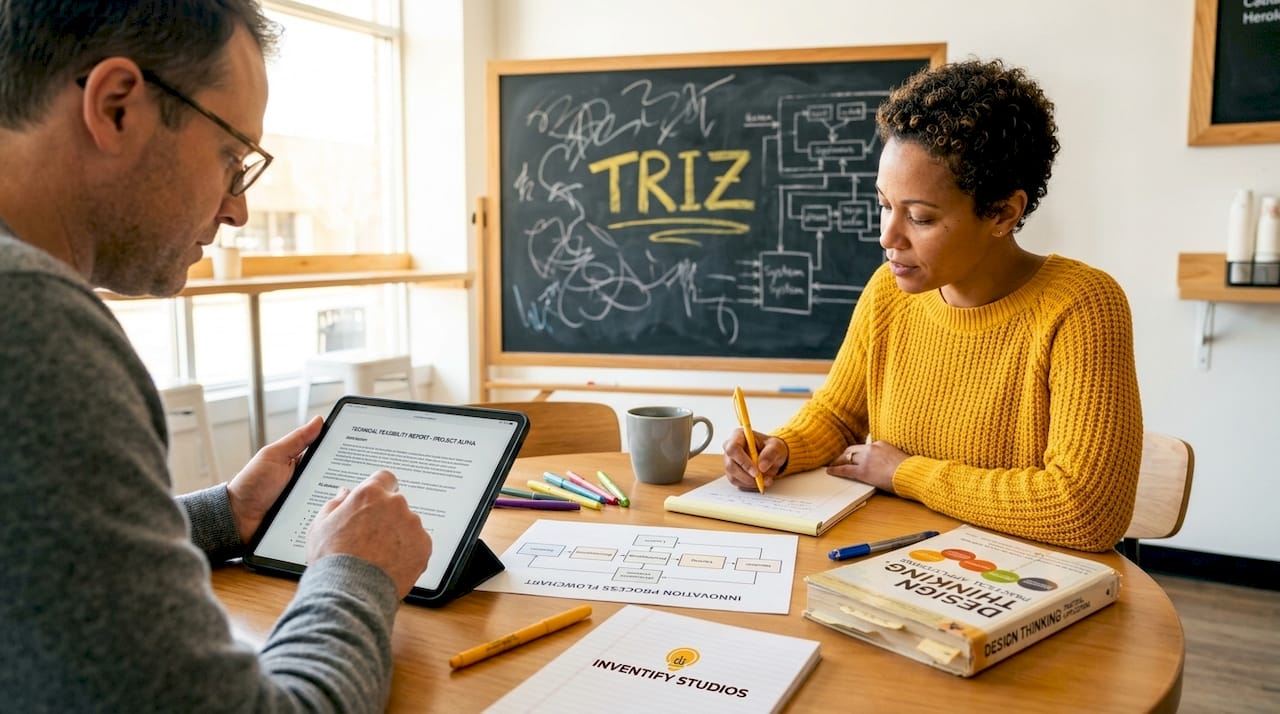
Multi-agent systems using TRIZ, Design Thinking, and SCAMPER simultaneously break that ceiling. Rather than running one methodology at a time, these frameworks deploy multiple AI agents in parallel, each applying a different creative lens to the same problem. The results are then reconciled against a shared knowledge graph that retains every intermediate reasoning step.
Here is why that matters for patent quality:
| Approach | Methodology | Knowledge Retention | Claim Confidence |
|---|---|---|---|
| Single-agent sequential prompting | One framework at a time | Lost between sessions | Lower, narrower claims |
| Multi-agent parallel frameworks | TRIZ + Design Thinking + SCAMPER | Persistent knowledge graph | Higher novelty, convergent claims |
The persistent knowledge graph architecture stores every AI-generated insight across these methodologies and uses an InnovationScore to rank claims by novelty and convergence. Claims supported by multiple methodologies score higher, giving you a ranked shortlist of your strongest patent candidates before you spend a dollar on attorney fees.
This is not theoretical. Innovation researchers now view AI's role as shifting toward structured innovation engines that run parallel creative methodologies rather than assisting one human thinker at a time. Teams that understand this distinction get more diverse, more defensible invention claims out of the same ideation session.
Pro Tip: When running a multi-agent session, treat the knowledge graph output as a first draft for your invention disclosure document, not a finished patent application. Human review of convergent claims is where you add the legal weight.
Legal framework for AI-assisted inventions in 2026
The legal picture has sharpened considerably. USPTO's 2025 revised guidance restores a clear presumption of human inventorship. Examiners will not question inventorship unless AI is explicitly named, which means the burden of proving human contribution sits with you from day one.
Here are the practical IP risks you need to manage:
- Confidentiality exposure. Inputting sensitive invention details into public AI tools may constitute an inadvertent public disclosure, potentially creating prior art that kills your patent before you file.
- AI hallucinations in patent drafts. AI models occasionally cite non-existent prior art or fabricate technical specifications. Every claim in an AI-assisted draft needs independent verification before submission.
- Thin documentation. Without records showing which humans framed the problem, directed the AI, and validated the output, your inventorship claims become difficult to defend if challenged.
Detailed documentation identifying which humans framed problems, validated AI outputs, and converted ideas into patentable concepts is your core legal asset. This documentation supports both IP clarity and litigation defense if a competitor challenges your inventorship.
"AI-assisted patent drafting brings immense workflow benefits but requires internal governance policies to safeguard against risks like hallucinated content and confidentiality breaches." — Baker Botts IP Practice Group
Beyond patents, consider your full IP stack. Trade secrets protect technical processes that AI helped you develop but that you choose not to disclose publicly. Copyright may apply to specific creative outputs depending on jurisdiction. Licensing strategies for AI-assisted inventions are still evolving, but the core principle holds: document everything, and get legal review before disclosure.
Balancing AI efficiency with creative originality
Speed is seductive. AI can generate 50 invention variations in the time it takes you to sketch three, and that productivity gain is real. But research shows that overreliance on AI can stifle original innovation by reinforcing known knowledge patterns. The AI optimizes within the territory it has been trained on. Genuinely breakthrough ideas often live at the edges of that territory, or outside it entirely.
The hidden cost is subtle. When your team consistently accepts AI-generated framing, you stop questioning the assumptions baked into the model's training data. Your ideation sessions start converging on the same clusters of solutions. You get efficient, but not original.
Mitigation requires deliberate structure. Human oversight is essential to prevent AI from narrowing the creative scope of your invention pipeline. Practically, that means:
- Running at least one ideation session per project with no AI input at all
- Asking AI to argue against its own top-ranked idea before you invest in it
- Bringing in team members from unrelated disciplines to challenge AI outputs
- Tracking how often your team overrides AI suggestions, as a diversity metric
Agentic AI models that handle long-horizon invention projects do expand creative scope when configured correctly. The key is giving them genuinely open-ended problem statements rather than constrained ones. A narrow prompt produces a narrow answer. A well-framed, open problem allows the model to surface connections you would not have reached on your own.
Pro Tip: Set a rule for your team: before accepting any AI-generated invention concept, write a one-paragraph argument for why that concept might be wrong or limited. That exercise surfaces assumptions you need to test.
Integrating AI across the invention lifecycle
The most effective teams do not drop AI into a single stage of their process. They integrate it across the full lifecycle, from first concept through prototype-ready documentation.
Here is a practical stage-by-stage breakdown:
- Idea generation. Use multi-agent frameworks or structured prompting to surface technical combinations and analogous domain solutions you would not have reached manually. Pair this with a human brainstorm to catch what AI misses.
- Prior art searching. The USPTO's Automated Search Results Notice program now delivers AI-generated prior art results to applicants before examination. Use this early, and verify every citation independently.
- Technical feasibility analysis. AI can model physical constraints, material properties, and manufacturability at a detail level that used to require costly simulation software. Run these analyses before committing to a prototype direction.
- Patent drafting assistance. AI produces strong first drafts of provisional patent narratives, but every claim needs attorney review before submission. Use AI to accelerate drafting, not to replace legal expertise.
- Prototype development. AI-powered 3D prototype generators can produce visual and functional concept models in minutes. These are not production-ready designs, but they are precise enough to validate your concept and communicate it to investors or partners.
| Lifecycle stage | AI contribution | Human contribution |
|---|---|---|
| Idea generation | Parallel methodology exploration | Problem framing, domain judgment |
| Prior art search | Automated retrieval and clustering | Relevance filtering, legal interpretation |
| Technical analysis | Feasibility modeling, simulation | Engineering validation |
| Patent drafting | Claim structure, narrative drafts | Legal review, inventorship documentation |
| Prototyping | 3D model generation, iteration | Design direction, specification sign-off |
For teams building a repeatable process, governance matters as much as the tools. Define which AI platforms are approved for use, what data can be shared with them, and who is responsible for reviewing outputs at each stage. You can explore invention development stages in more detail to build your internal framework.
My take on AI as a true creative partner
I have spent enough time inside invention workflows to notice the shift that most articles miss. Teams that treat AI as a drafting assistant get marginal gains. Teams that treat it as a structured creative partner get fundamentally different outcomes. The difference is not the tool. It is the mindset.
What I have learned is that the inventors who thrive with AI are the ones who stay genuinely curious about where the AI is wrong. They do not just accept a ranked list of invention claims. They push back, stress-test, and force the model to defend its outputs. That adversarial posture is where the real creative value gets unlocked.
The documentation question is non-negotiable in my view. I have seen promising inventions lose their IP footing because the team could not clearly show who contributed what and when. AI makes that problem worse if you let it, because it produces polished outputs that obscure the human thinking behind them. Build your documentation habit before you need it, not after.
The multi-agent frameworks are genuinely exciting. Running TRIZ alongside Design Thinking alongside SCAMPER in parallel, over a shared knowledge graph, produces a quality of invention claim that single-methodology prompting simply cannot match. Early adopters who build this into their standard workflow are getting a structural advantage that compounds over time.
The future belongs to human-AI teams that know exactly where each party adds irreplaceable value. AI brings scale, speed, and cross-domain synthesis. Humans bring judgment, accountability, and the creative instinct to ask the question no one has thought to ask yet.
— Hua
Build your invention with Inventifystudios
AI gives you the raw material. Inventifystudios gives you the structure to turn it into something real and protected.
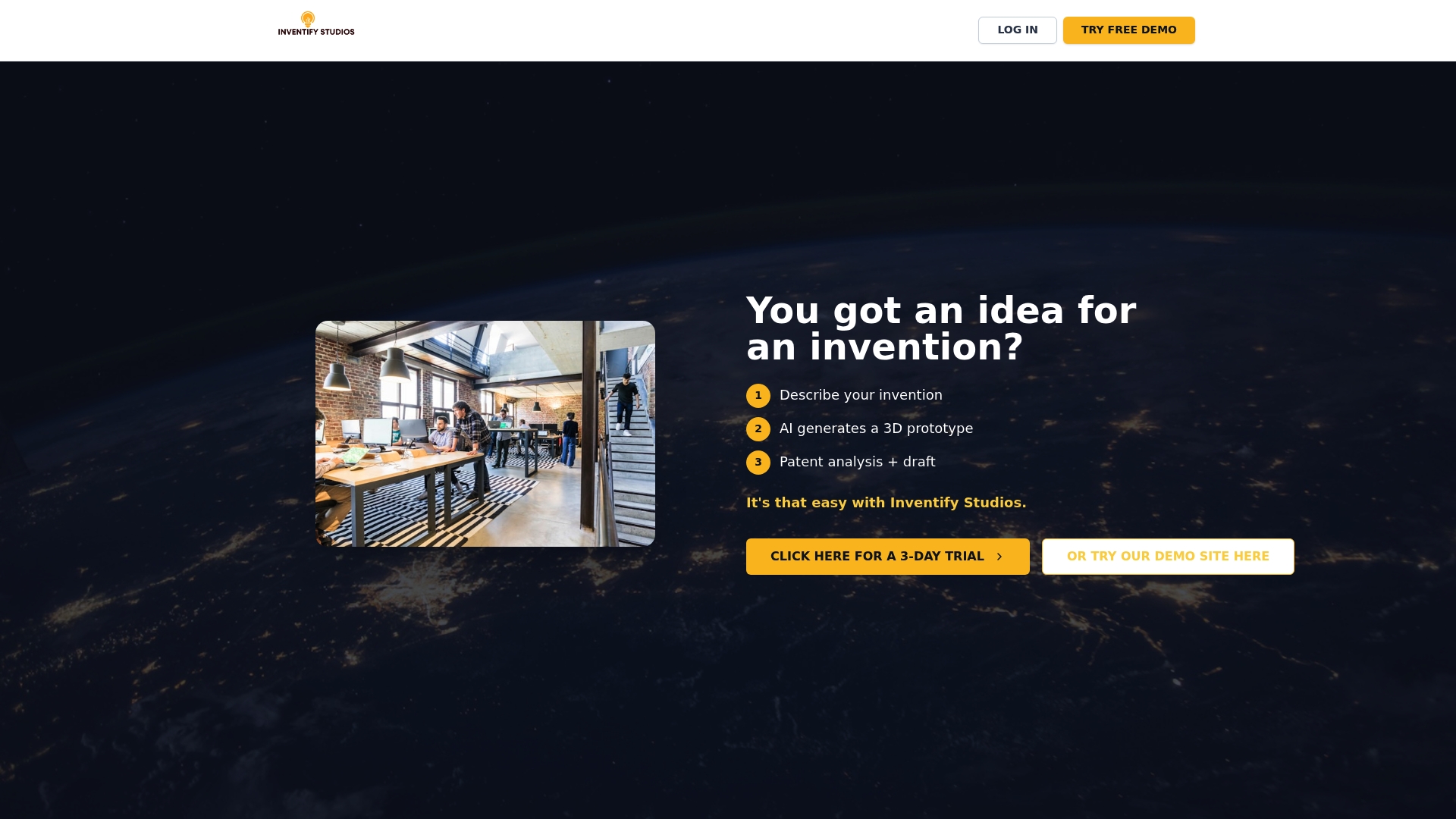
Inventifystudios is built for inventors who want to move fast without cutting corners on IP. The platform combines AI-generated 3D prototypes, patentability assessment, and provisional patent drafting into one workflow. You can explore your invention in detail to see how AI analysis maps your concept against prior art and surfaces your strongest claims. Whether you are validating a first idea or managing a full invention portfolio, Inventifystudios gives you the tools to document your human contribution clearly and move toward protection with confidence. No expensive consulting fees. No black-box process.
FAQ
What is the role of AI in invention development?
AI in invention development supports idea generation, prior art searching, technical feasibility analysis, prototype modeling, and patent drafting. It functions as a structured creative partner, not a replacement for human inventorship.
Can AI be named as an inventor on a U.S. patent?
No. Under USPTO's 2025 revised guidance, AI is treated as a tool, and a human must be the named inventor. Examiners will not question inventorship unless AI is explicitly listed.
What is a multi-agent AI framework for invention?
A multi-agent framework runs multiple AI agents applying different innovation methodologies simultaneously, such as TRIZ, Design Thinking, and SCAMPER, over a shared knowledge graph. This produces more diverse and patent-ready invention claims than single-prompt approaches.
How does AI affect the originality of inventions?
Research shows that overreliance on AI can reduce novelty by reinforcing existing knowledge patterns. Human oversight and deliberate ideation practices are needed to keep invention outputs genuinely original.
What documentation do I need for an AI-assisted invention?
You need records showing which humans defined the problem, directed the AI, and validated the outputs. This documentation supports IP clarity and is your primary defense if inventorship is ever challenged.