

The summary of invention is a legally required section in every U.S. patent application, defined under 37 CFR 1.73 as a concise description of the claimed invention's nature, operation, and purpose. Known formally as the "brief summary of the invention," this section does far more than introduce your idea. It sets the legal and technical foundation that patent examiners, licensees, investors, and competitors rely on throughout the patent's entire lifecycle. Get it right, and your patent stands on solid ground. Get it wrong, and you risk examination delays, claim inconsistencies, and weakened protection.
What is the role of summary of invention in the patent process?
The role of summary of invention goes well beyond satisfying a filing checkbox. A well-written summary materially aids what the USPTO calls "ready understanding" of the invention, giving patent examiners a clear picture of what is claimed before they read the full specification. This directly speeds up prior art searches and reduces the back-and-forth that slows examination.

The summary also serves a distinct function from the patent abstract. A patent abstract is capped at 150 words and optimized for quick technical gist, while the summary provides structured, claim-aligned understanding. Treating them as interchangeable is a mistake that many first-time applicants make.
Here is what a strong summary accomplishes:
- Clarifies invention scope for potential licensees and competitors scanning the patent database
- Reduces examination friction by aligning the examiner's first read with the claims
- Establishes legal accuracy early, which matters because the USPTO grants exclusive rights based on what the patent discloses from the start
- Differentiates your invention from prior art by describing specific features, not just goals
- Supports enforceability by precisely defining the invention at the earliest possible stage
Pro Tip: Think of the summary as your invention's first legal statement on record. Every word you include, and every word you omit, shapes how examiners and courts interpret your claims later.
How to write an effective invention summary: key elements and best practices
Writing a strong summary of invention requires discipline. The section must describe the invention's nature, operation, and purpose in specific terms, not just list what the invention hopes to achieve. Vague objective statements like "the invention improves efficiency" tell an examiner nothing about what is actually claimed.
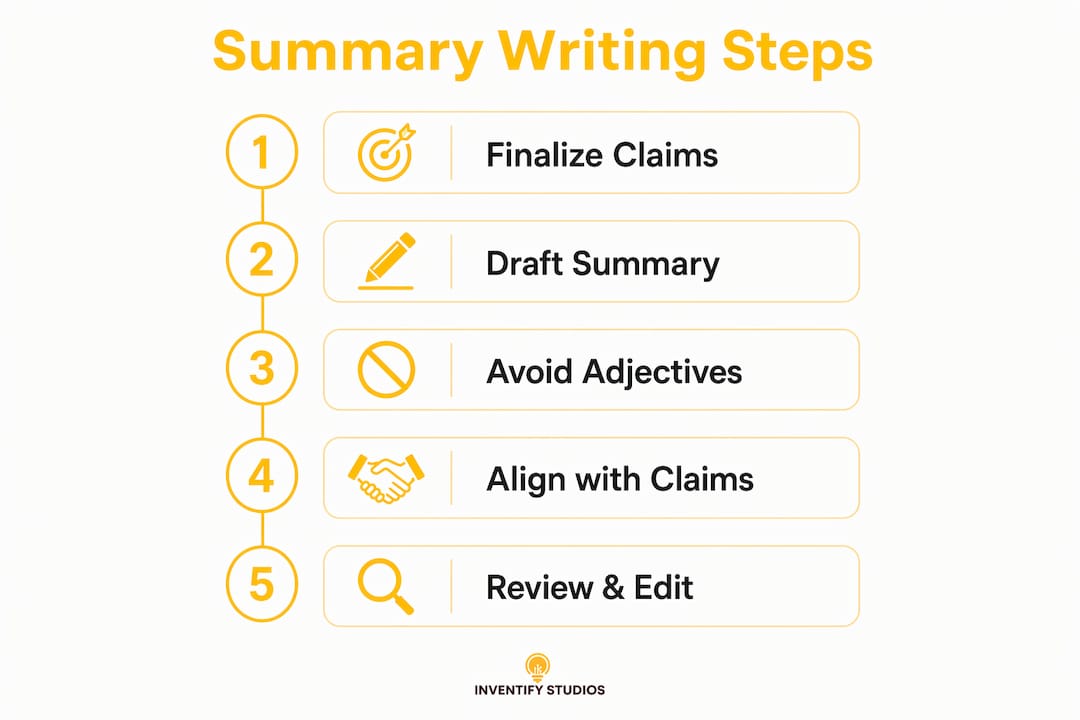
Follow this sequence when drafting:
- Draft your independent claims first. Drafting claims before the summary locks in the essential features of your invention and prevents late-stage edits that can delay filing or create information gaps.
- Paraphrase independent claims in prose. Convert each independent claim into plain, readable sentences. This keeps the summary's scope exactly aligned with what you are claiming.
- Describe the problem-solution relationship. Explain what problem exists, how your invention addresses it, and what makes your approach distinct. This is not marketing. It is technical disclosure.
- Name essential features explicitly. If your invention requires a specific mechanism, material, or configuration to function, say so. Omitting essential features weakens your summary and can create inconsistencies during examination.
- Keep it concise but complete. The summary is not the detailed description. It should be long enough to convey the invention's core structure and function, and short enough to read in under two minutes.
One practical framework used by experienced practitioners: write the summary immediately after finalizing independent claims, treating it as a prose translation of those claims. This method, recommended in patent specification drafting guides, reduces the risk of claim-summary drift, which occurs when the summary and claims describe slightly different inventions.
Pro Tip: Avoid adjectives like "superior," "advanced," or "improved" in your summary. MPEP guidance explicitly discourages marketing-style language, and using it signals to examiners that you may not have a clear technical grasp of your own invention.
How do invention summary requirements differ across jurisdictions?
If you plan to file internationally, you need to understand that the summary of invention is not a universal standard. Requirements vary meaningfully between the U.S., European Patent Office (EPO), and UK Intellectual Property Office (UKIPO).
| Jurisdiction | Summary requirement | Key rule | Ability to add information later |
|---|---|---|---|
| United States (USPTO) | Required as "brief summary" under 37 CFR 1.73 | Must describe claimed invention's nature, operation, and purpose | Limited; new matter cannot be added after filing |
| European Patent Office | Integrated within description; DOCX filings recommend a "Summary of invention" heading | Part of structured description sections | No new matter after filing date |
| United Kingdom (UKIPO) | Description must be complete at filing, including how invention solves the problem | Summary ties back to problem statement and essential features | New information generally cannot be added later |
The practical implication is significant. In the UK, the description, including your summary, must be complete at the time of filing. You cannot patch gaps later. This makes early, precise drafting non-negotiable for UK applicants. The EPO's DOCX filing standard now recommends a dedicated "Summary of invention" heading, signaling a move toward the structured approach the USPTO has required for decades.
For inventors filing under the Patent Cooperation Treaty (PCT) to pursue protection in multiple countries, the summary must be drafted with all target jurisdictions in mind. A summary that satisfies 37 CFR 1.73 may still need restructuring to meet EPO or UKIPO expectations. Working with regulatory compliance standards for each jurisdiction before filing saves significant time and cost.
What are the most common pitfalls when drafting an invention summary?
Most drafting errors in invention summaries fall into predictable patterns. Knowing them in advance is the fastest way to avoid them.
- Goal-listing instead of describing. Summaries that read "the invention provides a faster, cheaper, and more reliable solution" describe desired outcomes, not the invention itself. MPEP guidance explicitly discourages this approach and calls for factual, claim-oriented description.
- Claim-summary drift. This happens when the summary is written before claims are finalized, or when claims are revised without updating the summary. The result is two sections of the same patent that describe slightly different inventions. Examiners notice this immediately.
- Over-broad language. Describing your invention in the broadest possible terms sounds strategically smart but often backfires. If the summary is broader than the claims, it creates ambiguity. If it is narrower, it may limit your protection.
- Omitting essential features. Every feature that makes your invention work must appear in the summary. Leaving out a key component because it seems obvious can undermine your ability to enforce the patent later.
- Copying the abstract verbatim. The abstract and summary serve different purposes. Copying one from the other produces a section that is either too short or too vague to meet the summary's legal function.
Pro Tip: After drafting your summary, read it alongside your independent claims. Every element in your broadest claim should map directly to a statement in your summary. If something is missing, add it before filing.
The invention development stages that precede patent filing, including prototyping and prior art research, directly inform how specific and accurate your summary can be. Inventors who skip those stages often produce summaries that are too vague to withstand examination.
How does a strong summary support commercialization and patent enforcement?
A well-crafted summary of invention is a commercial asset, not just a legal requirement. The summary is often the first section that investors, potential licensees, and business partners read when evaluating a patent. A clear, specific summary communicates the invention's value immediately.
For inventors pursuing licensing deals, the summary defines the scope of what is being licensed. Ambiguous language creates negotiation friction and can lead to disputes about what the patent actually covers. Precise summaries reduce that friction from the start.
The summary as a communication tool also matters in enforcement contexts. When a patent owner asserts infringement, courts and opposing counsel examine the specification closely. A summary that clearly describes the invention's essential features supports a stronger infringement argument. A vague or inconsistent summary gives defendants room to argue that the patent's scope is unclear.
From a competitive intelligence standpoint, competitors monitoring your patent filings will read your summary first. A well-written summary that accurately reflects your claims signals that the patent is professionally prepared and worth taking seriously. It also makes it harder for competitors to design around your invention without understanding exactly what they are avoiding.
Key takeaways
A precise, claim-aligned summary of invention is the single most important section you can get right before filing, because it defines your invention's legal identity from day one.
| Point | Details |
|---|---|
| Legal requirement | The brief summary is required under 37 CFR 1.73 and must describe the invention's nature, operation, and purpose. |
| Draft claims first | Write independent claims before the summary to lock in essential features and prevent claim-summary drift. |
| Jurisdiction differences | U.S., EPO, and UK each have distinct summary requirements; international filers must adapt content for each system. |
| Commercial value | Clear summaries accelerate licensing discussions and strengthen patent enforcement by defining scope precisely. |
| Avoid common errors | Never list goals without describing the invention, and never copy the abstract verbatim into the summary. |
Why most inventors underestimate this section
I have reviewed hundreds of patent applications from first-time inventors, and the pattern is consistent. Inventors spend weeks on their claims and detailed description, then write the summary in twenty minutes the night before filing. That is exactly backwards.
The summary is the section that shapes every reader's first impression of your invention, including the examiner assigned to your application. A weak summary does not just create a bad impression. It creates a legal record that can haunt you during examination and enforcement. I have seen patents rejected or narrowed specifically because the summary described a different version of the invention than the claims.
The most effective approach I have found: treat the summary as a final quality check on your entire specification. If you cannot write a clear, concise, claim-aligned summary, that is a signal that your claims themselves may need work. The two sections should mirror each other so closely that reading one makes the other redundant.
For inventors who are unsure whether their summary meets the standard, the invention ownership rights guide from Inventifystudios offers practical context on how accurate early description protects your rights long-term. Do not treat the summary as an afterthought. Treat it as the foundation.
— Hua
Get your invention summary right with Inventifystudios

Inventifystudios built its Invention Detail service specifically for inventors who want a patent-ready specification without the guesswork. The platform's AI-powered tools guide you through describing your invention's nature, operation, and purpose in precise, claim-aligned language that meets USPTO standards. You get structured drafting prompts, patentability analysis, and a summary framework designed to hold up under examination. Whether you are filing your first provisional patent or preparing a full utility application, the Invention Detail service gives you the clarity and structure to get this critical section right. You can also explore the full invention creation workflow to take your idea from concept to patent-ready draft in one place.
FAQ
What is the summary of invention in a patent application?
The summary of invention is a required section under 37 CFR 1.73 that concisely describes the claimed invention's nature, operation, and purpose. It differs from the abstract in that it provides structured, claim-aligned understanding rather than a brief technical gist.
How long should an invention summary be?
There is no fixed word limit, but the summary should be long enough to describe the invention's essential features and problem-solution relationship, and short enough to read quickly. Most effective summaries run between 150 and 400 words.
Can I write the summary before my claims are finalized?
Writing the summary before finalizing independent claims increases the risk of claim-summary drift, where the two sections describe slightly different inventions. Draft your claims first, then paraphrase them into prose for the summary.
Does the invention summary affect patent enforceability?
Yes. Courts and opposing counsel examine the summary during infringement disputes. A precise, claim-aligned summary supports a stronger enforcement position by clearly defining the invention's scope from the filing date.
Are invention summary requirements the same in every country?
No. The U.S. requires a brief summary under 37 CFR 1.73, the EPO recommends a dedicated summary heading in DOCX filings, and the UK requires a complete description at filing with no ability to add new information later. International applicants must adapt their summaries to each jurisdiction's rules.