

Most inventors focus entirely on building the invention and assume the legal side will sort itself out later. It won't. Invention ownership rights protection — the formal practice of establishing, documenting, and defending who legally controls a patent — determines whether your creation becomes a commercial asset or an unenforceable idea. Miss a written assignment, skip a co-inventor agreement, or file with the wrong name on record, and you could lose control of your own invention before it ever reaches the market. This guide walks you through exactly how to get it right.
Table of Contents
- Key takeaways
- Understanding invention ownership rights protection
- Essential written agreements and documentation
- Navigating the patent application process
- Managing joint ownership and co-inventor relationships
- Verifying and maintaining your ownership rights post-filing
- What I have learned about ownership documentation
- Start protecting your invention today with Inventifystudios
- FAQ
Key takeaways
| Point | Details |
|---|---|
| Inventorship differs from ownership | The person who conceived an idea is not automatically the legal owner. Ownership requires written documentation. |
| Written assignments are non-negotiable | Oral agreements cannot transfer patent title. U.S. law requires a signed, written instrument to assign ownership. |
| Co-owner defaults create real risk | Without a written agreement, any co-owner can license your entire patent to a third party without your consent. |
| File provisional applications fast | A provisional filing locks in your priority date and gives you 12 months to convert to a full non-provisional application. |
| Record assignments with the USPTO | Public recordation protects your ownership claim and simplifies enforcement, licensing, and future transactions. |
Understanding invention ownership rights protection
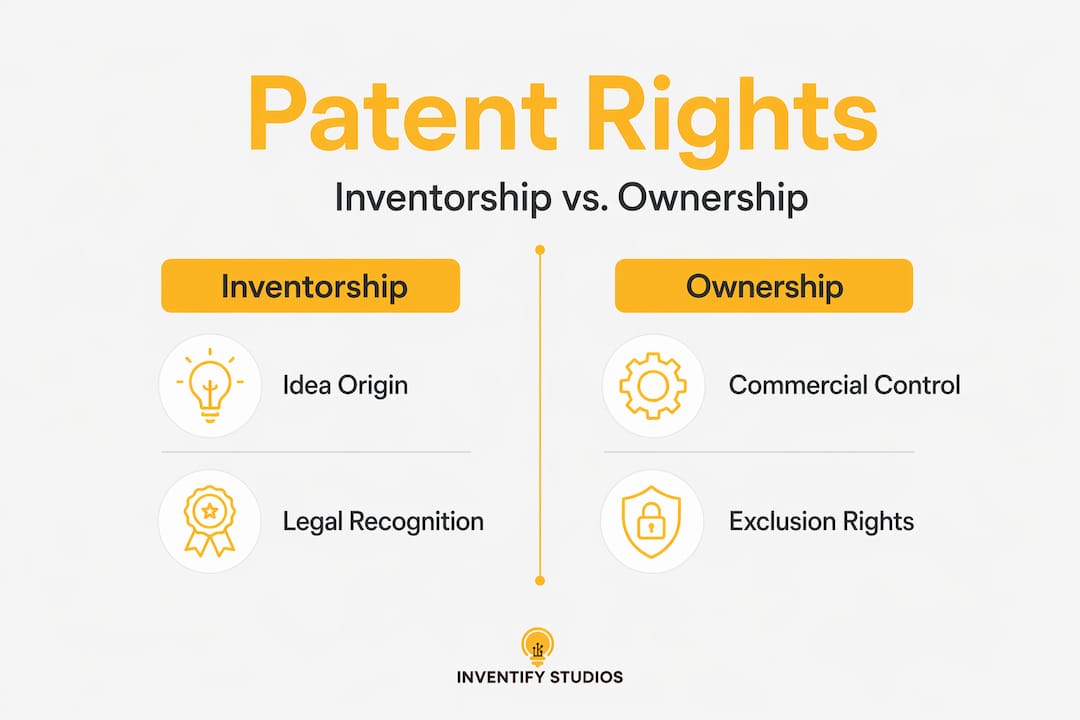
Before you can protect anything, you need to understand the legal structure underneath it. Two terms are central here: inventorship and ownership. They sound interchangeable. They are not.
Inventorship refers to the individual or individuals who actually conceived the claimed invention. U.S. patent law is strict on this point. You are an inventor only if you contributed to the conception of at least one claim in the patent. Contributing money, managing the project, or building the prototype does not make you an inventor under the law.
Ownership is a separate matter. Inventorship and ownership are legally distinct, and misaligning them can jeopardize enforceability across your entire patent. Patents are initially owned by the inventors, but that ownership can and often does transfer. Employers, investors, and business partners all routinely obtain patent ownership through assignments.
What exactly does owning a patent give you? Under 35 U.S.C. 154(a)(1), patent ownership grants the right to exclude others from making, using, selling, or importing your claimed invention in the United States. That exclusion right is the core commercial value of any patent.
One critical nuance: owning a patent does not guarantee your freedom to operate. A patent gives you the right to exclude others. It does not give you permission to make or sell your own invention if other existing patents cover components or processes you rely on.
Pro Tip: Get a freedom-to-operate analysis early. Knowing what patents your product might infringe on is just as important as knowing what rights your patent grants you.
Essential written agreements and documentation
Documentation is where most inventors stumble. The legal framework for securing your intellectual property rights depends almost entirely on written records. Good intentions and verbal commitments protect nothing.
Patent assignments
An assignment is the written instrument that transfers patent ownership from one party to another. Under 35 U.S.C. § 261, assignments must be in writing to legally transfer patent title. Oral promises, handshake deals, and email threads do not transfer ownership. Period.

The assignment document should identify the patent or application, name the parties clearly, include the effective date, and carry the signatures of all required parties. Once signed, the assignment should be recorded with the USPTO to make it a matter of public record.
Common scenarios where assignments matter most:
- Employment relationships. Employees who invent within the scope of their job typically assign rights to their employer through an employment agreement. If that agreement is missing or ambiguous, ownership becomes contested.
- Contractors and consultants. Independent contractors are not employees. Without a written assignment, they may retain rights to inventions they create for you.
- Investor arrangements. Investors who contribute capital but not conception do not become inventors. A separate written agreement is required to transfer any ownership stake.
- Academic or university work. Many universities claim ownership of inventions created using their facilities or funding. Understand your institution's IP policy before you file anything.
Pro Tip: Execute your assignment before you file the application, not after. Post-filing assignments create gaps in the chain of title that complicate enforcement and future deals.
Co-inventor agreements
When more than one person contributes to conception, you have co-inventors. And co-inventors who do not have a written agreement are sitting on a legal time bomb. Without written co-inventor agreements, any co-owner can license or use the entire patented invention without the consent of the other owners, a default rule under 35 U.S.C. § 262.
That means a co-inventor you trusted could grant a license to your direct competitor, pocket the fee, and do it all entirely within their legal rights.
A strong co-inventor agreement should cover:
| Agreement Element | Why It Matters |
|---|---|
| Prosecution authority | Defines who controls decisions during the patent application process |
| Licensing restrictions | Prevents unilateral licensing without consent of all co-owners |
| Revenue sharing | Specifies how licensing fees and royalties are distributed |
| Assignment approval | Requires mutual consent before any co-owner transfers their interest |
| Dispute resolution | Establishes a process for resolving disagreements without litigation |
Strong documentation and written agreements are the most effective way to prevent costly disputes and strengthen a patent's legal durability in both litigation and transactions.
Navigating the patent application process
The application process itself has direct implications for who owns what and when. Getting the procedural steps right is not just about securing a patent. It is about preserving your ownership position throughout.
-
File a provisional application first. A provisional application locks in your priority date and gives you a 12-month window to develop your invention and prepare a full non-provisional application. The provisional itself does not grant enforceable patent rights, but the filing date it establishes can be decisive.
-
Convert within 12 months. Missing the conversion deadline causes the provisional to expire. You lose your priority date. Under the U.S. first-inventor-to-file system, filing speed is critical. A competitor who files a similar invention after you but before your non-provisional is submitted can claim priority and ownership ahead of you.
-
Name inventors accurately at filing. The non-provisional application must list all individuals who contributed to the conception of the claims. No more, no fewer. Listing someone who did not contribute and omitting someone who did are both errors with serious consequences.
-
Understand the cost of inventorship errors. Correcting inventorship in issued patents requires petitions and the cooperation of all owners and inventors, subject to tight procedural rules. Errors that cannot be corrected may invalidate the patent entirely.
-
Avoid premature public disclosure. Publicly disclosing your invention before filing can eliminate your ability to obtain patent rights in many countries. In the U.S., you have a one-year grace period for your own disclosures, but other jurisdictions offer no such window.
Pro Tip: Use the invention development stages outlined for inventors as a planning framework. Knowing where you are in development helps you time your provisional filing strategically, not reactively.
Here is a quick comparison of the two application types:
| Application Type | Enforceable Rights | Priority Date | Time Limit |
|---|---|---|---|
| Provisional | No | Yes, when filed | 12 months to convert |
| Non-provisional | Yes, upon issuance | Established by provisional | 20 years from filing date |
Managing joint ownership and co-inventor relationships
Joint ownership is one of the most underestimated risks in patent law. Inventors collaborate. Teams build things together. But without structure, that collaboration can destroy your control over the final product.
The default rules under U.S. patent law are not designed to protect your interests. They are designed to define minimums when no agreement exists. Default co-ownership rules allow any single co-owner to independently license the entire patent without the consent of the others and without sharing the proceeds. That is the starting point if you have no written agreement.
Preventing this requires a co-inventor agreement that explicitly overrides these defaults. A few best practices:
- Define decision-making authority clearly. Who controls prosecution? Who approves licensing deals? Ambiguity in these areas leads directly to disputes.
- Address the assignment of interest. If one co-inventor wants to sell their share, does the other have a right of first refusal? Specify it in writing before it becomes an issue.
- Document each contributor's role. Keep records of who contributed to which claims and when. This prevents retroactive disagreements about inventorship and ownership.
- Align employment and contractor agreements. If you are working with employees or outside contractors, their contribution agreements must be in place before the collaboration begins. Rights do not automatically flow to you just because you are paying someone.
The key insight here is that the agreement conversation is far easier before there is money involved. Once licensing revenue enters the picture, every ambiguity becomes a negotiation point.
Pro Tip: Review due diligence frameworks from technology-focused IP strategies when structuring co-inventor agreements. IP protection structures used in high-stakes tech deals show exactly where ownership gaps tend to appear.
Verifying and maintaining your ownership rights post-filing
Securing ownership is not a one-time event. It requires active maintenance.
-
Record your assignment with the USPTO. Assignment recordation provides public notice of your ownership claim and protects you against competing interests. It is how the chain of title becomes verifiable by third parties during licensing negotiations, acquisitions, and litigation.
-
Verify your chain of title regularly. Every transfer of ownership, from inventor to company, from one company to another, needs a corresponding recorded document. Gaps in the chain create enforceability problems you do not want to discover mid-lawsuit.
-
Correct errors promptly. If you discover an inventorship or ownership error post-issuance, act immediately. Inventorship correction procedures are available but require all owners and inventors to cooperate, and procedural deadlines are strict.
-
Monitor your patent lifecycle. Patents expire. Maintenance fees must be paid at 3.5, 7.5, and 11.5 years after issuance. Missed fees cause patents to lapse, ending your exclusion rights entirely.
-
Prepare documentation for licensing or sale. When you are ready to license or sell, buyers and licensees will conduct due diligence on your ownership history. Clean records close deals. Messy records kill them.
| Post-Filing Task | Recommended Timing |
|---|---|
| Record assignment with USPTO | Within 3 months of execution |
| Review chain of title | Before any licensing discussion |
| Correct inventorship errors | As soon as discovered |
| Pay maintenance fees | Before each USPTO deadline |
| Audit co-inventor agreements | When any co-owner relationship changes |
What I have learned about ownership documentation
I have worked with enough inventors to see the same pattern repeat itself. Someone spends months building a great invention, files a provisional application, maybe even gets a non-provisional on file, and then discovers that a co-developer never signed an assignment, or that an employment contract from a previous job might cover the claims. The invention is real. The rights are a mess.
The painful truth is that inventorship and ownership confusion account for a disproportionate share of patent disputes. Not claim scope. Not prior art. Ownership. Who owns what and whether there is a piece of paper to prove it.
What I have found is that inventors treat legal documentation as an interruption to the creative process. It is not. It is the foundation that makes the creative process commercially meaningful. A patent without clean ownership documentation is like a deed to a house you cannot sell.
My strongest recommendation: get a patent attorney involved early. Not when you are ready to file. Before you share your idea with anyone. The conversations you have before documentation is in place are the ones that create the most risk.
Protecting your rights does not slow down invention. It makes the outcome of your work worth protecting.
— Hua
Start protecting your invention today with Inventifystudios
You now know what the documentation gaps look like and how much they cost. The next step is doing something about it before those gaps become disputes.

Inventifystudios gives inventors the tools to move from idea to protected concept without the barriers of traditional consulting costs. From AI-powered invention documentation that helps you build a clear ownership record, to patent-ready draft support and invention validation, the platform is built for exactly this stage of the process. You can also start your invention profile directly and begin establishing the documentation trail that protects your rights from day one. Need to manage multiple concepts? The invention portfolio tools let you track and organize your IP assets in one place. Your invention deserves a solid legal foundation. Inventifystudios helps you build it.
FAQ
What is the difference between inventorship and patent ownership?
Inventorship identifies who conceived the claimed invention. Ownership refers to who legally controls and can commercially exploit the patent. The two can differ significantly, particularly when written assignments transfer rights to employers, investors, or business partners.
Do I need a written agreement to transfer patent ownership?
Yes. Under 35 U.S.C. § 261, patent ownership can only be transferred through a written instrument. Oral agreements and informal promises have no legal effect on patent title.
What rights does a co-owner have without a written agreement?
Under 35 U.S.C. § 262, any co-owner can independently license the entire invention to a third party without the consent of other co-owners and without sharing the proceeds. A written co-inventor agreement is the only way to override this default.
How long do I have to convert a provisional patent application?
You have 12 months from the provisional filing date to file a corresponding non-provisional application. Missing this deadline results in the loss of your priority date and potentially your patent rights.
Why should I record my patent assignment with the USPTO?
Recording an assignment provides public notice of your ownership and strengthens your legal claim against competing interests. It is a standard requirement during due diligence for licensing deals, acquisitions, and enforcement actions.