

An invention abstract is a concise, single-paragraph summary of your invention's core problem, key technical features, operation, and principal advantage, written specifically to meet USPTO requirements and communicate your idea clearly to patent examiners and investors. Mastering the invention abstract writing steps is not optional if you want your patent application to succeed. The USPTO mandates a 150-word maximum for all patent abstracts, and examiners use this section as a first triage tool before reading the full specification. Get it wrong, and you risk rejection, miscommunication, or a narrowed patent scope before your application is even reviewed. Frameworks like the PerspireIP 7-step method give inventors a repeatable process to draft abstracts that are both compliant and technically precise.
What are the essential components in invention abstract writing?
Every strong patent abstract contains the same core building blocks, regardless of invention type. MPEP § 608.01(b) defines the abstract as a narrative that describes what is new in the art, explains the invention's function and operation, and avoids merits, prior art comparisons, or speculative applications. Think of it as a structured technical snapshot, not a sales pitch.
The abstract functions as a triage tool for examiners and readers, which means every sentence must carry technical weight. A vague or poorly structured abstract forces the examiner to dig deeper into your specification to understand the invention, which slows prosecution and increases the chance of a mischaracterization.
Here are the core components every invention abstract must include:
- Broadest independent claim as the foundation. The abstract should mirror broadest claim coverage, not just describe a preferred embodiment. This protects the full scope of your invention from the start.
- Statement of the problem addressed. One clear sentence identifying the technical deficiency your invention solves. This frames the entire abstract for the examiner.
- Key structural or functional elements. List three to five primary components or features that define the invention. These should correspond directly to your independent claim language.
- Overview of operation or mechanism. A brief explanation of how the invention works or how the method steps execute. This is where you show the examiner the invention is functional and enabled.
- Principal advantage or application. One sentence on the primary technical benefit or use case. Keep it factual and technical, not promotional.
- Plain, clear language throughout. Avoid terms like "means" or "said," legal boilerplate, reference numerals, and marketing phrases. The abstract must read as a standalone technical summary.
What you leave out matters as much as what you include. Background history, prior art discussion, and speculative future applications all weaken the abstract and can create prosecution problems later.
How to follow a step-by-step process to write your invention abstract
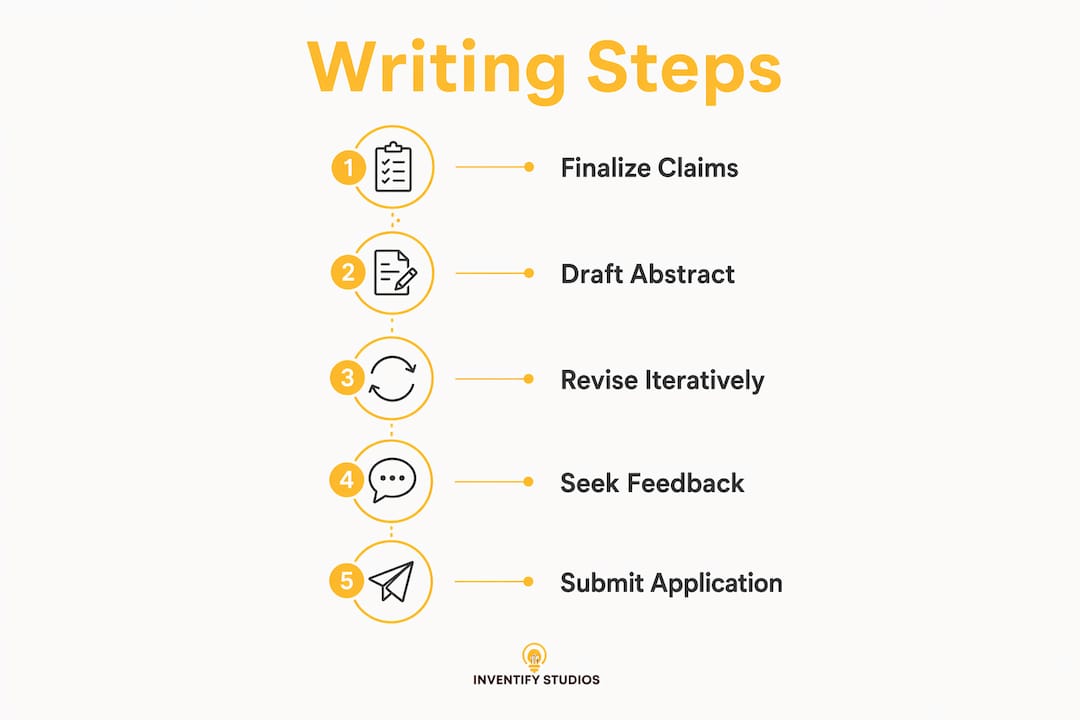
The PerspireIP 7-step method gives inventors a structured, repeatable process for drafting USPTO-compliant abstracts. Each step builds on the last, so skipping ahead creates gaps that are hard to fix in revision.
- Start with your broadest independent claim. Pull the language from your finalized independent claim and use it as the skeleton of your abstract. This guarantees alignment between your abstract and your actual patent scope.
- State the core problem in plain language. Write one sentence that identifies the technical gap or deficiency your invention addresses. Avoid jargon. If a non-specialist cannot understand the problem, rewrite it.
- List the key invention elements. Identify three to five structural or functional components that define how your invention solves the problem. These should map directly to your claim elements, not your preferred embodiment details.
- Describe the mechanism or operation. Write one to two sentences explaining how the invention works in practice. For a process invention, describe the method steps in sequence. For an apparatus, describe how the components interact.
- State the principal advantage or application. One factual sentence on the primary technical benefit. "The system reduces processing latency by eliminating redundant data queries" is strong. "The invention is a game-changing solution" is not.
- Target a word count between 100 and 140 words. The USPTO sets a hard limit of 150 words, so staying at 100 to 140 gives you a compliance buffer without sacrificing content. A useful sentence budget: one sentence for the problem, two sentences for elements and operation, one sentence for the advantage.
- Verify compliance before submitting. Confirm the abstract is a single paragraph, contains no reference numerals, includes no marketing language, and stays within the word limit. Read it aloud to catch awkward phrasing or unnecessary detail.
Pro Tip: Always write your abstract last, after your claims and specification are finalized. Drafting the abstract early leads to misalignment with your actual claims and can result in overpromising scope that your specification does not support.
The sequence matters. Inventors who draft the abstract first often find themselves revising it three or four times as claims evolve. Writing it last takes 20 minutes instead of two hours.

Common mistakes to avoid when writing invention abstracts
Most abstract rejections and prosecution problems trace back to a short list of recurring errors. Knowing them in advance saves significant time and legal cost.
- Overly vague or generic language. Phrases like "a device for improving efficiency" tell the examiner nothing. Every sentence must identify a specific technical feature or function tied to your invention.
- Including background or marketing content. The abstract is not the place to explain the history of your field or argue why your invention is superior. Abstracts must focus on novelty and operation, not persuasion.
- Using claim-specific legal jargon or reference numerals. Terms like "said," "means for," or "(10)" belong in claims and drawings, not in the abstract. They make the abstract harder to read and can trigger a USPTO objection.
- Exceeding the 150-word limit. This is a hard rule, not a guideline. An abstract over 150 words will receive an objection that delays prosecution.
- Writing the abstract before claims are finalized. Drafting the abstract prematurely is the single most common sequencing mistake. Claims define the legal scope of your invention. The abstract must reflect that scope, not anticipate it.
- Failing to highlight novelty. If your abstract could describe any product in your category, it is not doing its job. The examiner needs to understand what is new in the art from the abstract alone.
Pro Tip: Iterative review and peer feedback are the fastest way to catch compliance issues. Ask someone outside your field to read your abstract. If they cannot identify the invention's core function and advantage, revise before submitting.
Understanding the invention development stages helps you place abstract writing correctly in your overall timeline, which prevents most sequencing errors before they happen.
How to adapt your abstract for different invention types
The core structure of an abstract stays consistent, but the emphasis shifts depending on what you invented. A one-size-fits-all approach produces weak abstracts for anything outside a basic mechanical device.
| Invention type | Key emphasis in abstract | What to avoid |
|---|---|---|
| Machine or apparatus | Organization of components and how they interact during operation | Describing only one preferred configuration |
| Process or method | Sequential method steps and the technical outcome produced | Vague action verbs like "processing" or "handling" |
| Chemical compound | Composition, molecular structure, and primary use or application | Generic class descriptions without specific identifiers |
| Software or AI system | System architecture, technical problem addressed, and solution mechanism | Abstract functional claims with no technical grounding |
Software and AI inventions require the most care. USPTO guidance on Section 101 stresses that software abstracts must link claimed features to specific technical improvements described in the specification. A generic abstract that says "a system for processing data more efficiently" will not survive examination. Instead, identify the technical deficiency, name the architectural components that address it, and state the measurable technical outcome.
For example, a strong software abstract might read: "A distributed caching system addresses network latency in real-time data retrieval by implementing a predictive prefetch algorithm across distributed nodes. The system includes a request analyzer, a prefetch scheduler, and a node synchronization module. The prefetch scheduler reduces average query response time by pre-loading high-probability data requests before user initiation." That abstract names the problem, the components, and the technical result. It also supports patent eligibility under Section 101 by grounding the claims in a specific technical improvement.
For SaaS and platform-based inventions, reviewing SaaS case studies can help you understand how technical problem-solution framing translates into defensible patent language. You can also use invention documentation tools to organize your technical details before drafting.
Pro Tip: For software inventions, technical deficiency framing in the abstract directly supports your prosecution strategy. State the specific technical problem your system solves, not just the business outcome it produces.
Key takeaways
A strong invention abstract follows a fixed structure: state the problem, name the key elements, describe the operation, and close with the principal technical advantage, all within 150 words and a single paragraph.
| Point | Details |
|---|---|
| Write the abstract last | Finalize claims and specification first to prevent misalignment and overpromising scope. |
| Follow the 150-word rule | Stay between 100 and 140 words to maintain a compliance buffer with the USPTO limit. |
| Match your broadest claim | The abstract must reflect the full scope of your independent claim, not just one embodiment. |
| Adapt by invention type | Software and AI abstracts require technical problem-solution framing to support patent eligibility. |
| Avoid marketing language | No reference numerals, no legal boilerplate, no promotional claims. Keep it factual and technical. |
Why most inventors get the abstract wrong on the first try
I have reviewed hundreds of first-draft abstracts from inventors at every experience level, and the pattern is almost always the same. The abstract reads like a product description, not a technical summary. It opens with a sentence about the problem in the industry, spends two sentences on background, and then squeezes the actual invention into the last 30 words. By that point, the examiner has already formed an incomplete picture of what the invention does.
The root cause is not a lack of technical knowledge. It is a misunderstanding of the abstract's purpose. Inventors want to convince the reader that their idea is worth protecting. That instinct is natural, but it produces the wrong document. The abstract is not persuasion. It is a technical index. Its job is to give the examiner enough information to classify and search the invention, nothing more and nothing less.
The fix is structural. Write the abstract the same way you would write a technical specification summary: problem, components, operation, result. No context, no history, no enthusiasm. Once you internalize that structure, the abstract becomes the fastest section of your application to write, not the hardest.
The other mistake I see consistently is treating the abstract as a first draft exercise. Inventors write it on day one, then spend weeks refining their claims, and never go back to update the abstract. The result is a document that describes a version of the invention that no longer exists. Write it last. Treat it as a final quality check, not a starting point.
— Hua
Start your patent abstract with Inventifystudios
Writing a compliant, technically precise abstract is one of the most high-stakes steps in your patent application. Inventifystudios gives you the tools to get it right without expensive attorney fees.

The Inventifystudios platform combines AI-powered invention analysis with patent-ready drafting support, so you can build your abstract on a solid foundation of validated claims and documented technical details. From creating your invention profile to generating provisional patent narratives, Inventifystudios walks you through every step with clarity and precision. You do not need a law degree to protect your idea. You need the right process and the right tools. Start building your patent-ready abstract today at Inventifystudios.
FAQ
What is an invention abstract in a patent application?
An invention abstract is a concise, single-paragraph summary of your patent application that describes the invention's core problem, key elements, operation, and principal advantage. The USPTO requires it to be no more than 150 words and written without reference numerals or marketing language.
How long should a patent abstract be?
A patent abstract should be between 100 and 150 words. Staying between 100 and 140 words gives you a compliance buffer while still covering all required technical content.
When should I write the abstract in the patent process?
Write the abstract after your claims and specification are finalized. Drafting it early creates misalignment between the abstract and your actual claim scope, which can cause prosecution problems.
Can I use legal claim language in my abstract?
No. The USPTO requires plain, clear language in the abstract. Avoid terms like "said," "means for," and reference numerals. The abstract must read as a standalone technical summary, not an extension of your claims.
How is a software invention abstract different from a mechanical one?
Software and AI abstracts must identify a specific technical problem and link the claimed system architecture to a concrete technical improvement. Generic functional claims without technical grounding risk rejection under USPTO Section 101 eligibility guidelines.