

An inventor declaration form is a sworn legal statement where each inventor confirms their original role in creating an invention and authorizes the filing of a patent application. Known formally as the inventor's oath or declaration, this document is mandatory for U.S. nonprovisional patent applications under 35 U.S.C. 115 and shapes every step of the patent process that follows. The America Invents Act, which took effect September 16, 2012, updated the requirements significantly. If you are an aspiring inventor or entrepreneur preparing a 2026 filing, understanding this form is not optional. It is the legal foundation your patent stands on.
What is the role of inventor declaration form?
The inventor declaration form serves one primary function: it creates a legally binding record that the named inventors are the true and original creators of the invention. Without it, the USPTO cannot process a nonprovisional patent application to completion.
Required elements under 35 U.S.C. 115(a) and (b) include four specific statements. Each declaration must contain all of them to satisfy USPTO standards:
- Declarant's legal name. The full legal name of the inventor signing the form, exactly as it appears on official identification.
- Application identification. A reference to the specific patent application the declaration covers, typically by application number or title.
- Statement of original inventorship. A direct statement that the declarant believes the named inventor or joint inventors are the original inventors of the claimed subject matter.
- Authorization statement. A confirmation that the application was made or authorized to be filed by the declarant.
The form must also be signed under 37 CFR 1.66, either by handwritten or electronic signature. That signature carries real legal weight. Signing acknowledges potential penalties under 18 U.S.C. 1001 for willful false statements. This is not a checkbox. It is a sworn affirmation with federal consequences.
Pro Tip: Use USPTO Form PTO/AIA/01 for applications filed on or after September 16, 2012. This form is pre-formatted to meet current 35 U.S.C. 115 requirements and reduces the risk of missing a required element.

Why does each inventor need a separate declaration?
Joint inventorship is common, especially in startup and corporate environments. The rule is clear: each joint inventor must provide a separate declaration rather than sharing a single signature page. Here is how this plays out in practice.
- Each inventor signs independently. Every person named as an inventor on the application must execute their own oath or declaration. One inventor cannot sign on behalf of another.
- Separate declarations confirm individual contribution. The USPTO uses each declaration to verify that every named inventor believes they contributed to the claimed invention. This prevents inventorship disputes later.
- Pre-2012 filings followed different rules. For applications filed before September 16, 2012, combined declarations were sometimes acceptable. Post-2012 filings under the America Invents Act require strict individual compliance.
- The Application Data Sheet (ADS) plays a supporting role. Filing an ADS alongside the declarations identifies all inventors and their legal names. The ADS does not replace the declaration but works with it to establish the complete inventorship record.
- Timing coordination matters. If one inventor delays signing, the entire application can stall. The USPTO will not grant allowance until all required declarations are on file.
Coordinating signatures across multiple inventors is one of the most common sources of prosecution delay. If you have co-inventors in different cities or time zones, build in at least two weeks for signature collection before your filing deadline.
How do PCT applications affect declaration requirements?
Filing through the Patent Cooperation Treaty (PCT) adds a layer of complexity to the inventor declaration process. Many first-time international filers assume their WIPO PCT declaration covers U.S. requirements. It does not.
- Prior WIPO wording does not comply with current U.S. law. PCT applications entering the U.S. national stage after September 16, 2012, cannot rely on the standard WIPO PCT inventor declaration language. A separate declaration meeting U.S. statutory requirements must be filed.
- The ADS can buy you time. Submitting an Application Data Sheet at the time of national stage entry allows you to postpone the oath or declaration. The USPTO will issue a notice confirming the requirement is still pending.
- Notices have deadlines. If the declaration is not submitted when required, the USPTO issues a formal notice with a deadline and a surcharge for late filing. Missing that deadline increases cost and delays your patent grant.
- Plan for follow-up submissions. Treat the ADS as a placeholder, not a solution. Schedule the declaration submission well before the USPTO's notice deadline to avoid surcharges.
- International filing dates before September 16, 2012, follow older rules. If your PCT application has an international filing date before that cutoff, the pre-AIA declaration requirements apply instead.
Pro Tip: When entering the U.S. national stage from a PCT application, flag the declaration requirement in your docketing system the moment you file the ADS. Do not wait for the USPTO notice to act.
Common mistakes when completing inventor declaration forms
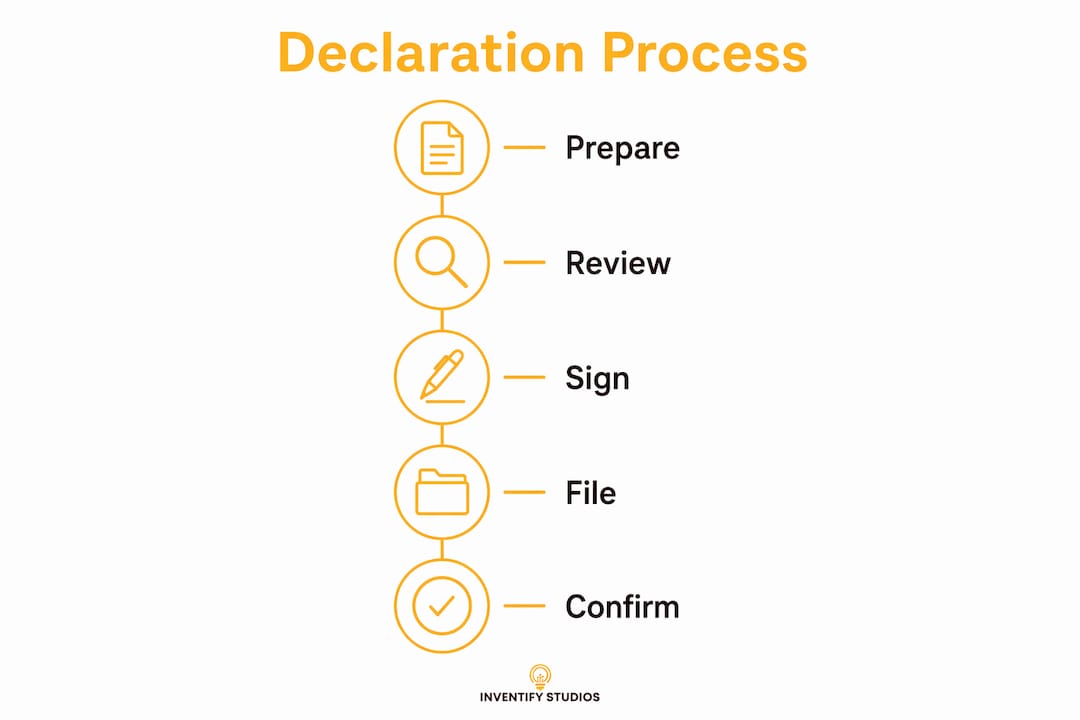
Errors in declarations can cause prosecution delays and require corrections like supplemental declarations. The USPTO treats these forms as factual and legal assertions. Accuracy is not optional.
| Common Mistake | Best Practice |
|---|---|
| Listing inventors who did not contribute to the claims | Include only those who contributed to the claimed subject matter |
| Omitting an inventor who did contribute | Review claims carefully against each person's actual contribution |
| Using outdated form versions (pre-AIA) | Always use current USPTO forms for post-September 16, 2012 filings |
| Submitting declarations with incomplete signatures | Confirm all signatures are present before filing |
| Filing late without an ADS in place | Submit ADS at filing to preserve the option to file declaration later |
| Relying on WIPO PCT declaration for U.S. national stage | Prepare a separate U.S.-compliant declaration for all post-2012 PCT entries |
One mistake that catches many entrepreneurs off guard is inventorship creep. This happens when a team member who contributed to early brainstorming gets listed as an inventor, even though their ideas did not make it into the final patent claims. Inventorship is determined by the claims, not by who worked on the project. Getting this wrong can invalidate your patent.
Pro Tip: Before anyone signs, have your patent attorney or agent map each inventor's contribution directly to at least one claim. This one step prevents the most common inventorship errors.
How does the declaration support inventor rights and ownership?
The inventor declaration form does more than satisfy a procedural requirement. Inventorship recorded by the USPTO relies directly on the inventorship stated in the oath or declaration and the ADS. That record has real consequences for ownership and legal rights.
- It establishes the legal record of inventorship. The USPTO's official record of who invented what flows from the declaration. Correcting that record later requires formal petitions and can be costly.
- It affects patent ownership and assignment. When inventors assign their patent rights to a company or co-founder, the declaration is the starting point. If the declaration names the wrong inventors, the assignment chain is compromised.
- It confirms authorization to file. The declaration states that the application was authorized by the inventor. This matters in disputes where one party claims the application was filed without their knowledge or consent.
- Accuracy protects enforceability. A patent with incorrect inventorship can be challenged in litigation. Courts have invalidated patents where the declaration misrepresented who actually invented the claimed subject matter.
You can read more about protecting your invention ownership rights in detail, especially if you are working with co-founders or employees who contributed to the invention.
If an inventor is unavailable to sign, a substitute statement under 37 CFR 1.64 is an option. This requires the applicant's signature and must meet specific USPTO rules. It is not a workaround to use casually. Reserve it for genuine situations where an inventor is legally incapacitated or cannot be reached after documented attempts.
Key takeaways
The inventor declaration form is a legally binding sworn statement that determines inventorship on record, shapes patent ownership, and must be completed accurately by every named inventor to avoid prosecution delays or patent invalidity.
| Point | Details |
|---|---|
| Legal requirement, not a formality | Every named inventor must sign their own declaration under 35 U.S.C. 115 for post-2012 U.S. filings. |
| Four required elements | Each declaration must include legal name, application ID, original inventorship statement, and authorization. |
| Joint inventors sign separately | Each co-inventor submits an individual declaration; one signature cannot cover multiple inventors. |
| PCT filers need a U.S.-compliant form | WIPO PCT declaration language does not satisfy U.S. national stage requirements after September 16, 2012. |
| Errors carry real consequences | Inaccurate inventorship claims can delay prosecution, require corrections, or expose the patent to invalidity challenges. |
What i have learned about declarations after years of watching inventors get this wrong
Most inventors treat the declaration as the last item on the filing checklist. That instinct costs them. I have seen applications stall at the allowance stage because one co-inventor was traveling and could not sign in time. I have seen patents challenged in court because a team member was listed as an inventor based on their role in the company, not their contribution to the claims.
The declaration is not paperwork. It is the legal moment where you state, under oath, that you are the original inventor. That statement has to be true, specific, and tied directly to the claims in your application. If your claims change during prosecution, revisit the inventorship question. Claims narrow. Sometimes that means a contributor who was an inventor at filing is no longer an inventor after amendment.
My strongest advice: treat the inventor declaration process as a workflow item, not an afterthought. Build it into your filing timeline from day one. If you have multiple inventors, assign one person to coordinate signatures and set a hard internal deadline at least ten days before the actual filing date. That buffer has saved more than a few applications I have been involved with.
The inventors who protect their patents most effectively are the ones who understand that accuracy in the declaration is the foundation of enforceability. Everything else, the claims, the drawings, the specification, rests on that sworn statement being correct.
— Hua
Ready to document your invention the right way?
Getting your invention details organized before you reach the declaration stage makes the entire patent process faster and cleaner. Inventifystudios helps aspiring inventors and entrepreneurs build a solid documentation foundation from the start.

With Inventifystudios, you can use AI-powered tools to capture your invention details, assess patentability, and generate patent-ready drafts before you ever speak to a patent attorney. The platform's Invention Detail service is built specifically to help you organize the information that feeds directly into your patent application and inventor declaration. Start with clarity. File with confidence. Inventifystudios makes that possible without the high cost of traditional consulting.
FAQ
What is an inventor declaration in a patent application?
An inventor declaration is a sworn statement required by the USPTO where each inventor confirms they are the original creator of the claimed invention and authorizes the patent application filing. It is legally required under 35 U.S.C. 115 for all U.S. nonprovisional applications filed on or after September 16, 2012.
Can one inventor sign the declaration for all co-inventors?
No. Each joint inventor must execute their own separate declaration per USPTO rules under 37 CFR 1.63. One inventor cannot sign on behalf of another, and combining signature pages does not satisfy the individual requirement.
What happens if you file an inventor declaration with errors?
Errors in declarations can cause prosecution delays and require supplemental declarations to correct the record. In serious cases, incorrect inventorship can expose an issued patent to invalidity challenges in litigation.
Does a PCT application declaration satisfy u.s. requirements?
No. PCT applications entering the U.S. national stage after September 16, 2012, must file a separate declaration that complies with U.S. law. The standard WIPO PCT declaration wording does not meet current U.S. statutory requirements.
When is the inventor declaration due in the patent process?
For most applications, the declaration can be submitted after filing if an Application Data Sheet is filed first. The USPTO will issue a notice with a deadline, and late submission triggers a surcharge. Filing the declaration at the time of application avoids both the notice and the extra fee.