

Online inventor communities are virtual networks where inventors, entrepreneurs, and creators connect to share knowledge, access resources, and gain mentorship that accelerates turning ideas into real products. The role of online inventor communities goes far beyond casual networking. These platforms, including the Inventor Smart Community and the Inventors Center of Kansas City, provide structured support across every stage of invention, from early concept validation to patent filing and licensing. For any aspiring inventor working alone, they represent the fastest path from isolated idea to informed action.
How do online inventor communities support inventors?
Online inventor communities deliver support across four distinct areas: education, feedback, mentorship, and emotional grounding. Each one addresses a real gap that solo inventors face when developing ideas without professional guidance.
On the education side, resources cover patenting, prototyping, marketing, and licensing in formats built for practical use. Licensing Playbook Live webinars offer interactive weekly Q&A sessions that let inventors ask real questions and get direct answers from experienced licensors. These sessions are recorded and published on YouTube, so the learning compounds over time rather than disappearing after a single event.

Mentorship access is equally direct. Hybrid inventor communities use always-open 24/7 chat hubs combined with structured virtual meetups, which means you can get a response to a pressing question on a Tuesday night without waiting for the next scheduled event. That immediacy matters when you are mid-prototype and need a fast answer.
The emotional dimension is the one most people underestimate. Inventors fail not because their ideas are weak but because isolation kills momentum and distorts judgment. Veteran inventor Brian Fried makes this point directly: inventors who connect with peers gain better guidance, avoid common missteps, and maintain forward momentum. Hearing that someone else struggled with the same patent examiner response or the same manufacturer ghosting them normalizes the experience and keeps you moving.
- Education: Access to archived webinars, patent guides, licensing tutorials, and live Q&A sessions
- Feedback: Peer and mentor review of prototypes, pitches, and business models
- Mentorship: Direct access to experienced inventors and industry professionals
- Emotional support: Peer connection that counters isolation and builds confidence
Pro Tip: When you join a community, attend at least three live events before deciding whether it fits your needs. One session rarely shows you the full depth of what a community offers.
Research on inventor collaboration networks confirms that inventors with access to central collaborators show increased invention productivity and faster innovation cycles. Connection is not a soft benefit. It is a measurable performance driver.
What are the different models of inventor communities?
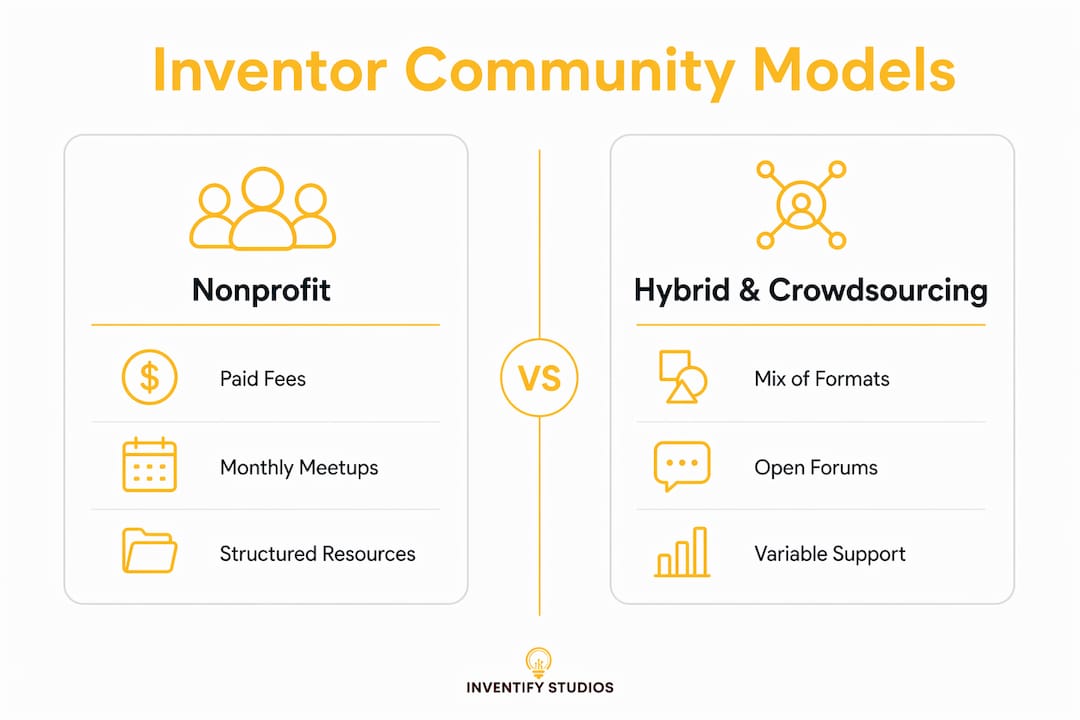
Not every online inventor community is built the same way. Understanding the structural differences helps you choose the right fit for your stage and working style.
| Community model | Structure | Best for |
|---|---|---|
| Nonprofit membership | Paid annual fee, monthly meetups, archived content | Inventors wanting structured local or regional networks |
| Open forum | Free access, asynchronous discussion threads | Early-stage inventors exploring broadly |
| Hybrid digital community | 24/7 chat plus scheduled virtual events | Inventors needing flexible, always-on support |
| Crowdsourcing platform | Idea submission to corporate or public audiences | Inventors seeking external validation or licensing deals |
The Inventors Center of Kansas City operates on a nonprofit membership model. At $30 annual membership, members get monthly meetups attracting 60 to 80 attendees, archived event videos, product listing opportunities, and discounts on services. That price point makes professional-grade networking accessible to inventors who cannot afford expensive consulting.
Hybrid communities like the Inventor Smart Community combine the best of synchronous and asynchronous formats. You get the depth of a live conversation and the convenience of a searchable archive. For inventors in rural areas or different time zones, this model removes the geographic barrier that once made community participation impractical.
Crowdsourcing platforms represent a fundamentally different model, and one with a complicated track record. Early crowdsourcing communities failed largely by treating participants as free idea sources rather than partners. Innovation expert Bill Johnston identifies this as the core failure mode: when a platform extracts ideas without building relationships, contributors burn out and the community collapses. Sustainable models focus on building innovation capability across all stages, not just harvesting submissions.
Pro Tip: Before committing to any paid community, check whether it publishes its event archives publicly. A community confident in its content will show you what you are buying.
The invention development stages you are currently navigating should directly influence which model you choose. Early-stage inventors benefit most from open, low-pressure formats. Inventors closer to licensing or manufacturing need communities with direct industry connections.
What are the common pitfalls when engaging with inventor communities?
Joining a community is the easy part. Getting real value from it requires avoiding several patterns that consistently undermine inventors' experience.
The most damaging is what practitioners call the extraction mindset. This is the habit of showing up only when you need something, treating the community as a search engine for answers rather than a network of relationships. Treating communities as a resource to mine leads to contributor fatigue and erodes the trust that makes genuine mentorship possible. The inventors who get the most out of these networks are the ones who contribute answers, share updates, and celebrate others' wins.
A second pitfall is emotional attachment to your own idea. When you present a concept to peers and receive critical feedback, the instinct is to defend rather than listen. Emotional normalization in inventor communities helps separate personal attachment from objective commercialization realities, but only if you let it. The community can only help you if you are willing to hear what it tells you.
A third issue is the idea void. Some platforms accept submissions or questions and simply never respond. This is especially common on large, underfunded forums where volunteer moderators are stretched thin. If your posts consistently go unanswered, that is a signal about the community's health, not your idea's quality.
"The inventors who thrive in communities are the ones who show up consistently, contribute freely, and treat feedback as data rather than judgment." This mindset shift separates inventors who advance from those who stall.
- Avoid joining multiple communities simultaneously. Depth in one beats shallow presence in five.
- Separate your identity from your invention when receiving feedback. The critique is about the product, not you.
- Track which community interactions lead to concrete progress. Double down on what works.
- If a community charges fees but offers no verifiable member outcomes, walk away.
Skipping professional consultation is a related risk. Inventors who rely solely on peer advice without ever engaging qualified patent attorneys or product development professionals often pay a significant price later. Communities are a complement to professional guidance, not a replacement for it.
How to join and leverage inventor communities effectively
Finding the right community and getting real value from it follows a clear sequence. These steps apply whether you are joining your first group or rebuilding your network after a failed launch.
-
Research communities with verifiable track records. Look for published member outcomes, named organizers, and transparent pricing. The Inventors Center of Kansas City and the Inventor Smart Community both meet this standard. Avoid any group that promises invention success without showing evidence of member results.
-
Start with a free or low-cost entry point. Inventor Smart Community Hangouts are relaxed virtual meetups where newcomers ask questions and engage without pressure. These sessions focus on progress through connection, not productivity metrics. Attending one costs nothing and tells you immediately whether the community culture fits your working style.
-
Use educational resources before asking for help. Most established communities archive their webinars, guides, and Q&A sessions. Working through that material first means your questions are sharper and your contributions more useful.
-
Pursue membership benefits deliberately. Community membership often includes tax-deductible dues, mentor program access, and opportunities to present your project for structured feedback. These are not passive perks. They require you to actively request and schedule them.
-
Integrate community learning with your development tools. The knowledge you gain from peers becomes more powerful when paired with digital tools for inventing that let you act on feedback immediately. If a mentor suggests a design change, you want to be able to prototype it the same day.
Pro Tip: When you introduce yourself in a new community, lead with what you are working on and what specific challenge you are facing. Vague introductions get vague responses. Specific questions attract the right people.
You can also explore inventor community resources to compare platforms and identify which formats align with your current development stage.
Key takeaways
Online inventor communities accelerate invention success by combining peer education, mentorship access, and emotional support that solo inventors cannot replicate on their own.
| Point | Details |
|---|---|
| Community models vary significantly | Choose between nonprofit, hybrid, open forum, or crowdsourcing based on your stage and needs. |
| Emotional support drives momentum | Peer connection normalizes setbacks and improves decision-making at every invention stage. |
| Extraction mindset kills results | Contribute consistently to build the trust that makes genuine mentorship possible. |
| Membership benefits are underused | Tax deductions, mentor programs, and project feedback opportunities require active pursuit. |
| Digital tools amplify community learning | Pair peer insights with AI-powered prototyping and patent tools to act on feedback fast. |
Why the room matters more than the resource
I have watched inventors spend months consuming content, reading forums, and downloading guides without ever posting a single question or attending a live event. They treat community membership like a library card, something to have rather than something to use. That approach produces almost no results.
The real value of these networks is not the archived webinar or the resource list. It is the moment when someone who has already made the mistake you are about to make tells you exactly what to do differently. That only happens when you are present, visible, and willing to be seen as someone who does not have all the answers yet.
What I find most underappreciated is the hybrid continuity model. The combination of always-on chat and scheduled live events means that geography and time zones no longer determine who gets access to good mentorship. An inventor in a small town in Nebraska now has the same access to experienced licensors and patent strategists as someone in San Francisco. That shift is genuinely significant, and most inventors have not fully absorbed what it means for them.
The communities that last are the ones built around shared commitment rather than shared transactions. When you approach a community as a place to build relationships and contribute your own hard-won knowledge, you become someone others want to help. That reciprocity is the actual mechanism behind every success story you will hear from long-term community members.
— Hua
Take your invention further with Inventifystudios
Community knowledge gets you oriented. Inventifystudios gets you moving.
Inventifystudios is an AI-powered invention platform built for exactly the moment when community feedback tells you your idea has potential and you need to act on it. Use the Create Invention service to generate AI-powered 3D prototypes and validate your concept in minutes, not months. When you are ready to protect what you have built, the Invention Detail service delivers patent analysis and provisional patent drafting insights without the cost of traditional consulting. Inventifystudios removes the financial and technical barriers that stop most inventors before they start.
FAQ
What is the role of online inventor communities?
Online inventor communities provide inventors with peer networking, educational resources, mentorship, and emotional support that accelerate idea development and reduce costly mistakes. They function as structured ecosystems, not just discussion boards.
How do I find trustworthy inventor communities to join?
Look for communities with named organizers, published member outcomes, and transparent pricing. The Inventors Center of Kansas City and the Inventor Smart Community are established examples with verifiable track records.
Are online inventor communities worth the membership cost?
Yes, when the community offers structured benefits. A $30 annual membership at the Inventors Center of Kansas City provides monthly meetups, archived content, mentor access, and tax-deductible dues, which represent strong value for active members.
What is the biggest mistake inventors make in these communities?
The extraction mindset is the most common failure. Inventors who only consume without contributing build no relationships, which means they miss the mentorship and honest feedback that make communities genuinely useful.
Can online communities replace professional patent or legal advice?
No. Communities complement professional guidance but do not replace it. Peer advice is valuable for direction and experience sharing, but patent filing, licensing agreements, and IP protection require qualified professionals.