

The conception date in invention law is defined as the moment an inventor forms a definite and permanent idea of a complete and operative invention. This is not the day you build a prototype or file paperwork with the USPTO. It is the specific mental event where your idea becomes clear enough that a person skilled in the relevant field could execute it without undue experimentation. Understanding what is conception date invention means, and why it matters legally, is the difference between owning your idea and losing it to someone who filed first or documented better.
What is conception date in invention law?
Conception date is the legal term for the point at which an inventor has a complete and operative idea that a skilled artisan could reduce to practice without undue experimentation. The Federal Circuit's May 2025 ruling in Regents of Univ. of Cal. v. Broad Inst. sharpened this definition considerably. The court drew a clear line: conception does not require the inventor to know with certainty that the invention will work.
That distinction carries real weight. Many inventors assume they need proof of a working device before their idea counts legally. The Federal Circuit says otherwise. What you need is a sufficiently definite concept, not a successful experiment.
Here is what the legal standard actually requires:
- The idea must be definite and permanent, not vague or exploratory.
- A person of ordinary skill in the art must be able to practice the invention from your description.
- You do not need to prove the invention works at the conception stage. That certainty applies to reduction to practice, which comes later.
- The burden of proof falls on the party asserting an earlier conception date in any dispute.
- Both the Patent Trial and Appeal Board (PTAB) and the Federal Circuit apply this standard in inventorship challenges.
Pro Tip: Keep your conceptual notes completely separate from your experimental logs. Mixing the two creates ambiguity about when your definite idea actually formed, which can undermine your conception date claim during a PTAB challenge.
How has the America Invents Act changed the role of conception date?
The America Invents Act (AIA), enacted in 2011, moved the United States from a first-to-invent system to a first-inventor-to-file system. That shift changed how patent priority is determined, but it did not eliminate the importance of the conception date. The filing date governs patent priority under the AIA, but conception date remains the foundation for resolving inventorship disputes and derivation claims.
Here is why that matters in practice. Suppose two researchers at different institutions independently develop similar gene-editing tools. The one who files first wins the patent race under the AIA. But if one party claims the other derived the invention from their work, conception date becomes the central question. Who had the complete idea first? That is what derivation proceedings at the USPTO examine.
For inventors in 2026, the practical implications break down into five key areas:
- Inventorship disputes. Courts and the PTAB look at who contributed the conceptual framework, not who built the prototype. An inventor who shaped the core idea qualifies as a co-inventor even without hands-on lab work.
- Derivation proceedings. If you believe someone filed a patent based on your idea, you must prove your earlier conception date with documented evidence.
- Employment and collaboration agreements. Conception date determines who owns an invention when multiple parties are involved, especially in university or corporate research settings.
- Provisional patent strategy. Filing a provisional patent application early locks in your filing date, but your conception date documentation strengthens your inventorship claim if that filing is challenged.
- International filings. Some foreign patent systems still consider conception-related evidence in priority disputes, making early documentation globally relevant.
Understanding the invention development stages helps inventors recognize exactly where conception sits in the timeline and why documenting it separately from later stages protects their rights.
What documentation and practices help establish your conception date?
Documented conception date evidence is the strongest defense against rival inventors claiming priority, particularly in interference or derivation disputes. The evidence must show when your definite and permanent idea formed, not just when you started experimenting.

Effective documentation falls into several categories. Dated lab notebooks with signed witness entries remain the gold standard in academic and research settings. Timestamped emails and internal memos work well in corporate environments. Sketches, diagrams, and written descriptions that are specific enough for a skilled artisan to act on carry significant legal weight. Digital tools that automatically timestamp files add another layer of credibility.
What you document matters as much as when. A vague note saying "idea for a better battery" establishes nothing. A detailed written description explaining the specific electrochemical mechanism, the materials involved, and the expected performance outcome is the kind of record that holds up in court.
Common pitfalls to avoid:
- Undated records. A sketch without a date is nearly useless in a dispute.
- Mixing conception with experimentation. Separating conceptual documentation from experimental proof protects your conception date claim.
- Vague language. Descriptions that require a skilled person to guess or experiment excessively do not meet the legal threshold.
- No corroboration. Courts require corroborating evidence beyond the inventor's own testimony.
Pro Tip: Use a cloud-based platform that generates automatic timestamps and version histories for your invention notes. Services that log access and edits create a verifiable paper trail that is far harder to challenge than a handwritten notebook.
| Documentation type | Strengths | Limitations |
|---|---|---|
| Dated lab notebooks | High credibility, widely accepted by courts | Requires witness signatures to corroborate |
| Timestamped emails | Easy to generate, automatically dated | Can be altered; metadata must be preserved |
| Digital invention platforms | Auto-timestamped, version-tracked | Dependent on platform reliability and data retention |
| Sketches and diagrams | Visual clarity for complex ideas | Must include dates and sufficient technical detail |
Proper invention documentation practices give you a defensible record from day one, which is far easier than reconstructing a timeline after a dispute arises.
How does conception date differ from reduction to practice and filing date?
These three terms describe distinct legal events in the patent process, and confusing them is one of the most common mistakes inventors make. Each date carries different legal significance, and each requires different evidence to establish.
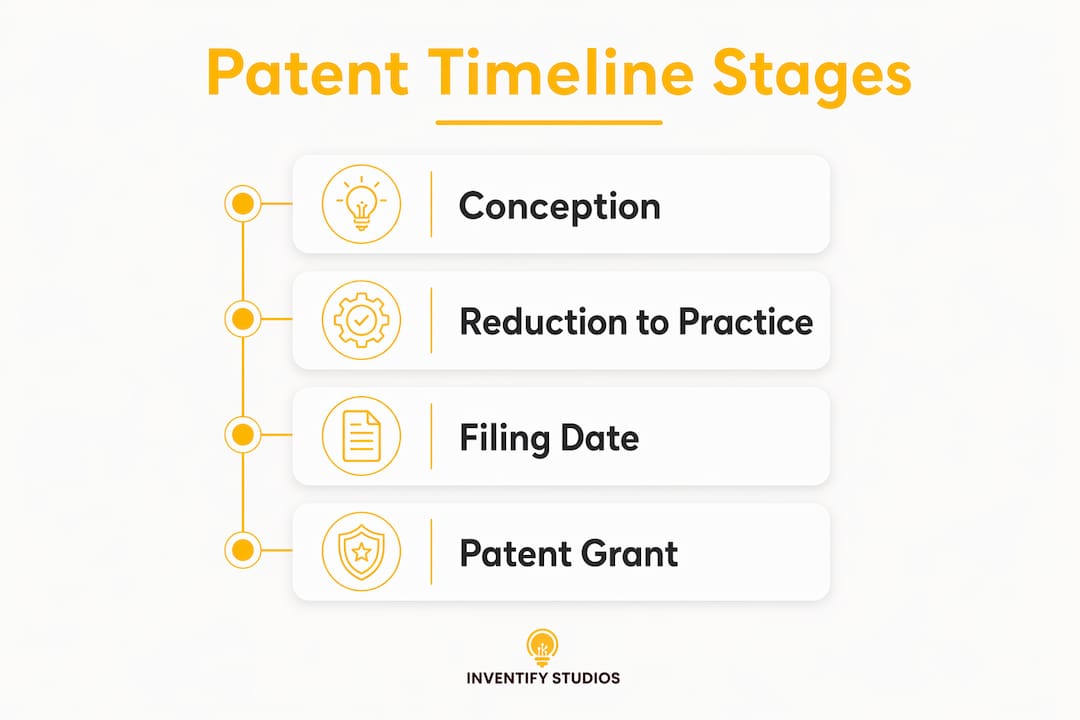
Conception date is the mental formation of a complete and operative invention idea. No physical object is required. No proof of operability is required. The knowledge that an invention will work belongs to the reduction to practice stage, not conception.
Reduction to practice is the physical realization of the invention. Actual reduction to practice means you have built a working version and confirmed it operates as intended. Constructive reduction to practice occurs when you file a patent application with a complete description, even without a physical prototype.
Filing date is simply the date your patent application reaches the USPTO. Under the AIA, this date determines your priority over other applicants for the same invention.
| Date type | What it represents | Legal significance |
|---|---|---|
| Conception date | Mental formation of a complete idea | Determines inventorship; central to derivation disputes |
| Reduction to practice | Physical or constructive proof of operability | Confirms the invention works; required for full patent rights |
| Filing date | Date application submitted to USPTO | Governs patent priority under the AIA |
The CRISPR patent dispute between the University of California and the Broad Institute illustrates how these distinctions play out at the highest level. Both institutions had strong conception date claims. The Federal Circuit's 2025 ruling clarified that the Broad Institute's earlier reduction to practice did not automatically override UC's conception date arguments. The court's analysis turned on whether each party had a sufficiently definite idea at the time they claimed. That case is now a reference point for how courts will evaluate conception versus reduction to practice in future disputes.
For inventors considering early patent filing, understanding these three dates clarifies exactly what you are protecting at each stage of the process.
Key takeaways
Conception date is the legal cornerstone of inventorship, and documenting it separately from experimental work is the single most important step an inventor can take to protect their rights.
| Point | Details |
|---|---|
| Conception date definition | The moment an inventor forms a definite, complete idea a skilled person could execute without undue experimentation. |
| AIA does not eliminate it | Filing date governs patent priority, but conception date remains decisive in inventorship and derivation disputes. |
| Documentation is your defense | Dated notebooks, emails, and digital records with timestamps are the strongest evidence in any conception dispute. |
| Conception vs. reduction to practice | Conception is the idea; reduction to practice is the proof. Courts treat them as legally separate events. |
| Inventorship turns on conception | Co-inventors are those who shaped the core idea, not necessarily those who built or tested the prototype. |
Why the 2025 Federal Circuit ruling should change how you document ideas
The Federal Circuit's 2025 decision in Regents of Univ. of Cal. v. Broad Inst. is the most significant clarification of conception doctrine in years, and most inventors are not paying attention to it. What struck me most about the ruling is how precisely it separates the mental act of invention from the physical proof of it. Courts have always maintained this distinction in theory, but the CRISPR case forced a level of specificity that now sets a clear evidentiary bar.
The practical lesson is uncomfortable for inventors who rely on informal records. A general idea sketched on a napkin, even a brilliant one, does not establish a legally defensible conception date. What the Federal Circuit demands is specificity: enough detail that a skilled person in your field could act on the description without guessing. That is a higher bar than most first-time inventors realize.
My advice is to treat your conception documentation as a legal document from the moment the idea forms. Write it as if you are explaining it to a patent attorney who has never heard of your field. Separate it completely from your experimental notes. Date everything. Get a witness to sign and date it too. The inventors who lose conception disputes almost always lose because their records are ambiguous, not because their idea came second.
Digital tools change this calculus significantly. Platforms that log every edit with a timestamp and preserve version histories create a paper trail that is genuinely hard to challenge. The role of digital tools in inventing has moved from convenience to legal necessity for anyone serious about protecting their work.
— Hua
How Inventifystudios helps you document and protect your conception date
Protecting your invention starts the moment the idea forms, not when you file paperwork.

Inventifystudios gives inventors the tools to document their conception clearly and credibly from day one. The platform's AI-powered invention detailing service helps you articulate your idea with the specificity courts require, creating timestamped, structured records that support your inventorship claims. From detailed invention documentation to patent-ready drafts and patentability analysis, Inventifystudios removes the guesswork from the process. Whether you are a first-time inventor or a seasoned innovator, the platform gives you a defensible record of your conception date without the cost of traditional legal consulting.
FAQ
What is the legal definition of conception date in a patent?
Conception date is defined as the point when an inventor has a definite and permanent idea of a complete and operative invention that a person of ordinary skill in the art could reduce to practice without undue experimentation. It does not require proof that the invention works.
Does the America Invents Act make conception date irrelevant?
No. The AIA shifted patent priority to the first inventor to file, but conception date remains critical for resolving inventorship disputes, derivation proceedings, and claims of idea misappropriation.
How do you prove your conception date?
You prove it with dated, corroborated documentation such as signed lab notebooks, timestamped emails, sketches, and digital records that show when your complete and operative idea formed. Courts require evidence beyond the inventor's own testimony.
What is the difference between conception and reduction to practice?
Conception is the mental formation of the invention idea. Reduction to practice is the physical confirmation that the invention works as intended. The Federal Circuit treats these as legally distinct events with different evidentiary requirements.
Who counts as an inventor if multiple people worked on an idea?
Inventorship focuses on conception, not physical construction. Anyone who contributed to the conceptual framework of the invention qualifies as a co-inventor, even if they never built or tested a prototype.