

Patent protection gives inventors a legally enforceable right to exclude others from making, using, selling, or importing their invention for up to 20 years, making it the single most powerful tool for converting an idea into a defensible asset. The United States Patent and Trademark Office (USPTO) grants this right under Title 35 U.S.C. § 154, and the scope of that right is defined entirely by the patent's claims. Without a filed application, your invention is exposed the moment you describe it publicly. Understanding why inventors need patent protection is not just a legal exercise. It is a business decision with measurable financial consequences.
Why inventors need patent protection: the commercial case
The financial argument for patents is direct and well-documented. SMEs with registered IPRs achieve 44% higher revenue per employee compared to those without protection. That gap reflects what market exclusivity actually does: it lets you price without a race to the bottom, attract partners who need your technology, and build a business around a protected position rather than a temporary head start.
Patents also create licensing income. When you hold a patent, competitors who need your technology must either design around it or pay you. That dynamic shifts negotiating power in your favor before a single lawsuit is filed. Patents convert inventions into legally enforceable competitive positions that can be monetized or defended, which means the patent itself becomes a revenue-generating asset separate from the product it covers.

One distinction most first-time inventors miss: owning a patent does not guarantee your right to practice the invention. If your product incorporates technology covered by someone else's patent, you still need a license. The patent grants the right to exclude others, not a blanket permission to operate. This is a critical nuance that shapes how you build your IP strategy from day one.
Pro Tip: Integrate your patent strategy with trademarks, copyrights, and trade secrets from the start. A coordinated IP strategy covering multiple forms of protection creates overlapping layers of defense that are far harder for competitors to work around than a single patent alone.
| Point | Details |
|---|---|
| Revenue per employee | SMEs with IPRs earn 44% more per employee than unprotected competitors. |
| Licensing income | Patent holders can charge competitors for access rather than racing to cut prices. |
| Market exclusivity | Protection blocks direct copying and forces competitors to invest in alternatives. |
| Negotiating leverage | A granted patent shifts power in deals with partners, distributors, and acquirers. |
What exclusive rights does a patent actually grant?
A U.S. patent grants the right to exclude others from making, using, selling, offering for sale, or importing the invention throughout the United States for 20 years from the filing date. That list is exhaustive and intentional. Each verb represents a separate act of infringement, meaning a competitor who manufactures your invention abroad and imports it into the U.S. is still liable, even if they never sold a unit domestically.
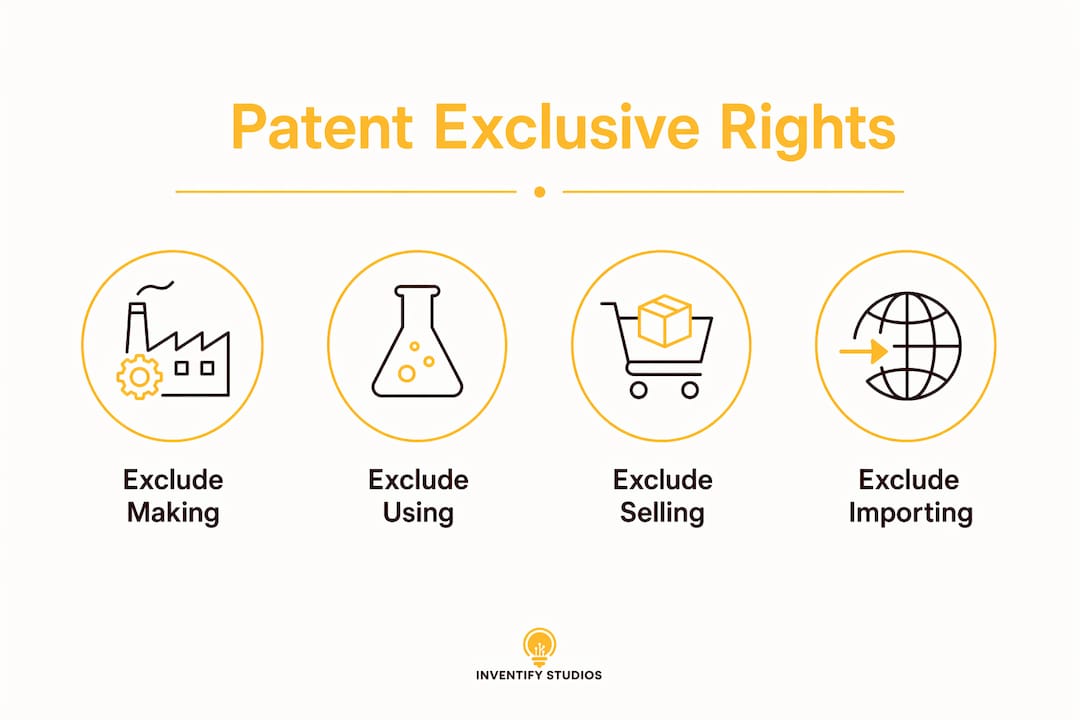
Infringement does not require copying. A competitor who independently develops the same solution and brings it to market infringes your patent just as much as one who copied your design directly. This is strict liability territory, and it is one of the most misunderstood aspects of patent rights. Enforcement mechanisms include active monitoring, formal notice, and proof of infringement, making enforcement a proactive process rather than a passive one.
Patent rights are also territorial. A U.S. patent provides no protection in Germany, Japan, or Canada. If your market is global, you need filings in each jurisdiction where you want protection. The Patent Cooperation Treaty (PCT) simplifies this by allowing a single international application that preserves your rights in over 150 countries while you decide where to pursue full national phase entry.
Your enforcement options as a patent holder include:
- Cease-and-desist letters: The lowest-cost first step, often enough to stop infringement or open licensing talks.
- Licensing negotiations: Convert the infringer into a paying licensee rather than a litigation opponent.
- Litigation: File suit in federal district court for injunctive relief and damages, including lost profits or reasonable royalties.
- Inter partes review (IPR): A USPTO proceeding used defensively to challenge a competitor's patent validity.
Pro Tip: Mark your products with the patent number or "patent pending" status. Proper patent marking puts the public on notice and can significantly increase the damages you recover in an infringement suit, since courts can award damages from the date of notice rather than only from the date you filed suit.
Common misconceptions about patent protection
The most persistent myth is that a patent only protects you against direct copying. In reality, patent protection applies even if a competitor independently reverse-engineers your invention. Independent development is not a defense to patent infringement. This is the fundamental difference between patent protection and trade secret protection, and it matters enormously when choosing your strategy.
Trade secrets offer indefinite duration with no registration cost, but they provide zero protection against independent discovery or reverse engineering. Once a competitor figures out your formula or process on their own, your trade secret is gone. A patent, by contrast, holds regardless of how the competitor arrived at the same solution. The tradeoff is disclosure: patents require you to publish your invention, while trade secrets require you to keep it hidden.
Timing also shapes your strategy in ways most inventors do not anticipate. A patent application is typically published 18 months after filing, disclosing your invention to the public before the patent is granted. During that window, no enforceable patent rights exist. This means competitors can see your technology and begin designing around it before you have any legal recourse. Strategic inventors use this window to accelerate commercialization and build market position before competitors can respond.
Key misconceptions worth correcting:
- "I need to keep it secret until the patent is granted." Filing a provisional application establishes your priority date and gives you 12 months of "patent pending" status to disclose and test the market.
- "A patent means I can do whatever I want with my invention." Patent rights are exclusionary, not permissive. Other patents or regulations may still restrict your ability to practice.
- "Only large companies benefit from patents." The EUIPO data shows SMEs with IPRs consistently outperform those without, regardless of size.
Pro Tip: Work with a registered patent attorney early, specifically on claim drafting. The commercial defensibility of a patent depends on how claims are structured, not just what the invention does. Broad, well-drafted claims are worth far more than a detailed description with narrow coverage.
How inventors can leverage patents beyond legal defense
Patents are strategic assets, not just legal shields. Startups with patents are ten times more likely to secure early-stage venture capital and twice as likely to achieve successful exit events. Investors read a patent portfolio as evidence of defensible technology, which directly reduces their perceived risk. For an early-stage inventor, a single well-drafted patent can be the difference between a term sheet and a pass.
Cross-licensing is another underused tool. When two companies hold patents that each needs to operate, they can exchange licenses rather than pay cash or fight in court. This is standard practice in industries like semiconductors and telecommunications, where patent portfolios function as currency in negotiations. A strong portfolio also deters litigation: a competitor considering a lawsuit will think twice if you hold patents that could be asserted back against them.
Defensive patenting, the practice of filing patents specifically to prevent others from patenting the same space, creates a moat around your core technology. Even patents you never intend to enforce carry value by blocking competitors from locking you out of your own market. The credible threat of enforcement drives licensing and settlements far more often than actual litigation, since patent litigation can cost millions of dollars for both sides.
| Strategic use | Benefit | Example |
|---|---|---|
| Licensing | Generates royalty income without manufacturing | Tech inventor licenses process patent to manufacturers |
| Cross-licensing | Eliminates royalty payments and litigation risk | Two startups swap licenses to use each other's core tech |
| Venture capital signaling | Increases funding probability tenfold | Patent portfolio cited in Series A term sheet |
| Defensive patenting | Blocks competitors from patenting adjacent space | Filing on obvious variations to protect core product |
| Acquisition leverage | Raises company valuation in M&A negotiations | Patent portfolio cited as primary asset in acquisition |
For inventors working in technology, understanding how biometric encryption patents function as enforceable exclusionary rights offers a concrete example of how claim scope translates into competitive moats in fast-moving sectors.
Key takeaways
Patent protection is the only intellectual property right that stops competitors from independently developing and commercializing the same invention, making it the foundation of any serious commercialization strategy.
| Point | Details |
|---|---|
| Exclusionary rights | A patent blocks making, using, selling, and importing, covering every route to market. |
| Revenue impact | SMEs with IPRs earn 44% more per employee than those without protection. |
| VC access | Patented startups are ten times more likely to secure early-stage venture capital. |
| Enforcement is proactive | Monitoring, notice, and proof of infringement are all required to enforce rights effectively. |
| Claims define value | Patent coverage depends on claim structure, not invention description alone. |
Patents are tools, not trophies: my honest perspective
Most inventors I have worked with treat a granted patent as the finish line. It is not. It is the starting line for a business strategy. The inventors who extract the most value from their patents are the ones who understand that a patent's worth is determined by what you do with it, not by the fact that you have it.
The commercial leverage a patent provides rarely comes from litigation. Patent litigation costs millions, and most inventors cannot sustain that fight. What patents actually do, in practice, is change the conversation. A competitor who might have copied your product outright will instead approach you about a license. An investor who was skeptical will reconsider when they see a defensible IP position. A partner who wanted equity will accept a royalty arrangement instead.
I have seen inventors skip professional consultation on claim drafting to save money, only to end up with patents so narrow they cover nothing a competitor cannot easily work around. That is not a savings. That is an expensive mistake. Read why inventors skip professional consultation before you decide to cut that corner.
The patent system balances exclusive rights with public interest, which means your patent is not an absolute monopoly. It is a time-limited, claim-bounded right that rewards disclosure with exclusivity. Use that window aggressively. File early, draft broadly, and treat your patent portfolio as a living business asset that needs active management.
— Hua
Protect your invention with Inventifystudios
You have the idea. The next step is making sure it is protected and positioned to succeed.
Inventifystudios gives inventors the tools to document, validate, and protect their inventions without the cost of traditional consulting. Use the AI-powered platform to assess patentability, generate 3D prototypes, and receive tailored drafting insights for provisional patents. Whether you are filing for the first time or building a portfolio, the platform removes the barriers that slow most inventors down. Start by detailing your invention for patent protection or go straight to creating your invention with guided AI support. Your idea deserves a defensible foundation.
FAQ
Why do inventors need patent protection?
Patent protection gives inventors the exclusive right to exclude others from making, using, or selling their invention for up to 20 years, converting an idea into a legally enforceable and commercially valuable asset.
Does a patent protect against independent invention by a competitor?
Yes. A patent provides legal rights to stop competitors even if they independently develop the same solution, which is the key advantage patents hold over trade secrets.
What is the difference between a provisional and non-provisional patent application?
A provisional application establishes a priority date and grants 12 months of "patent pending" status without formal examination. A non-provisional application triggers full examination and, if granted, provides enforceable rights.
How do patents help inventors attract investors?
Startups with patents are ten times more likely to secure early-stage venture capital, since a patent portfolio signals defensible technology and reduces investor risk.
When should an inventor file a patent application?
File before any public disclosure, sale, or demonstration of the invention. In the U.S., you have a one-year grace period after public disclosure, but filing first eliminates that risk entirely and establishes the earliest possible priority date.