

Patenting early-stage ideas is defined as filing a patent application before public disclosure, investor pitches, or product launch to secure your legal priority date and exclusive rights. Under the first-to-file system established by the America Invents Act, patent rights go to the first applicant filed, not the earliest inventor. This single rule changes everything for aspiring inventors. If you wait until your product is polished, a competitor who files first owns the rights, regardless of who conceived the idea. The benefits of patenting ideas early extend beyond legal protection: they include investor credibility, competitive deterrence, and the creation of a real intangible asset.
Why patent early stage ideas: the legal framework you must understand
The America Invents Act, signed into law in 2011, converted the U.S. patent system from "first-to-invent" to a first-to-file priority system. The practical consequence is stark. Even a difference of days in filing date can determine who owns a patent. If two inventors independently develop the same solution and one files on Monday while the other files on Wednesday, the Monday filer wins. The Wednesday filer loses all rights, regardless of who had the idea first.
Your priority date is the legal stake in the ground that secures your rights from that moment forward. Every subsequent development, refinement, and commercialization effort you make is protected from that date. Delaying that date is not a neutral decision. It is an active risk.
The risks of delayed filing include:
- Competitor preemption. A competitor who files before you can legally block your patent application, even if you invented first.
- Loss of novelty from public disclosure. Public disclosure before filing can destroy patentability under U.S. law, because your own disclosure becomes prior art against your application.
- Investor exposure. Sharing technical details in pitch meetings without a filed application creates disclosure risk that can impair your patent rights.
- Weakened negotiating position. Without a priority date, you have no documented IP asset to show investors, acquirers, or licensees.
The core principle is simple: file first, refine later. The patent system rewards speed, not perfection.
How provisional patent applications work as a strategic tool
A provisional patent application is the most practical entry point for early stage innovation protection. It is not examined by the USPTO and never becomes a patent on its own. Its sole purpose is to lock in a priority date at a lower cost while giving you 12 months to develop your invention, raise funding, and prepare a full non-provisional utility patent.

A provisional application costs between $1,500 and $4,000 when professionally drafted, compared to $10,000 or more for a full utility patent. That cost difference makes provisional filing the right move for most early-stage inventors who need protection without committing full resources before validating their concept.
Here is how to use a provisional application strategically:
- Draft it thoroughly. A provisional that vaguely describes your invention provides weak protection. The application must support the claims you intend to file in your non-provisional patent. An effective provisional application must support eventual utility patent claims to maintain priority. Vague disclosures are one of the most common and costly mistakes inventors make.
- File before any public disclosure. This includes demo days, crowdfunding campaigns, trade shows, and investor presentations. Once you file, you can legally use the phrase "patent pending," which signals protection and deters copying.
- Use the 12-month window actively. Build your MVP, refine your design, conduct market research, and secure funding. Then convert to a non-provisional utility patent before the deadline.
- Do not miss the conversion deadline. Missing the 12-month window to convert a provisional patent causes loss of priority and patent rights. Set a hard calendar reminder at month nine to begin the conversion process.
- File incrementally for iterative inventions. If your product evolves through development cycles, early filings can be modular, with new provisional applications filed as significant new features emerge.
Pro Tip: Before drafting your provisional, review your invention claim drafting guidelines to understand what level of detail the USPTO expects. A well-scoped provisional is worth ten times more than a rushed one.
What are the business advantages of patenting early for startups?
Early patent filing delivers business value that goes well beyond legal protection. The moment you file, your invention carries "patent pending" status. That phrase does real work in the market.
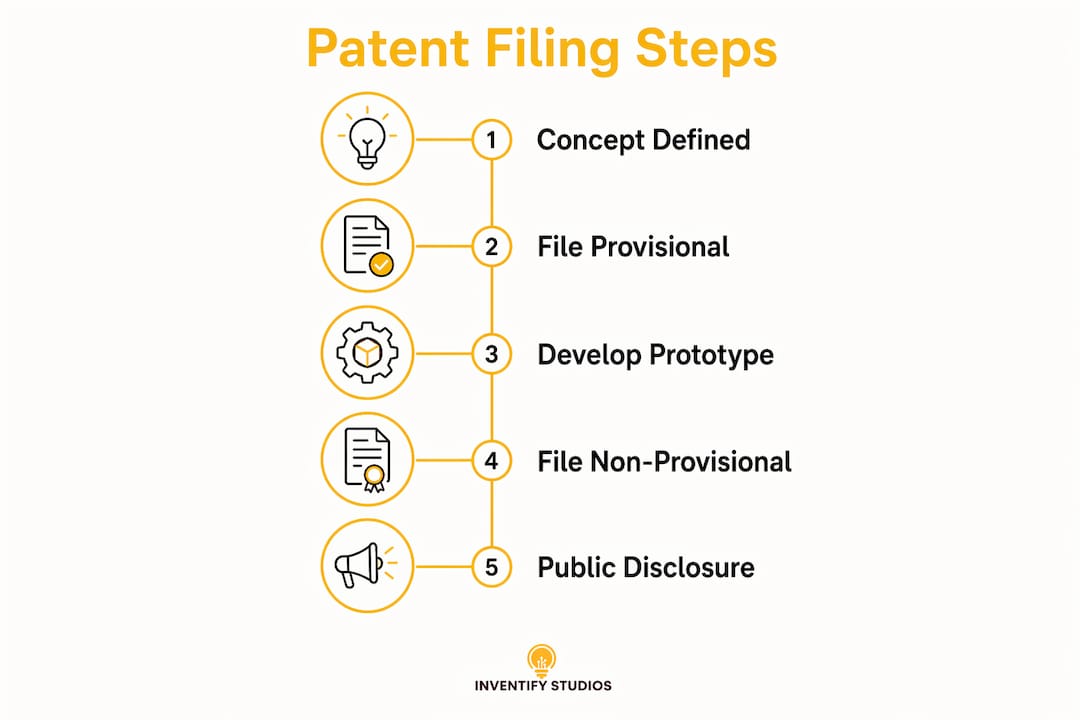
"Patent pending" status builds investor confidence and deters competitors before a patent is even granted. Investors evaluating early-stage startups treat filed IP as evidence of defensibility. A startup with a patent pending application signals that the founding team is serious, organized, and protecting its core technology. That perception directly affects term sheets and valuations.
The business advantages of securing patents early include:
- Competitive deterrence. Competitors who see "patent pending" on your product or marketing materials face uncertainty about what is protected. That uncertainty slows their response and gives you time to establish market position.
- Intangible asset creation. A filed patent application is a documented asset on your balance sheet. It can be licensed, sold, or used as collateral in financing discussions.
- Fundraising leverage. Filing before fundraising prevents the accidental disclosure of valuable technical details during investor conversations. Filing first, then pitching, is the correct sequence.
- Freedom to operate. Once you have a priority date, you can openly discuss your invention with partners, manufacturers, and distributors without risking your rights.
The invention development stages that matter most for IP strategy are the transition from concept to prototype and from prototype to market. Both transitions involve disclosures. Filing before each one protects you at the moments of highest risk.
How to time patent filings with development and public disclosures
Timing is where most inventors make their most expensive mistakes. Filing too early, before your invention is sufficiently defined, produces a weak application that may not support your eventual claims. Filing too late, after a public disclosure, can eliminate your rights entirely.
The table below maps key invention milestones to the recommended patent filing action:
| Invention milestone | Recommended filing action |
|---|---|
| Concept defined, no public disclosure yet | File provisional application immediately |
| MVP in development, fundraising planned | File provisional 2 to 3 months before investor meetings |
| Product launching publicly | Non-provisional utility patent should already be in process |
| New feature developed post-launch | File new provisional for each significant new feature |
| Licensing or acquisition discussions | Confirm non-provisional is filed and prosecution is active |
Filing a provisional 2 to 3 months before planned fundraising is the standard recommendation from patent attorneys who work with startups. This timing buffers against accidental disclosure during investor due diligence and strengthens your IP position before anyone outside your team sees the technical details.
Marketing and investor discussions must be actively managed to prevent accidental public disclosures that impair patentability. This is not just about formal presentations. It includes LinkedIn posts, product teasers, podcast appearances, and even casual conversations at networking events. Any description of your invention that reaches the public before filing creates risk.
Pro Tip: Treat your filing date as a hard product milestone, not a legal afterthought. Build it into your invention development stages alongside your MVP and funding targets.
The USPTO patent process requires professional drafting and ongoing management through filing and prosecution. This is not a process to handle alone with a template. The scope of your claims determines the scope of your protection, and that scope is set at the time of filing.
Key takeaways
Early patent filing secures your legal priority date, deters competitors, and builds the IP foundation that investors and acquirers expect from serious startups.
| Point | Details |
|---|---|
| File first under first-to-file rules | The America Invents Act awards rights to the first applicant, not the first inventor. |
| Use provisional applications strategically | A $1,500 to $4,000 provisional locks in priority for 12 months at a fraction of full patent cost. |
| File before any public disclosure | Sharing technical details before filing can destroy patentability under U.S. law. |
| Align filing with fundraising milestones | File 2 to 3 months before investor meetings to protect rights during due diligence. |
| Quality of drafting determines protection scope | Weak provisional applications allow competitors to design around your invention. |
What most inventors get wrong about filing early
The conventional advice is "file as early as possible." That is correct but incomplete. What I have seen consistently is that inventors treat the provisional application as a checkbox rather than a strategic document. They file something thin and vague, feel protected, and then spend the next 12 months pitching and building without revisiting the application. When it is time to convert, the provisional does not support the claims they want to make. They lose priority on the features that matter most.
Poor patent quality helps competitors design around your invention and erodes your market advantage. A well-drafted patent creates a real barrier. A poorly drafted one creates the illusion of protection while leaving you exposed.
The other mistake I see is treating patent filing as separate from product strategy. The best founders I have worked with treat IP milestones the same way they treat product milestones. They know their provisional filing date, their conversion deadline, and their prosecution timeline. They also know which features are claimed and which are not, so they can file incremental provisionals as the product evolves.
One more thing: do not skip professional help to save money upfront. Skipping professional consultation on patent drafting is one of the most common and costly decisions early-stage inventors make. The cost of a weak patent is far higher than the cost of drafting it properly the first time.
— Hua
Start protecting your invention with Inventifystudios
Inventifystudios gives aspiring inventors and early-stage entrepreneurs the tools to act fast without the high cost of traditional patent consulting.
The platform's AI-powered patent analysis assesses your invention's patentability and generates tailored drafting insights for provisional patents in minutes. You can validate your concept, build a 3D prototype, and get a patent-ready draft before your first investor meeting. For inventors who need to move quickly and protect their rights without overpaying, start your invention detail today. If you are ready to take the first step from idea to protected asset, create your invention on the platform and see how fast early-stage protection can be.
FAQ
Why does filing date matter more than invention date?
Under the America Invents Act, U.S. patent rights go to the first applicant to file, not the first to invent. A competitor who files even one day before you can legally own the patent on your invention.
What is a provisional patent application?
A provisional patent application is a lower-cost filing that locks in a priority date and gives you 12 months to convert to a full non-provisional utility patent. It costs between $1,500 and $4,000 when professionally drafted and is never examined on its own.
Can I pitch investors before filing a patent?
You should file a provisional application before pitching investors. Sharing technical details in investor meetings without a filed application creates disclosure risk that can impair your patentability under U.S. law.
What happens if I miss the 12-month provisional conversion deadline?
Missing the 12-month window to convert your provisional application causes loss of your priority date and patent rights. Begin the conversion process at month nine to avoid this outcome.
Does "patent pending" actually protect my invention?
"Patent pending" does not grant legal rights, but it deters competitors by signaling that protection is in process. It also builds investor confidence and allows you to market and fundraise openly without risking your rights.