

Invention risk assessment is the systematic process of identifying, evaluating, and managing potential risks that could prevent a new product from reaching the market successfully. Every invention faces three core risk categories: technical risks (will it work?), commercial risks (will it sell?), and legal risks (can you own and protect it?). Frameworks like ISO 14971 and Freedom-to-Operate (FTO) analysis give inventors structured tools to answer those questions before spending serious money. Skipping this process does not eliminate risk. It just means you discover problems at the worst possible time.
What are the key components of invention risk assessment?
Invention risk assessment, known formally as structured risk management in engineering and IP practice, breaks down into four sequential phases. Each phase builds on the last, and skipping any one of them creates blind spots that compound later.
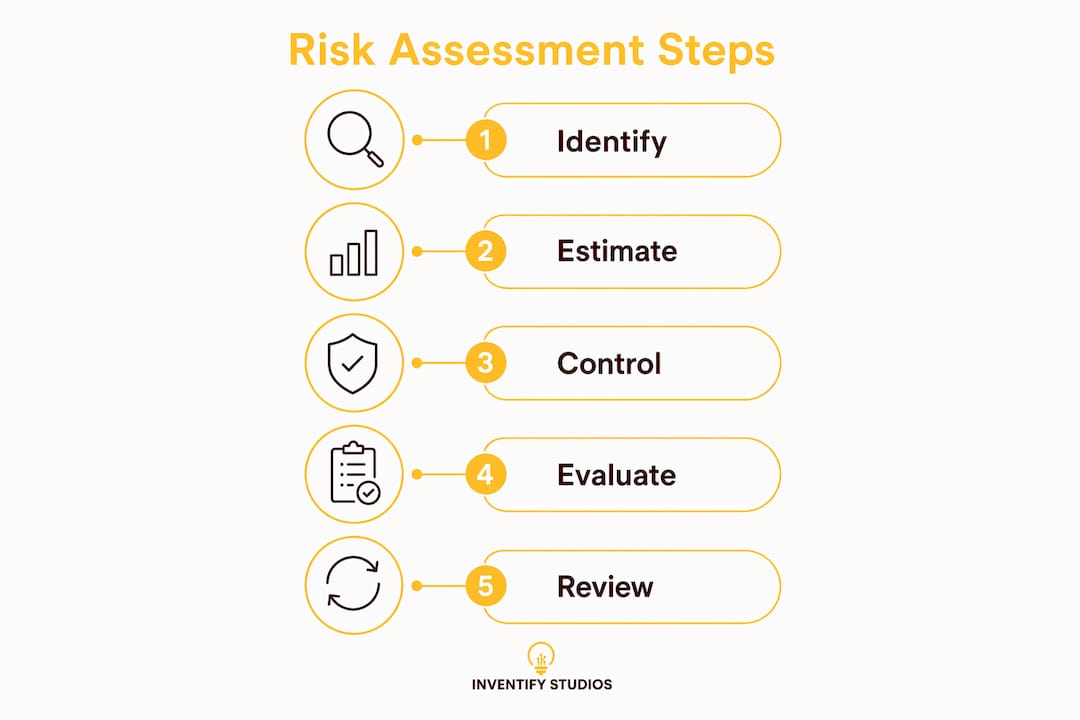
Hazard identification is the starting point. You map every potential source of failure across the invention's intended use, foreseeable misuse, operating environment, and full lifecycle. Missed hazards in this phase are the single biggest reason risk assessments fail, because every subsequent step is only as reliable as the hazard list you start with.

Risk estimation follows. For each identified hazard, you assess two variables: the severity of the potential harm and the probability that it occurs. You can use historical data, expert judgment, or structured techniques like Failure Mode and Effects Analysis (FMEA) or Preliminary Hazard Analysis (PHA). FMEA, originally developed for aerospace and adapted widely in product development, assigns a Risk Priority Number to each failure mode so you can rank and address the most critical issues first.
Risk evaluation compares your estimates against predefined acceptability criteria. This is where a risk matrix becomes useful. A standard 5x5 matrix plots severity against probability and assigns each combination to a risk zone: acceptable, as low as reasonably practicable (ALARP), or unacceptable. The key discipline here is defining those criteria before you run the analysis, not after you see the results.
Documentation and traceability tie the whole process together. A traceability matrix maps each hazard through its risk estimate, control measure, verification evidence, and residual risk status. This record supports patent attorney reviews, investor due diligence, and regulatory submissions.
- Identify hazards across all use scenarios, not just intended use
- Estimate severity and probability using FMEA or PHA
- Evaluate against pre-set acceptability criteria using a risk matrix
- Document every decision with a traceability matrix
- Review and update the assessment at each development milestone
Pro Tip: Start your hazard list by asking "what could go wrong if someone uses this incorrectly?" Misuse scenarios surface hazards that intended-use analysis routinely misses.
How do legal risks affect invention risk assessment?
Legal risk is the dimension most first-time inventors underestimate. You can build a technically sound product and still face an injunction that shuts down your entire commercialization effort if you have not assessed your patent position.
Freedom-to-Operate (FTO) analysis is the primary tool for evaluating legal risk before launch. FTO analysis examines whether your product or process would infringe valid patents held by third parties. It is distinct from a patentability search, which asks whether your invention is novel enough to receive a patent. FTO asks a different question entirely: can you make, use, and sell this without getting sued? Many inventors conflate the two, which is a costly mistake.
A rigorous FTO process follows these steps:
- Define the product or process scope precisely, including all key components and methods
- Search relevant patent databases (USPTO, EPO, WIPO) for potentially blocking patents
- Map each claim element of identified patents against your invention's features
- Assess patent validity and enforceability, including any pending challenges at patent offices
- Evaluate claim interpretation doctrines such as the doctrine of equivalents, which can extend a patent's reach beyond its literal language
- Document conclusions and identify design-around options or licensing targets
Prior art management is equally critical. Prior art includes any public disclosure of your invention before the patent filing date, and it can destroy patentability. The U.S. offers a one-year grace period for inventor-originated disclosures, but most other jurisdictions do not. This means a conference presentation, a crowdfunding campaign, or even a detailed conversation with an AI tool could constitute prior art in Europe or Asia before you file.
AI tools present a specific and emerging risk. Sharing invention details with platforms like ChatGPT or Gemini may qualify as public disclosure depending on the provider's terms of service and how data is stored or accessed. Inventors using AI-powered platforms for development need to understand those terms before inputting sensitive technical details. You can read more about this risk in the context of AI disclosure risks.
Mitigation strategies for legal risk include filing a provisional patent application early to establish a priority date, conducting FTO analysis before prototype investment, and working with a patent attorney to identify design-around options when blocking patents exist.
Pro Tip: File your provisional patent application before any public disclosure, including investor pitches. A provisional costs a fraction of a full application and locks in your priority date immediately.
What frameworks can inventors use to structure their risk assessment?
Structured frameworks prevent the ad hoc approach that leaves critical risks unaddressed. ISO 14971, FMEA, and Preliminary Hazard Analysis each serve different purposes, and the most effective inventor risk analysis combines them.
| Framework | Best used for | Key output |
|---|---|---|
| ISO 14971 | Lifecycle risk management, especially for regulated products | Risk management file with full traceability |
| FMEA | Component-level failure analysis during design | Risk Priority Numbers ranked by severity and probability |
| Preliminary Hazard Analysis | Early-stage hazard identification before detailed design | Initial hazard register for scoping |
| Failure Tree Analysis | Root cause mapping for complex system failures | Fault tree diagram showing failure pathways |
ISO 14971 is the international standard for medical device risk management, but its principles apply to any invention. The standard requires defining acceptability criteria in advance and verifying both the implementation and effectiveness of every risk control with objective evidence. Test reports, usability studies, and performance data all count as verification. This discipline forces inventors to prove their controls work, not just assume they do.
The ISO 14971 hierarchy of risk controls runs in this order: first, eliminate the hazard through inherent safe design; second, add protective measures if elimination is not possible; third, provide information for safety (warnings, labels, instructions) as a last resort. This hierarchy matters because information-based controls are the weakest option. A warning label does not prevent a hazard. It just informs users it exists.
When residual risks remain after applying controls, benefit-risk analysis is required. You document the technical or commercial benefits of the invention and compare them transparently against the remaining risks. This analysis is not a one-time exercise. It functions as a living document updated as new evidence emerges from testing, user feedback, and post-market data.
ISO 14971 also requires a traceability matrix that connects each hazard through controls and verification to residual risk status. For inventors outside regulated industries, this level of documentation may seem excessive. It is not. Investors, licensing partners, and acquirers all conduct technical due diligence, and a well-maintained risk management file accelerates those conversations significantly.
How can inventors implement risk assessment in their development process?
Theory becomes useful only when it connects to the decisions you actually make. Here is how to integrate risk evaluation for inventions into your real development workflow.
Start before you build anything. Define the scope of your invention, its intended users, operating environment, and key performance requirements. This scoping exercise feeds directly into hazard identification and shapes your FTO search parameters. Inventors who skip this step often discover late-stage conflicts between their design and a blocking patent that could have been avoided with a two-week search at the outset.
Run technical and legal assessments in parallel. Technical risk assessment and FTO analysis are not sequential tasks. A design-around option identified during FTO may change your technical approach, and a technical constraint may eliminate a patent conflict. Coordinating these workstreams saves time and produces a more accurate picture of your invention's viability.
Use invention disclosures to protect your position. A formal invention disclosure document captures the invention's details, development timeline, prior disclosures, and the contributions of each inventor. This record supports your patent attorney's evaluation, establishes priority evidence, and tracks grace period deadlines. In the AI era, disclosures must also document which elements were AI-generated versus human-invented, since inventorship rights attach only to human contributions.
- Define invention scope and intended use before starting any assessment
- Conduct FTO analysis before committing to prototype investment
- File a provisional patent application to lock in your priority date
- Maintain a traceability matrix linking hazards to controls and verification
- Schedule formal risk reviews at each major development milestone: concept, prototype, pre-launch
Build risk reviews into your go/no-go decisions. Every major investment decision in your development process, from prototype funding to manufacturing commitments, should be preceded by a risk review. This is where your risk matrix earns its value. If a risk sits in the unacceptable zone and you have no viable control measure, that is a no-go signal. If it sits in the ALARP zone with a clear mitigation path, you proceed with eyes open.
Pro Tip: The most common pitfall in inventor risk analysis is treating legal and technical risks as separate workstreams managed by different people who never talk to each other. Schedule a joint review with your patent attorney and lead engineer at least once per development phase.
Bringing in expertise from patent attorneys, mechanical engineers, and business advisors at the right moments does not slow development. It prevents the kind of late-stage surprises that do. You can explore how this fits into your broader invention development stages to see where risk assessment checkpoints belong in your timeline.
Key takeaways
Effective invention risk assessment integrates technical, legal, and commercial risk evaluation from day one, not as a final checkpoint before launch.
| Point | Details |
|---|---|
| Start with hazard identification | Map all failure scenarios before estimating risk, since missed hazards invalidate every downstream control. |
| Run FTO analysis early | Conduct freedom-to-operate analysis before prototype investment to avoid costly design changes or legal conflicts. |
| Manage prior art proactively | File a provisional patent before any public disclosure to protect patentability in all major markets. |
| Use structured frameworks | Apply ISO 14971 principles and FMEA to build a traceable risk management file that supports due diligence. |
| Treat risk assessment as ongoing | Update your benefit-risk analysis at every development milestone, not just at the start of the project. |
Why most inventors get risk assessment backwards
I have worked with inventors across hardware, software, and consumer products, and the pattern is consistent: most people treat risk assessment as a compliance task they complete once, late in development, to satisfy an investor or a regulatory requirement. That framing gets it exactly backwards.
The inventors who build durable, fundable products treat risk assessment as a decision-making tool from day one. They use hazard identification to shape their design choices, not to document them after the fact. They run FTO analysis before they commit to a manufacturing approach, not after they have already built tooling. They file provisional patents before they pitch at demo days, not after someone in the audience asks about their IP position.
The legal and technical dimensions of risk are not separate problems. A blocking patent may force a design change that introduces a new technical hazard. A technical constraint may eliminate a patent conflict without any legal action at all. Inventors who keep these workstreams siloed miss the interactions between them, and those interactions are often where the real risk lives.
My honest advice: view your risk management file the same way you view your financial model. It is never finished. It gets updated every time you learn something new about your invention, your market, or your competitive position. Inventors who maintain that discipline do not just avoid problems. They make better decisions faster, because they have a clear, current picture of what they know and what they do not.
— Hua
Start your invention with a clear risk picture
Building a strong invention starts with knowing exactly what you are working with. Inventifystudios gives you the tools to document, validate, and protect your concept before you invest in development.

The Invention Detail service captures your invention's full technical scope, prior art context, and patent-relevant details in a structured format that supports both risk evaluation and patent attorney review. For inventors ready to move from idea to documented concept, the Create Invention tool guides you through the development process with AI-powered analysis at every step. Both services are built to give you clarity on your invention's viability and legal position without the cost of traditional consulting.
FAQ
What is invention risk assessment?
Invention risk assessment is the structured process of identifying, estimating, and managing technical, legal, and commercial risks that could prevent an invention from reaching the market successfully. It uses frameworks like ISO 14971 and FTO analysis to evaluate risk before major development investments are made.
How is FTO analysis different from a patentability search?
A patentability search asks whether your invention is novel enough to receive a patent. An FTO analysis asks whether you can make, use, and sell your invention without infringing patents held by others. Both are necessary, but they answer different questions.
Can sharing my invention with an AI tool affect my patent rights?
Yes. Sharing invention details with AI platforms may constitute public disclosure depending on the provider's data terms, which can jeopardize patentability in jurisdictions without a grace period. File a provisional patent application before using AI tools to develop or refine your invention concept.
When should I start invention risk assessment?
Start before you build anything. Defining your invention's scope and running an initial hazard identification and FTO search at the concept stage costs far less than discovering a blocking patent or a critical design flaw after prototype investment.
What is a risk management file?
A risk management file is the complete documentation record of your risk assessment process, including hazard lists, risk estimates, control measures, verification evidence, and residual risk status. It supports patent attorney reviews, investor due diligence, and regulatory submissions throughout your invention's lifecycle.