
Patent eligibility is defined by whether your invention falls into one of four protected categories under 35 U.S.C. § 101: processes, machines, manufactures, or compositions of matter. Understanding the examples of patentable vs unpatentable ideas is the single most important step before filing with the USPTO. Abstract concepts, natural phenomena, and laws of nature are excluded from protection, regardless of how original they feel. Landmark Supreme Court decisions like Alice Corp. v. CLS Bank (2014) and Association for Molecular Pathology v. Myriad Genetics (2013) have drawn firm lines that every inventor needs to know.
1. Examples of patentable vs unpatentable ideas: the core distinction
Patentable subject matter covers processes, machines, manufactures, and compositions of matter that are new, useful, and non-obvious. That definition comes directly from 35 U.S.C. § 101 and sets the outer boundary for what the USPTO will consider. Utility patents protect inventions for 20 years, design patents for 15 years, and plant patents for 20 years. Each type covers a different aspect of an invention.
The critical distinction is between an idea and its technical implementation. A patent protects the concrete "how," not the abstract "what." An inventor who says "I want to build a faster battery" has an idea. An inventor who describes a specific electrode composition that delivers 15% improved cycle life has a patentable invention.

2. What qualifies as a patentable invention?
Four categories define patentable innovation types. Each one requires specificity and a concrete technical contribution.
- Processes: A new method for manufacturing a drug compound, a specific algorithm that improves data compression by measurable steps, or a novel surgical technique with defined procedural steps.
- Machines: An improved engine design with a specific valve configuration, a robotic arm with a novel joint mechanism, or a medical device with a defined sensor array.
- Manufactures: A new type of biodegradable packaging made from a specific plant fiber blend, or a composite material with a defined layered structure.
- Compositions of matter: A new chemical compound with a specific molecular formula, a pharmaceutical formulation with defined active ingredients and ratios, or a synthetic polymer with novel bonding properties.
Improvements on existing inventions also qualify. You do not need to invent something entirely new. A meaningful technical upgrade to an existing machine or process can meet the criteria for patentability, as long as the improvement is novel and non-obvious.
AI and machine learning claims represent a growing category. AI/ML patent claims succeed when they specify model architectures, training methods, and quantify technical improvements. A claim that describes a neural network trained on labeled audio data to achieve measurable improvements in speech separation is patentable. A claim that simply says "use AI to improve audio" is not.
Pro Tip: Describe your invention's mechanism in enough detail that a skilled engineer could reproduce it. Vague outcome statements fail; specific technical configurations succeed.
3. Common unpatentable idea examples and why they are excluded
Abstract ideas, pure mathematical formulas, laws of nature, and natural phenomena are excluded from patent protection. This is not a technicality. It is a foundational principle designed to keep basic scientific building blocks available to everyone.
Common unpatentable concepts include:
- Pure business goals: "Deliver groceries faster" or "reduce customer wait times" are outcomes, not inventions. They describe what you want, not how you achieve it.
- Mathematical formulas: A formula for calculating compound interest or a statistical model in isolation cannot be patented.
- Laws of nature: Gravity, thermodynamics, and biological processes that occur naturally are not patentable.
- Naturally occurring substances: Isolated natural DNA is unpatentable. The Myriad Genetics case confirmed that extracting a gene from the body does not make it a patentable invention.
- Abstract software ideas: A broad claim to "using a computer to manage financial transactions" fails under the Alice standard because it simply applies an abstract idea on a generic computer.
- Pure organizational methods: A new management hierarchy or a novel meeting structure has no technical implementation and cannot be patented.
The Alice decision established a two-step test. First, courts ask whether the claim is directed at an abstract idea. Second, they ask whether the claim adds an inventive concept beyond that abstract idea. Claims that fail both steps are rejected under 35 U.S.C. § 101.
4. How to turn an unpatentable idea into a patentable invention
The gap between an unpatentable idea and a patentable invention is specificity. Most inventors start with a goal. The patent process requires you to describe the technical means that achieve it.
- Replace outcome language with mechanism language. Instead of "a system that detects fraud faster," write "a system using a convolutional neural network trained on transaction metadata with defined input parameters that reduces false positives by 18%."
- Quantify your improvements. Measurable performance gains convert abstract claims into patent-eligible ones. Specific numbers, such as 15% improved cycle life or 18% faster processing, give examiners concrete evidence of a technical advance.
- Specify the architecture. For software and AI inventions, name the model type, the training data structure, and the output format. General references to "machine learning" are not enough.
- Use Subject Matter Eligibility Declarations (SMEDs). The USPTO introduced SMEDs to let applicants document technical improvements with objective data. SMEDs provide real-world evidence that a technology is better, cheaper, or more efficient, and they have become a critical tool for overcoming § 101 rejections.
- Detail your chemical or biological composition. For biotech inventions, specify molecular structures, synthesis routes, and functional properties. Synthetic DNA with defined sequences and engineered bacteria with specific genetic modifications qualify. Naturally occurring versions do not.
Pro Tip: File a detailed invention disclosure before drafting claims. Document every technical parameter, test result, and measurable outcome. That documentation becomes the foundation of a defensible patent application.
5. Industry examples: patentable vs unpatentable across technology, biotech, and business
The distinction between patent-eligible and ineligible ideas plays out differently across industries. The table below shows concrete contrasts.
| Industry | Patentable example | Unpatentable example |
|---|---|---|
| Technology | Software with a specific algorithm that improves network intrusion detection by a defined metric | A broad claim to "using software to improve security" |
| Biotech | Synthetic DNA with a novel sequence; genetically modified bacteria (Diamond v. Chakrabarty) | Isolated natural human DNA (Myriad Genetics) |
| Business | A payment processing method tied to a specific machine architecture with defined technical steps | A general business goal of "processing payments more efficiently" |
| Manufacturing | A new composite material with a defined fiber-to-resin ratio and bonding process | The concept of "stronger materials" without a specific formulation |
Software is patentable when it provides a concrete technical improvement beyond an abstract idea, such as better data security or more efficient resource usage. Post-Alice, claims must go beyond simply implementing an abstract idea on a generic computer. That standard has pushed inventors to write more technically precise claims, which ultimately produces stronger patents.
In biotech, the Diamond v. Chakrabarty case established that engineered bacteria with markedly different characteristics from naturally occurring organisms are patentable. That ruling opened the door for genetically modified organisms and synthetic biology. The Myriad Genetics ruling closed the door on naturally occurring gene sequences. The line between the two is whether human ingenuity created something that does not exist in nature.
Business method patents require a technical implementation tied to a machine or a specific technical process. The Bilski v. Kappos case clarified that a pure business method, with no technical anchor, does not qualify. Inventors in this space need to connect their method to a defined system or device.
6. Common misconceptions about patent eligibility
The biggest myth in patent law is that a groundbreaking idea alone is patentable. It is not. Only specific technical implementations qualify for patent protection. Inventors must describe how their invention works with novel mechanisms or processes.
Several other misconceptions cause real damage to patent applications:
- Novelty is not the same as eligibility. An idea can be completely new and still fail § 101 if it is abstract. Novelty and non-obviousness are separate requirements that come after eligibility is established.
- Claiming results without means leads to rejection. Result-oriented claims that lack specific means to achieve them are frequently rejected under § 101. Federal Circuit rulings consistently require concrete configurations.
- Utility and design patents are not interchangeable. Utility patents cover function; design patents cover ornamental appearance. One product can qualify for both, but each requires a separate application and a separate strategy.
- Broad claims are not stronger claims. Overly broad claims are more likely to be rejected or invalidated. Precise, well-supported claims are more durable.
Inventors who understand these distinctions before filing save time, money, and frustration. Reviewing common invention misconceptions before drafting claims is one of the most practical steps you can take. For inventors protecting ideas at the earliest stage, understanding why patent early stage ideas matter can also prevent costly delays.
Key takeaways
Patent eligibility requires a specific, concrete technical implementation. Abstract ideas, natural phenomena, and broad goals are never patentable, regardless of how original they are.
| Point | Details |
|---|---|
| Four patentable categories | Processes, machines, manufactures, and compositions of matter define what the USPTO will protect. |
| Abstract ideas are excluded | Business goals, math formulas, and natural phenomena fail § 101 without a concrete technical anchor. |
| Specificity converts ideas | Quantified improvements and defined mechanisms turn unpatentable concepts into eligible inventions. |
| SMEDs strengthen applications | Subject Matter Eligibility Declarations provide objective data to overcome § 101 rejections. |
| Utility and design patents differ | Function and appearance require separate applications; one product can qualify for both. |
Why specificity is the only thing that matters in 2026
Working with inventors across different stages, the single most common failure I see is a claim that describes what an invention does without explaining how it does it. An inventor will spend months developing a genuinely useful product, then file a patent application that reads like a press release. The examiner rejects it under § 101, and the inventor is confused because the idea is clearly new.
The confusion comes from a reasonable but wrong assumption: that originality is enough. Patent law does not reward originality alone. It rewards documented, specific, reproducible technical contributions. The USPTO's current guidance, shaped by Alice, Mayo, and the introduction of SMEDs, consistently rewards inventors who show their work. Measurable improvements, defined architectures, and specific compositions are not bureaucratic requirements. They are the substance of what a patent actually protects.
My advice to every inventor is to write down the technical details of your invention before you think about claims. Document every parameter, every test result, and every measurable outcome. That record is not just useful for patent filing. It is the proof that your invention is real. For inventors navigating intellectual property protection for the first time, that documentation habit is the single most valuable practice you can build.
— Hua
How Inventifystudios helps inventors build patent-ready details
Knowing the difference between a patentable invention and an unpatentable idea is one thing. Documenting your invention with the technical depth that the USPTO requires is another challenge entirely.
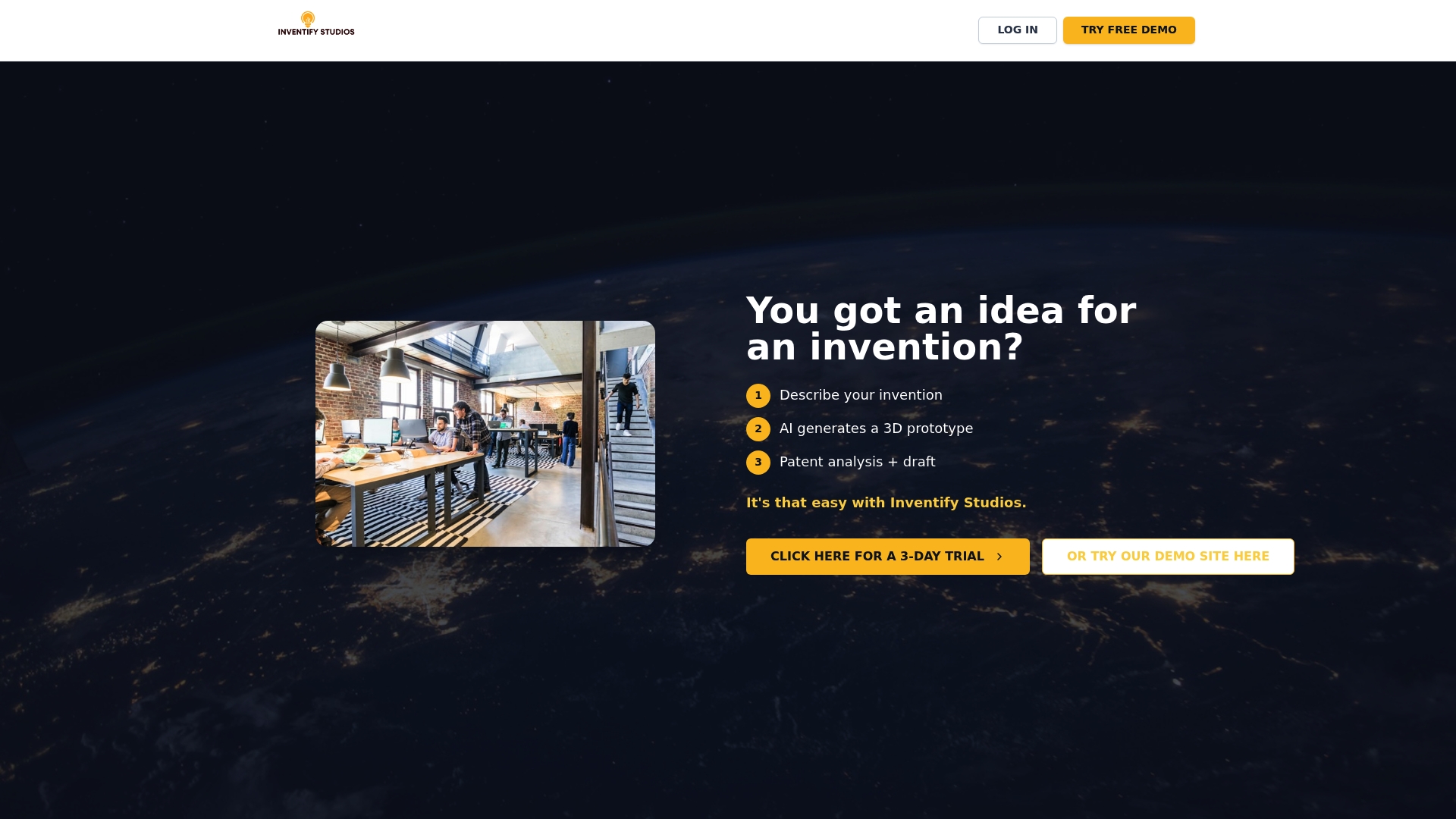
Inventifystudios gives inventors the tools to develop that documentation without expensive consulting fees. The platform's invention detail service helps you capture specific technical parameters, generate AI-powered prototype visuals, and produce patent-ready drafts that reflect the concrete implementation your claims need. Whether you are specifying a novel chemical composition or defining a software architecture, Inventifystudios structures your invention details so they align with current patent eligibility standards. You build the idea. Inventifystudios helps you document it in a way that holds up.
FAQ
What makes an idea patentable under US law?
An idea is patentable when it falls into one of four categories under 35 U.S.C. § 101: processes, machines, manufactures, or compositions of matter. It must also be new, useful, and non-obvious.
Can software be patented?
Software is patentable when it delivers a concrete technical improvement, such as faster processing or better security, beyond simply applying an abstract idea on a generic computer. Post-Alice claims must specify the technical mechanism that produces the improvement.
Why is isolated DNA unpatentable?
The Supreme Court ruled in Myriad Genetics (2013) that isolated natural DNA is a product of nature and therefore unpatentable. Synthetic DNA with a novel sequence created through human ingenuity does qualify for patent protection.
What is a Subject Matter Eligibility Declaration (SMED)?
A SMED is a USPTO tool that lets patent applicants submit objective data proving their invention is technically better, cheaper, or more efficient than existing solutions. SMEDs are used to overcome § 101 rejections by demonstrating a concrete technical advance.
What is the difference between a utility patent and a design patent?
A utility patent protects how an invention functions and lasts 20 years. A design patent protects the ornamental appearance of an invention and lasts 15 years. One product can qualify for both, but each requires a separate application.