

Patent novelty is defined as the legal requirement that an invention must be genuinely new and not previously disclosed to the public before the patent filing date. Under 35 U.S.C. § 102, the United States Patent and Trademark Office (USPTO) will reject any application where the invention was already known, used, or described in prior art. Novelty is one of three core patentability requirements alongside non-obviousness and utility, and it is the first filter every invention must pass. Over 70% of first-time rejections involve novelty, obviousness, or enablement issues. That number tells you one thing: most inventors hit this wall before they ever get close to a granted patent.
What is patent novelty under U.S. law?
Patent novelty is assessed through a legal concept called anticipation. Anticipation means a single prior art reference must disclose every element of your claimed invention, arranged as you claim it, for your application to be rejected on novelty grounds. No combination of references is allowed at this stage. That distinction matters because it separates novelty from non-obviousness, where examiners can combine multiple references to argue your idea was obvious.
Prior art includes a wide range of disclosures:
- Patents and published patent applications filed anywhere in the world
- Scientific publications, journal articles, and books available to the public
- Public use or demonstration of the invention before the filing date
- Commercial offers for sale, even without a detailed public description
- Online content, product listings, and conference presentations accessible to anyone
The America Invents Act (AIA), enacted in 2011, shifted U.S. patent law to a first-inventor-to-file system. Before the AIA, the first person to invent held priority. Now, the first person to file wins, which makes early filing a direct competitive advantage.
U.S. law does provide a one-year grace period under 35 U.S.C. § 102(b)(1). This grace period protects inventors who publicly disclose their own invention before filing, giving them up to 12 months to submit an application. The grace period does not protect against third-party disclosures. If someone else publishes information about your invention during that window, your novelty is at risk.

Pro Tip: File a provisional patent application before any public disclosure. A provisional establishes your filing date immediately and gives you 12 months to refine your full application without sacrificing novelty.
Novelty is also a binary legal standard. Your invention is either anticipated by prior art or it is not. There is no middle ground, no partial credit, and no negotiation once a valid anticipating reference is found.
What are the most common novelty pitfalls for inventors?
Most inventors underestimate how easy it is to lose novelty before they even file. The mistakes fall into predictable patterns, and knowing them in advance saves significant time and money.
-
Skipping a thorough prior art search. Insufficient prior art searches before drafting claims are the leading cause of avoidable rejections. Searching only Google or a single patent database is not enough. A proper search covers USPTO databases, the European Patent Office's Espacenet, Google Patents, and relevant academic literature.
-
Misreading the U.S. grace period. Many inventors treat the one-year window as a safe zone for public disclosure. It is not. The grace period only covers your own disclosures. A competitor who independently publishes a similar idea during that window can destroy your novelty claim.
-
Ignoring international filing plans. If you plan to file in Europe, India, Japan, or most other countries, the U.S. grace period offers zero protection. Absolute novelty standards in those jurisdictions mean any public disclosure before your international filing date ends your patent rights there permanently.
-
Overlooking secret prior art. Unpublished patent applications filed before yours can still be cited against you once they publish. You cannot find these in a standard search, which is why filing early is the only reliable defense.
-
Assuming a sale requires a public description. Under U.S. law, a commercial offer for sale can destroy novelty even if you never publicly described how the invention works. Many inventors learn this the hard way after pitching to retailers or distributors before filing.
Pro Tip: Sign non-disclosure agreements before sharing your invention with anyone, including potential investors, manufacturers, or business partners. An NDA preserves your novelty and protects your rights to file internationally.
Understanding why inventors lose patent rights often comes down to these exact missteps. Awareness is the first defense.
How do global patent systems differ on novelty?
The U.S. grace period is the exception, not the rule. Most patent systems worldwide apply absolute novelty, meaning any public disclosure before the filing date destroys patentability with no exceptions.
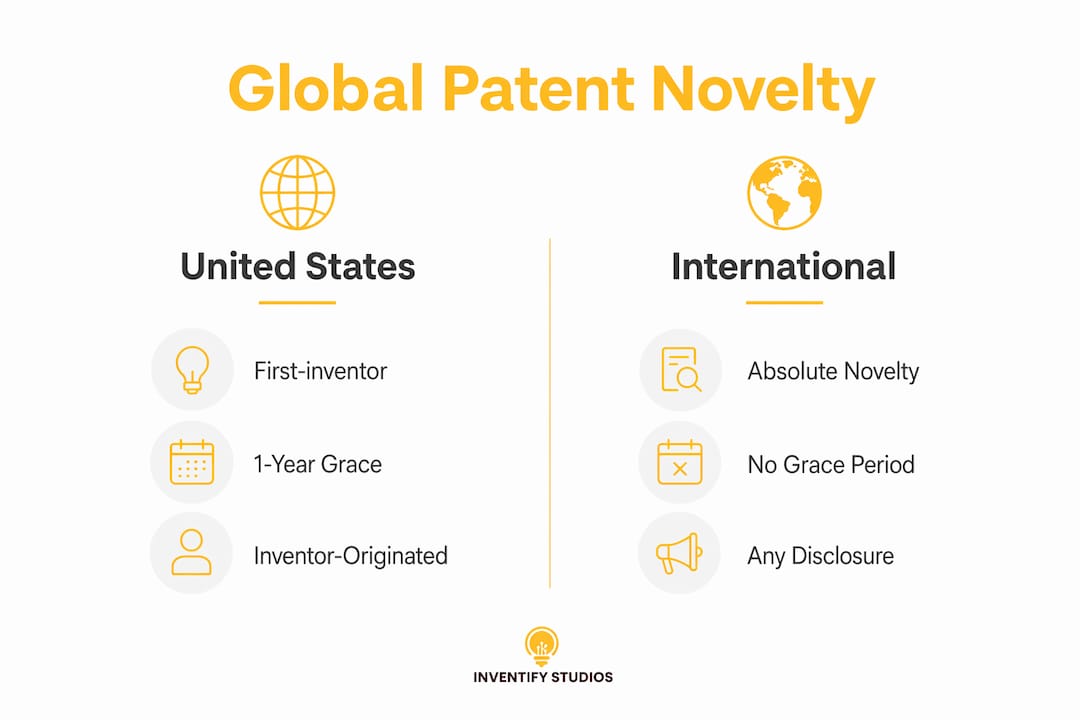
| Jurisdiction | Novelty Standard | Grace Period | Key Trigger for Loss |
|---|---|---|---|
| United States | First-inventor-to-file | 1 year (inventor disclosures only) | Public use, sale, or publication |
| European Patent Convention (EPC) | Absolute novelty | None | Any enabling public disclosure |
| India | Absolute novelty | None | Prior publication or public use |
| Japan | Absolute novelty | Limited (6 months, specific cases) | Any prior disclosure |
The European Patent Convention requires an enabling disclosure to destroy novelty. That means a vague reference to your product category may not be enough to anticipate your specific claims. U.S. law is stricter on commercial activity: a public offer for sale triggers novelty loss even without a technical description.
Absolute novelty standards in Europe, India, and most other jurisdictions catch many U.S.-based inventors off guard. An inventor who presents at a trade show in Chicago in january, then files a U.S. provisional in march, and later tries to file a PCT application in april has already lost European and Indian rights. The trade show disclosure is the problem.
Relying on the U.S. grace period is risky for international strategies. If your business has any global ambition, file before you disclose. That single rule eliminates the most common international novelty failure.
What practical steps protect your invention's novelty?
Protecting novelty is a process, not a single action. These steps apply whether you are a first-time inventor or an entrepreneur building a product line.
-
Conduct a prior art search before drafting claims. Search USPTO full-text databases, Espacenet, and Google Patents. Include keyword searches in academic databases like Google Scholar for your technical field. A search done before drafting saves you from building claims around an already-known concept.
-
File before you disclose. File at minimum a provisional patent application before any public presentation, product demo, investor pitch, or online post describing your invention. A provisional costs less than a full utility application and locks in your filing date immediately.
-
Use non-disclosure agreements consistently. Every conversation with a manufacturer, co-founder, or potential partner should be covered by a signed NDA before you share technical details. This preserves your right to file internationally.
-
Document your invention thoroughly. A well-written invention disclosure document captures the technical details, development timeline, and unique features of your invention. This documentation supports your patent claims and helps your attorney or drafting tool identify what is genuinely novel.
-
Draft claims with precision. Broad, vague claims invite rejections. Specific, well-structured claims that clearly define what is new give examiners less room to find anticipating prior art. Review claim drafting guidelines before you write or review your application.
-
Plan your filing timeline around your business milestones. If you plan to launch a product, pitch to investors, or exhibit at a trade show, your filing date must come first. Build your patent strategy into your product roadmap from day one.
Founders who want to understand the full picture of why patent early stage ideas matter will find that novelty protection and business timing are inseparable decisions.
Key Takeaways
Patent novelty is a strict binary legal test: your invention is either new under 35 U.S.C. § 102 or it is not, and no amount of negotiation reverses a valid anticipating prior art reference.
| Point | Details |
|---|---|
| Novelty is a binary test | A single prior art reference disclosing all claim elements destroys novelty with no exceptions. |
| File before you disclose | Any public disclosure before filing ends international patent rights in absolute novelty jurisdictions. |
| Grace period has limits | The U.S. one-year grace period covers only inventor disclosures, not third-party prior art. |
| Secret prior art is a real risk | Unpublished patent applications can be cited against your filing once they publish. |
| Prior art search is non-negotiable | Skipping a thorough search before drafting claims is the leading cause of avoidable rejections. |
The novelty mistake I see most often
Most inventors I work with understand that their idea needs to be new. What they do not understand is how unforgiving the legal standard actually is. They assume that because no one is selling the exact same product, they are safe. That assumption is wrong.
Novelty is not about the market. It is about prior art. A product that never sold commercially can still destroy your patent if it was described in a 1998 journal article or disclosed in an expired patent. I have seen strong inventions rejected because of a single obscure reference the inventor never found, simply because the prior art search was done too quickly or too narrowly.
The grace period misunderstanding is the second most costly mistake. Entrepreneurs pitch their ideas at startup events, post about them on LinkedIn, or demo prototypes at trade shows, all before filing. They believe the U.S. grace period covers them. It covers their U.S. application, sometimes. It covers nothing internationally. By the time they decide to file in Europe or Asia, the window is closed.
Technology startups and solo inventors feel this disproportionately. They move fast, which is a strength in business and a liability in patent law. The fix is not to slow down. The fix is to build filing into the process before any public-facing milestone. A provisional application takes days to prepare. Losing international rights takes one trade show presentation.
— Hua
How Inventifystudios supports your patent novelty strategy
Protecting your invention's novelty requires more than a good idea. It requires the right process at the right time.
Inventifystudios offers an invention evaluation service that covers prior art assessment, patentability analysis, and patent claim drafting support. The platform uses AI-powered tools to help you identify what is genuinely novel about your invention and structure your claims to reflect that clearly. For first-time inventors and entrepreneurs who need to move fast without sacrificing legal rigor, Inventifystudios removes the barriers that make patent protection feel out of reach. You get the clarity and documentation you need to file with confidence, without the cost of traditional consulting. Explore the IP fundamentals that every founder should know before your next product milestone.
FAQ
What is the legal definition of patent novelty?
Patent novelty is the requirement under 35 U.S.C. § 102 that an invention must not have been publicly disclosed, used, sold, or described in prior art before the patent filing date. An invention that fails this test is considered anticipated and cannot be patented.
How does novelty differ from non-obviousness?
Novelty requires a single prior art reference to disclose every element of the claimed invention. Non-obviousness allows examiners to combine multiple references to argue the invention would have been obvious to a skilled person in the field.
Does the U.S. grace period protect international patent rights?
No. The one-year U.S. grace period applies only to U.S. applications and only covers inventor-originated disclosures. Most countries enforce absolute novelty, meaning any public disclosure before filing permanently destroys patent rights in those jurisdictions.
Can an unpublished patent application destroy my novelty?
Yes. Earlier-filed but unpublished patent applications can be cited as prior art once they publish, even if your application was already filed. This is called secret prior art, and it is one of the hardest risks to detect in advance.
What is the fastest way to protect novelty before a product launch?
File a provisional patent application before any public disclosure, product demo, or investor pitch. A provisional establishes your filing date immediately and gives you 12 months to prepare a full utility application without losing novelty.