

Prototypes reduce revision cycles because they surface flawed assumptions and technical risk before a design gets expensive to change. A rough model tested in week two catches the problems a finished spec would have hidden until week twelve. That single shift, testing before committing, is what separates teams stuck in endless review loops from teams that ship.
The evidence backs this up from two directions. Rapid prototyping research from HBS shows that validating direction early lets teams pivot before major investment, avoiding the costly redesigns that dominate late-stage schedules. Separately, Stanford's d.school found that building several rough prototypes in parallel, rather than refining one design serially, produces more diverse and higher-performing outcomes.
Two things you can do today:
- Identify the single riskiest assumption in your current design and build the cheapest possible test for it.
- Set a measurable acceptance criterion before you build anything, so the test has a clear pass or fail.
Key Takeaways
Prototypes reduce revision cycles because they surface flawed assumptions and technical risk while changes are still cheap to make.
| Point | Details |
|---|---|
| Test the riskiest assumption first | Build the cheapest prototype that answers your biggest unknown before refining anything else. |
| Match fidelity to the question | Use low-fidelity wireframes for usability questions and functional prototypes for feasibility questions. |
| Build in parallel, not serially | Several rough variants tested at once outperform one polished prototype refined over time. |
| Log every revision with a decision gate | Record the assumption, result, and next step so future projects don't repeat the same mistake. |
| Loop manufacturing in early | Request DFM input at the concept CAD stage, not after tooling is committed. |
| AI-assisted generation speeds the first draft | Inventifystudios compresses concept-to-3D-model time but doesn't replace engineering review for critical systems. |
Table of Contents
- Why Early Prototypes Shorten Revision Loops
- How Do You Choose the Right Prototype Fidelity?
- What Does an Effective Prototype Testing Protocol Look Like?
- When Should Manufacturing and Engineering Get Involved?
- How Do You Document Revisions to Prevent Backtracking?
- What Workflows and Tools Speed Up Iteration?
- Can AI-Assisted Prototyping Actually Shorten the Cycle?
- A Habit Worth Building Into Every Project
- A Faster Path From Sketch to Testable Prototype
- Frequently Asked Questions
- Sources
Why Early Prototypes Shorten Revision Loops
Every revision cycle traces back to an assumption nobody checked. A tolerance that seemed fine on paper. A workflow that made sense to the engineer but confused the user. Prototypes exist to expose these assumptions while they are still cheap to fix.
The mechanism is straightforward. A tangible model forces a decision that a spec document lets you postpone. When stakeholders can hold a part or click through a flow, ambiguity collapses fast, because everyone is reacting to the same object instead of interpreting the same words differently. Nielsen Norman Group's research on paper prototyping points to a rule of thumb worth internalizing: changes made early in a design process can cost roughly 100 times less than changes made after launch. That gap is the entire business case for prototyping.
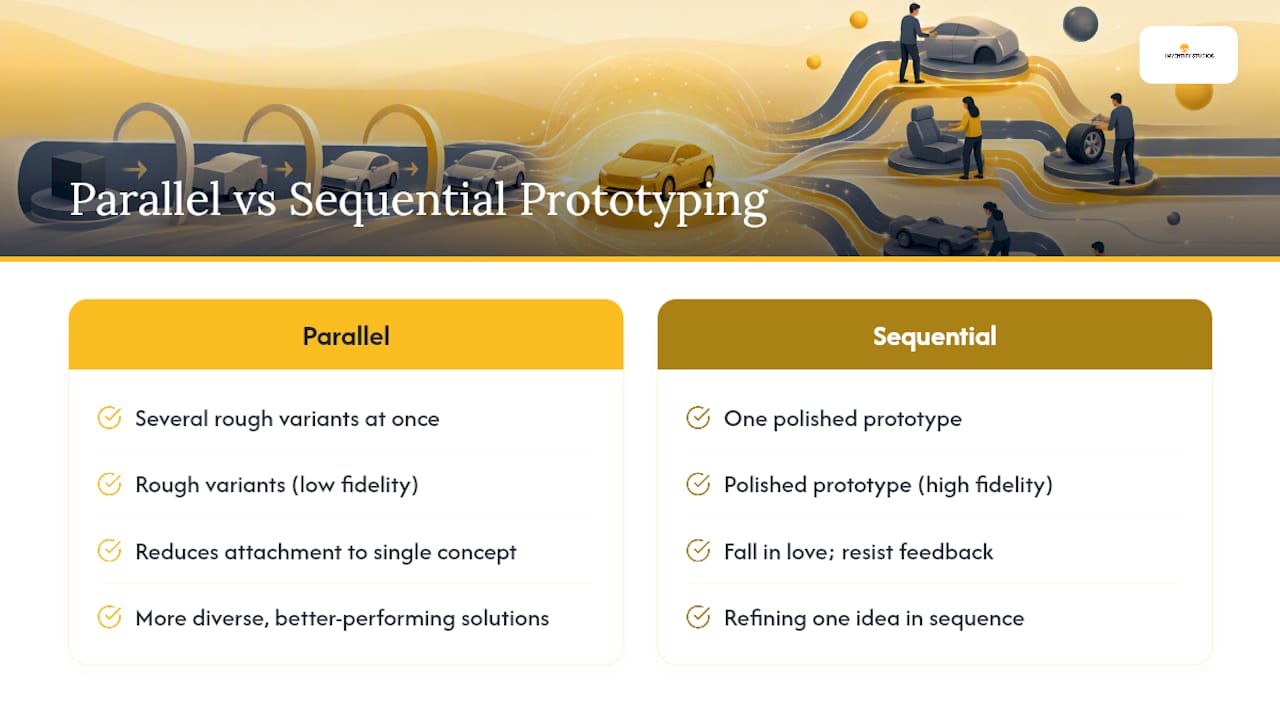
There's also a psychological effect that engineers underestimate. Teams that build one polished prototype tend to fall in love with it, then resist feedback that contradicts months of work. Teams that build several rough variants at once avoid this trap entirely. Stanford's AAA Lab found that parallel prototyping reduces attachment to any single concept and consistently produces more diverse, better-performing solutions than refining one idea in sequence.
SVPG frames this well: prototypes exist for discovery, not display. Their job is to answer a question, not to look finished. That reframing changes how you run tests.
Pro Tip: Write down what failure looks like before you run any test. If you can't describe a specific outcome that would kill the concept, you're not testing, you're just admiring your own work.
How Do You Choose the Right Prototype Fidelity?
The most common prototyping mistake isn't skipping the step. It's building the wrong kind of prototype for the question you're actually asking. A polished CAD render tells you nothing about whether users understand your interface. A clickable wireframe tells you nothing about whether a hinge will survive 10,000 cycles.
Fidelity runs on a spectrum from low (sketches, paper, foam) to high (functional prototypes, injection-molded test parts). Scope runs on a separate axis: horizontal prototypes cover a broad surface shallowly (a full user flow with no working backend), while vertical prototypes go deep on one function (a single mechanism built to spec, ignoring everything around it). HBS's guidance on rapid prototyping makes a useful distinction here: when the risk is technical feasibility, build narrow and deep; when the risk is whether users understand your product, build broad and shallow.
A quick way to pick fidelity:
- Name the riskiest unknown in the project right now.
- Ask whether that risk is about usability, technical feasibility, manufacturability, or performance.
- Match the fidelity to the risk. Usability questions rarely need working electronics. Feasibility questions rarely get answered by a wireframe.
- Build the cheapest version that still gives you a real answer.
In practice, that means paper or clickable wireframes for a workflow question, a function prototype for a mechanism that has to actually work, and a 3D-printed part when you need to check fit and tolerance against a real enclosure.
When you're still exploring divergent concepts rather than refining a chosen direction, build several rough variants in parallel instead of committing early to one. It costs less than it sounds like, and it protects you from the sunk-cost trap that shows up later in the project.
What Does an Effective Prototype Testing Protocol Look Like?
Untested prototypes generate opinions. Tested prototypes generate decisions. The difference is a protocol.
A minimal test plan needs eight elements: objective, hypothesis, target audience, success criteria, method, duration, data to capture, and a decision gate. Skip the decision gate and you'll run a test, get mixed feedback, and revise anyway based on whoever spoke loudest in the debrief.
- Objective. What question does this test answer?
- Hypothesis. What do you expect, and what would prove you wrong?
- Audience. Real users if you're testing usability; domain experts if you're testing feasibility.
- Success criteria. A number or a threshold, not a feeling.
- Method. Moderated session, controlled variable test, or expert review.
- Duration. Cap it. A test with no end date never ends.
- Data to capture. Both qualitative notes and at least one quantitative measure.
- Decision gate. What happens if the hypothesis fails.
Controlled-variable testing matters more than most engineers give it credit for. Change one thing at a time. If you swap the material and the interface layout in the same test, you won't know which change moved the result. Short A/B comparisons, even with small sample sizes, beat open-ended "what do you think" sessions almost every time, because they force a comparison instead of an opinion.
Pro Tip: Turn every piece of user feedback into a discrete engineering ticket with its own acceptance criteria before the next sprint starts. Vague feedback like "make it feel more premium" becomes scope creep the moment it enters a backlog unfiltered.
When Should Manufacturing and Engineering Get Involved?
The costliest revisions in physical product development happen after tooling is cut, not before. That means DFM (design for manufacturability) input should ideally arrive early, such as at the concept CAD review stage, rather than later in the process.
Request manufacturing input at three points: when you finalize a concept sketch into CAD, when you first define tolerances on critical dimensions, and when you're choosing materials. Early prototyping surfaces manufacturing constraints that are invisible on a screen, like a part that looks fine in CAD but can't be molded without a costly slide or undercut.
A working manufacturing checklist covers:
- Critical dimensions and where tolerance stack-ups could cause assembly failure.
- Material substitutions that change strength, cost, or supplier lead time.
- Supplier minimums and constraints that affect your production timeline.
- Fit and function validated through small-batch pilot runs before committing to a full run.
Run-to-failure tests on a handful of units before tooling reveals weak points that a single prototype never would. Autodesk's research on prototyping advantages makes the case plainly: catching a design flaw during prototyping costs a fraction of catching it after production tooling is already committed.
How Do You Document Revisions to Prevent Backtracking?
Undocumented prototyping is how the same mistake gets repeated three projects later. A revision log fixes this with almost no overhead: version number, date, author, the assumption tested, the result, the decision made, and next steps. Five minutes per test, saved permanently.
Revision gates work alongside the log. Before a project moves from prototype to detailed engineering, define what must be true first: has the riskiest assumption been tested? Does the result meet the success criteria set in the test plan? Who signs off on moving forward? Acceptance criteria set in advance stop subjective rework requests, because "I don't like it" doesn't override a documented pass.
Document every prototype's hypothesis and its outcome. A living revision log with clear acceptance criteria builds institutional memory, and that memory is what stops a team from relearning the same lesson on the next project.
That discipline, as Addy Osmani argues, is really the point of the whole exercise: the artifact matters less than the insight it produces, and insight only compounds if someone writes it down.
What Workflows and Tools Speed Up Iteration?
The fastest teams don't have better ideas. They have shorter loops between building something and learning from it. Three workflows cover most physical and digital product cases: CAD to 3D print for form and fit questions, clickable wireframe to usability sprint for flow questions, and embedded-sensor proof-of-concept to lab test for performance questions.
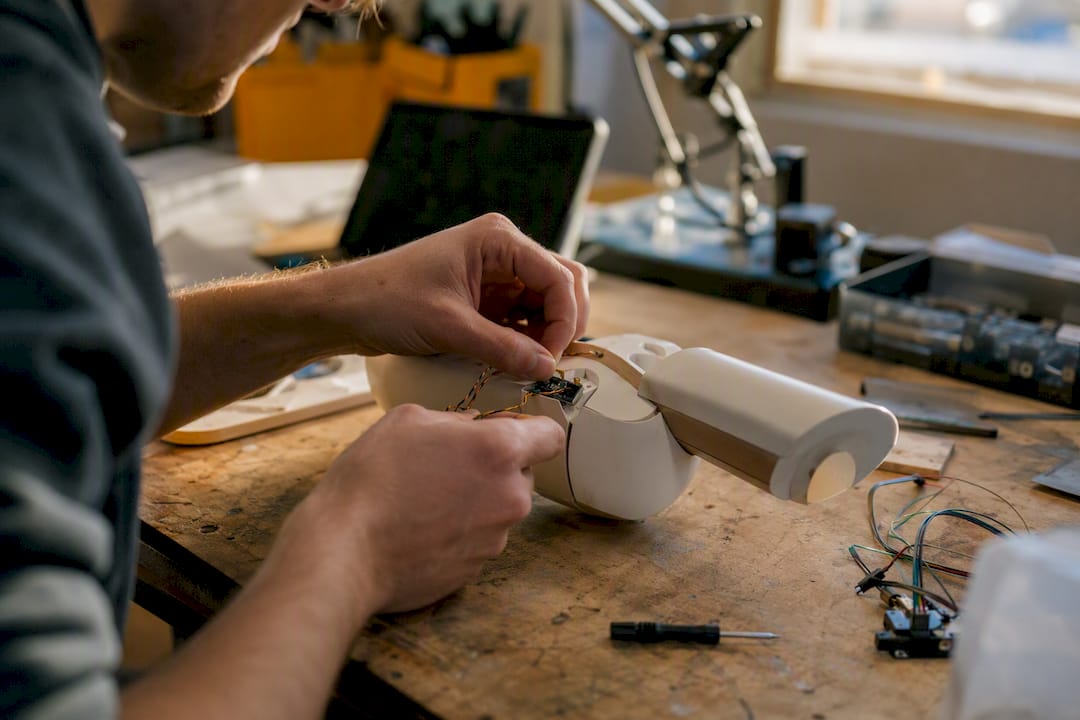
Match the tool to the loop. CAD software paired with desktop 3D printing handles physical iteration in hours instead of weeks. Clickable-wireframe tools handle interface questions without writing production code. Lightweight telemetry, even a $20 sensor logging to a spreadsheet, gives you objective data instead of relying on someone's impression of "it felt slow."
Structure the work in short sprints: timebox the build, run the test, record what you learned, hit the decision gate, repeat. A one-week sprint that ends in a documented decision beats a month-long build that ends in another meeting.
Pro Tip: Bake basic logging into your prototype from day one, even a manual timestamp log. Objective data ends debates that subjective impressions keep alive for weeks.
Can AI-Assisted Prototyping Actually Shorten the Cycle?
Modern AI-assisted tools change where the CAD-to-test loop starts, not what happens after it. An inventor with a rough sketch and a functional description can generate a 3D model in minutes instead of waiting on a CAD contractor for a first pass. That speed matters most in the earliest phase, when you're still deciding which of several concepts deserves real engineering time.
AI-generated prototypes work best as a discovery accelerant. They compress the distance between an idea and something you can look at, which is exactly the step that used to eat the most calendar time.
Limits matter just as much as capability here. Tolerance stack-ups, regulatory testing, and performance-critical mechanisms still require qualified human engineering review. No generation tool replaces a structural analysis or a DFM consultation.
Where AI-assisted generation genuinely helps:
- Turning a concept into a viewable 3D model before committing to CAD software time.
- Producing multiple rough variants quickly, supporting the parallel-prototyping approach that outperforms serial refinement.
- Giving early feasibility signals before an inventor invests in a full engineering pass.
A Habit Worth Building Into Every Project
Every project I've studied that avoided a death spiral of revisions had one thing in common: someone forced a test before the team felt ready. I've come to believe the three-day rapid-prototype sprint is underused, not because it's complicated, but because it feels premature. Pick the riskiest assumption in your current project, build the cheapest possible test for it, and give yourself three days.
That single habit correlates with fewer late-stage revisions and faster go/no-go decisions, because it forces the hardest question to the front of the schedule instead of the back.
A Faster Path From Sketch to Testable Prototype
Everything in this article points to the same conclusion: the sooner you have something real to test, the fewer expensive revisions you'll face later. Inventifystudios was built around that principle. Instead of waiting weeks for a CAD contractor or paying consulting fees to explore a rough idea, you generate an AI-powered 3D prototype in minutes, directly from your own concept.
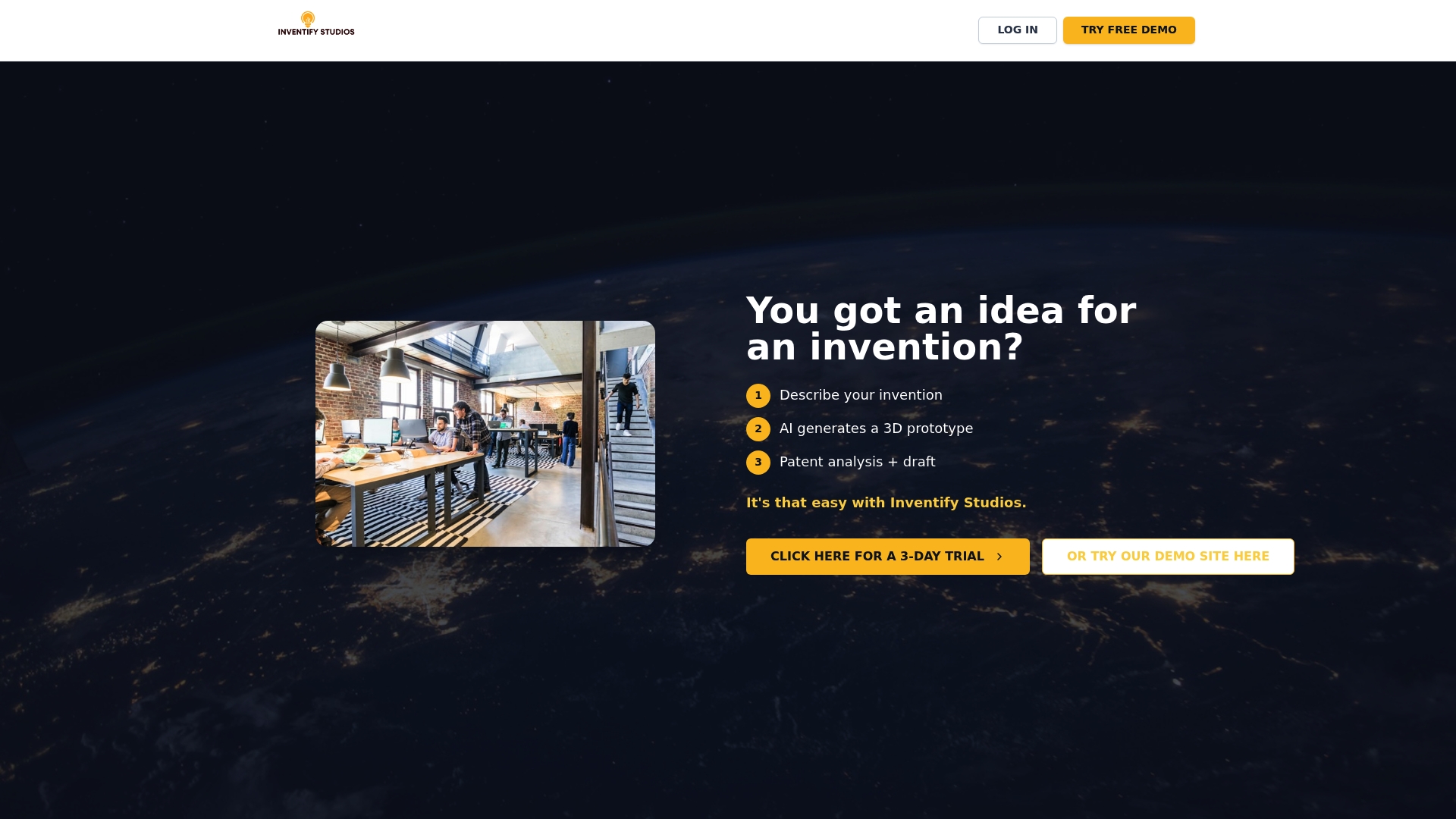
The platform pairs that prototype generation with patentability analysis and provisional patent drafting guidance, so you get more than a model. You get a clearer picture of whether the idea is worth pursuing before you spend money on tooling or a patent attorney. This fits inventors and small teams who want to move from sketch to testable concept without the overhead of traditional consulting.
Human engineering review is still necessary for tolerance work, safety testing, and anything performance-critical. Inventifystudios shortens the discovery phase; it doesn't replace the engineering that follows it. If you're sitting on an idea and want to see it as a real 3D model before committing further time or money, start with your invention details.
Frequently Asked Questions
Why do prototypes reduce revision cycles more than detailed planning documents?
A prototype forces a concrete decision that a spec document lets you avoid. Reviewers react to an actual object or interaction instead of interpreting written requirements differently, which collapses ambiguity before it turns into a revision.
How many prototypes should you build before committing to a design?
There's no fixed number, but parallel prototyping research suggests testing several rough variants at once produces better outcomes than refining a single concept through many rounds.
What's the difference between a prototype and an MVP?
A prototype exists to validate assumptions and reduce risk before you build anything real. An MVP exists to test market demand with an actual working product. Sequencing matters: validate the assumptions with a prototype first, then build the MVP to test the market.
Does low-fidelity prototyping work for physical products, not just software?
Yes. Paper sketches and cardboard mockups can validate a workflow or ergonomic question before you ever touch CAD software. Save 3D printing and functional builds for questions about fit, tolerance, or mechanical performance.
When is it too early to bring in manufacturing input?
It's rarely too early. Requesting DFM feedback at the concept CAD stage, before tolerances or materials are locked, catches manufacturability problems while they still cost little to fix.
Sources
- Why do building, sharing, and testing a work in progress help you get to a good solution? | Design Questions Library | d.school Public Library
- Rapid prototyping (HBS Online blog)
- The purpose of prototypes - Silicon Valley Product Group
- Paper prototyping (Nielsen Norman Group)