

An accessible inventor platform is defined as an AI-powered software tool that guides inventors through ideation, prior art searches, and disclosure drafting within a single, affordable workflow. These platforms replace the fragmented, expensive process of hiring multiple consultants with one structured system any creator can use. Inventifystudios is built on this exact model, combining AI-generated prototypes, patent analysis, and provisional patent drafting into one place. The result is a faster, cheaper path from raw idea to attorney-ready documentation. For aspiring inventors who lack legal training or deep pockets, this type of platform removes the two biggest barriers: cost and complexity.
What is an accessible inventor platform and how does it work?
An accessible inventor platform is a technology tool that walks inventors through the full pre-filing process using conversational AI and integrated research. The industry also refers to these tools as invention disclosure platforms or AI-guided invention workflows. Both terms describe the same core function: replacing scattered, manual steps with one guided system.
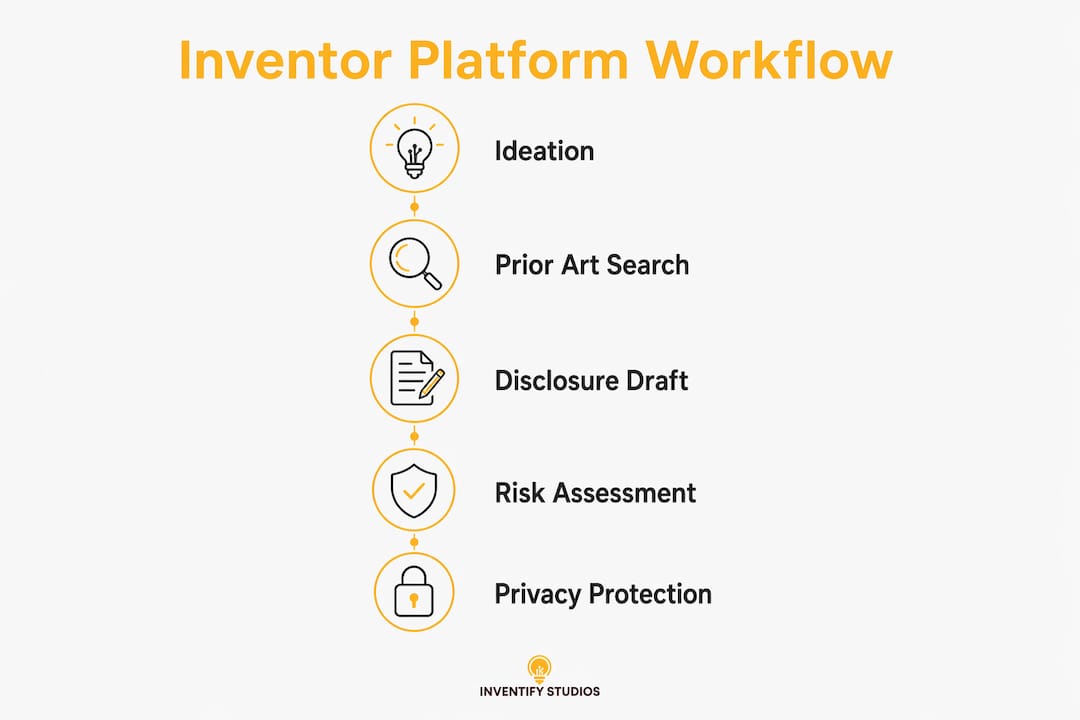
The platform starts with ideation. You describe your idea in plain language, and the AI helps you sharpen the problem-solution statement. This step alone saves hours that inventors typically spend trying to articulate what their invention actually does differently from existing products. From there, the platform runs an automated prior art search against patent databases to surface existing inventions that could block your path.
After the search, the platform structures your inputs into a formal invention disclosure document. This document is not a filed patent. It is a pre-filing record that a qualified patent attorney can review and build from. Guided AI workflows organize your technical notes, sketches, and use cases into a format attorneys recognize and can work with immediately.
The entire cycle, from first description to draft-ready disclosure, typically takes 30–60 minute sessions. That speed matters. Most inventors lose momentum between the idea stage and the documentation stage, and that gap kills more inventions than bad ideas do.

What features do accessible inventor platforms include?
The core features of an accessible inventor platform fall into five categories. Each one addresses a specific bottleneck in the traditional invention process.
- Guided ideation: Conversational AI prompts you to define the problem, the solution, and the novelty of your idea. The AI asks follow-up questions to fill gaps you might not notice.
- Automated prior art search: The platform queries patent databases and surfaces relevant existing patents. This step validates whether your idea has a clear path to patentability before you spend money on legal fees.
- Invention disclosure drafting: Your inputs get structured into a formal disclosure document. The output is attorney-ready, meaning a patent professional can review it without starting from scratch.
- Multimedia input support: You can upload sketches, notes, or images to supplement your written descriptions. Visual inputs strengthen the disclosure and reduce ambiguity.
- Collaboration tools: Some platforms allow co-inventors and attorneys to review and iterate within the same workspace. Live collaboration improves disclosure quality and cuts review cycles significantly.
Pro Tip: Treat every AI conversation on these platforms like a structured lab notebook entry. The more specific and technical your inputs, the stronger your final disclosure will be.
Platforms built for accessibility also prioritize privacy. Leading platforms in 2026 use privacy-first architectures that prevent your invention data from being used to train shared AI models. That policy protects your intellectual property from the moment you type your first description.
How do accessible inventor platforms reduce risk and speed up success?
The primary value of an accessible invention platform is early validation. Traditional consulting forces inventors to spend money before they know whether their idea is viable. These platforms flip that sequence.
"The most successful inventors view accessible inventor platforms as collaborative partners that make documentation and validation 20 times more efficient. These tools free inventors to focus on creativity rather than legal or technical paperwork."
That efficiency gain is not abstract. When a platform runs a prior art search in minutes instead of weeks, you find out early whether your concept is blocked by an existing patent. Early discovery of a conflict saves thousands of dollars in attorney fees and months of wasted development time. The benefits of self-guided platforms compound across every stage of the invention lifecycle.
Accessible inventor platforms also address risk reduction in product development by integrating market feasibility checks alongside patent research. You learn whether your invention has commercial potential at the same time you learn whether it is patentable. That combination of signals gives you a much clearer picture of whether to move forward, pivot, or stop entirely.
Privacy-first design adds another layer of protection. Inventors concerned about IP theft can use these platforms knowing their disclosures stay private. That assurance matters especially for solo inventors and small teams who lack the legal infrastructure of large corporations.
What are common misconceptions about inventor platforms?
The most damaging misconception is that an accessible inventor platform replaces a patent attorney. It does not. These platforms do not replace legal advice but prepare inventors to work with attorneys more effectively. The platform produces a disclosure document. The attorney files the patent. Both roles are necessary.
A second misconception is that casual, vague inputs produce useful outputs. They do not. High-quality, detailed inventor input during AI-guided workflows directly determines the completeness and strategic value of the final disclosure. Treat the platform like a rigorous documentation tool, not a brainstorming chatbot.
Here are the most important usage rules for getting real results from an accessible inventor platform:
- Prepare before you start. Organize your sketches, use cases, and technical notes before opening the platform. Structured inputs produce structured outputs.
- Be specific about the problem. Vague problem statements produce weak disclosures. Name the exact pain point your invention solves and who experiences it.
- Describe the novelty clearly. Explain what makes your solution different from existing products. The AI uses this to sharpen the prior art search.
- Act on the disclosure quickly. Disclosure momentum is the biggest bottleneck in the invention lifecycle. Move from draft disclosure to attorney review within days, not months.
- Review the output critically. Read the generated disclosure as if you are the attorney. Flag anything vague or incomplete before sending it for legal review.
Pro Tip: After your first session, compare the AI-generated disclosure against your original notes. The gaps you find reveal exactly what your invention still needs to clarify.
How do you choose and start using an accessible inventor platform?
Choosing the right platform starts with four evaluation criteria. Apply them in order of importance.
- AI capability: Does the platform use conversational AI to guide ideation, or does it just offer templates? Guided workflows produce far better disclosures than fill-in-the-blank forms.
- Privacy policy: Does the platform explicitly state that your data will not train shared AI models? If the policy is vague, your IP is at risk.
- Output format: Does the platform produce attorney-ready disclosure documents, or just notes? The output must be structured for legal review.
- Cost and access: Does the platform offer a free trial or demo? Test the workflow before committing to a subscription.
Once you select a platform, follow this workflow from idea to prototype:
| Stage | Action |
|---|---|
| Preparation | Gather sketches, notes, and use case descriptions |
| Ideation session | Use conversational AI to define problem and solution |
| Prior art search | Review platform-generated patent search results |
| Disclosure drafting | Generate and review the structured disclosure document |
| Attorney handoff | Send the disclosure to a qualified patent attorney for review |
| Prototype planning | Use platform outputs to guide early prototype development |
The components of an invention disclosure matter at every stage. Understanding what goes into a strong disclosure helps you give the platform the inputs it needs to produce one. Platforms like Inventifystudios take this further by adding AI-generated 3D prototypes and patentability analysis, so you leave each session with more than just a document.
Key Takeaways
Accessible inventor platforms are the fastest, most affordable way for aspiring inventors to move from raw idea to attorney-ready documentation using AI-guided workflows.
| Point | Details |
|---|---|
| Core function | Guides inventors through ideation, prior art search, and disclosure drafting in one workflow. |
| Speed advantage | Full sessions from idea to draft-ready disclosure typically complete in 30–60 minutes. |
| Risk reduction | Early patent and market validation prevents wasted effort on non-viable concepts. |
| Platform limits | These tools prepare inventors for attorneys but do not replace qualified legal counsel. |
| Input quality | Detailed, specific inputs produce stronger disclosures and better AI-guided outcomes. |
Why I think most inventors underestimate these platforms
Most inventors I have observed approach accessible inventor platforms the wrong way. They treat the AI like a search engine, typing in a vague idea and expecting a polished result. That approach produces weak disclosures and weak patents.
The inventors who get real results treat the platform like a co-author. They come prepared. They push back on the AI's questions. They revise their problem statements three or four times until the language is tight. That discipline is what separates a disclosure that an attorney can work with from one that gets sent back for revision.
The democratization argument for these platforms is real, but it only holds if inventors take the process seriously. A first-time inventor with a detailed, well-structured disclosure is in a stronger position than a seasoned inventor with a vague one. The platform levels the playing field, but only for the inventors who use it with rigor.
The future of invention belongs to creators who combine their own domain knowledge with AI-guided structure. The technology is already here. The question is whether you will use it with the discipline it deserves.
— Hua
How Inventifystudios supports your invention from idea to documentation
Inventifystudios puts the full accessible inventor workflow into one platform built for creators who want results without the traditional consulting price tag.
The platform combines AI-guided ideation, automated patentability analysis, and AI-generated 3D prototypes so you can validate and visualize your invention before spending a dollar on legal fees. Every session produces structured, attorney-ready outputs that give patent professionals exactly what they need to move forward. Privacy-first design keeps your IP protected from the first keystroke. Whether you are filing your first provisional patent or developing your tenth product concept, the Invention Detail platform gives you the structure, speed, and confidence to take your idea seriously.
FAQ
What is an accessible inventor platform?
An accessible inventor platform is an AI-powered tool that guides inventors through ideation, prior art searches, and invention disclosure drafting in one affordable workflow. It replaces fragmented consulting steps with a single, structured system any creator can use.
Do inventor platforms replace patent attorneys?
No. Accessible inventor platforms prepare inventors to work with attorneys more effectively by producing structured, attorney-ready disclosures. A qualified patent attorney must still review and file any patent application.
How long does it take to complete a session on an inventor platform?
Most platforms guide inventors from initial idea to a draft-ready disclosure in 30–60 minute sessions. The exact time depends on the complexity of the invention and the quality of the inputs provided.
Are my invention ideas safe on these platforms?
Leading platforms use privacy-first architectures that prevent inventor data from training shared AI models. Always review a platform's privacy policy before entering any invention details.
What is the biggest mistake inventors make on these platforms?
The most common mistake is providing vague, incomplete inputs. Detailed technical descriptions and specific problem statements directly determine the quality of the final disclosure document.