

Self-guided invention platforms are defined as digital tools that combine AI with structured workflows, enabling inventors to independently manage every stage of the innovation process. The benefits of self-guided invention platforms are measurable and significant: AI automation reclaims 15–25% of creator time on routine tasks, while structured documentation workflows cut legal preparation costs by up to 50%. Inventifystudios exemplifies this category, giving aspiring inventors access to AI-generated prototypes, patent analysis, and invention validation without the cost of traditional consulting. The result is a faster, more affordable path from raw idea to protected product concept. This article breaks down the top benefits so you can decide whether a self-guided approach fits your invention goals.
1. Benefits of self-guided invention platforms: reclaiming your time
Time is the most constrained resource for any inventor working without a team. AI-enabled platforms automate routine tasks like data formatting, summarization, and first-draft writing, recovering 15–25% of a creator's working hours. That is not a marginal gain. For a solo inventor working 40 hours a week, it means 6–10 hours freed from administrative work every single week.
The tasks that AI handles well include:
- Drafting initial invention descriptions from structured prompts
- Formatting disclosure documents to meet patent office standards
- Summarizing prior art search results into readable reports
- Generating preliminary claims language for provisional patents
- Organizing invention timelines and development milestones
What matters most is what you do with that recovered time. Redirecting AI-generated time savings into structured autonomy programs yields 19% higher innovation index improvements compared to simply increasing output volume. That means the real win is not just speed. It is using freed time for the creative and technical work that AI cannot replicate.
Pro Tip: Treat AI as your documentation assistant, not your creative director. Use it to handle the paperwork so you can focus on the problem-solving and design decisions that require human judgment.

2. Cost savings through better documentation and legal preparation
Patent attorneys charge by the hour, and poorly organized invention disclosures create expensive back-and-forth revisions. Self-guided platforms address this directly. Structured disclosures reduce documentation time by up to 50% and cut associated legal and administrative costs by a comparable margin. That reduction comes from submitting cleaner, more complete documents the first time.
The documentation advantages include:
- Fewer revision cycles with patent attorneys due to complete initial submissions
- Reduced risk of omissions that delay filing or weaken patent claims
- Faster provisional patent preparation through guided drafting workflows
- Earlier identification of prior art that would otherwise waste attorney time
- Lower overall legal spend by entering attorney consultations better prepared
Early prior art searches within the platform prevent a particularly costly mistake: pursuing an idea that already exists. Discovering a patent conflict at the attorney stage costs far more than finding it yourself at the platform stage. Better documentation also means fewer errors and omissions that cause filing delays, which can affect patent priority dates.
Pro Tip: Before scheduling time with a patent attorney, run a full prior art search and complete your invention disclosure document inside your platform. You will enter that meeting with answers, not questions.
3. Higher engagement and a larger innovation pipeline
Structured autonomy is the practice of giving inventors clear boundaries, defined objectives, and reporting checkpoints while leaving the creative work to them. It is distinct from unstructured free time, which research consistently shows leads to unfocused effort and abandoned projects. Structured autonomy tools produce 31% higher engagement and 24% more innovation pipeline volume compared to traditional unguided methods.
The psychological mechanism behind this is straightforward. When inventors know what they are working toward and have a clear process to follow, they persist longer and produce more. A self-guided platform provides that structure without requiring a manager or consultant to impose it. You set the pace, but the platform keeps you on track.
A larger pipeline also means more options. Inventors who generate and document multiple concepts simultaneously are better positioned to pivot when one idea hits a dead end. Invention pipeline management becomes a real advantage when you have a system that captures and organizes every concept, not just the one you are currently excited about.
4. Stronger ideas through early validation and prior art analysis
The most expensive mistake in invention is investing months of effort into an idea that already exists. Self-guided platforms with natural language processing (NLP) capabilities address this problem at the start, not the end, of the development process. NLP simplifies patent searches by letting inventors describe their idea in plain language rather than requiring mastery of Boolean search logic or patent classification codes.
NLP-powered prior art analysis delivers three specific advantages:
- It expands your search vocabulary to surface analogous technologies you would not have thought to search for
- It identifies crowded patent spaces early, before you invest in prototyping or legal fees
- It flags related solutions in adjacent industries that could inform or differentiate your design
Early detection of saturated ideas is not a failure signal. Stopping and pivoting when you find prior art saturation is considered good innovation management by industry experts. The inventor who pivots early saves months of work and thousands of dollars. The inventor who ignores early signals pays for that decision later.
Pro Tip: Run your prior art search before you build anything. If the AI surfaces five patents that closely match your concept, treat that as useful data, not discouragement. Use it to identify the gap your idea can fill.
5. Faster prototyping without the traditional cost barriers
Traditional prototyping requires either expensive physical fabrication or hiring a design firm. Self-guided platforms with AI prototype generation change that equation entirely. Inventifystudios, for example, generates 3D prototype visuals in minutes from a structured invention description. That speed matters because visual prototypes accelerate feedback loops, investor conversations, and your own design thinking.
The role of AI in invention development now includes generating concept visuals that communicate an idea clearly without requiring CAD software skills or a design budget. For first-time inventors, this removes one of the most intimidating barriers to moving forward. For experienced inventors, it compresses the iteration cycle from weeks to hours.
Rapid prototyping also changes how you validate market fit. Showing a realistic visual to potential customers or partners is far more effective than describing an idea verbally. You get real reactions to a real representation, which produces better feedback and faster decisions.
6. Accessible patentability assessment without legal expertise
Understanding whether an idea is patentable used to require a preliminary opinion from a patent attorney, which typically costs hundreds of dollars before any filing begins. Self-guided platforms now provide structured patentability assessments that give inventors a working understanding of their idea's novelty and non-obviousness before spending money on legal counsel.
Inventifystudios includes patent analysis as a core platform feature, assessing an invention's patentability and providing tailored drafting insights for provisional patents. This does not replace an attorney's formal opinion, but it gives you the information needed to make an informed decision about whether to pursue filing at all. That decision point, made early and with good data, is where self-guided platforms deliver some of their clearest financial value.
The invention disclosure document produced through a structured platform workflow also serves a dual purpose. It documents your invention for internal development purposes and prepares the core content needed for a provisional patent application. Two outputs from one structured process.
7. Self-directed innovation benefits: building momentum without burnout
Inventors who work without structure often experience a pattern of intense early enthusiasm followed by stalled progress. Self-guided platforms interrupt that pattern by breaking the invention process into defined stages with clear deliverables at each step. The invention development stages framework gives you a map, which makes the work feel manageable rather than open-ended.
Structured boundaries improve innovation performance by focusing creator effort and preventing the drift that comes from too much unstructured freedom. This is the core insight behind structured autonomy: freedom within a framework produces better outcomes than freedom without one. A platform that guides you through validation, documentation, prototyping, and patent preparation keeps momentum alive between creative breakthroughs.
Burnout in solo invention work usually comes from feeling stuck, not from working too hard. A clear next step, even a small one, is enough to maintain forward motion. Self-guided platforms are built around that principle.
8. Democratized access to invention tools previously reserved for funded teams
Historically, the full invention workflow, including prior art searches, professional documentation, prototype development, and patent preparation, required either a funded team or expensive outside consultants. Self-guided platforms make all of those capabilities available to individual inventors at a fraction of the traditional cost. This is not a minor convenience. It is a structural shift in who gets to participate in the invention process.
AI automation across industries has consistently lowered the cost of entry for knowledge-intensive work. Invention is no exception. A first-time inventor using Inventifystudios today has access to tools that would have required a professional services budget just a few years ago. That access changes the math on whether pursuing an invention idea is worth attempting at all.
The practical implication is that more ideas get tested. More ideas get documented. More inventors reach the stage where they can make an informed decision about filing a patent or taking a concept to market. The platform does not guarantee success, but it removes the cost barriers that previously prevented the attempt.
Key takeaways
Self-guided invention platforms deliver the greatest value when inventors use AI for documentation and validation while reserving creative and strategic decisions for themselves.
| Point | Details |
|---|---|
| Time savings are real and measurable | AI automation reclaims 15–25% of creator time, best reinvested in design and problem-solving. |
| Documentation quality reduces legal costs | Structured disclosures cut documentation time and legal expenses by up to 50%. |
| Structured autonomy drives output | Platforms using structured autonomy produce 31% higher engagement and 24% more pipeline volume. |
| Early validation prevents wasted investment | NLP-powered prior art searches identify saturated ideas before prototyping or legal spending begins. |
| Access is now broadly available | Self-guided platforms give solo inventors capabilities that previously required funded teams or consultants. |
What I have learned from watching inventors use these platforms
The inventors who get the most out of self-guided platforms share one habit: they treat the platform as a thinking partner, not a shortcut. They use the AI to question their assumptions, document their reasoning, and surface blind spots in their prior art searches. They do not expect it to invent for them.
The most effective use of AI in invention workflows is using it to question and document human insights, not to generate inventions autonomously. That distinction matters more than any feature list. Inventors who understand it move faster and waste less. Inventors who treat AI output as finished work tend to produce generic concepts that do not hold up under patent scrutiny.
The other pattern I have observed is that structured autonomy works best when inventors commit to the platform's workflow rather than skipping steps. The temptation to jump straight to prototyping before completing a prior art search is real. Resisting it is where the financial and creative payoff lives.
Realistic expectations also matter. A self-guided platform will not replace the judgment of an experienced patent attorney or the market knowledge of a seasoned entrepreneur. What it will do is get you to a much stronger starting position before you engage either of those resources. Measure success by the quality of your documentation, the clarity of your patentability assessment, and the number of ideas you have moved through the pipeline. Those are the metrics that predict long-term outcomes.
— Hua
Inventifystudios: a self-guided platform built for serious inventors
Inventifystudios gives aspiring inventors a complete set of AI-powered tools to move from raw idea to protected concept without the cost of traditional consulting.
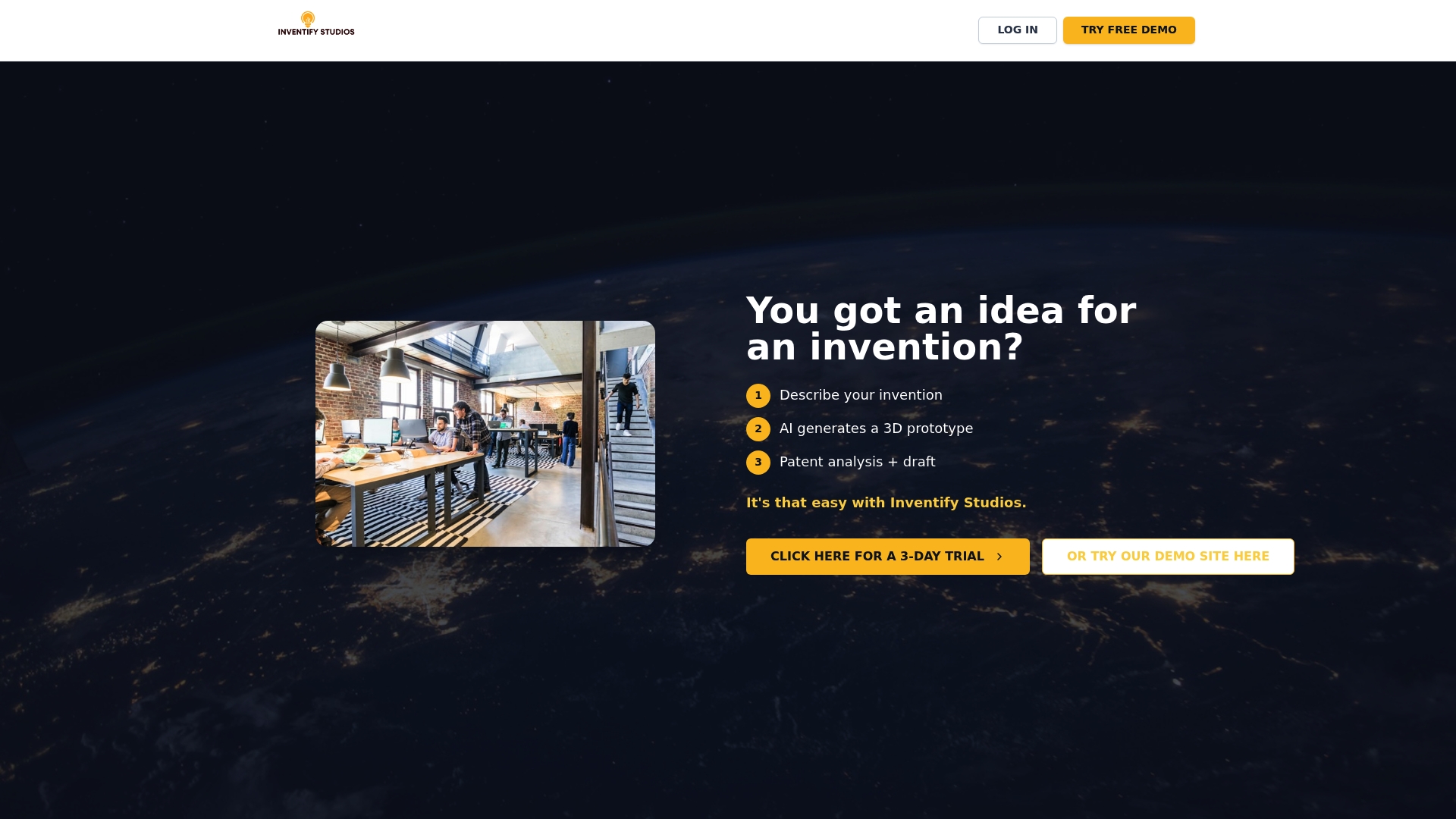
The platform includes AI-generated 3D prototypes, structured patentability assessments, and guided provisional patent drafting. Each feature maps directly to the benefits covered in this article: faster documentation, lower legal costs, and earlier idea validation. Inventors can explore the full invention detail workflow to see how each stage connects. Whether you are developing your first concept or managing multiple ideas simultaneously, Inventifystudios provides the structure and tools to move forward with confidence. The DIY invention development approach means you stay in control of your idea at every step.
FAQ
What are the main benefits of self-guided invention platforms?
Self-guided invention platforms reclaim 15–25% of inventor time through AI automation, reduce documentation and legal costs by up to 50%, and improve idea quality through early prior art analysis. They give solo inventors access to tools that previously required funded teams or expensive consultants.
How do self-guided platforms reduce patent costs?
Structured documentation workflows produce cleaner, more complete invention disclosures, which reduces revision cycles with patent attorneys and lowers billable hours. Early prior art searches also prevent costly pursuit of ideas that already exist in the patent record.
What is structured autonomy in the context of invention platforms?
Structured autonomy is a framework that gives inventors clear objectives and defined process stages while leaving creative decisions to them. Platforms using this approach report 31% higher engagement and 24% more innovation pipeline volume compared to unguided methods.
Can a self-guided platform replace a patent attorney?
No. Self-guided platforms prepare inventors to work more effectively with patent attorneys by producing better documentation and earlier prior art analysis. The formal patent opinion and legal filing strategy still require qualified legal counsel.
How does NLP improve prior art searches for inventors?
Natural language processing lets inventors describe their idea in plain language rather than using complex Boolean search queries or patent classification codes. This expands the search vocabulary and surfaces analogous technologies that a manual search would likely miss.