

Invention licensing is the contractual permission an inventor grants to a company or individual to make, use, or sell their invention, typically in exchange for royalty payments. Known formally as a patent license agreement, this arrangement lets you profit from your idea without building a factory, hiring a sales team, or funding distribution. The licensor (you, the inventor) retains ownership. The licensee (a company or individual) gets defined rights to commercialize the invention. Understanding invention licensing is the first step toward turning a protected idea into a steady income stream.
What is invention licensing explained for new inventors?
Invention licensing is a legal permission structure built on intellectual property rights. When you license an invention, you are not selling it. You are renting specific rights to another party for a defined period, in a defined market, under defined conditions. This distinction matters enormously. Licensing preserves ownership and ongoing revenue streams, while an assignment permanently transfers all rights in a one-time transaction.
The four core rights you can grant in a license are the rights to make, use, sell, and import the invention. You can grant all four or limit the license to just one or two. A manufacturer might receive only the right to make and sell, while a distributor in a separate territory receives only the right to import and sell. This granularity is what makes licensing so flexible as a monetization strategy.

Compensation takes several forms. Royalty rates typically range from 3% to 10% of wholesale sales, depending on exclusivity, industry, and negotiation leverage. Consumer goods commonly land near 5% of the wholesale price. Beyond royalties, agreements can include upfront license fees, milestone payments, and minimum annual guarantees that protect you if the licensee underperforms.
What rights and terms are involved in licensing agreements?
A licensing agreement is only as strong as its written terms. Disputes most often arise from unclear scope clauses about exactly what rights the licensee holds. Every agreement must define field of use (which industry or application), territory (which countries or regions), and term (how long the license lasts). Leaving any of these undefined creates expensive legal exposure.
Exclusive, non-exclusive, and sole licenses compared
The license type you choose shapes both your control and your earning potential. Exclusive licenses grant sole rights that prevent everyone, including you, from using the invention within the licensed scope. They command higher royalties because the licensee takes on market risk alone. Non-exclusive licenses allow multiple licensees and preserve your right to use the invention yourself. They offer flexibility but lower per-licensee payments. A sole license sits between the two: only you and the licensee can use the invention, but no other third parties.
| License type | Who can use it | Typical royalty range | Best for |
|---|---|---|---|
| Exclusive | Licensee only | 7%–10% of wholesale | Large companies wanting market control |
| Sole | Licensor and licensee | 5%–8% of wholesale | Partnerships with shared commercialization |
| Non-exclusive | Multiple licensees | 3%–5% of wholesale | Wide distribution, software, and tools |
Pro Tip: Define the field of use as narrowly as possible in your first deal. A narrow field of use lets you license the same invention to a different company in a different industry, multiplying your royalty streams without violating any agreement.
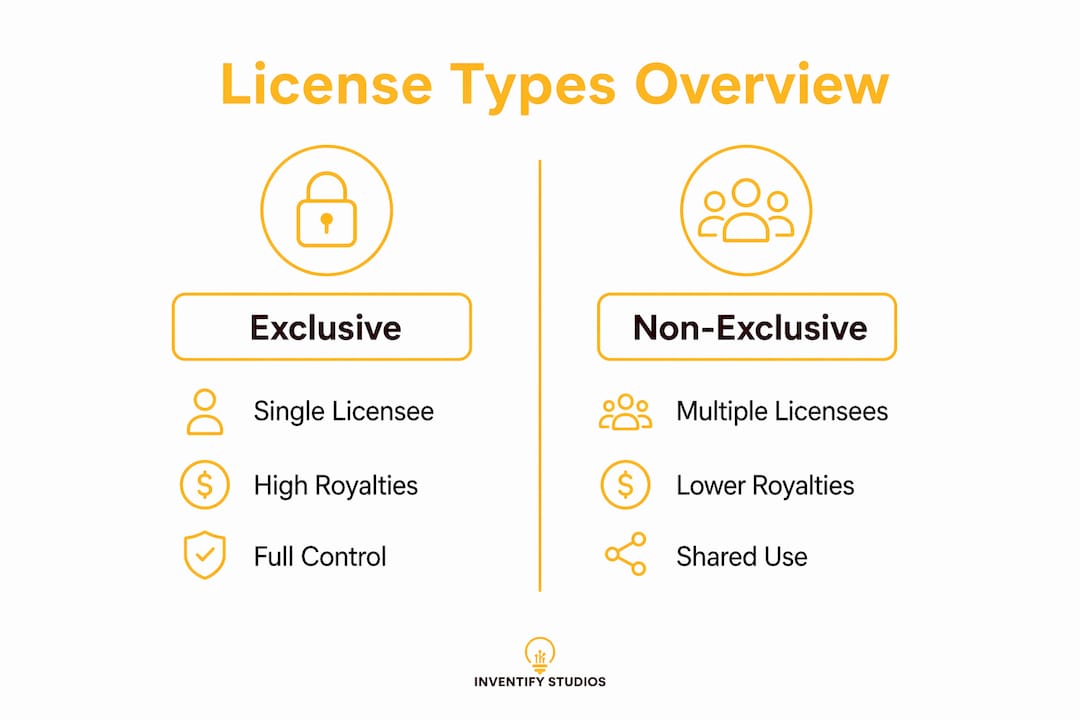
Choosing between exclusive and non-exclusive licenses is one of the most consequential decisions in the licensing process. An exclusive deal with a well-resourced company can generate far more revenue than ten non-exclusive deals with smaller players. However, if the exclusive licensee fails to perform, you are locked out of the market. Performance clauses, such as minimum annual royalty guarantees, are the standard protection against this risk.
How does the invention licensing process typically work?
The invention licensing process follows a clear sequence from IP preparation to signed agreement. Skipping steps, especially early ones, is the fastest way to lose leverage or compromise your patent rights.
- Secure your IP. File a patent application or establish trade secret protections before any external disclosure. Licensing deals can proceed on the basis of a patent application, not just a granted patent, so you do not need to wait years before approaching companies.
- Build your IP package. Prepare a one-page invention summary, patent filing documentation, prototype images or a 3D model, and a brief market analysis. This package is what you present to potential licensees.
- Sign NDAs before disclosing details. Early disclosure without a signed NDA can compromise your patent rights and weaken your negotiating position. Get a non-disclosure agreement in place before sharing any technical specifics.
- Identify target licensees. Research companies already operating in your invention's market. A company with existing distribution, manufacturing, and brand equity is a far stronger licensee than a startup. Look at product catalogs, trade show exhibitors, and industry directories to build your target list.
- Present a commercial opportunity, not just an idea. Businesses license opportunities that make strategic sense, not just interesting inventions. Your pitch must explain what problem the invention solves, why it is superior to existing solutions, and what the market opportunity looks like in dollar terms.
- Negotiate key terms. Focus on royalty rate, exclusivity scope, territory, term length, and minimum performance guarantees. Get legal counsel to review the draft agreement before signing.
- Execute the agreement. Once both parties sign, establish a reporting schedule for royalty statements and set calendar reminders for renewal or termination dates.
Pro Tip: Never share a working prototype or detailed technical drawings with a potential licensee before an NDA is signed and dated. A verbal agreement or a handshake provides zero legal protection for your IP.
You can explore the invention development stages in more detail to understand where licensing fits within the broader product lifecycle.
Licensing vs. manufacturing: which path fits your invention?
Licensing lets you leverage a company's existing manufacturing, distribution, and brand infrastructure without building any of it yourself. That is its primary strategic advantage. You trade a share of the revenue for access to capabilities that would take years and millions of dollars to replicate independently.
| Factor | Licensing | Self-manufacturing |
|---|---|---|
| Financial risk | Low. No capital investment required. | High. Requires funding for production and operations. |
| Control | Limited. Licensee makes most decisions. | Full. You control every aspect of the product. |
| Profit margin | Lower per unit (royalty percentage). | Higher per unit if volume is achieved. |
| Time to market | Faster if licensee is established. | Slower due to setup, tooling, and distribution. |
| Scalability | Scales with licensee's capacity. | Scales with your own capital and team. |
Licensing makes the most sense when the licensee already has the market relationships your invention needs. A new kitchen gadget, for example, is far better served by a company with existing retail shelf space at Target or Walmart than by an inventor trying to break into retail from scratch.
Self-manufacturing makes sense when your invention has very high margins, requires specialized knowledge only you possess, or when no suitable licensee exists in the market. Some inventors pursue a hybrid approach: they manufacture and sell directly in one territory while licensing rights in others, capturing both income streams simultaneously.
The risks of licensing are real. If your licensee loses interest, pivots their strategy, or simply underperforms, your royalty income drops to zero. Performance clauses and termination rights are your primary defenses. Conduct a thorough invention risk assessment before committing to any single commercialization path.
Common pitfalls and best practices for licensing success
Most licensing failures trace back to a small set of avoidable mistakes. Knowing them in advance puts you well ahead of the average first-time inventor.
- Confusing licensing with assignment. A license is a temporary permission. An assignment is a permanent sale of ownership. Never sign an assignment when you intend to license, and read every contract clause that mentions "transfer of rights."
- Disclosing before protecting. Sharing invention details without a patent application on file or an NDA in place can destroy your ability to patent later. The U.S. patent system allows a one-year grace period after public disclosure, but most international systems do not.
- Accepting vague royalty terms. Royalty agreements must specify the royalty base (net sales, wholesale price, or gross revenue), the rate, and the reporting frequency. Vague language always favors the licensee.
- Skipping performance clauses. Without a minimum annual royalty guarantee, an exclusive licensee can sit on your invention and block you from licensing it to anyone else. Always include a minimum performance threshold with a termination right if it is not met.
- Underestimating the pitch. Packaging your invention's IP with clear business value, market data, and a professional presentation dramatically increases your chances of closing a deal. A rough sketch and a verbal description rarely move a corporate licensing team to action.
Pro Tip: Before approaching any company, research their existing product line and frame your invention as a natural extension of what they already sell. Licensees are far more receptive when they can see exactly where your invention fits in their catalog.
Protecting your invention ownership rights before entering any licensing conversation is non-negotiable. It is the foundation every other negotiation tactic depends on.
Key takeaways
Invention licensing is the most capital-efficient path to monetizing an idea, provided you protect your IP first, define agreement terms precisely, and choose licensees with the infrastructure to perform.
| Point | Details |
|---|---|
| License vs. assignment | A license retains your ownership; an assignment permanently transfers it. Never confuse the two. |
| Royalty ranges | Rates typically fall between 3% and 10% of wholesale, with consumer goods near 5%. |
| Agreement scope | Define field of use, territory, and term in every contract to prevent costly disputes. |
| NDA before disclosure | Never share technical details with a potential licensee before a signed NDA is in place. |
| Pitch commercial value | Present market size, problem solved, and competitive advantage, not just the invention itself. |
Why most inventors get licensing backwards
I have seen hundreds of inventors approach licensing with the same flawed assumption: that a great invention sells itself. It does not. Companies do not license inventions. They license revenue opportunities. The inventors who close deals are the ones who walk in with a market analysis, a clear problem statement, and a number that shows the licensee what they stand to gain.
The second misconception I encounter constantly is that you need a granted patent before you can approach anyone. You do not. A solid patent application, a well-documented IP package, and a credible prototype are enough to open serious conversations. Waiting for full patent approval can cost you two to three years of market timing.
Patience is genuinely required in this process. A typical licensing deal from first contact to signed agreement takes six to eighteen months. That timeline frustrates inventors who expect fast results. But the inventors who stay organized, follow up consistently, and keep refining their pitch are the ones who eventually close. Licensing is not a lottery. It is a sales process with a long cycle.
My honest advice: treat your first licensing attempt as a learning exercise, not a make-or-break moment. The feedback you get from companies that pass on your invention is often more valuable than the deal itself. Use it to sharpen your pitch, tighten your IP package, and identify a better-fit licensee for the next round.
— Hua
Ready to prepare your invention for licensing?
Inventifystudios is built for exactly this stage of the inventor's journey. Before you can license an invention, you need a clear, documented concept that a potential licensee can evaluate quickly and confidently.
With Inventifystudios, you can generate AI-powered 3D prototypes in minutes, run a patentability analysis on your concept, and produce patent-ready documentation that strengthens your IP package. These are the materials that make licensing conversations move faster. Visit the invention detail service to see how Inventifystudios helps you document and present your invention with the clarity and professionalism that corporate licensing teams expect. You can also start building your concept directly on the platform today.
FAQ
What is invention licensing in simple terms?
Invention licensing is a legal agreement where an inventor grants a company or individual the right to make, use, or sell their invention in exchange for compensation, typically royalties. The inventor retains ownership throughout the agreement.
How much do inventors earn from licensing royalties?
Royalty rates for licensed inventions typically range from 3% to 10% of wholesale sales, with consumer goods commonly earning around 5%. The exact rate depends on exclusivity, industry norms, and negotiation.
Do I need a granted patent to license my invention?
No. Licensing deals can proceed based on a patent application or trade secret protections, not just a granted patent. A strong IP package with a filed application is sufficient to begin approaching potential licensees.
What is the difference between exclusive and non-exclusive licenses?
An exclusive license grants sole rights to one licensee, preventing all others including the inventor from using the invention in that scope. A non-exclusive license allows multiple licensees and preserves the inventor's own right to use the invention.
What is the biggest mistake inventors make when licensing?
The most common mistake is disclosing invention details to potential licensees without a signed NDA in place. This can compromise patent rights and significantly weaken your negotiating position before any deal is even discussed.