

Invention validation is the systematic process of testing whether your idea has real market demand and is legally viable before you spend serious money on it. In the industry, this process is also called idea feasibility assessment or concept validation, and understanding both terms helps you research it more effectively. The invention validation steps beginners most often skip are the ones that cost the most later: IP checks, behavioral customer tests, and staged prototyping. This guide breaks down each step in plain language, with real tools and decision frameworks so you can move from idea to informed action without guesswork.
1. Invention validation steps beginners should start with
The first step is not building anything. It is defining the problem your invention solves with precision. Write one sentence that names the problem, the person who has it, and why existing solutions fall short. If you cannot write that sentence clearly, your idea is not ready to validate yet.
This problem definition becomes your filter for every decision that follows. Inventors who skip it often build solutions to problems that are too vague, too small, or already solved. A sharp problem statement also makes your customer conversations far more productive because you are asking specific people about a specific pain, not fishing for general reactions.

Once your problem statement is solid, document your proposed solution in plain terms. No technical jargon. No patent language. Just: what does it do, who uses it, and what does it replace or improve? This two-part foundation, problem plus solution, is the starting point for every validation method in this guide.
2. How to quickly test market demand for your invention idea
The 5-minute market test is the fastest zero-cost demand check available to beginners. Search Amazon for your product category, Google for the problem your invention solves, and scan Instagram, TikTok, and Twitter/X using relevant hashtags. The goal is to find evidence that people are already spending money on partial solutions or actively complaining about the problem. This test takes 30 to 60 minutes and costs nothing.
Use Google Trends to check whether search interest in your category is growing, flat, or declining. A rising trend line signals an expanding market. A flat or declining line does not disqualify your idea, but it raises the bar for differentiation. Seasonality spikes matter too. An invention that only sells in December faces a very different business model than one with year-round demand.
Apply a simple "Yes / Maybe / No" method to interpret what you find:
- Yes: Multiple competitors exist, customers are paying, and complaints about current solutions are visible online.
- Maybe: Some interest exists but spending behavior is unclear or the market is very small.
- No: No competitors, no complaints, no search volume. Either the problem does not exist at scale or the market is too early.
A "Yes" result is actually good news, not a reason to abandon your idea. Competition confirms demand. The absence of competition often means the absence of a market.
Pro Tip: Search Reddit threads and Amazon one-star reviews in your product category. Customers describe exactly what they wish existed. That language is free market research and often reveals the specific gap your invention can fill.
3. Assessing intellectual property risk and competitive landscape
Patent risk is a separate validation dimension from market demand. An invention can have strong customer interest and still be blocked from manufacturing or sale because it infringes an existing patent. Beginners consistently underestimate this risk because they conflate "no one sells this yet" with "no one owns this yet." Those are very different things.
A Freedom to Operate (FTO) analysis is the formal term for checking whether your invention can be made and sold without infringing active patents. You do not need a patent attorney to run a preliminary check. The USPTO's patent database and Google Patents both allow free keyword and classification searches. Search your core mechanism, not just your product name.
Here is a simplified IP and competitive landscape checklist for beginners:
- Search USPTO.gov and Google Patents for patents covering your core function.
- Search the USPTO Trademark Electronic Search System (TESS) for brand names you plan to use.
- Identify the top three to five direct competitors and note their patent filing dates.
- Check whether any competitor patents are still active (patents expire after 20 years from filing).
- Note white space: functions or user segments that existing patents do not cover.
| Check | What it tells you |
|---|---|
| USPTO patent search | Whether your core mechanism is already protected |
| Google Patents | Broader landscape including international filings |
| TESS trademark search | Whether your brand name is available |
| Competitor patent dates | Whether key IP is expiring and becoming available |
| White space mapping | Where you can legally operate and differentiate |
Pro Tip: Tools like InventaIQ offer automated patent and trademark risk checks that surface conflicts in minutes. For a first-pass assessment, this is faster and more structured than a manual USPTO search, especially if you are not familiar with patent classification codes.
Early-stage patent checks also reveal whether you have a patentable angle worth protecting. If your invention is genuinely novel in a specific mechanism, filing a provisional patent application early locks in your priority date at a fraction of the cost of a full utility patent.
4. Methods to test real customer interest and willingness to pay
Verbal interest and financial commitment are not the same signal. Someone saying "I would totally buy that" costs them nothing. Someone entering a credit card number or paying a deposit is behavioral validation, and it is the only signal that reliably predicts real demand.
The "five-conversation rule" is a structured approach to direct customer feedback. Talk to five people who match your target customer profile, not friends or family. Ask them to describe the last time they experienced the problem your invention solves. Listen for frequency, frustration level, and what they currently use as a workaround. Do not pitch your solution yet. You are testing whether the problem is real and painful enough to motivate spending.
After those conversations, move to behavioral tests:
- Build a simple landing page describing your invention with a "Pre-Order" or "Join Waitlist" button.
- Drive traffic to it using a small paid ad on Meta or Google (even $50 to $100 is enough for a signal).
- Measure click-through rate on the buy button, not just page visits.
- If you use Stripe, you can set up a pre-order flow that captures payment intent without charging until you are ready to fulfill.
A conversion rate above 2% on a cold audience is a meaningful positive signal. Below 0.5% suggests either the offer is unclear or the demand is weaker than expected.
Pro Tip: Never use friends or family as your primary validation audience. They want to support you, which creates false positives. Recruit strangers through Reddit communities, Facebook groups, or Craigslist posts in your target demographic. Honest strangers are worth ten encouraging relatives.
5. Staged validation framework to reduce risk and cost
Skipping validation stages can cost between $50,000 and $500,000 per gate if a product fails at scale. The staged framework exists to catch fatal flaws early, when fixes are cheap, rather than late, when they are catastrophic.
The stages in order are:
- Stage 1: Problem definition. Confirm the problem is real, frequent, and painful for a specific group.
- Stage 2: Market signal check. Run the 5-minute market test and Google Trends analysis.
- Stage 3: IP and feasibility check. Conduct a preliminary patent search and assess whether the invention can be manufactured at a viable cost.
- Stage 4: Customer commitment test. Run the five-conversation rule and a behavioral landing page test.
- Stage 5: Prototype testing. Build a minimum viable prototype (MVP) to test ergonomics, failure modes, and user experience before committing to tooling or mass production.
Each stage has a defined "kill criterion," a pre-set condition that tells you to stop before spending more. For example: "If fewer than 2 of 5 target customers confirm they would pay, we do not proceed to prototyping." Pre-defined kill criteria prevent the most common beginner mistake: continuing to invest in an idea because you are emotionally attached to it rather than because the data supports it.
CAD modeling and materials review at Stage 3 can reveal manufacturing cost problems before you spend on physical prototypes. A design that costs $180 per unit to manufacture cannot be sold profitably at a $40 retail price point, and that math is better learned in a CAD file than in a factory run.
Key takeaways
Invention validation works because it forces you to test assumptions with real data before committing resources to manufacturing, patenting, or marketing.
| Point | Details |
|---|---|
| Start with problem definition | Write one sentence naming the problem, the person, and why current solutions fail. |
| Test market demand first | Use the 5-minute market test on Amazon, Google, and social media before spending anything. |
| Separate IP risk from demand | A patent conflict can block sales even when customer demand is strong. |
| Use behavioral signals | Pre-orders and deposits are reliable indicators. Verbal interest alone is not. |
| Apply kill criteria at each stage | Pre-set stop conditions prevent emotional bias from overriding weak data. |
What I've learned about validation mistakes beginners make
Most beginners do not fail because their ideas are bad. They fail because they mix up three distinct questions that must be answered in sequence: Does the problem exist? Will someone pay to solve it? Will they choose my solution over alternatives? Answering all three at once produces muddy data that feels encouraging but proves nothing.
The emotional attachment trap is real and I have seen it derail otherwise promising inventors. When you have spent weeks on an idea, every piece of ambiguous feedback gets interpreted as positive. That is why a quantitative Go/No-Go framework matters so much. Scoring zones like Go (80 to 100%), Pivot (60 to 79%), and No-Go (below 60%) remove the subjectivity from a decision that feels personal.
My strongest advice: treat validation as an attempt to disprove your idea, not confirm it. The goal of early validation is to find the fatal flaw cheaply, before prototyping costs mount. If you cannot find a fatal flaw after rigorous testing, that is when you invest with confidence. Inventors who approach validation as a stress test rather than a cheerleading exercise make far better decisions with far less wasted money.
— Hua
How Inventifystudios helps you validate and protect your idea
Inventifystudios is built specifically for inventors who want to move fast without the cost of traditional consulting. The platform runs patent and trademark risk assessments automatically, delivers market viability snapshots, and maps your competitive landscape into reports you can actually read and act on.
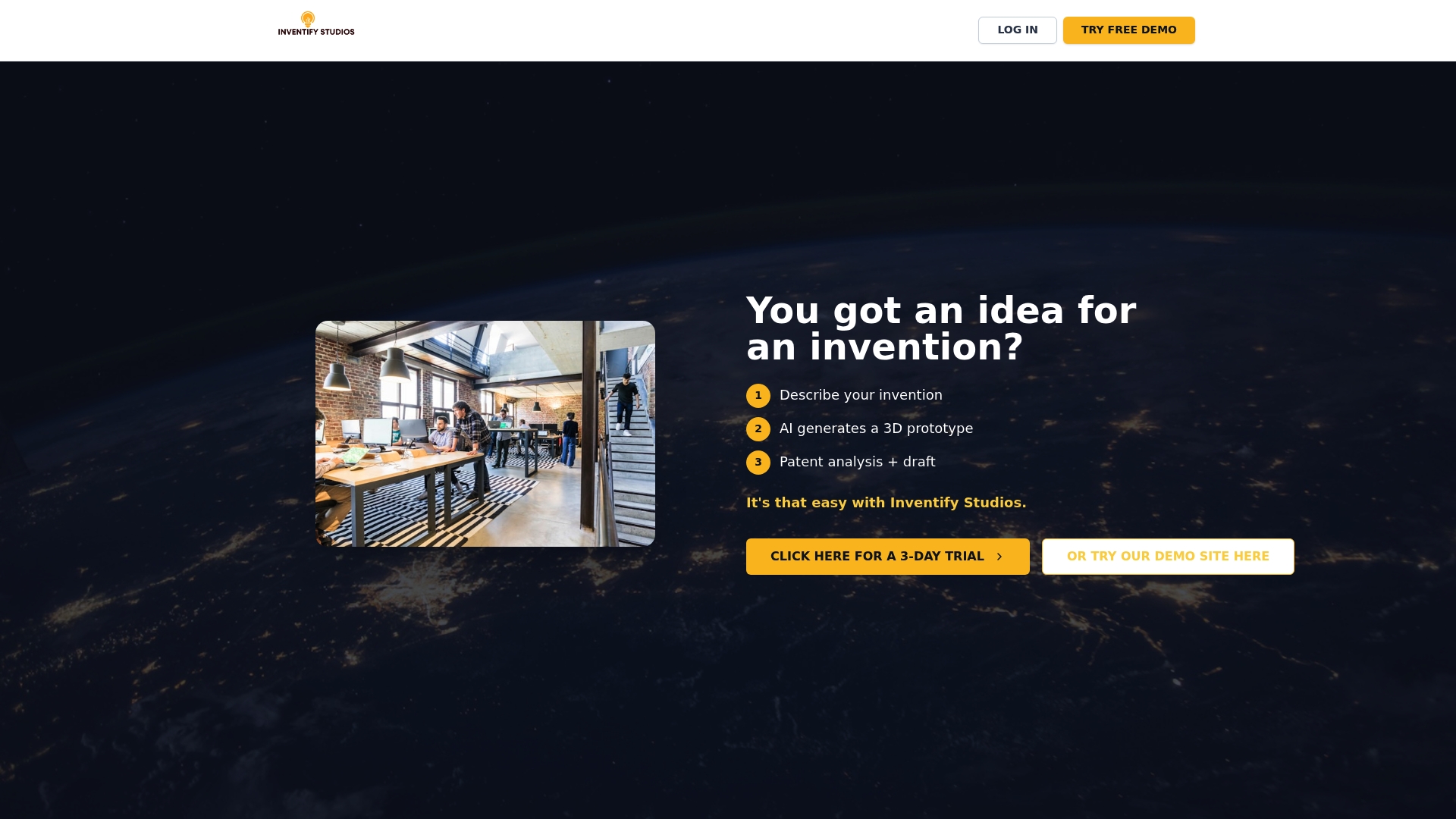
If you are ready to move from idea to a structured development plan, the invention detail service gives you a full validation and roadmap report in one place. For inventors ready to take the next step, Inventifystudios also offers AI-generated 3D prototypes and provisional patent drafts through its invention creation tool. No expensive consultants. No guesswork.
FAQ
What are the first invention validation steps for beginners?
Start with a clear problem definition, then run a 5-minute market test on Amazon, Google, and social media to confirm demand exists before spending any money on prototyping or patents.
How do I know if my invention idea has real market demand?
Look for behavioral evidence: competitors selling similar products, customers complaining about current solutions online, and rising Google Trends data in your category. Verbal interest from friends is not reliable demand data.
Why is patent risk checked separately from market demand?
Patent risk is a distinct layer from market viability. An invention can have strong demand and still be legally blocked if it infringes an active patent, so both checks are required before investing in development.
What is a kill criterion in invention validation?
A kill criterion is a pre-set condition that tells you to stop development before spending more resources. For example: if fewer than 2 of 5 target customers confirm willingness to pay, do not proceed to prototyping.
How much does invention validation cost for a beginner?
The market demand and IP screening stages can be completed for free or near-free using Google Patents, USPTO search tools, Google Trends, and a small landing page test. Physical prototyping and formal patent filings carry higher costs and should only follow successful early-stage validation.