

Low cost invention validation methods are techniques that test whether a product idea has real market demand before you spend serious money building it. The standard industry term for this practice is "lean validation," a framework popularized by the Lean Startup methodology. Most inventors skip this step and pay for it later. Rapid, no-code validation techniques combined with honest kill criteria reduce waste and increase efficiency across every stage of invention development. The core insight is simple: collect paid signals, not opinions, and set your pass/fail threshold before you run a single test. Inventifystudios is built on exactly this principle, giving inventors the tools to validate ideas affordably and move forward with confidence.
What are the best low cost invention validation methods?
The most effective budget-friendly product validation starts with the right tools and a clear hypothesis. Before you run any test, you need three things defined: who your buyer is, what problem you solve for them, and what price you expect to charge. Without those three anchors, any data you collect is meaningless.
Essential tools for affordable invention testing:
- Landing page builders: Carrd (free tier available), Webflow, and Framer let you build professional pages in hours for under $50 total. No developer required.
- Ad platforms: Google Ads and Meta Ads let you drive cold traffic to your page for a controlled budget. Cold traffic matters because warm audiences (friends, followers) inflate your results.
- Payment processors: Stripe and Gumroad let you collect real deposits or pre-orders. A real payment is the strongest signal you can get.
- Prototyping resources: Local maker spaces and public library fabrication labs reduce physical prototyping costs significantly. Community prototyping resources are underused by most first-time inventors.
Pro Tip: Write your kill criteria on paper before you launch any test. Example: "If landing page conversion rate stays below 2% after 1,000 visitors, I stop this project." Pre-defining pass/fail metrics prevents the natural founder bias toward seeking confirmation instead of data.
Setting kill criteria is not pessimism. It is the single most cost-saving habit in lean validation. Inventors who skip this step routinely move goalposts after a test fails, burning more money chasing a bad idea.

How do you execute affordable invention testing step by step?
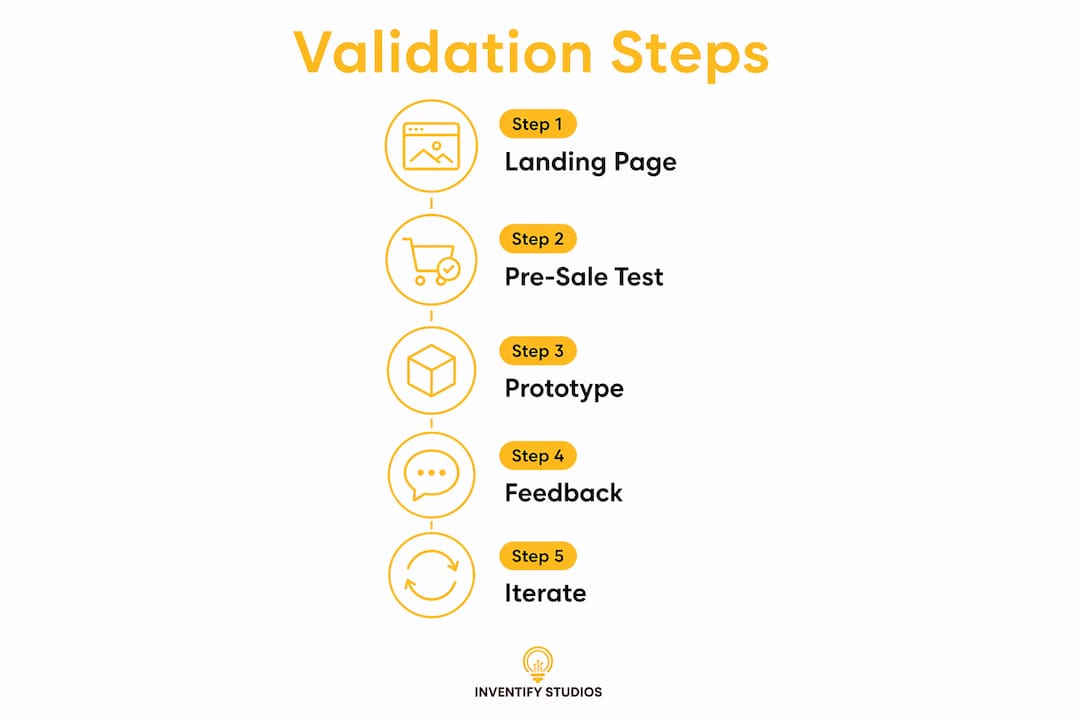
The five methods below cover the full range of cost-effective testing approaches. Each one targets a different type of risk.
-
Landing page smoke test. Build a one-page site describing your product and its price. Drive paid traffic to it using a $300 ad budget over 7–14 days. A 1.5% checkout conversion rate signals strong demand for physical products. Conversion rates under 0.5% signal low demand. Rates between 0.5% and 1.5% are inconclusive and require refined messaging or a different audience segment.
-
Fake door test. Add a "Buy Now" or "Join Waitlist" button inside an existing community, forum, or product. The button leads to a short survey or email capture. Fake door tests cost $50–$100 and can be completed in as little as 48 hours. Five or more paid deposits is a strong viability signal, especially for software-based inventions.
-
Pre-sale test. Create a Stripe or Gumroad payment link and share it with a targeted list or community. Charge a real price, even a discounted early-access rate. Pre-sale payment tests provide the strongest evidence of market demand over any softer signal. A goal of five or more pre-orders gives you high confidence to move forward.
-
Wizard of Oz / manual fulfillment. Advertise the product as if it exists, then fulfill orders manually behind the scenes. The Wizard of Oz approach is one of the most durable early validation techniques because it validates your business model before you invest in any infrastructure. It also teaches you edge cases and workflow details that no interview or survey will surface.
-
Customer discovery interviews. Talk directly to potential buyers. Identifying problem urgency requires at least three people describing the same pain with visible frustration before you treat it as a strong signal. Interviews are the weakest signal type on their own, but they sharpen your messaging for every other test.
Pro Tip: Run methods 1 and 3 together for consumer products. The landing page captures demand signals; the pre-sale confirms willingness to pay. Together, they give you the highest signal-to-cost ratio for the budget spent.
The right sequence matters. Start with the cheapest test that answers your biggest question. Do not build a physical prototype until a pre-sale or fake door test confirms real demand.
How do you read validation signals and avoid costly mistakes?
Validation signals exist on a clear hierarchy. Knowing where each signal sits prevents you from treating weak data as proof.
Signal hierarchy from weakest to strongest:
- Social media likes and shares
- Free email signups
- Survey responses and interview quotes
- Waitlist signups with no payment
- Paid deposits or pre-orders
- Recurring subscription payments
What people do with their money is a significantly stronger validation signal than what people say in surveys or interviews. This distinction is the most important concept in lean validation. Inventors consistently overweight verbal enthusiasm and underweight payment behavior.
"The most dangerous validation is when everyone says they love your idea but nobody pulls out a wallet. Enthusiasm is free. Payment is evidence. Build your entire testing process around collecting the latter, not the former."
Common mistakes that inflate costs:
- Moving goalposts after a test fails ("Let me try one more audience segment")
- Over-investing in polished prototypes before confirming demand
- Testing only with warm audiences (friends, family, existing followers)
- Ignoring low conversion rates by blaming ad creative instead of the idea itself
Setting pass/fail thresholds before testing prevents bias and saves both time and money when ideas fail early. If your landing page conversion rate stays below your threshold after 1,000 visitors, the data is telling you something. Listen to it.
When conversions are low, troubleshoot in this order: first, check your headline and value proposition. Second, check your audience targeting. Third, reconsider the price point. If all three adjustments fail to move the needle, the problem is likely the core idea, not the execution.
Which validation method fits your invention's risk profile?
Successful validation blends multiple methods to address demand, willingness to pay, operational feasibility, and channel risk. No single test covers all four. Matching your method to your dominant risk type saves time and money.
| Risk Type | Dominant Question | Best Method |
|---|---|---|
| Demand risk | Does anyone want this? | Landing page + paid ad smoke test |
| Willingness-to-pay risk | Will people pay your price? | Pre-sale test on a warm list |
| Operational risk | Can you actually deliver this? | Wizard of Oz / manual fulfillment |
| Channel risk | Where do buyers actually live? | Fake door test in existing communities |
Most physical inventions face demand risk first. Start with a landing page smoke test, then layer in a pre-sale to confirm price tolerance. Most service-based inventions face operational risk. Start with manual fulfillment before building any technology.
Early prototypes should focus on iteration, not polish, using community resources like maker spaces to keep costs low. Local fabrication labs, university maker spaces, and open-source design tools can reduce physical prototyping expenses by a significant margin. The open-source prototyping tools available to inventors in 2026 make low-fidelity physical models more accessible than ever.
Pro Tip: Skip validation only when you have direct, paying customers already asking for the product by name. That is the rare case where building immediately makes sense. Every other situation benefits from at least one cheap test first.
The inventors who waste the most money share one habit: they build before they test. The inventors who move fastest share a different habit: they treat every dollar spent before a paid signal as a cost to minimize, not an investment to celebrate.
For a full walkthrough of the invention validation steps that apply to beginners, Inventifystudios has published a dedicated 2026 guide covering each stage in detail.
Key Takeaways
The most effective low cost invention validation combines paid signal tests, pre-defined kill criteria, and method selection matched to your invention's specific risk type.
| Point | Details |
|---|---|
| Paid signals beat opinions | Pre-orders and deposits confirm demand far more reliably than surveys or interviews. |
| Set kill criteria first | Define your pass/fail threshold before testing to prevent founder bias from distorting results. |
| Match method to risk type | Use landing page tests for demand risk, manual fulfillment for operational risk, and pre-sales for price risk. |
| Start cheap, then build | No-code tools and maker spaces let you validate for under $300 before committing to a prototype. |
| Blend multiple methods | One test rarely covers all four risk types; combining methods gives the clearest picture of viability. |
The uncomfortable truth about validation most inventors ignore
Most inventors treat validation as a formality. They run one test, get lukewarm results, and build anyway because they believe in the idea. I have seen this pattern repeat more times than I can count, and it almost always ends the same way: a polished product that nobody buys.
The discipline that separates successful inventors from expensive hobbyists is not creativity. It is the willingness to let data override conviction. Writing kill criteria before a test feels uncomfortable because it forces you to admit the idea might fail. That discomfort is exactly the point. Over-investing in polished prototypes prematurely is one of the most common and costly mistakes in invention development. The fix is not more research. It is cheaper, faster tests with honest thresholds.
The other thing most articles will not tell you: community resources are genuinely underused. Maker spaces, library fabrication labs, and inventor meetups give you access to equipment, feedback, and peer accountability at near-zero cost. The inventors who use them consistently iterate faster and spend less. Start there before you spend a dollar on manufacturing.
— Hua
How Inventifystudios supports budget-conscious inventors
Validating an invention idea does not require expensive consultants or a large development budget. Inventifystudios gives inventors the tools to move from idea to validated concept without the traditional cost barriers.
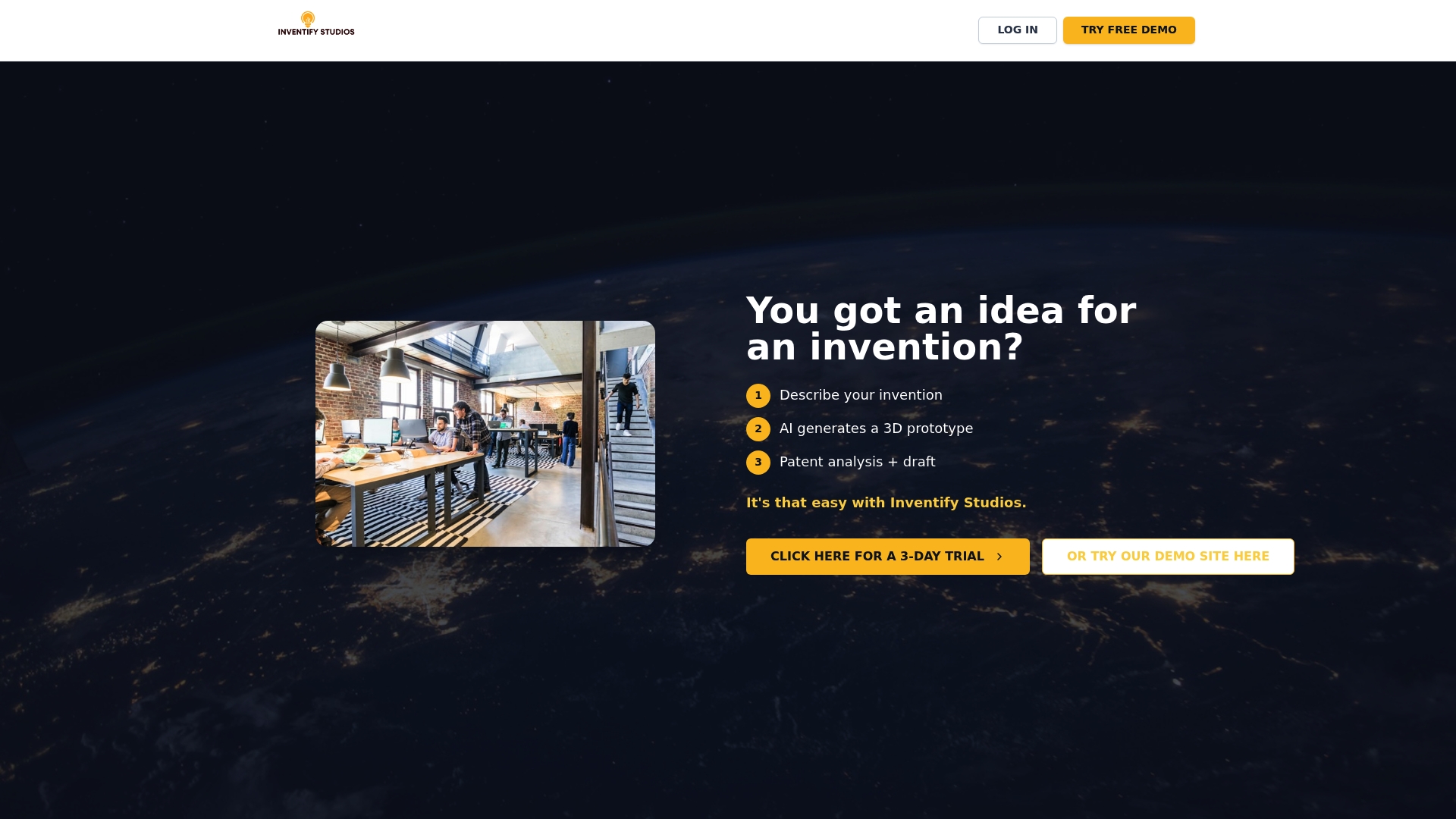
The platform's invention detail tools let you assess patentability, generate AI-powered 3D prototypes, and receive provisional patent drafting insights, all in one place. These capabilities replace what would typically cost thousands of dollars in consulting fees. Whether you are testing your first idea or refining a concept that has already passed a smoke test, Inventifystudios gives you a clear, affordable path forward. The DIY invention development steps available through the platform make the process concrete and repeatable for inventors at every level.
FAQ
What is the cheapest way to validate an invention idea?
A landing page smoke test using a no-code builder and a $300 ad budget is the cheapest structured method. It delivers measurable conversion data within 7–14 days without requiring a physical prototype.
How many pre-orders do I need to confirm real demand?
Five or more paid pre-orders is a high-confidence signal to begin development. Fewer than five suggests the audience, price, or value proposition needs adjustment before moving forward.
What is a kill criterion in invention validation?
A kill criterion is a pre-defined threshold that ends a test if results fall below a set benchmark. An example is stopping a project if landing page conversion stays under 2% after 1,000 visitors.
Can I validate a physical invention without building a prototype?
Yes. Manual fulfillment and Wizard of Oz methods let you take real orders and fulfill them by hand, confirming demand and operational feasibility before any physical product exists.
How do I know which validation method to use?
Match your method to your biggest risk. Use landing page tests for demand risk, pre-sales for price risk, manual fulfillment for operational risk, and fake door tests for channel risk.