

An invention cost breakdown planning guide is a structured framework that maps every dollar you will spend across research, prototyping, patenting, and manufacturing before you commit a single cent. Most first-time inventors underestimate total costs by 40% or more because they plan for the obvious expenses and ignore the hidden ones. This guide covers the full cost analysis for inventions, from early patent searches to first production runs, using 2026 cost data and phased budget methods. Follow it and you will know exactly where your money goes, when it goes there, and how much to hold in reserve.
What are the main cost components in invention development?
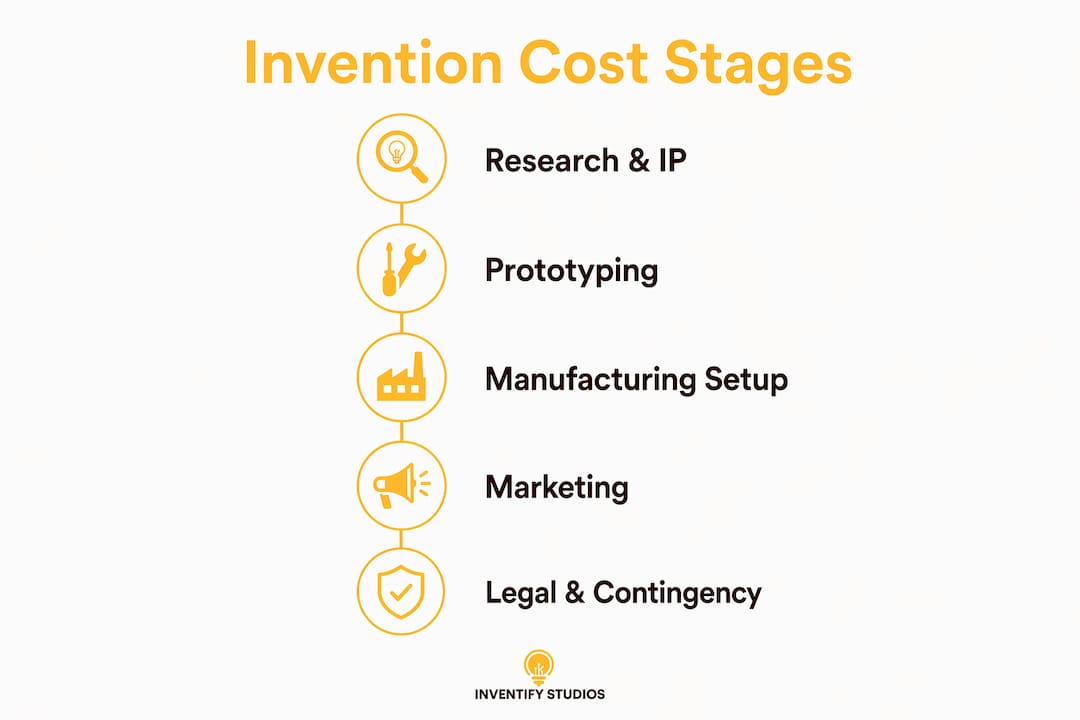
Invention development costs fall into six distinct categories. Each one carries its own timing, variability, and risk. Missing any one of them is how budgets collapse mid-project.
Research and market analysis is the starting point. Expect to spend $500–$3,000 on market research, competitor analysis, and feasibility studies. This spending validates demand before you invest in anything physical.
Patent-related costs are the most misunderstood line item in any inventor budget guide. Here is what the numbers actually look like:
- Professional patent search: $500–$2,000, which helps you avoid expensive IP conflicts before filing
- Provisional patent application: $2,000–$6,000 including attorney fees and USPTO filing costs
- Utility patent costs from drafting through grant: $5,000–$15,000+ over 18–36 months
- PCT international filing at 12 months: $4,000–$8,000, versus $30,000–$50,000 for immediate multi-country national filings
Prototyping expenses vary by fidelity. A basic CAD drawing costs $500–$2,000. A 3D-printed concept model runs $200–$2,000. A functional prototype with working electronics or mechanical systems can reach $5,000–$25,000. Each stage answers a specific question, so do not skip to the expensive version before the cheap one has done its job.
Manufacturing setup is where costs scale dramatically. Tooling and first production runs range from a few thousand dollars to $100,000 or more, depending on complexity and minimum order quantities. A simple injection-molded consumer product sits at the low end. A device with custom electronics and precision tolerances sits at the high end.

Marketing and branding is consistently underbudgeted. A typical marketing budget for a new invention ranges from $1,000 to $20,000+, depending on whether you are running a direct-to-consumer launch or a trade show campaign.
Legal and contingency expenses round out the picture. Budget $1,000–$5,000 for contracts, NDAs, and business formation. Then add your emergency buffer on top of everything else.
How to plan and allocate a realistic invention budget
Phased investment is the most reliable method for invention budget planning. It prevents you from spending manufacturing money on prototyping and running out of capital before you reach the market.
The recommended phased budget allocation framework divides your total capital like this:
- Research and IP (25%): Market validation, patent searches, and provisional patent filing. This phase answers whether your idea is novel and whether anyone will buy it.
- Prototyping and market testing (30%): CAD models, 3D prints, functional prototypes, and early user feedback. Spend here only after Phase 1 confirms viability.
- Refined engineering (30%): Design for manufacturing, final CAD, and pre-production samples. This is where you prepare for scale, not experiment.
- Reserve (15%): Hold this as a hard reserve. Do not touch it unless a specific, documented cost overrun requires it.
On top of that 15% reserve, budget an emergency buffer of 10–20% of your total project cost. Experienced inventors treat this as non-negotiable. Unexpected tooling changes, patent office rejections, and supplier delays are not rare events. They are standard.
The table below shows realistic total budget ranges by invention complexity, based on 2026 hardware development data:
| Complexity level | Total budget range | Typical use case |
|---|---|---|
| Lean | $5,000–$15,000 | Simple consumer accessories, basic mechanical devices |
| Simple | $15,000–$50,000 | Single-function electronics, straightforward hardware |
| Moderate | $50,000–$150,000 | Multi-component devices, IoT products |
| High complexity | $150,000–$300,000+ | Medical devices, advanced robotics, complex systems |
These cost ranges by complexity reflect full development cycles, not just prototyping. They include IP, engineering, and pre-production costs.
Pro Tip: Validate your concept at the Lean budget level before committing to Moderate or High complexity spending. A $10,000 proof-of-concept can save you $100,000 in the wrong direction.
What tools and strategies help control invention development costs?
Cost control in invention development is not about spending less. It is about spending in the right sequence. These are the methods that actually work.
Use a Resource-Light Innovation approach. Low-fidelity MVPs and structured market validation cycles let you test assumptions before committing capital to manufacturing or complex patent filings. A cardboard mockup that proves user behavior is worth more than a $15,000 prototype that proves nothing about demand.
Apply Design for Manufacturing (DFM) from day one. Fragmented design and engineering work produces technically valid but expensive designs that require costly redesigns later. Consolidating your design, mechanical engineering, and manufacturing inputs early eliminates that waste. DFM is not a late-stage review. It is a starting constraint.
Run a professional patent search before filing anything. At $500–$2,000, a patent search is the cheapest insurance you can buy. Discovering a blocking patent after you have spent $10,000 on a prototype is a budget disaster that a $1,000 search would have prevented.
Sequence your international patent strategy. Filing a PCT application at the 12-month mark costs $4,000–$8,000 and gives you 18–30 additional months to validate international markets before committing to multi-country national filings at $30,000–$50,000. This sequencing is one of the most underused cost-deferral tools available to independent inventors.
Choose your commercialization path before you build. Licensing an invention shifts manufacturing setup costs of $50,000–$500,000 to the licensee. If your capital is limited, licensing is not a compromise. It is a rational financial strategy. You can read more about how this decision changes your entire budget in this invention licensing overview.
Watch for the most common cost overruns:
- Prototype iterations that exceed the original scope
- Patent office office actions requiring attorney responses ($1,500–$3,000 each)
- Tooling revisions after design changes
- Underestimated marketing spend at launch
- Regulatory compliance testing for consumer electronics or medical devices
Pro Tip: Track every expense in a shared spreadsheet from day one, categorized by phase. Inventors who track spending weekly catch overruns weeks earlier than those who review monthly.
How do invention cost estimates vary by complexity and development pathway?
The same invention can cost radically different amounts depending on how you plan to bring it to market. Complexity and commercialization path are the two variables that matter most in any cost analysis for inventions.
The table below contrasts the licensing path against the manufacturing path across key cost categories:
| Cost category | Licensing path | Manufacturing path |
|---|---|---|
| Prototype development | $5,000–$25,000 | $5,000–$50,000 |
| Patent costs | $7,000–$21,000 | $7,000–$21,000 |
| Manufacturing setup | Shifted to licensee | $50,000–$500,000 |
| Marketing | $1,000–$10,000 | $5,000–$50,000+ |
| Total capital needed | $15,000–$60,000 | $70,000–$600,000+ |
The gap is significant. A licensing-focused inventor with a moderate complexity product can reach a deal with $30,000–$50,000 in total spending. The same inventor pursuing direct manufacturing needs five to ten times that capital before seeing revenue.
Patent cost variability also deserves attention. A simple mechanical device may reach full utility patent grant for $8,000. A software-integrated hardware product with multiple claim sets can exceed $20,000 in patent prosecution costs alone. The prototype-to-patent connection matters here because a well-documented prototype directly strengthens your patent claims and reduces attorney time.
Budget planning for inventions also needs to account for timeline. A Lean project may reach market in 12–18 months. A High Complexity product typically takes 3–5 years from concept to commercial launch. Longer timelines mean more reserve capital, more patent maintenance fees, and more marketing spend before revenue arrives.
The right approach is to match your budget to your path, not to an idealized version of your invention. Start with the invention development stages that fit your current capital, then scale up as validation reduces your risk.
Key takeaways
Effective invention budget planning requires phased allocation, a defined commercialization path, and a mandatory emergency buffer of 10–20% to absorb the cost overruns that every development project encounters.
| Point | Details |
|---|---|
| Phase your budget allocation | Split capital: 25% research/IP, 30% prototyping, 30% engineering, 15% reserve. |
| Know your complexity tier | Total costs range from $5,000 for Lean projects to $300,000+ for High Complexity products. |
| Choose your path early | Licensing shifts $50,000–$500,000 in manufacturing costs to the licensee, cutting your capital need dramatically. |
| Sequence patent filings | A PCT application at 12 months costs $4,000–$8,000 and defers $30,000–$50,000 in international filings. |
| Track spending weekly | Weekly expense tracking by phase catches overruns early and keeps your budget aligned with your plan. |
Why most inventors get budgeting wrong from the start
I have worked with hundreds of inventors at various stages, and the pattern is almost always the same. They budget for the invention they want to build, not the invention they can afford to validate. The result is a prototype that proves technical feasibility but leaves no money for patents, marketing, or manufacturing setup.
The fix is not a bigger budget. It is a smarter sequence. Every dollar you spend before validating market demand is a dollar at risk. Every dollar you spend after validation is an investment with a known return probability.
The inventors I have seen succeed consistently do two things differently. First, they define their commercialization path before they spend anything on prototyping. Second, they treat their emergency buffer as untouchable until a specific, documented need arises. Inventors who dip into that buffer for convenience almost always run short at the worst possible moment, usually right before a licensing meeting or a production run.
One more thing worth saying directly: professional help is worth it selectively. A patent attorney for your utility patent filing is worth every dollar. A full-service invention consulting firm for your initial concept sketch is not. Use tools like Inventifystudios to handle the early-stage work affordably, and save your professional budget for the moments that legally require it.
The goal of any cost breakdown for invention planning is not to minimize spending. It is to maximize the value of every dollar you commit, in the right order, at the right time.
— Hua
How Inventifystudios supports your invention cost planning
Planning invention expenses is easier when you have the right tools from the start. Inventifystudios gives you AI-powered prototype generation, patent analysis, and provisional patent drafting in one place, without the high fees of traditional consulting.
You can generate a 3D prototype concept in minutes, assess your invention's patentability, and get a provisional patent narrative ready for filing, all before you spend a dollar on attorneys or manufacturing. For inventors working within a Lean or Simple budget tier, this kind of early-stage clarity is exactly what keeps costs under control. Explore how Inventifystudios supports your full invention development process and start building your budget with real data behind it.
FAQ
What is a typical total cost to develop an invention?
Total development costs range from $5,000–$15,000 for Lean projects to $150,000–$300,000+ for High Complexity products. Your actual cost depends on invention complexity, commercialization path, and how efficiently you sequence each development phase.
How much should I budget for a patent?
A provisional patent application costs $2,000–$6,000, while a full utility patent runs $5,000–$15,000+ over 18–36 months. A professional patent search at $500–$2,000 is the first step and prevents far more expensive conflicts later.
Should I license my invention or manufacture it myself?
Licensing shifts $50,000–$500,000 in manufacturing setup costs to the licensee, making it the right choice for inventors with limited capital. Manufacturing gives you higher margins but requires significantly more upfront investment and operational capacity.
What is a phased budget allocation for invention development?
The recommended framework allocates 25% to research and IP, 30% to prototyping and market testing, 30% to refined engineering, and 15% as a reserve. Add a separate emergency buffer of 10–20% on top of your total project budget.
How do I reduce invention development costs without cutting corners?
Use a Resource-Light Innovation approach with low-fidelity MVPs to validate demand before committing to expensive prototypes. Apply Design for Manufacturing principles from the start to avoid costly redesigns, and sequence your patent filings strategically to defer major international costs.