

Inventors lose patent rights when they publicly disclose, sell, or use their inventions without filing a patent application on time, triggering irreversible forfeiture under U.S. and international patent law. The formal term for this is "loss of patent protection," and it covers everything from missed maintenance fees to passive non-enforcement. Under 35 U.S.C. § 102, a one-year countdown begins the moment an inventor publicly discloses or sells their invention. Miss that window, and the rights are gone permanently. Understanding why inventors lose patent rights is the first step toward protecting what you build.
Why inventors lose patent rights: the core causes
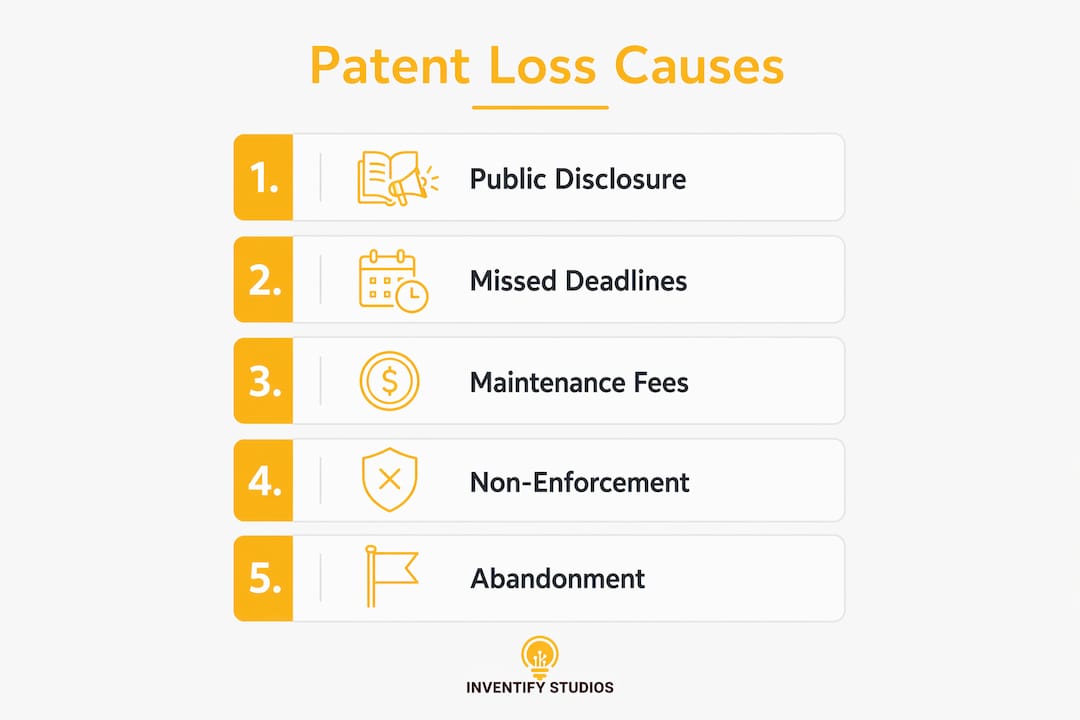
Inventors lose patent rights through five primary failures: premature public disclosure, missed filing deadlines, non-payment of maintenance fees, abandonment, and failure to enforce. Each cause is distinct, but they share one trait. They are all avoidable with the right preparation.

The loss is rarely sudden. It builds quietly through inaction, misunderstanding, or misplaced priorities. Inventors often prioritize engineering perfection over timely filing and legal strategy. That trade-off costs them everything.
Patent rights expiration is the one scenario that cannot be reversed. A utility patent lasts 20 years from filing, and no renewal exists. Every other cause of patent loss, from missed fees to disclosure traps, can be prevented if you act before the deadline.
How premature public disclosure causes loss of patent rights
Public disclosure is the most common and most misunderstood reason for patent loss. It happens when an inventor shares invention details publicly before filing, whether through a social media post, a pitch to investors without a non-disclosure agreement, or a product listing on Amazon.
Under U.S. law, public disclosure starts a mandatory 12-month countdown. File within that year, and you may still secure a U.S. patent. Wait longer, and the right to file is permanently gone. The U.S. grace period sounds forgiving, but it creates a false sense of security.
The real danger is international. Many countries, including all European Patent Office member states, apply absolute novelty rules. Under those rules, any public disclosure immediately bars patent rights abroad, with no grace period at all. A single tweet or a product demo at a trade show can wipe out your ability to patent in Europe, Japan, China, and dozens of other markets.
Common disclosure mistakes include:
- Posting prototype photos or product descriptions on Instagram, LinkedIn, or YouTube before filing
- Pitching to potential investors or partners without a signed NDA
- Listing a product for sale on Etsy, Amazon, or Kickstarter before the application is filed
- Presenting at a university research conference or startup competition without legal protection in place
Pro Tip: File a provisional patent application before any public disclosure. A provisional establishes your filing date, gives you 12 months to develop a full application, and costs significantly less than a utility patent. Pair it with a signed NDA for every investor conversation.
Inventifystudios offers AI-powered tools that help inventors document their invention details before any public activity, reducing the risk of accidental disclosure.
What filing deadlines and maintenance fees actually cost you
Missing a filing deadline is permanent. The U.S. on-sale bar, defined under 35 U.S.C. § 102(b)(1), means that crowdfunding or Amazon listings trigger the patent clock the moment a product is offered for sale. Inventors who launch Kickstarter campaigns before filing routinely discover this rule too late.
The three critical filing deadlines every inventor must track:
- First public use or disclosure. The 12-month U.S. grace period begins on this date. International rights may already be lost.
- First offer for sale. Crowdfunding pledges, pre-order pages, and retail listings all count as offers for sale under U.S. law.
- Provisional patent expiration. A provisional application expires exactly 12 months after filing. If no utility application is filed by then, the provisional's priority date is lost.
Maintenance fees are a separate and equally serious risk. U.S. utility patents require fee payments at 3.5, 7.5, and 11.5 years after the grant date. Non-payment causes a lapse, and while a 24-month grace period exists after each due date, missing that window permanently ends patent rights. There is no appeal and no reinstatement after the grace period closes.
| Deadline | Trigger event | Consequence of missing |
|---|---|---|
| 12-month U.S. filing deadline | First public disclosure or sale | Permanent loss of U.S. patent rights |
| Provisional expiration | 12 months after provisional filing | Loss of priority date; must refile |
| Maintenance fee at 3.5 years | Grant date anniversary | Patent lapses; 24-month grace period applies |
| Maintenance fee at 7.5 years | Grant date anniversary | Patent lapses; 24-month grace period applies |
| Maintenance fee at 11.5 years | Grant date anniversary | Patent lapses permanently if grace period missed |
Pro Tip: Use a dedicated patent docketing calendar, not a general task manager. Set reminders 90 days, 30 days, and 7 days before every deadline. Patent attorneys use tools like Docketbird or CPi for this purpose. If you are managing your own patent, a simple Google Calendar with recurring alerts works better than nothing.
Understanding patent filing timelines in detail helps inventors avoid the most common deadline mistakes before they become permanent losses.
How failure to enforce and abandonment lead to patent rights loss
A granted patent does not protect itself. Non-enforcement of patent rights can be legally interpreted as abandonment, which weakens or nullifies exclusivity over time. An inventor who discovers a competitor copying their patented product and does nothing sends a clear signal to the market and to courts.
Abandonment also happens through administrative failure. Missing patent office deadlines or ignoring office actions during examination causes the application to go abandoned. Once abandoned, the invention may enter the public domain, giving competitors free access to the technology.
The practical consequences of passive non-enforcement include:
- Competitors establishing market presence that becomes harder to challenge over time
- Courts viewing long delays in enforcement as implied permission or waiver
- Weakened negotiating position in licensing discussions
- Reduced patent value if the patent is later sold or used as collateral
"Patent expiration is not the only way to lose rights. Passive failure to enforce can practically nullify patent protections just as effectively as a missed deadline." — PatentPC
Active patent management means monitoring competitors, responding to all USPTO communications within required timeframes, and consulting a patent attorney when infringement is suspected. Waiting is not a neutral choice.
U.S. vs. international patent loss: how the rules differ
Patent loss rules vary significantly by jurisdiction. What saves your rights in the U.S. may not protect you anywhere else. Inventors planning global protection need to understand these differences before they disclose anything publicly.
| Factor | United States | Europe (EPO) | Most other countries |
|---|---|---|---|
| Grace period after disclosure | 12 months | None | None (absolute novelty) |
| First-to-file system | Yes | Yes | Yes |
| On-sale bar applies | Yes | No direct equivalent | Varies |
| Maintenance fees required | Yes (3.5, 7.5, 11.5 years) | Yes (annual) | Yes (annual in most) |
| DIY provisional filing risk | High if incomplete | Not applicable | Not applicable |
The absolute novelty standard used in Europe and most of Asia means that a single public disclosure before filing destroys international patent rights with no recourse. The U.S. grace period is a domestic exception, not a global standard. Inventors who disclose first and plan to file internationally later face a serious problem.
Poorly drafted provisional applications create a specific risk in the U.S. context. If a provisional does not fully describe the invention, later claims in the utility application may not receive the benefit of the original filing date. That gap can expose the invention to prior art that emerged between the provisional and utility filings.
Inventors targeting markets in Germany, France, Japan, South Korea, or China must file before any public activity. The PCT (Patent Cooperation Treaty) application process allows inventors to file in multiple countries simultaneously, but the filing must happen before disclosure to preserve international rights. Consulting a patent attorney with international experience is the most reliable way to navigate these differences.
Key Takeaways
Inventors lose patent rights through five preventable causes: premature disclosure, missed filing deadlines, unpaid maintenance fees, abandonment, and failure to enforce.
| Point | Details |
|---|---|
| Disclose after filing, not before | Any public disclosure before filing starts a 12-month U.S. clock and immediately bars international rights. |
| Track all three maintenance fee dates | U.S. patents lapse if fees at 3.5, 7.5, and 11.5 years are not paid within the grace period. |
| File provisionals carefully | Incomplete provisional applications can cause later claims to lose their priority date. |
| Enforce your rights actively | Non-enforcement can be treated as abandonment and weaken patent exclusivity in court. |
| International rules are stricter | Europe and most countries apply absolute novelty with no grace period after disclosure. |
What I have seen inventors get wrong about patent protection
The most consistent mistake I see is treating the patent process as something to handle after the product is ready. Inventors spend months perfecting a prototype, then disclose it at a trade show or post it online, and only then start thinking about filing. By that point, international rights are already gone and the U.S. clock is running.
The second mistake is treating a provisional patent as a finished job. A provisional buys time. It does not grant protection. I have seen inventors file a rough provisional, relax for 12 months, and then discover that their utility application cannot claim the priority date because the provisional was too vague. That is not a technicality. It is a real loss of rights.
The third mistake is underestimating how much passive inaction costs. Inventors who notice competitors copying their products often delay enforcement because litigation feels expensive and uncertain. That hesitation is understandable. But courts notice when patent holders wait years to act, and that delay can undermine the entire case.
My practical advice: file early, file thoroughly, and treat your patent like an asset that needs active management. Use a practical guide to ownership rights to build a maintenance routine from day one. The inventors who protect their rights consistently are the ones who treat patent management as part of their product strategy, not an afterthought.
— Hua
Protect your invention before the clock starts
Inventors who document their ideas thoroughly before any public activity have a clear advantage. Inventifystudios gives you the tools to do exactly that, without the cost of traditional consulting.

The Invention Detail service from Inventifystudios helps inventors capture every technical aspect of their idea in a structured, patent-ready format. From AI-generated prototypes to tailored provisional patent narratives, the platform prepares your documentation before you pitch, post, or sell. That preparation is what keeps your filing date defensible and your rights intact.
FAQ
Why do inventors lose patent rights after public disclosure?
Public disclosure before filing starts a 12-month U.S. deadline under 35 U.S.C. § 102. In most other countries, disclosure immediately and permanently bars patent rights with no grace period.
What happens to a patent if maintenance fees are not paid?
The patent lapses. U.S. utility patents require fee payments at 3.5, 7.5, and 11.5 years after grant. Missing a payment starts a 24-month grace period, but failure to pay within that window permanently ends the patent.
Does selling a product before filing a patent affect rights?
Yes. Offering a product for sale, including through crowdfunding platforms like Kickstarter, triggers the U.S. on-sale bar and starts the 12-month filing deadline. International rights may be lost immediately.
Can a patent be lost through non-enforcement?
Yes. Failing to act against known infringers can be interpreted as implied permission or waiver of exclusivity. Courts have used long delays in enforcement to weaken or invalidate patent claims.
What is the difference between patent expiration and patent abandonment?
Patent expiration is the natural end of a patent's 20-year term. Abandonment is an early, often unintentional loss caused by missed deadlines, unpaid fees, or failure to respond to USPTO communications.