

Patents, trademarks, and copyrights are three distinct forms of intellectual property rights that protect fundamentally different things. A patent covers a functional invention or process. A trademark protects a brand name, logo, or slogan used in commerce. A copyright protects original creative works the moment they are fixed in a tangible form. Understanding the difference patent trademark copyright creates is not optional for entrepreneurs and creators. It is the foundation of any real protection strategy. The United States Patent and Trademark Office (USPTO) administers patents and trademarks, while copyright protection under U.S. law is governed by the Copyright Act and managed through the U.S. Copyright Office.
What does each type of intellectual property protect?
The core difference between patent, trademark, and copyright comes down to the nature of the asset being protected.
Patents protect functional inventions. The USPTO grants patent rights for new, useful, and non-obvious inventions including machines, processes, chemical compositions, and ornamental designs. A utility patent covers how something works. A design patent covers how something looks. A plant patent covers new plant varieties. If you invent a new type of battery, a patent is the right tool.
Trademarks protect brand identity. Trademark registration covers names, logos, slogans, color schemes, and even sounds that identify the source of goods or services in commerce. The Nike swoosh, the McDonald's golden arches, and the phrase "Just Do It" are all trademarks. A trademark tells consumers who made the product, not what the product does.

Copyrights protect creative expression. Original works of authorship including novels, music, software code, films, photographs, and visual art receive copyright protection automatically. The Berne Convention, an international treaty, establishes that protection attaches the moment a work is fixed in a tangible medium. No registration is required for the right to exist.
Here is a quick breakdown of what each type covers:
- Patent: A new drug formula, a mechanical device, a manufacturing process, an ornamental product design
- Trademark: A company name, a product logo, a brand color palette, a distinctive jingle
- Copyright: A novel, a song, a photograph, a software program, a painting, a film script
The clearest way to remember the distinction: patents protect what a product does, trademarks protect who it comes from, and copyrights protect how something is creatively expressed. A single product can legitimately use all three. A smartphone, for example, may have patented internal technology, a trademarked brand name, and copyrighted software code.
How do application processes, costs, and timelines compare?
The practical difference between these protections shows up most clearly in cost and time.
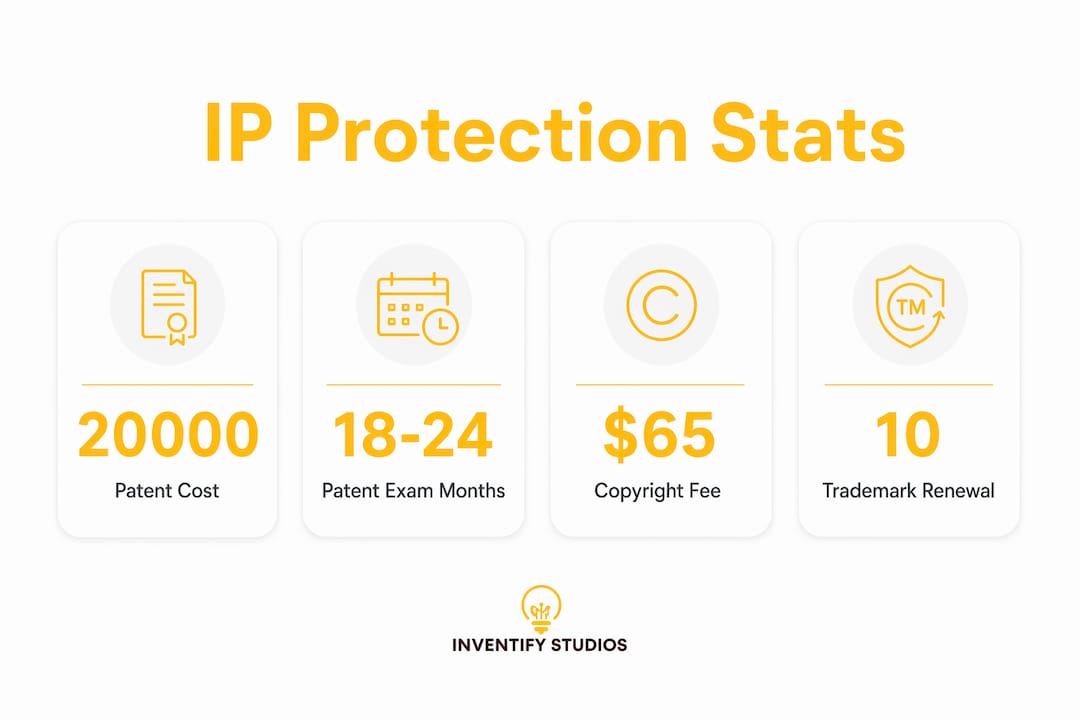
| Protection Type | Filing Cost (All-In) | Examination Time | Duration |
|---|---|---|---|
| Utility Patent | $7,000–$20,000+ | 18–24 months | 20 years |
| Design Patent | Lower than utility | 18–24 months | 15 years |
| Trademark | ~$350 per class | 8–12 months | Indefinite |
| Copyright | ~$65 per work | Automatic | Life + 70 years |
Patent costs run $7,000 to $20,000 or more when legal fees are included. That figure reflects the complexity of drafting a patent application that satisfies USPTO examination standards. Trademark government fees run roughly $350 per class of goods or services, making brand protection far more accessible. Copyright registration costs approximately $65 per work, though registration is not required for the right itself to exist.
USPTO patent examination averages 18–24 months. That is a significant wait, and the clock starts from the filing date, not the date of invention. Trademark examination moves faster, averaging 8–12 months. Copyright protection requires no USPTO approval at all.
Pro Tip: Register your copyright even though it is automatic. Without timely registration, you cannot sue for statutory damages or attorney fees in U.S. federal court. That gap in enforcement can cost you far more than the $65 filing fee.
One common and costly mistake is assuming a trademark protects a product's function. It does not. Filing a trademark instead of a patent to protect how a product works leaves the invention completely exposed. Each protection type has a specific lane, and mixing them up creates real legal vulnerability.
How long does each protection last?
Duration is one of the most misunderstood aspects of intellectual property rights.
| Protection Type | Duration | Renewal Required |
|---|---|---|
| Utility Patent | 20 years from filing | No |
| Design Patent | 15 years from grant | No |
| Trademark | Indefinite | Yes, every 10 years |
| Copyright | Life of author + 70 years | No |
Utility patents last 20 years from the filing date. Design patents last 15 years. Neither requires renewal, but once they expire, the invention enters the public domain. Anyone can then freely use, manufacture, or sell the invention. That is not a flaw in the system. It is the deliberate trade-off: inventors receive a time-limited monopoly in exchange for full public disclosure of how the invention works.
Trademarks work differently. Trademark registration requires use in commerce and renewal every 10 years, but there is no hard expiration date. A brand that stays active and maintains its registrations can hold a trademark indefinitely. Coca-Cola has held its trademark for well over a century. The key obligation is continued use. Abandoning a trademark in commerce can cause it to lapse.
Copyrights under the Berne Convention last for the life of the author plus 70 years. Works made for hire follow a different calculation. After expiration, works enter the public domain and become freely usable by anyone.
Why can't one form of protection replace another?
A patent protects functionality while a trademark protects brand identity. Neither can substitute for the other. This is the single most important concept for entrepreneurs to internalize.
Consider a practical scenario. A competitor copies your product's core mechanism but sells it under a completely different brand name. Your trademark gives you no recourse. Only a patent stops that. Flip the scenario: a competitor uses a name confusingly similar to yours but builds a completely different product. Your patent gives you no recourse. Only a trademark stops that.
Here is where layered IP protection becomes the right strategy:
- File a patent to protect the functional mechanism of your invention
- Register a trademark to protect the brand name and logo you sell it under
- Rely on copyright to protect any original creative content, software, or marketing materials you produce
- Consider trade secrets for proprietary processes that are hard to reverse-engineer and where public disclosure would be harmful
Patent applications require full public disclosure of the invention so that a person with ordinary skill in the field could replicate it after the patent expires. That disclosure is a legal requirement, not optional. For some inventions, this trade-off is unfavorable. If a formula or process is difficult to reverse-engineer, a trade secret may offer better long-term protection than a patent. The Coca-Cola formula is the most cited example of a trade secret chosen over a patent.
Pro Tip: Map your assets before filing anything. List every functional element, every brand identifier, and every piece of creative content separately. Then match each to the correct protection type. Skipping this step is how entrepreneurs end up with gaps in their coverage.
Creators managing digital content face the same layering logic. Understanding why content protection matters for creators helps clarify that copyright alone may not prevent unauthorized distribution without active enforcement tools.
How can creators and entrepreneurs use these protections together?
A layered protection strategy follows a clear sequence. Inventors and creators who plan this early avoid expensive corrections later.
- Identify what you have. Separate your invention's functional elements from its branding and from any creative content you have produced. These are three distinct asset categories requiring three distinct protections.
- File a provisional patent first. A provisional patent application establishes a priority date at lower cost and gives you 12 months to develop the invention before filing a full utility patent. This is especially valuable for first-time inventors. Learn more about patent novelty requirements before filing.
- Register your trademark early. Brand names and logos can be filed before a product launches using an "intent to use" application with the USPTO. Waiting until launch risks someone else registering a similar mark first.
- Register your copyright proactively. Copyright exists automatically, but timely registration is required to sue for statutory damages and attorney fees. Register before any public release of creative work.
- Review your strategy annually. IP needs change as businesses grow. A product line that starts with one patent may eventually need multiple patents, several trademark classes, and active copyright enforcement.
Cost-benefit thinking matters here. A small business or solo creator cannot always afford full patent prosecution at $7,000 to $20,000. Prioritize the protection that covers your most commercially valuable asset first. For a brand-driven business, trademark registration at roughly $350 per class delivers strong return. For a technology-driven business, patent protection is the priority. Many creators overlook common invention misconceptions that lead to misfiled or incomplete applications.
Key Takeaways
Patents, trademarks, and copyrights protect fundamentally different assets and cannot substitute for one another. Effective IP protection requires matching each asset type to the correct legal tool.
| Point | Details |
|---|---|
| Patents protect function | A utility patent covers how an invention works and lasts 20 years from the filing date. |
| Trademarks protect brand identity | Trademark registration with the USPTO can last indefinitely with use and renewal every 10 years. |
| Copyrights are automatic but register anyway | Copyright attaches on creation, but registration is required to sue for statutory damages in U.S. courts. |
| Costs vary widely | Patents cost $7,000–$20,000+, trademarks roughly $350 per class, and copyright registration approximately $65. |
| Layer all three for full coverage | A single product may need a patent for its function, a trademark for its brand, and copyright for its creative content. |
What I have learned from watching inventors get this wrong
The most expensive IP mistake I see is not failing to file. It is filing the wrong thing. An entrepreneur builds a genuinely novel product, spends months on branding, and then files only a trademark because it is faster and cheaper. Six months later, a competitor reverse-engineers the product and sells it under a different name. The trademark is useless in that fight.
The second most expensive mistake is treating copyright as a passive right. Yes, it exists automatically. But I have watched creators lose enforcement cases because they did not register before publication. The statutory damages provision in U.S. copyright law is one of the most powerful enforcement tools available to individual creators. Giving it up to save $65 is a bad trade.
What I tell every inventor and entrepreneur: think about IP the way you think about insurance. You do not buy one policy and assume it covers everything. You map your risks and match coverage to each one. A patent covers your invention's function. A trademark covers your brand. A copyright covers your creative output. Each does its job. None does the others' job.
The public disclosure requirement of patents also catches people off guard. Filing a patent means publishing a detailed description of how your invention works. That information becomes public. If your competitive advantage depends on secrecy and your invention is hard to reverse-engineer, a trade secret may serve you better than a patent. That is a real strategic decision, not a default.
Start with a clear asset map. Know what you have, what it does, and what it means to your business. Then protect each piece with the right tool.
— Hua
Protect your invention with Inventifystudios
Knowing the difference between patents, trademarks, and copyrights is the first step. Applying that knowledge to your specific invention is where most creators and entrepreneurs need real support.

Inventifystudios gives you AI-powered tools to assess your invention's patentability, generate 3D prototypes, and receive tailored drafting insights for provisional patents. The platform is built for first-time inventors and experienced innovators alike. You can identify which IP protections apply to your concept, validate your idea's market potential, and move toward a patent-ready draft without paying traditional consulting fees. Start your invention evaluation today and get clarity on exactly what your idea needs to be protected.
FAQ
What is the main difference between a patent and a trademark?
A patent protects how an invention works or looks, while a trademark protects the brand name, logo, or slogan that identifies who made it. A competitor can copy your product's function without infringing your trademark, and vice versa.
Does copyright registration cost money?
Copyright protection is automatic upon creation, but formal registration costs approximately $65 per work through the U.S. Copyright Office. Registration is required to pursue statutory damages and attorney fees in U.S. federal court.
How long does a patent last?
A utility patent lasts 20 years from the filing date. A design patent lasts 15 years. Neither requires renewal, but once expired, the invention enters the public domain and can be freely used by anyone.
Can one product have a patent, trademark, and copyright at the same time?
Yes. A smartphone, for example, can hold patents on its internal technology, trademarks on its brand name and logo, and copyrights on its software code and interface design. Each protection covers a different asset.
What happens if I file a trademark to protect my invention's function?
A trademark cannot protect how an invention works. Filing a trademark instead of a patent leaves the functional invention completely unprotected, allowing competitors to copy it freely under a different brand name.