

A patent abstract is a concise narrative summary of an invention's technical disclosure, written to let examiners and the public quickly grasp what the invention does without reading the full application. Under USPTO MPEP §608, the abstract functions as a scanning tool, not a legal document. It carries no weight in determining claim scope or patent enforceability. That distinction matters for every inventor and legal professional preparing a US filing.
Key facts about the patent abstract at a glance:
- Length: Preferably 50–150 words, matching the recommended range and regulatory expectations (see WIPO abstract standards).
- Format: Single paragraph on a separate sheet, following the claims
- Legal weight: None. Courts rely on claims and the specification, not the abstract
- Governed by: USPTO MPEP §608.01(b), 37 CFR 1.72(b), and PCT Rule 8 for international filings
- Purpose: Technical information only, to aid search and classification
What are the legal requirements and formatting rules for patent abstracts?
The USPTO and international bodies set clear, enforceable rules on how abstracts must be written and presented. Getting these right from the start prevents objections and publication problems.
Content rules:
- The abstract must summarize the disclosure as contained in the description, claims, and drawings, per USPTO MPEP §1826
- It must indicate the technical field, the problem addressed, the solution, and the principal use of the invention
- Statements on alleged merits, speculative applications, or implied phrases like "This invention relates to" are prohibited
- Legal claim language, including words like "said" and "means," must be avoided
- Chemical formulas or a single representative drawing may accompany the abstract when they aid clarity
Formatting rules:
- The abstract must appear on a separate sheet, following the claims, with a distinct heading
- Physical space matters as much as word count: the abstract plus one figure must fit on a single A4 or letter-size page at 1.5 spacing
- PCT Rule 8 mirrors these requirements for international applications, also recommending 50–150 words and allowing a supplementary drawing for informational purposes only
Jurisdictional differences: The European Patent Office (EPO) allows up to 150 words and requires the abstract to appear at the front of the published document. The Japan Patent Office (JPO) similarly limits length but has specific formatting conventions for Japanese-language filings. All three systems converge on the same core principle: brevity, technical focus, and no legal interpretation.
Non-compliance carries real consequences. A missing abstract at PCT filing does not forfeit a filing date, but failure to submit one within one month of notification results in the application being declared withdrawn.
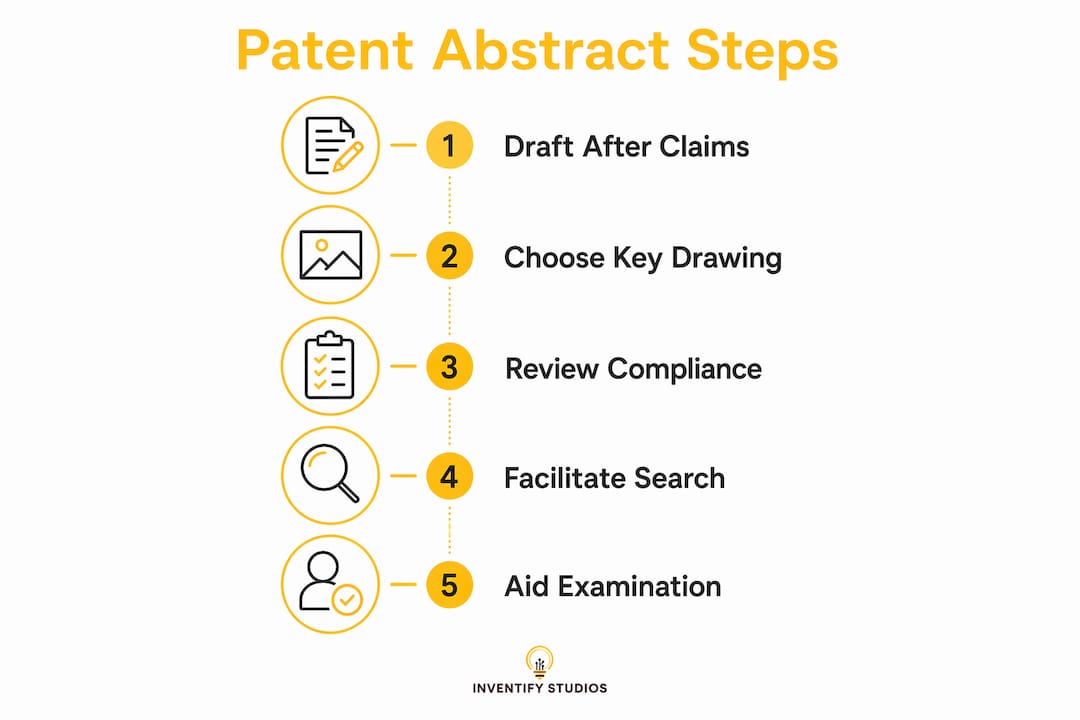
How to draft an effective patent abstract
The single biggest drafting mistake is copying the claims into the abstract. USPTO MPEP §1826 explicitly discourages this, and doing so draws objections while stripping the abstract of its actual function. The abstract must narrate the technical essence of the invention in plain, direct language.
Core drafting principles:
- Focus on what is new in the art. If the invention modifies an existing apparatus, describe the modification, not the prior art baseline
- Write for a technically literate reader who is not a patent attorney. Avoid legal phraseology; use plain technical language
- Cover the invention's organization, operation, and principal use in a single, tight paragraph
- If the invention involves alternatives, address the preferred one and briefly note that others exist
- Do not include statements about commercial value, market potential, or speculative benefits
Common mistakes to avoid:
- Paraphrasing claims word-for-word (the "paraphrase trap" flagged in MPEP §1826)
- Exceeding 150 words, which risks publication truncation
- Using vague openers like "The present invention provides a method for..."
- Including multiple drawings instead of one representative figure
- Combining the abstract with other sections of the application
When selecting a drawing to accompany the abstract, choose the single figure that best conveys the invention's core operation. Avoid figures with dense labels or complex sub-assemblies that require the full specification to interpret.
Pro Tip: Draft the abstract after you have finalized the claims and specification. At that point, you know exactly what is new and what the invention's core solution is. Writing it first often leads to a vague summary that no longer matches the final disclosure.
The applicant bears primary responsibility for abstract preparation. An examiner will review for compliance, but a poorly written abstract that technically passes review can still hurt search discoverability. You can find practical abstract writing steps that walk through this process in detail.
How does the patent abstract function in examination and prior art searching?
The abstract's practical value shows up most clearly in the examination and search process. USPTO examiners use it as a first-pass filter to assess whether a prior art document is relevant before pulling the full specification. A well-drafted abstract accelerates that assessment; a vague or claim-heavy one forces examiners to dig deeper, slowing the process.

Beyond examination, abstract quality directly influences search indexing accuracy in patent databases. Automated classification systems parse abstracts to assign patent classification codes. If the abstract fails to capture the invention's technical field and core solution clearly, the patent may be misclassified, reducing its discoverability for competitors, researchers, and future applicants conducting prior art searches.
For competitors and the public, the abstract is the first document they read when scanning search results. A clear abstract lets them decide quickly whether to consult the full application. That efficiency benefits the entire patent ecosystem, not just the applicant.
One point that frequently causes confusion: the abstract has no role in litigation. Courts determine enforcement scope from the claims and specification. An abstract that overstates or understates the invention's scope does not expand or limit what the patent actually covers.
Common questions about patent abstracts
Does a provisional patent application require an abstract? No. Provisional applications do not require an abstract. Only non-provisional applications must include one under USPTO rules.
What is the difference between the abstract and the claims? The abstract summarizes the invention's technical disclosure for search and scanning purposes. The patent claims define the legal boundaries of protection. Courts use claims, not the abstract, to determine what is and is not covered.
Can the abstract be used to interpret claim scope? No. The abstract carries no legal weight in scope determination. It is a technical informational tool only.
What content is prohibited in the abstract? Statements on alleged merits, speculative applications, legal claim language ("said," "means"), and implied phrases like "This disclosure concerns" are all prohibited.
How does the abstract affect patent searching? A well-written abstract improves classification accuracy and discoverability in patent databases, helping examiners and researchers find relevant prior art faster.
What happens if the abstract is missing or deficient? For PCT applications, a missing abstract does not affect the filing date, but the application may be declared withdrawn if the abstract is not submitted within one month of notification.
Inventifystudios insights on patent abstract drafting
Understanding USPTO and international standards is the foundation of a compliant, effective abstract. But compliance alone does not make an abstract useful. The best abstracts are written by inventors who understand both the technical core of their invention and the audience reading it.
Inventifystudios works with inventors at the earliest stages of disclosure, where abstract drafting decisions have the most impact. Several patterns appear consistently in applications that run into problems:
- Applicants who draft the abstract before finalizing the specification often produce summaries that no longer match the final disclosure
- Abstracts written by copying claims produce objections and reduce search accuracy
- Inventors who skip the abstract on provisional filings sometimes carry vague summaries forward into non-provisional applications without revision
Pro Tip: Treat the abstract as your invention's technical headline. If a researcher in your field cannot understand the core solution from your abstract alone, rewrite it before filing. Clarity at this stage pays dividends in examination speed and prior art search accuracy.
Inventifystudios supports inventors through AI-powered patent analysis and drafting tools that help you articulate what is genuinely new in your invention before you write a single word of the abstract. That clarity is what separates a compliant abstract from an effective one. Explore how Inventifystudios can support your invention detail process from concept through patent-ready draft.

How does the abstract relate to other parts of the patent document?
The abstract sits at the end of the application as filed but appears at the front of the published patent. That placement reflects its purpose: it is the entry point for anyone scanning the document, not a component of the legal record.
The relationship between the abstract and the other sections is one of summary, not authority. The specification provides the full technical disclosure. The claims define the legal scope. The drawings illustrate the invention's structure and operation. The abstract draws from all three but controls none of them. A discrepancy between the abstract and the claims does not create a legal conflict; the claims govern.
Patent drawings deserve particular attention here. When a drawing accompanies the abstract, it must be the single most representative figure from the full drawing set. The role of patent drawings in the broader application is to support the specification's technical disclosure, and the abstract drawing serves the same purpose in miniature: one clear image that conveys the invention's core operation at a glance.
What do well-written patent abstracts actually look like?
A strong abstract follows a consistent structure: field of invention, technical problem, solution, and principal use. Here are two examples that illustrate the standard.
Example 1: Mechanical device
"A portable water filtration device uses a dual-stage membrane assembly to remove particulates and biological contaminants from untreated water sources. The first stage employs a 0.2-micron hollow-fiber membrane; the second stage uses activated carbon to reduce chemical contaminants. The device operates without electricity and produces up to two liters per minute. Primary applications include field use in emergency response and outdoor recreation."
This abstract identifies the field (portable water filtration), the technical solution (dual-stage membrane assembly), the operating parameters, and the principal uses. It contains no legal language and no claims about commercial value.
Example 2: Software process
"A method for real-time anomaly detection in network traffic analyzes packet header data using a trained classification model to identify deviations from baseline behavior. The method operates on standard network hardware without dedicated processing units and generates alerts within 200 milliseconds of anomaly detection. The method applies to enterprise network security monitoring and intrusion detection systems."
Both examples stay within 150 words, avoid claim language, and focus entirely on what is technically new and how it works. Neither makes speculative statements about performance advantages or market value. That restraint is what makes them compliant and useful for prior art searching.
Key Takeaways
The role of a patent abstract is to provide a concise technical summary that enables fast, accurate searching and examination, without carrying any legal weight in claim interpretation or enforcement.
| Point | Details |
|---|---|
| Abstract length limits | Preferably 50–150 words; must fit with one figure on a single A4 or letter page at 1.5 spacing. |
| No legal weight | Courts use claims and the specification to determine scope; the abstract cannot limit or expand patent protection. |
| Provisional applications | Provisional patent applications do not require an abstract; only non-provisional filings must include one. |
| Drafting priority | Write the abstract after finalizing the claims and specification to accurately reflect the final disclosure. |
| Search impact | A well-drafted abstract improves classification accuracy and discoverability in patent databases for examiners and researchers. |