

Patent drawings are a legally mandated visual component of most patent applications, defined under 35 U.S.C. § 113 as required whenever they are necessary to understand the invention. Most inventors know they need drawings. Few understand how much those drawings control the outcome of their application. The role of patent drawings extends far beyond illustration. They define claim scope, influence examiner decisions, and serve as primary evidence in court. Under 37 CFR § 1.84, the USPTO sets strict formatting standards that govern everything from line weight to margin size. For design patents, drawings are not supplementary. They are the disclosure itself.
What are the legal requirements for patent drawings under USPTO rules?
Patent drawings are mandatory under 35 U.S.C. § 113 whenever a drawing is necessary to understand the invention. For utility patents covering mechanical devices, electrical circuits, or physical structures, that threshold is almost always met. For design patents, the rules go further. Drawings serve as the principal disclosure, meaning the visual representation is the patent.
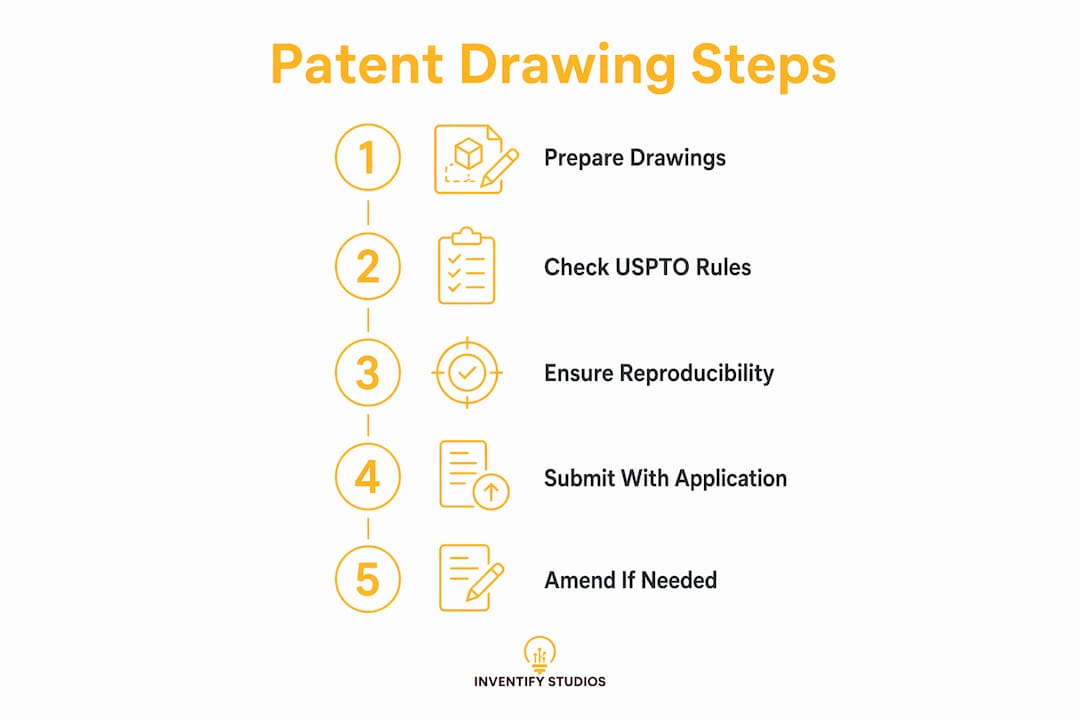
The governing standard is 37 CFR § 1.84. This regulation specifies every formal element a drawing must meet before the USPTO accepts it:
- Margins: Minimum margins of 2.5 cm on the top and left, 1.5 cm on the right and bottom
- Line quality: Black, solid lines with sufficient contrast for reproduction
- Numbering: Each figure must be numbered consecutively, and reference numerals must match the written description
- View types: Cross-sections, exploded views, and perspective views must be clearly labeled
- Paper size: Drawings must appear on 21.0 cm x 29.7 cm or 21.6 cm x 27.9 cm sheets
The logic behind these rules is reproducibility. USPTO drawing rules require that drawings maintain clarity through scanning, reduction, and printing across the patent's entire published life. A drawing that looks fine on screen may become illegible when reduced to a journal page. That is why line weight and margin rules are not bureaucratic formalities. They are functional requirements.
Non-compliance triggers formal objections called Office Actions. Drawing defects under 37 CFR § 1.84 add 2–4 months to prosecution timelines. That delay also increases costs, since each correction cycle requires attorney time and filing fees.
Pro Tip: Submit informal drawings with your provisional patent application to secure a filing date, then upgrade to formal drawings compliant with 37 CFR § 1.84 before your non-provisional filing. This saves time without sacrificing your priority date.
How do patent drawings impact approval and prosecution speed?
Patent examiners rely on drawings as the visual foundation for understanding an invention before reading a single claim. A well-constructed drawing set reduces the examiner's interpretive burden and shortens the time needed to evaluate the application. Poor drawings do the opposite.
The prosecution impact follows a clear sequence:
- Initial review: The examiner scans drawings first to build a mental model of the invention.
- Claim mapping: Each claim element must correspond to a reference numeral in the drawings. Missing elements trigger written description rejections.
- Prior art search: Examiners use drawings to identify comparable inventions. Clear drawings narrow the search to relevant art.
- Office Action generation: Ambiguous drawings produce more rejections, each adding months to prosecution.
- Allowance: Applications with complete, clear drawings reach allowance faster because examiners spend less time requesting clarification.
Consider a mechanical device patent with 15 claims. If the drawings omit two components referenced in claims 8 and 12, the examiner issues a rejection under 35 U.S.C. § 112. The applicant must then file a response, wait for re-examination, and potentially amend claims. That single oversight can add six months to the process.
Drawings act as the visual spine of a patent application. Even polished written claims cannot compensate for drawings that leave the examiner guessing.

Pro Tip: Cross-reference every claim element with a specific reference numeral in your drawings before filing. If a claim mentions "a locking mechanism," that mechanism must appear in at least one figure with a corresponding number.
Why do high-quality drawings matter for enforceability and litigation?
Patent enforceability depends on how clearly the patent defines the invention. Courts interpret claims in light of the drawings, and ambiguous drawings limit claim scope under 35 U.S.C. § 112. A patent with vague or inconsistent illustrations gives opposing counsel a direct path to invalidity arguments.
The specific risks are concrete:
- Inconsistent reference numerals: Using different numbers for the same component across figures creates ambiguity. Opposing counsel can argue the patent fails the written description requirement.
- Missing embodiments: Drawings form part of the statutory written description. Any embodiment not depicted at filing cannot be added later. That gap permanently limits claim breadth.
- Incomplete cross-sections: A mechanical patent that shows only external views may fail to disclose internal structure, weakening claims that depend on that structure.
- Inconsistent shading: Shading inconsistencies across figures can be used to argue that different parts are being depicted, creating doubt about what the patent actually covers.
"Drawings are not decoration. They are legal evidence. Every line, label, and reference numeral either strengthens or weakens the patent's enforceability in court. Inventors who treat drawings as a formality often discover their mistake during litigation, when it is too late to fix them."
Licensing partners face the same scrutiny. Licensing partners assess commercial viability through patent drawings before reading claims or specifications. A patent with clear, professional drawings signals that the inventor understood the invention well enough to depict it completely. That perception directly affects licensing negotiations and deal terms.
Understanding why inventors need patent protection starts with recognizing that the drawings are where that protection either holds or breaks down.
How to create patent drawings that meet legal and strategic requirements
Creating compliant patent drawings requires attention to both legal standards and strategic completeness. The two goals reinforce each other. A drawing that satisfies 37 CFR § 1.84 and also depicts every claim element gives the patent its best chance at approval and enforceability.
Formal vs. informal drawings
Formal drawings meet all USPTO requirements under 37 CFR § 1.84 and are required for non-provisional applications. Informal drawings are acceptable for provisional applications and serve to establish a filing date. The distinction matters because inventors often file provisionals quickly, then neglect to upgrade their drawings before the non-provisional deadline.
| Feature | Formal drawings | Informal drawings |
|---|---|---|
| Required for | Non-provisional applications | Provisional applications only |
| Line quality standard | Black, solid, reproducible lines | Flexible, but must be legible |
| Margin compliance | Strict per 37 CFR § 1.84 | Not enforced |
| Reference numerals | Required, must match specification | Recommended but not mandatory |
| Accepted by USPTO | Yes, for examination | Yes, for filing date only |
Best practices for drawing preparation
Every claim element must appear in at least one figure. This is not optional. Missing a depicted embodiment at filing bars any later attempt to add it, permanently restricting the patent's scope. Map your claims to your figures before submitting.
Reference numerals must be consistent across all figures. Assign each component a single number and use it everywhere that component appears. Inconsistent labeling is one of the most common grounds for both Office Actions and validity challenges. Good invention claim drafting depends on drawings that mirror the written description exactly.
Working with a professional patent illustrator reduces compliance errors significantly. Illustrators who specialize in USPTO submissions understand line weight, shading conventions, and figure labeling requirements. For inventors who prefer digital tools, vector-based drawing software produces clean, scalable lines that hold up through the reproduction process. Keeping an organized inventor's notebook with detailed sketches before formal drawing preparation also helps ensure no feature gets overlooked.
Pro Tip: Include more figures than you think you need. Show the invention from multiple angles, include cross-sections for internal components, and add an exploded view if the assembly has multiple parts. Examiners and courts both benefit from thorough visual disclosure.
Key Takeaways
Patent drawings are a legal and strategic asset that directly control the scope, approval speed, and enforceability of every patent application.
| Point | Details |
|---|---|
| Legal mandate | 35 U.S.C. § 113 requires drawings whenever necessary to understand the invention. |
| Compliance cost | Non-compliance with 37 CFR § 1.84 adds 2–4 months to prosecution timelines. |
| Enforceability risk | Inconsistent labeling and missing embodiments create grounds for invalidity challenges under 35 U.S.C. § 112. |
| Strategic value | Drawings are reviewed by licensing partners and investors before written claims, affecting commercial credibility. |
| Filing strategy | Informal drawings secure a provisional filing date; formal drawings must be upgraded before non-provisional submission. |
What inventors consistently get wrong about patent drawings
Most inventors I work with treat drawings as a box to check. They spend weeks refining their claims, then hand off a rough sketch to a generalist illustrator the day before filing. That sequence is backward.
Drawings set the ceiling for what a patent can protect. If a feature is not depicted at filing, it cannot be claimed later. That is not a procedural inconvenience. It is a permanent limitation on the patent's value. I have seen strong inventions lose licensing deals because the drawings were incomplete, and the prospective partner's legal team flagged the gaps immediately.
The commercial reality is equally underappreciated. Investors and licensing partners look at drawings before they read a single word of the specification. Professional, complete drawings signal that the inventor has a thorough command of the invention. Rough or inconsistent drawings signal the opposite, regardless of how well the claims are written.
My recommendation is simple. Treat drawings as a first-class deliverable, not an afterthought. Budget time and money for them at the start of prosecution, not the end. The cost of getting drawings right upfront is always lower than the cost of fixing them after an Office Action or, worse, during litigation.
— Hua
Inventifystudios supports inventors with patent-ready drawings
Preparing compliant, complete patent drawings is one of the most technically demanding parts of the application process. Inventifystudios makes it accessible.

Through the Invention Detail service, Inventifystudios helps inventors document their concepts with the clarity and completeness that USPTO examiners and licensing partners expect. The platform combines AI-powered analysis with structured guidance to help you identify every claim element that needs visual disclosure. Whether you are filing your first provisional or preparing a non-provisional application, Inventifystudios gives you the tools to move forward with confidence and without the cost of traditional consulting.
FAQ
What are patent drawings required for?
Patent drawings are required under 35 U.S.C. § 113 whenever they are necessary to understand the invention. Design patents rely on drawings as their primary disclosure.
What happens if my patent drawings don't meet USPTO standards?
Non-compliant drawings trigger an Office Action under 37 CFR § 1.84. That correction process adds 2–4 months to prosecution and increases filing costs.
Can I add new drawings after filing my patent application?
No. Drawings form part of the statutory written description. Any embodiment not depicted at the original filing date cannot be added later without risking a new matter rejection.
How do patent drawings affect litigation?
Courts interpret patent claims in light of the drawings. Ambiguous or inconsistent drawings weaken claim scope and give opposing counsel grounds to challenge validity under 35 U.S.C. § 112.
What is the difference between formal and informal patent drawings?
Formal drawings comply fully with 37 CFR § 1.84 and are required for non-provisional applications. Informal drawings are accepted for provisional filings to secure a priority date but must be upgraded before non-provisional submission.