

Patent claims are the only section of a patent that legally defines the scope of exclusive rights granted to an inventor. Everything else in a patent document, including the drawings, abstract, and specification, provides context and support. The role of patent claims is to draw a precise legal boundary around your invention, telling the public exactly what is protected and what constitutes infringement. Without strong claims, even a brilliant invention has no enforceable shield. Inventors and entrepreneurs who understand how patent claims work gain a real advantage in protecting their ideas and maximizing their patent's commercial value.
What legal functions do patent claims serve?
Patent claims define the boundaries of legal protection for an invention, serving a dual purpose: they notify the public of what is protected and establish the legal basis for infringement actions. Think of them as the legal fence around your intellectual property. No fence means no property line, and no property line means no trespassing case.
The all-elements rule is the cornerstone of patent infringement analysis. Under this rule, a product or process infringes a patent only if it contains every element listed in at least one claim. If a single element is missing, there is no infringement. This makes precise claim drafting critical. A claim with too many elements is easy to design around. A claim with too few may fail to distinguish the invention from prior art.

Claims also serve a central function during USPTO prosecution and litigation. USPTO examiners assess claims independently under statutes §§ 101, 102, 103, and 112, checking for novelty, non-obviousness, and written description support. Claims that fail these tests get rejected. Claims that survive become the enforceable core of your patent.
Key legal functions of patent claims include:
- Exclusivity: Claims grant the right to exclude others from making, using, or selling the claimed invention.
- Notice: Claims inform competitors precisely where the legal boundary sits.
- Infringement standard: The all-elements rule applies claim-by-claim to determine infringement.
- Prosecution record: Claims shape the patent's prosecution history, which courts use to interpret scope.
- Litigation anchor: In court, the claims are the only text that determines what was infringed.
Pro Tip: Write each claim as a complete, self-contained sentence. Claims must be self-contained and cannot rely on drawings or specification text to fill in missing elements. Any gap in a claim's language is a gap in your protection.
How are different types of patent claims structured?
Independent claims act like fence posts establishing the broadest scope of protection, while dependent claims add specific limitations that create layered protection from multiple angles. Together, they build a multi-layered legal barrier around the invention that is much harder to design around than a single broad claim.
An independent claim stands alone. It defines the invention without referencing any other claim. It should be as broad as prior art allows. A dependent claim, by contrast, references an independent claim and narrows it by adding one or more specific features. If the broad independent claim gets rejected or invalidated, the dependent claims serve as fallback positions that may still survive.
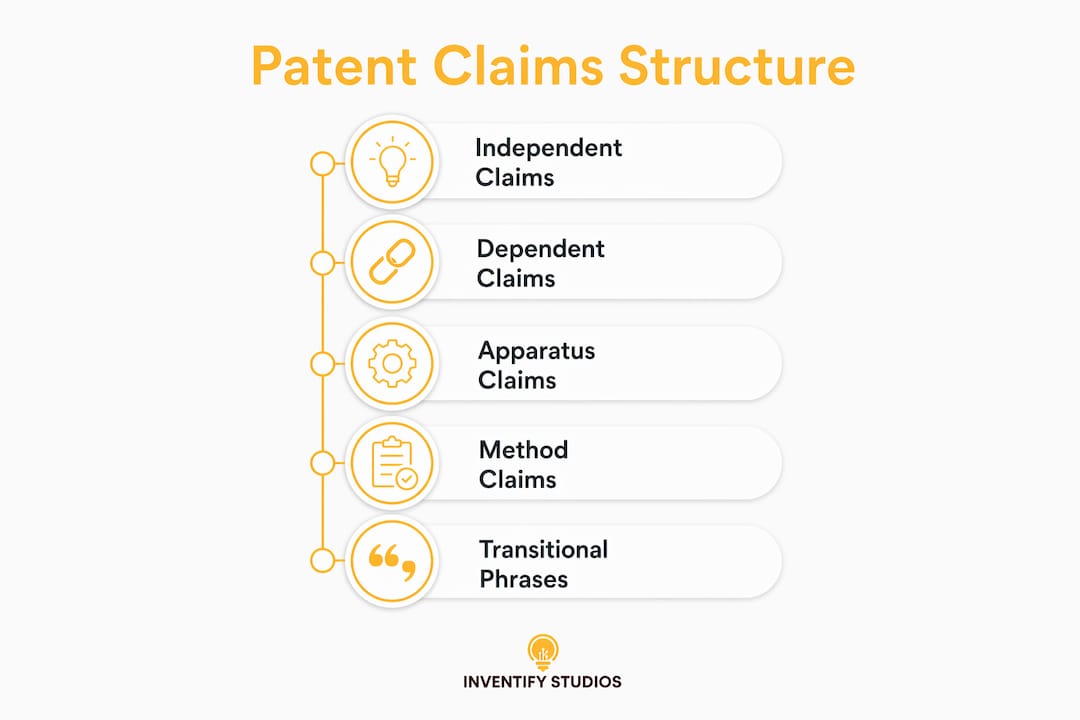
Multiple claim categories add another layer of protection. An apparatus claim covers the physical device. A method claim covers the process of using it. A system claim covers how components interact. Filing all three categories for the same invention makes it significantly harder for a competitor to work around your patent.
Transitional phrases determine whether a claim is open or closed to additional elements:
| Transitional phrase | Scope | Effect |
|---|---|---|
| "comprising" | Open | Covers products with additional elements beyond those listed |
| "consisting of" | Closed | Covers only products with exactly the listed elements |
| "consisting essentially of" | Semi-closed | Covers listed elements plus those that do not materially change the invention |
Most patent attorneys favor "comprising" for independent claims because it captures the broadest possible scope. A competitor cannot escape infringement simply by adding an extra component.
Pro Tip: Use dependent claims to protect every significant variation of your invention. Multiple claim categories combined with well-structured dependents create a stronger, harder-to-design-around portfolio. Think of each dependent claim as a separate line of defense.
What practical strategies should inventors follow when drafting claims?
Strong claim drafting balances breadth with enforceability. A claim that is too broad will be rejected by the USPTO or invalidated in court. A claim that is too narrow invites design-arounds. The goal is to find the widest scope that prior art and the specification can support.
Follow these steps to build an effective claim set:
- Start with the broadest independent claim. Identify the fewest elements that distinguish your invention from all known prior art. Every element you add narrows your protection.
- Add dependent claims for each key feature. Each significant variation, material choice, or configuration should appear in a dependent claim. These protect specific embodiments and provide licensing flexibility.
- Use functional language where appropriate. Functional claim language describes what an element does rather than its physical structure. Terms like "configured to" can cover broad implementations, but your specification must provide detailed structural or algorithmic disclosure to avoid indefiniteness rejections under 35 USC 112.
- Anticipate design-arounds. Ask yourself how a competitor might modify your invention to avoid each claim. Then draft additional claims or dependents that capture those modifications.
- Manage your claim count strategically. USPTO filing fees cover up to 20 claims with a maximum of 3 independent claims. Excess claims incur additional fees. Prioritize your strongest and broadest claims within these limits to avoid unnecessary costs.
- Verify specification support for every claim element. Every term in a claim must have a clear antecedent basis and full written description support in the specification. Unsupported claims face rejection under § 112.
Pro Tip: Read your independent claim aloud and ask: "Could a competitor sell a product that does everything in this claim but is clearly different from my invention?" If yes, the claim is too narrow. Revise it until the answer is no.
The DIY patent strategy guide for inventors covers additional tactics for managing claim scope during prosecution, including how to respond to office actions without giving up more ground than necessary.
How do patent claims affect commercial value and licensing?
The commercial value of a patent depends directly on the quality and scope of its claims. Weak or narrow claims allow competitors to design around the patent, reducing its value to near zero. Strong, broad claims create durable protection that holds up in licensing negotiations and litigation.
Claims determine what gets licensed. When you license a patent, you are licensing the right to practice the claims. A licensee paying royalties for a narrow claim covering only one specific configuration gets far less value than one licensing a broad claim covering an entire product category. Claim quality directly affects the royalty rate you can command.
The importance of patent claims in licensing negotiations is often underestimated by first-time inventors. Consider these commercial realities:
- Broad independent claims give you leverage in negotiations because they cover more of the market.
- Dependent claims on specific features let you license individual features separately, creating multiple revenue streams from one patent.
- Weak claims that are easy to design around reduce your negotiating position to near zero before talks even begin.
- Claim quality affects acquisition value. Buyers and investors evaluate patent portfolios claim by claim. A patent with broad, well-supported claims commands a higher price.
Overly broad claims risk invalidation while overly narrow claims invite design-arounds. Skilled claim drafting balances these two risks to maximize strength and enforceability over the full patent term. The invention protection guide explains how claim quality directly affects your ability to identify and act on infringement.
The technology sector, where patent claims define legal ownership and protection for innovations, shows this dynamic clearly. Companies with strong claim portfolios consistently outperform those with weak or narrow patents in licensing revenue and market exclusivity.
Key Takeaways
Patent claims are the legal core of every patent, and their quality determines both the enforceability and commercial value of your invention.
| Point | Details |
|---|---|
| Claims define legal scope | Only the claims legally establish what is protected; the rest of the patent provides context. |
| All-elements rule governs infringement | Every element in a claim must be present in a product for infringement to exist. |
| Independent and dependent claims work together | Independent claims set broad scope; dependents add layered fallback protection. |
| Claim count has USPTO limits | USPTO fees cover up to 20 claims and 3 independent claims; plan your set within these limits. |
| Claim quality drives commercial value | Broad, well-supported claims command higher licensing fees and stronger negotiating positions. |
Why I think most inventors misunderstand what claims actually do
Most inventors treat patent claims as a formality. They spend months perfecting their invention, then rush through the claims as if they are just a legal checkbox. That is the single most expensive mistake an inventor can make.
Claims are legal instruments defining ownership, not technical descriptions. The specification tells the story of your invention. The claims are the deed to the property. You would not rush through a real estate deed. Do not rush through your claims.
The analogy that resonates most with me is the land claim. Staking a land claim announces your discovery, but the actual fence you build around it is what legally establishes your property and prevents others from encroaching. A vague fence with gaps is an invitation, not a deterrent.
I have seen inventors with genuinely world-changing ideas end up with patents worth almost nothing because their independent claims were so narrow that a competitor changed one component and walked right through. The invention was brilliant. The claims were not.
The fix is not complicated, but it requires discipline. Draft your broadest independent claim first, test it against every prior art reference you can find, and then build your dependent claims as a deliberate fallback system. View every claim through the lens of enforceability, not just technical accuracy. Ask whether a judge and jury could apply this claim to a real product in a real courtroom. If the answer is uncertain, rewrite it.
Technology evolves fast. Your claims need to survive not just today's products but the versions competitors will build five years from now. Functional language, when properly supported, gives you that reach. Use it deliberately.
— Hua
How Inventifystudios helps inventors build stronger patent protection
Inventifystudios gives inventors the tools to move from idea to protected invention without the cost of traditional consulting. The platform's AI-powered patent analysis helps you assess patentability, identify prior art gaps, and generate provisional patent drafts with claim-ready language built in.
For inventors ready to go deeper, the invention detail service walks you through claim drafting with AI-generated insights tailored to your specific invention. You get layered claim structures, apparatus and method coverage, and guidance on how to position your independent claims for maximum scope. The claim drafting guidelines on the Inventifystudios blog give you a practical starting point before you file. Strong claims start with a clear understanding of what you are protecting. Inventifystudios helps you get there faster.
FAQ
What is the role of patent claims in a patent application?
Patent claims are the only part of a patent that legally defines the scope of exclusive rights. They establish what is protected and what constitutes infringement.
What is the difference between independent and dependent claims?
Independent claims stand alone and define the broadest scope of protection. Dependent claims reference an independent claim and add specific limitations, serving as fallback positions if broader claims are challenged.
How many claims can you include in a USPTO patent application?
USPTO filing fees cover up to 20 total claims with a maximum of 3 independent claims. Claims beyond these limits incur excess claim fees.
What happens if a patent claim is too broad or too narrow?
Overly broad claims risk rejection or invalidation for lack of support. Overly narrow claims invite competitors to design around the patent, reducing its commercial value significantly.
Why do patent claims matter for licensing and commercial value?
Claims determine exactly what is licensed and enforced. Broad, well-supported claims command higher royalties and stronger negotiating leverage than narrow or weak claims.