

A DIY patent strategy is a structured, self-managed plan that guides inventors through researching, drafting, and filing a patent application without hiring a professional attorney. Known formally as "pro se" filing, this approach is used by independent inventors and early-stage entrepreneurs who want to protect their ideas while keeping costs low. The USPTO accepts pro se applications, and with the right preparation, inventors can secure real legal protection. This guide covers what is diy patent strategy, how it works in practice, and what separates a successful filing from a costly mistake.
What are the essential components of a DIY patent strategy?
A solid DIY patent process starts with prior art research, not drafting. Before writing a single word of your application, you need to confirm your invention is actually new. The USPTO's Patent Full-Text Database and Google Patents are free tools that let you search existing patents by keyword, classification code, and inventor name. If a nearly identical invention already exists, filing is a waste of time and money.
Once you confirm novelty, the next step is drafting a provisional patent application. A provisional patent gives you "patent pending" status and locks your filing date, but it expires after 12 months if you do not follow up with a full utility application. That 12-month window is your runway to refine the invention, test the market, and decide whether a full patent is worth pursuing.

The claims section is the most legally consequential part of any patent. Narrow claims can be bypassed by competitors who make minor design changes, while overly broad claims invite USPTO rejections. Getting the balance right requires careful drafting and a clear understanding of what makes your invention distinct. For detailed guidance on this, Inventifystudios offers a dedicated resource on claim drafting that breaks down the process for independent inventors.
Filing fees are another key variable. Provisional application fees are $65 for Micro Entities, $130 for Small Entities, and $325 for Large Entities as of 2026. Qualifying as a Micro Entity requires meeting income and prior filing limits set by the USPTO. Checking your entity status before filing can cut your costs significantly.
- Conduct a prior art search using USPTO and Google Patents before drafting
- Draft a provisional application with full technical detail, not a rough summary
- Write claims that balance breadth with USPTO acceptance likelihood
- Verify your entity status to pay the correct, lowest applicable fee
- Set a calendar reminder for the 12-month provisional deadline
Pro Tip: Write your provisional application as if it were a full utility patent. Courts and examiners will hold you to what you disclosed, not what you intended to disclose.
How does DIY patent strategy compare to hiring a patent attorney?
Filing a patent yourself saves substantial attorney fees, but the tradeoff is real. Pro se applications represent 10–15% of all USPTO filings but carry roughly a 30% approval rate. Attorney-assisted filings succeed at over 50%. That gap reflects the complexity of patent law, not the quality of the underlying invention.
| Factor | DIY filing | Attorney-assisted filing |
|---|---|---|
| Upfront cost | Low ($65–$325 for provisional) | High ($3,000–$15,000+ typical) |
| Approval rate | Around 30% | Over 50% |
| Claims quality | Varies widely | Professionally calibrated |
| Risk of under-disclosure | High without guidance | Low with experienced counsel |
| Best suited for | Simple, well-documented inventions | Complex, high-value innovations |
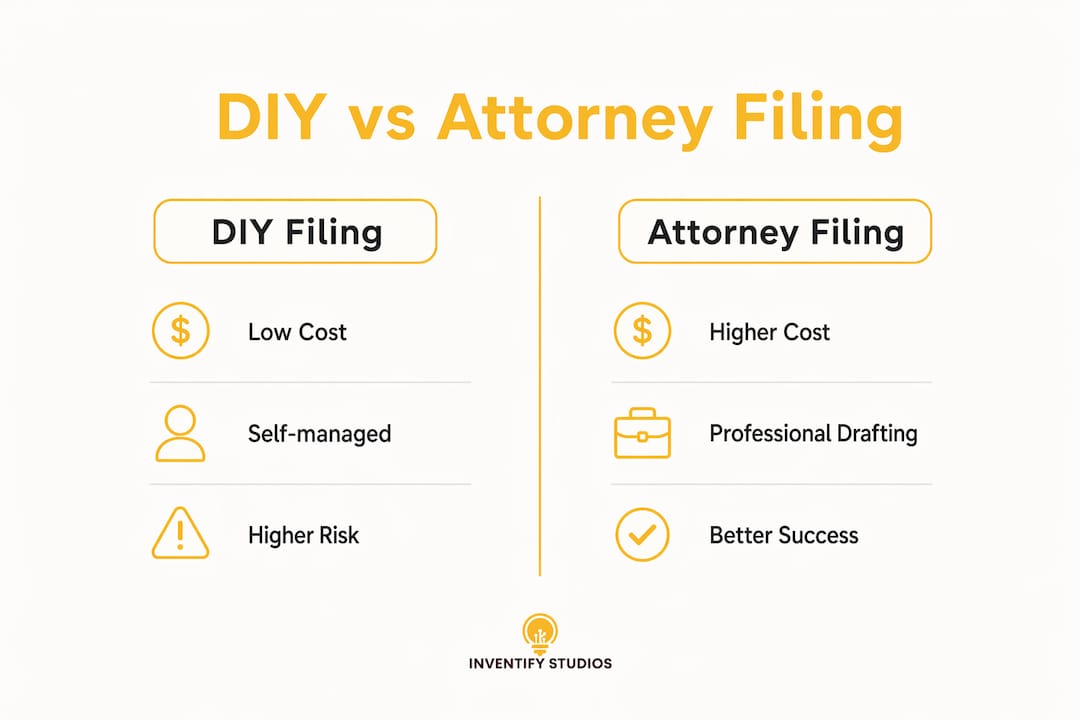
The cost difference is real, but so is the risk. Under-describing your invention in a DIY provisional application can invalidate your future patent priority. That means a competitor could file a similar invention after you and still win the patent because your disclosure was incomplete.
Professional attorneys also bring claim drafting experience that is hard to replicate through self-study. They know how examiners think, which arguments work during prosecution, and how to write claims that hold up in court. For high-value inventions with clear commercial potential, the attorney fee is often the better investment.
DIY filing makes the most sense for inventors with simple, well-documented inventions, limited budgets, and a willingness to invest serious time in learning the process. If your invention is complex, involves multiple components, or sits in a crowded technology space, professional help is worth the cost.
Pro Tip: Use DIY filing for your provisional to lock your priority date cheaply, then consult a patent attorney before converting to a utility application. You get the cost savings upfront and professional quality when it counts most.
What practical steps should inventors follow for a DIY patent strategy?
Executing a self-filing patent guide requires following a clear sequence. Skipping steps or reordering them is the most common source of DIY errors.
-
Assess invention uniqueness. Search USPTO's Patent Full-Text Database and Google Patents using multiple keyword combinations. Read the claims sections of similar patents, not just the abstracts. A patent can look different in its title and still cover your invention in its claims.
-
Draft a detailed technical disclosure. Describe every component, material, and function. Include alternative embodiments, meaning variations of the invention that achieve the same result differently. This protects you against competitors who make small changes to design around your patent.
-
Prepare clear drawings. The USPTO requires drawings that show every claimed feature. Use numbered reference labels that match your written description exactly. Free tools like LibreOffice Draw or paid options like Adobe Illustrator work for this purpose. Drawings do not need to be artistic, but they must be precise and consistent.
-
File through the USPTO EFS-Web portal. Create an account, select "Provisional Application for Patent," and upload your documents. Embed all fonts in your PDF before uploading. The USPTO portal rejects applications with non-embedded fonts instantly, with no warning or grace period.
-
Track your 12-month deadline. Set multiple reminders for the date your provisional expires. If you miss the window, you lose your priority date and must refile as if the provisional never existed. Use a simple spreadsheet or a calendar app to track this date from day one.
-
Apply the friend test. Before filing, have a technically literate person who is unfamiliar with your invention read your disclosure and explain it back to you. If they cannot accurately describe how it works, your disclosure is not clear enough. Rewrite before you file.
Pro Tip: Not every invention needs a patent. Focus protection on core innovations that competitors cannot easily design around, and consider trade secrets for peripheral features. This keeps your filing costs focused and your protection meaningful.
What common mistakes should you avoid in your DIY patent strategy?
The most damaging DIY errors are not formatting mistakes. They are substantive errors in how the invention is described and claimed.
- Treating the provisional as a rough draft. A provisional application is a legal document, not a placeholder. Courts evaluate what you actually disclosed, not what you planned to disclose later. An incomplete provisional can destroy your priority date.
- Using inconsistent terminology. Inconsistent terminology across your application creates legal gaps that undermine future claims. If you call a component a "lever" in one section and a "bar" in another, an examiner or court may treat them as different elements.
- Drafting claims that are too narrow or too broad. Narrow claims are easy for competitors to work around. Broad claims get rejected by the USPTO. Both outcomes waste your filing fee and your priority date.
- Skipping or rushing the prior art search. Filing without a thorough search means you may unknowingly describe an existing invention. That makes your application invalid from the start, regardless of how well it is written.
- Ignoring entity status qualifications. Filing as a Large Entity when you qualify as a Micro Entity means paying five times more than necessary. Verify your status before every filing, including continuation applications.
- Submitting PDFs with non-embedded fonts. The USPTO portal rejects these files automatically. Always check your PDF export settings and confirm fonts are embedded before uploading.
Understanding DIY patents means accepting that the legal details matter as much as the technical ones. A brilliant invention described poorly is a patent that will not hold up.
Key takeaways
A DIY patent strategy succeeds when inventors treat every document as a legal filing, not a technical summary.
| Point | Details |
|---|---|
| Prior art search comes first | Search USPTO and Google Patents before drafting to confirm your invention is genuinely new. |
| Provisional quality determines priority | File a complete, detailed provisional to protect your priority date for the full 12-month window. |
| Claims balance is critical | Draft claims broad enough to block competitors but specific enough to pass USPTO examination. |
| Entity status cuts fees | Qualifying as a Micro Entity reduces provisional filing fees from $325 to $65. |
| DIY approval rates are lower | Pro se filings succeed at around 30% versus over 50% for attorney-assisted applications. |
Why most DIY patent failures are avoidable
Hua here. After watching hundreds of inventors go through the patent process, the pattern is consistent. The inventors who struggle with DIY filing are not the ones who lack technical knowledge. They are the ones who underestimate how much legal precision the process demands.
The most common error I see is treating the provisional application like a product spec sheet. Inventors write what the invention does, but they skip how it does it, what the components are, and what the alternatives look like. That omission is what kills priority dates. A competitor files six months later with a complete disclosure and wins the patent. The original inventor had the idea first but documented it poorly.
The second pattern is overconfidence in claim drafting. Writing a claim that is both broad enough to matter and specific enough to survive examination is genuinely difficult. It requires understanding how examiners interpret language and how courts construe claims in litigation. That is not something you learn from reading one guide.
My honest view: DIY filing is a legitimate path for inventors with simple, well-documented inventions and a real willingness to study the process. It is not a shortcut. The inventors who succeed treat it with the same rigor they would apply to any technical project. They research thoroughly, write precisely, and test their disclosure before filing. The ones who treat it casually end up with a patent that either gets rejected or cannot be enforced. Protecting your idea is worth doing right. If you want to understand the full picture of self-drafted patent risks before committing, that context will sharpen your decision.
— Hua
How Inventifystudios helps inventors document and protect their ideas
Knowing the steps is one thing. Executing them with the precision a patent requires is another.
Inventifystudios built its Invention Detail service specifically for inventors at this stage. The platform helps you document your invention with the depth and consistency that patent applications demand, without the cost of traditional consulting. You get AI-powered analysis of your invention's patentability, structured drafting guidance for provisional applications, and clarity on what to protect and what to leave out. For inventors who want to file confidently, Inventifystudios removes the guesswork from the documentation phase so your filing reflects the full strength of your idea.
FAQ
What is a DIY patent strategy?
A DIY patent strategy is a self-managed plan for researching, drafting, and filing a patent application without a professional attorney. It is formally called "pro se" filing and is accepted by the USPTO.
How much does it cost to file a provisional patent yourself?
Provisional patent application fees are $65 for Micro Entities, $130 for Small Entities, and $325 for Large Entities as of 2026. Your entity status depends on income and prior filing history.
What is the success rate for DIY patent filings?
Pro se patent applications have roughly a 30% approval rate compared to over 50% for attorney-assisted filings. The gap reflects the difficulty of claim drafting and legal precision, not invention quality.
Can a provisional patent expire?
A provisional patent expires after 12 months if you do not file a full utility application within that window. Missing the deadline means losing your priority date entirely.
What is the biggest mistake in DIY patent filing?
Under-describing the invention is the most damaging error. An incomplete provisional application can invalidate your priority date, allowing a later filer with a complete disclosure to win the patent instead.