

Patent pending protection is the legal status assigned to an invention the moment a complete patent application is filed with the USPTO, signaling to the public and competitors that patent rights are actively being sought. This status is not a granted patent. It does not give you the right to sue anyone for infringement today. What it does give you is a priority date, a public notice, and a conditional path to provisional rights under 35 U.S.C. §154(d). For aspiring inventors and entrepreneurs, understanding exactly what patent pending status means, and what it does not mean, is the difference between protecting your idea and leaving it exposed.
What is patent pending protection and what legal rights does it actually give you?
Patent pending status is a public notice, not an enforcement tool. The USPTO grants this status immediately upon receiving a complete application and filing fee. It applies to provisional, non-provisional, design, and plant applications. The moment your application is filed, your invention is officially "patent pending."
The legal rights attached to this status are narrower than most inventors expect. You cannot sue a competitor for infringement while your application is under review. What you can do is establish a priority date, which means your invention is on record as of the filing day. That date matters enormously if a competitor files a similar application later.

The most misunderstood benefit is provisional rights. Under 35 U.S.C. §154(d), you may collect reasonable royalties from infringers who had actual notice of your published application, but only after your patent is granted and only if the issued claims are substantially identical to the published application. That second condition is critical. Significant changes to your claims during examination can nullify these rights entirely.
Here is what patent pending status actually provides:
- Priority date: Your filing date is locked in, protecting you against later filers with similar inventions.
- Public notice: Competitors can see your application once published, typically 18 months after filing.
- Provisional rights eligibility: Potential royalties from infringers who had notice, subject to claim consistency.
- Market deterrence: The label signals that rights are coming, which discourages direct copying.
- Negotiation leverage: Investors and licensees treat patent pending status as a credibility marker.
Pro Tip: Carefully manage your claims throughout the examination process. Practitioners advise keeping claims as consistent as possible during prosecution to preserve provisional rights eligibility and maximize any retroactive royalty claims.
How do you file for patent pending status and what is the timeline?
Filing for patent pending status follows a defined process with the USPTO. The steps below reflect the standard path for a utility patent, which is the most common type for new inventions.
- Prepare your application. Draft claims, a detailed description, drawings, and an abstract. The quality of your claims determines the scope of protection you can eventually enforce.
- File with the USPTO. Submit your application online through the USPTO's Patent Center portal and pay the required filing fees. Filing a provisional application is faster and cheaper, and it immediately establishes your priority date.
- Receive your filing receipt. The USPTO confirms receipt and your patent pending status begins on that date.
- Wait for examination. A patent examiner reviews your application. Utility patent examination averages 28 months from filing to first office action.
- Respond to office actions. Examiners often issue rejections or requests for clarification. You must respond within set deadlines or risk abandonment.
- Receive a final decision. Your patent pending status ends when the USPTO issues a Notice of Allowance (patent granted), a final rejection, or when you abandon the application.
The timeline varies by technology area and application complexity. Here is a general reference:
| Application Type | Average Examination Time | Patent Term |
|---|---|---|
| Utility patent | ~28 months | 20 years from filing date |
| Design patent | ~18 months | 15 years from grant |
| Provisional application | No examination | 12-month placeholder only |
| Plant patent | ~28 months | 20 years from filing date |
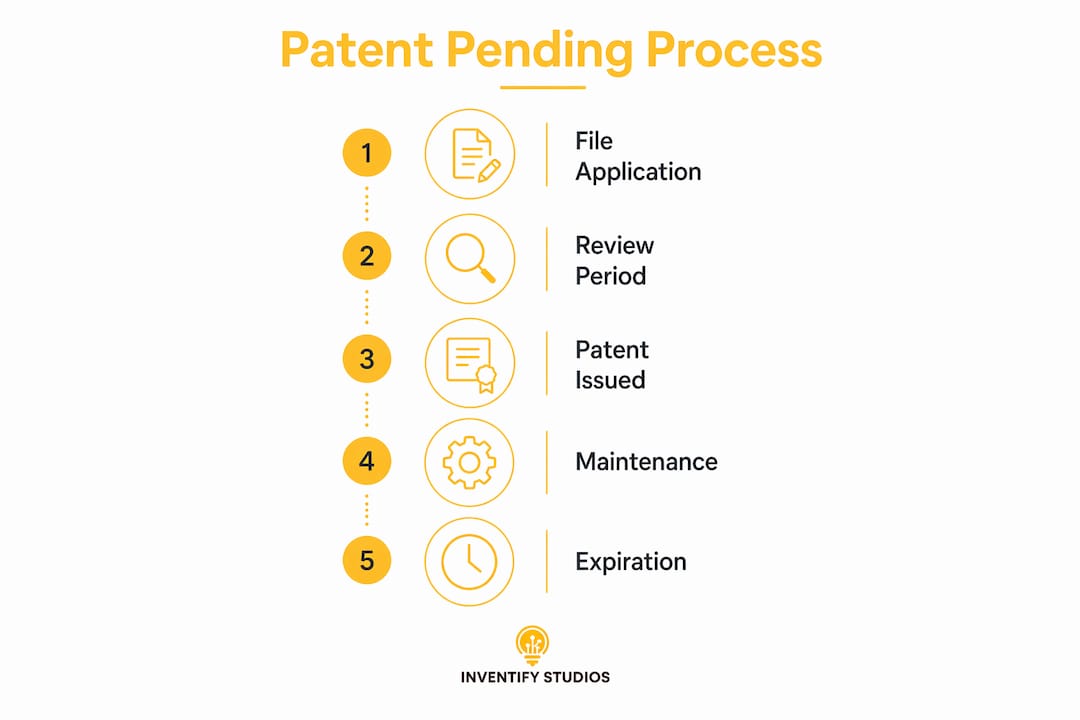
Utility and plant patents last 20 years from the filing date, subject to maintenance fees paid at 3.5, 7.5, and 11.5 years after grant. Missing a maintenance fee deadline causes the patent to lapse, ending your protection early.
Pro Tip: File a provisional patent application first if your invention is not fully ready. A provisional application gives you 12 months of patent pending status at lower cost, letting you refine your invention before committing to a full non-provisional filing.
What are the strategic business benefits of patent pending status?
Patent pending status is a business asset, not just a legal formality. Inventors who treat it only as a legal step miss its commercial value entirely. The label creates real uncertainty in the market. A competitor who sees "patent pending" on your product cannot know exactly what claims will be granted. That uncertainty alone deters many would-be copycats from investing in a similar product.
The credibility signal patent pending sends to investors and partners is equally valuable. Venture capital firms and angel investors treat patent pending status as evidence that an inventor has taken formal steps to protect their idea. It shows commitment and reduces perceived risk. For entrepreneurs in early fundraising rounds, this distinction can influence whether a conversation moves forward.
Licensing discussions also benefit from patent pending status. When you approach a potential licensee, patent pending tells them that exclusive rights may be available once the patent is granted. That future exclusivity has present value. Many licensing agreements are negotiated and signed while a patent is still pending, with royalty terms contingent on grant.
The key commercial benefits of patent pending status include:
- Competitor deterrence: The label signals that copying carries legal risk once the patent is granted.
- Investor credibility: Patent pending status demonstrates that your invention has entered the formal IP system.
- Licensing leverage: Potential licensees value the prospect of future exclusivity.
- Partnership discussions: Partners and distributors treat patent pending as a sign of a serious, defensible product.
- Marketing use: You can legally label your product "patent pending," which builds consumer trust.
The difference between patent pending and a granted patent in commercial discussions is significant. A granted patent gives you an enforceable right. Patent pending gives you a credible claim that those rights are coming. Both have value, but they are not interchangeable in negotiations.
What limitations and misconceptions about patent pending must inventors avoid?
Patent pending is not a blanket shield. Treating it as one is the most common and costly mistake inventors make. A competitor can legally copy your invention while your application is pending. You have no right to stop them until your patent is granted. The only recourse is the provisional rights mechanism, and that requires strict conditions to be met.
Patent pending also does not protect your brand, product design, or trade secrets. Those require separate IP strategies. Trademarks protect your brand name and logo. Trade dress protects distinctive product appearance. Trade secrets protect confidential processes and formulas. Patent pending covers none of these. A complete IP strategy uses all of these tools together.
Pro Tip: Pair your patent pending filing with a well-drafted NDA for any conversations with manufacturers, partners, or investors. Patent pending establishes public notice, but an NDA protects confidential details that are not yet in the public record. A comprehensive IP strategy uses both.
International protection is another area where inventors get caught off guard. Public disclosure of your invention, even a product demo or a crowdfunding campaign, can count as prior art in many countries. This can destroy your ability to file patents abroad. The U.S. gives inventors a 12-month grace period after disclosure to file domestically, but most foreign countries do not. International filing deadlines must be coordinated carefully with your U.S. filing date to preserve foreign rights.
One more risk that inventors overlook is false marking. Displaying "patent pending" after your application has been abandoned or rejected is illegal. False marking carries penalties and can expose you to civil lawsuits. Update your product labeling promptly if your application status changes.
Key Takeaways
Patent pending protection establishes your priority date and signals market intent, but enforceable rights only begin when the USPTO grants your patent.
| Point | Details |
|---|---|
| Patent pending is a status, not a right | Filing triggers public notice and priority, not the ability to sue for infringement. |
| Provisional rights have strict conditions | Royalties under 35 U.S.C. §154(d) require actual notice and substantially identical claims. |
| Examination averages 28 months | Plan your business timeline around a multi-year review process, not immediate protection. |
| Patent pending does not cover all IP | Trademarks, trade secrets, and NDAs must complement your patent filing for full protection. |
| False marking carries legal risk | Remove "patent pending" labels immediately if your application is abandoned or rejected. |
Why patent pending is a signal, not a sword
I have worked with enough early-stage inventors to know that the biggest mistake is not filing too late. The biggest mistake is filing and then assuming the work is done. Patent pending status is the beginning of your IP strategy, not the end of it.
The inventors who get the most value from patent pending are the ones who use it actively. They put it on their pitch decks. They mention it in licensing conversations. They use it to open doors with distributors who want assurance that a product has defensible IP. The label does real commercial work long before a patent is ever granted.
What I tell every inventor is this: think of patent pending as a "coming soon" sign on a storefront. It tells the market something is happening. It creates anticipation and caution in competitors. But the store is not open yet. You still need to build the inventory, which means managing your claims carefully, meeting every USPTO deadline, and layering in trademarks and confidentiality agreements where they apply.
The inventors who patent early-stage ideas and integrate that filing into a broader IP plan consistently outperform those who treat patent pending as a checkbox. Consult an IP attorney early. File before you disclose. And use the patent pending period to build your business, not just wait for your patent.
— Hua
How Inventifystudios can help you move from idea to patent pending
Knowing what patent pending protection means is one thing. Getting your application filed correctly is another. Inventifystudios is built for inventors who want to move fast without the cost of traditional patent consulting.

With Inventifystudios, you can assess your invention's patentability with AI-powered analysis, generate 3D prototypes in minutes, and receive tailored drafting insights for provisional patent applications. The platform removes the financial barriers that stop most inventors before they even file. Whether you are filing your first provisional application or preparing a full non-provisional submission, Inventifystudios gives you the tools to take that step with confidence. Visit the invention development platform to see how it works and get your idea into the USPTO system.
FAQ
What does patent pending mean for my invention?
Patent pending means a complete patent application has been filed with the USPTO and is under review. Your invention is on public record with an established priority date, but you cannot enforce patent rights until the patent is granted.
How long does patent pending status last?
Patent pending status lasts until the USPTO issues a final decision. For utility patents, examination averages 28 months, though the process can take longer depending on the technology area and examination complexity.
Can someone copy my invention while it is patent pending?
Yes. A competitor can legally copy your invention while your application is pending. You cannot sue for infringement until your patent is granted, though provisional rights may allow retroactive royalties if specific conditions are met.
What is the difference between a provisional and non-provisional patent application?
A provisional application establishes a priority date and patent pending status for 12 months but is never examined. A non-provisional application enters the full examination process and can result in a granted patent.
Is patent pending the same as having a patent?
No. Patent pending means an application is filed and under review. A granted patent gives you enforceable rights to exclude others. The difference in commercial discussions is significant: pending signals future rights, while a granted patent delivers present enforcement power.