
Self-drafting a patent application means you prepare and file your own patent documents without hiring an attorney, a legally permitted practice in the United States. The reasons why inventors self-draft patents come down to two core drivers: cutting upfront costs and controlling the filing timeline. This guide covers both the real benefits and the serious risks of the do-it-yourself patent route, so you can decide whether it fits your situation. Tools like provisional applications, AI drafting aids, and platforms like Inventifystudios have made the process more accessible, but the pitfalls remain significant.
Why inventors self-draft patents: the core motivations
Cost is the primary reason inventors choose to draft their own patent applications. A registered patent attorney typically charges between $8,000 and $15,000 for a utility patent application. For a first-time inventor or early-stage startup working on a tight budget, that figure alone can stop the process before it starts.
Beyond cost, inventors value the ability to file on their own schedule. When you work with an attorney, you depend on their availability, their intake process, and their billing cycle. Filing a provisional patent application yourself lets you lock in an early priority date, which is the official date the USPTO recognizes as the start of your patent rights, without waiting weeks for a law firm to get started.
Here are the most common reasons inventors choose the self-drafting route:
- Cost savings. Attorney fees for a full utility patent can exceed $10,000. A provisional application filed yourself costs as little as $320 in USPTO fees for a micro-entity.
- Early priority date. Provisional applications help secure early filing dates and buy time to assess commercial potential before committing to full prosecution costs.
- Control over technical disclosure. Inventors know their technology better than anyone. Many prefer to write the first description themselves before handing it to a professional.
- Speed to market. Filing early, even provisionally, lets you label your product "Patent Pending" and begin commercializing while the application is active.
- Learning the process. Many inventors want to understand patent law firsthand, especially if they plan to build a portfolio over time.
Pro Tip: Read five to ten granted patents in your technology area before writing a single word of your own application. Study how claims are structured, how the abstract is written, and how drawings are labeled. This alone will save you from the most common formatting errors.
What are the main risks of self-drafting a patent?
The risks of DIY patent drafting are concrete and well-documented. Self-drafted applications frequently contain incorrect claim scope, missing technical details, or procedural errors that increase rejection risk significantly. The USPTO does not guide you through mistakes. It simply rejects the application or grants a patent so narrow it offers almost no real protection.
Here are the most critical risks, in order of impact:
- Weak or overly narrow claims. Claims define the legal scope of your patent. Broad claims with dependent fallbacks increase protection. Narrow claims are easier for competitors to design around, meaning they can copy your idea with a minor tweak and avoid infringement entirely.
- Enablement failures. The USPTO requires that your specification teach a person skilled in your field how to make and use the invention across the full scope of your claims. Superficial descriptions fail this standard and can result in rejection or invalidity even after a patent is granted.
- Thin provisional disclosures. A provisional application is not just a rough sketch. Insufficient detail in a provisional can result in claims not being supported, causing you to lose your effective filing date entirely. This is called losing priority, and it can expose your invention to prior art that emerged after you filed.
- On-sale bar violations. If you sell or publicly disclose your invention before filing, you may lose patent rights. Many inventors miss this deadline when managing the process alone.
- Procedural errors. Missing a response deadline, filing in the wrong category, or omitting required drawings can abandon your application without warning.
The real danger is not that your application gets rejected. The real danger is that it gets granted with claims so weak that no competitor takes them seriously.
This is the hidden cost of cutting corners on patent drafting. A granted patent with poor claims gives you a false sense of security while providing almost no commercial protection.
Self-drafting vs. hiring a patent attorney: how do they compare?
The comparison between DIY drafting and attorney-assisted drafting is not simply about money. It is about the quality of protection you end up with.

| Factor | Self-Drafting | Attorney-Assisted |
|---|---|---|
| Upfront cost | Low ($320–$800 in USPTO fees) | High ($8,000–$15,000+) |
| Claim quality | Often narrow or flawed | Broader, strategically framed |
| Rejection risk | Higher | Lower |
| Technical accuracy | Strong (inventor knows the tech) | Dependent on inventor input |
| Legal precision | Frequently missing | Core attorney skill |
| Long-term enforceability | Often weak | Significantly stronger |
Patent attorneys add value in ways that go beyond writing. Attorneys cross-examine inventors to extract the true inventive concept, often identifying aspects the inventor did not realize were patentable. They frame claims broadly, add dependent fallback claims, and anticipate the design-arounds competitors will attempt.
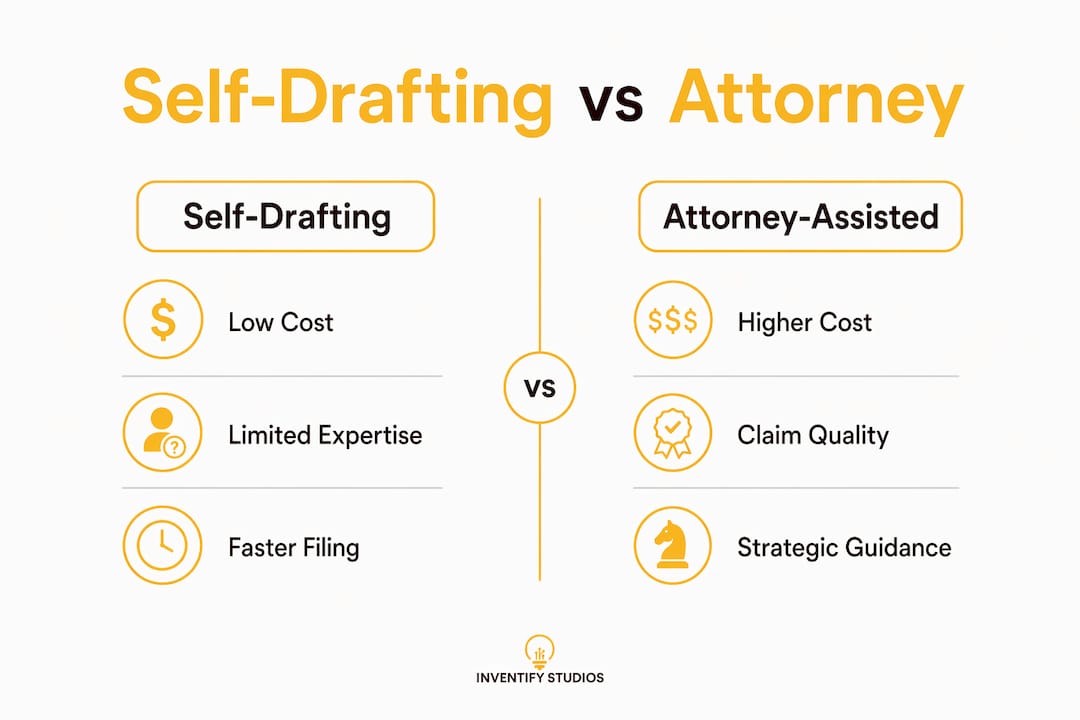
Attorney expertise transforms an inventor's technical description into enforceable claim language. That translation is the step most self-drafters miss entirely.
Self-drafting can be acceptable in two specific situations. First, when you are filing a provisional application to secure a priority date and plan to hire an attorney for the non-provisional. Second, when the invention is simple, well-defined, and you have studied claim drafting thoroughly. For complex inventions, software, or anything you plan to license or enforce, professional involvement is not optional.
Pro Tip: Even if you self-draft, pay an attorney for a one-hour review before you file. A single consultation can catch fatal errors in your claims before they become permanent problems.
How to self-draft a stronger patent application
If you decide to move forward with the patent self-drafting process, quality of disclosure is everything. A strong application starts with a thorough, detailed technical description that covers every variation of your invention, not just the version you built first.
Follow these steps to improve your self-drafted application:
- Write a complete technical description. Describe every component, every step, and every variation. Include how to make it and how to use it. Good provisionals preserve claim breadth and support efficient drafting of the non-provisional later.
- Draft your claims carefully. Start with one broad independent claim that defines the invention at its most general level. Add dependent claims that narrow it down with specific features. Review the claim drafting basics before you write a single claim.
- Include professional-quality drawings. USPTO drawings must meet specific formatting rules. Use tools like AutoCAD, Adobe Illustrator, or even PowerPoint to create labeled figures that match every element described in your specification.
- Use AI drafting tools cautiously. AI tools can help structure your disclosure and flag missing sections, but they do not replace legal judgment. Always review AI-generated claim language against USPTO requirements.
- Maintain a dated invention record. Keep a notebook or digital log with timestamped entries describing your invention's development. This supports your priority claims and helps you identify the true date of conception.
- Check USPTO deadlines. Know the difference between your provisional filing date and the 12-month deadline to file your non-provisional. Missing this window abandons your priority date permanently.
For inventors considering whether to file early, the startup patenting guide from Inventifystudios covers the strategic timing decisions in detail.
Pro Tip: Treat your provisional application like a technical paper, not a rough draft. The more detail you include now, the more claim options you preserve for the non-provisional filing 12 months later.
How does self-drafting affect long-term patent value?
The quality of your initial drafting directly determines how much your patent is worth commercially. Poorly drafted patents reduce commercial value by generating weak or easily designed-around rights. This is not just a legal problem. It is a business problem.
Investors and acquirers evaluate patent portfolios during due diligence. A patent with narrow claims or an incomplete specification signals weak IP strategy. It can reduce your company's valuation or kill a licensing deal before it starts.
Fixing a poorly drafted patent after grant is expensive and often impossible. Post-grant amendments are limited by what was originally disclosed. If you did not describe a key feature in your provisional, you cannot add it later without losing your priority date. The errors you make at the drafting stage follow the patent for its entire 20-year life.
"Self-drafting is risk management, not just cost-cutting. The question is not whether you can file yourself. The question is whether what you file will actually protect your invention."
Filing early with a solid disclosure, even a self-drafted one, does support future business outcomes. It establishes your priority date, signals to investors that you are protecting your IP, and gives you 12 months to refine the application before committing to full prosecution costs.
Key takeaways
Self-drafting a patent is legally permitted but carries real risks that directly affect the commercial value and enforceability of your patent rights.
| Point | Details |
|---|---|
| Cost drives self-drafting | USPTO fees start at $320, compared to $8,000+ for attorney-drafted applications. |
| Provisionals need full detail | Thin provisional disclosures can cause you to lose your priority date entirely. |
| Claim quality determines value | Narrow or flawed claims let competitors design around your patent with minor changes. |
| Attorneys add legal translation | Professionals frame claims broadly and anticipate design-arounds inventors typically miss. |
| Early filing protects your rights | Filing a detailed provisional early secures your priority date and preserves future claim options. |
What i have learned watching inventors self-draft
I have reviewed hundreds of self-drafted patent applications over the years, and the pattern is consistent. Inventors write excellent technical descriptions. They know their inventions deeply. Where they consistently fall short is in the claims section, and that is the only section that legally matters for enforcement.
The most costly mistake I see is not a missing drawing or a formatting error. It is an inventor who files a thin provisional, assumes the priority date is locked in, and then discovers 11 months later that the disclosure does not support the claims they want to make. At that point, they either file a weak non-provisional or start over and lose the original priority date. Both outcomes are expensive.
My honest view: self-drafting a provisional is a reasonable starting point if you treat it with the same rigor as a full application. Write every variation. Describe every use case. Do not save details for later. The inventors who get the most value from DIY drafting are the ones who skip professional consultation on the front end but invest in a professional review before they file the non-provisional. That combination gives you cost control without sacrificing protection quality.
Stay engaged with your patent. No one understands your invention better than you do. Use that knowledge as an asset, not a substitute for legal precision.
— Hua
How Inventifystudios helps you draft stronger patents
Protecting your invention starts with getting the disclosure right. Inventifystudios gives you AI-powered tools to build a detailed technical description, assess your invention's patentability, and generate provisional patent drafts built for real USPTO requirements.
You get structured guidance on claim framing, technical disclosure, and patentability analysis without the $10,000+ attorney bill. Whether you are filing your first provisional or preparing for a non-provisional, Inventifystudios puts professional-grade drafting support in your hands. Visit the invention detail page to start building a patent application that actually protects what you built.
FAQ
Can inventors legally file their own patent applications?
Yes. U.S. patent law allows inventors to file their own applications, a practice called "pro se" filing. The USPTO permits it, but self-drafted applications carry a significantly higher rejection rate due to claim errors and procedural mistakes.
What is the biggest risk of self-drafting a patent?
The biggest risk is writing claims that are too narrow. Narrow claims let competitors make small changes to your design and avoid infringement, which makes your patent nearly impossible to enforce commercially.
Does a provisional patent application protect my invention?
A provisional application secures your priority date but does not itself become a patent. It must be followed by a non-provisional application within 12 months, and the provisional must include sufficient detail to support the claims you plan to make later.
How much does it cost to self-draft and file a patent?
USPTO filing fees for a provisional application start at $320 for micro-entities and $640 for small entities. A non-provisional utility patent adds $800 to $1,760 in USPTO fees alone, not counting any professional review costs.
When should i hire a patent attorney instead of self-drafting?
Hire an attorney for complex inventions, software patents, or any patent you plan to license or enforce. For simple inventions at the provisional stage, self-drafting is viable if you provide thorough technical disclosure and get a professional review before filing the non-provisional.