

A design patent is defined as a form of intellectual property protection granted for the ornamental appearance of a manufactured article, not its function. Under 35 U.S.C. § 171, the United States Patent and Trademark Office (USPTO) grants design patents for new, original, and ornamental designs applied to physical products. If you have created a product with a distinctive look, a design patent is the legal tool that stops competitors from copying that appearance. This guide covers the design patent definition, how to get a design patent, and why it matters for your product's market position.
What is a design patent and what does it protect?
A design patent protects the visual appearance of a product, not how it works. The USPTO grants this protection under federal patent law, specifically covering shape, surface ornamentation, and overall configuration as applied to an article of manufacture. Think of the iconic contoured shape of a Coca-Cola bottle or the distinctive silhouette of an Apple iPhone. Those visual identities are exactly what design patents are built to protect.
The key distinction from a utility patent is scope. A utility patent covers how an invention functions or operates. A design patent covers only how it looks. A chair with a patented reclining mechanism needs a utility patent for that function. If the chair also has a unique sculptural frame, a design patent protects that visual form separately.
Design patents do not protect ideas, concepts, or functional features. They protect the specific ornamental appearance of a finished, manufactured product. This makes the design patent definition narrow but powerful within its scope.
What does a design patent cover vs. what it does not?
Ornamental design means visual features that are not required for the product to function. This is the most misunderstood aspect of design patent law. A shape that exists purely because the product cannot work without it is functional, not ornamental, and cannot receive design patent protection.
What a design patent covers:
- The overall shape or configuration of a product
- Surface ornamentation such as patterns, textures, or graphic elements applied to an article
- A combination of shape and ornamentation that creates a unique visual appearance
- The design of a graphical user interface (GUI) displayed on a screen, recognized as an article of manufacture
What a design patent does not cover:
- Any functional feature of the product, even if it looks distinctive
- The underlying idea or concept behind the design
- Color alone, unless it forms part of the claimed ornamental design
- Designs that are offensive or that simulate existing designs
A practical example: a uniquely shaped ergonomic handle on a kitchen knife can receive design patent protection for its visual form. The ergonomic grip function itself cannot. If the shape is dictated entirely by the need to fit a human hand, it may not qualify as ornamental at all.
Pro Tip: If your product has both a unique look and a novel function, file both a design patent and a utility patent. Each protects a different dimension of your invention.

Many inventors make the mistake of assuming a visually striking product is automatically protectable. The legal test is whether the appearance is ornamental, meaning it goes beyond what function alone requires. This subtlety is often overlooked by first-time inventors.
How to get a design patent: the application process
Filing a design patent with the USPTO follows a defined process. Each step matters, and skipping any one of them can result in rejection or weak protection.
-
Confirm your design qualifies. The design must be new, original, and ornamental as applied to a manufactured article. It cannot be an obvious variation of an existing design, and it must not duplicate a known design.
-
Prepare your drawings. The drawings are the invention in a design patent application. The USPTO requires multiple views: front, back, left side, right side, top, and bottom. These drawings define the exact scope of your patent protection. Vague or incomplete drawings produce weak patents that are easy to design around.
-
Write a brief description. The written portion of a design patent application is minimal compared to a utility patent. The title, a one-sentence description, and a single claim referencing the drawings are typically all that is required.
-
File with the USPTO. You can file electronically through the USPTO's Patent Center portal. Filing fees vary based on entity size. Small entities and micro-entities pay reduced fees, which makes design patents more accessible for independent inventors.
-
Respond to office actions. The USPTO examiner may issue objections or rejections. Responding promptly and accurately is critical to keeping your application alive.
-
Receive your patent. Once approved, your design patent grants exclusive rights for 15 years from the date of grant for applications filed after may 13, 2015.
The connection between prototypes and patent filings is direct. A well-developed prototype helps you identify the exact visual features worth protecting before you file.
Pro Tip: Legal representation is not required to file a design patent, but applications prepared without patent knowledge risk rejection or produce weak protection due to poor drawing disclosure. If budget is a concern, at minimum consult a patent illustrator for your drawings.
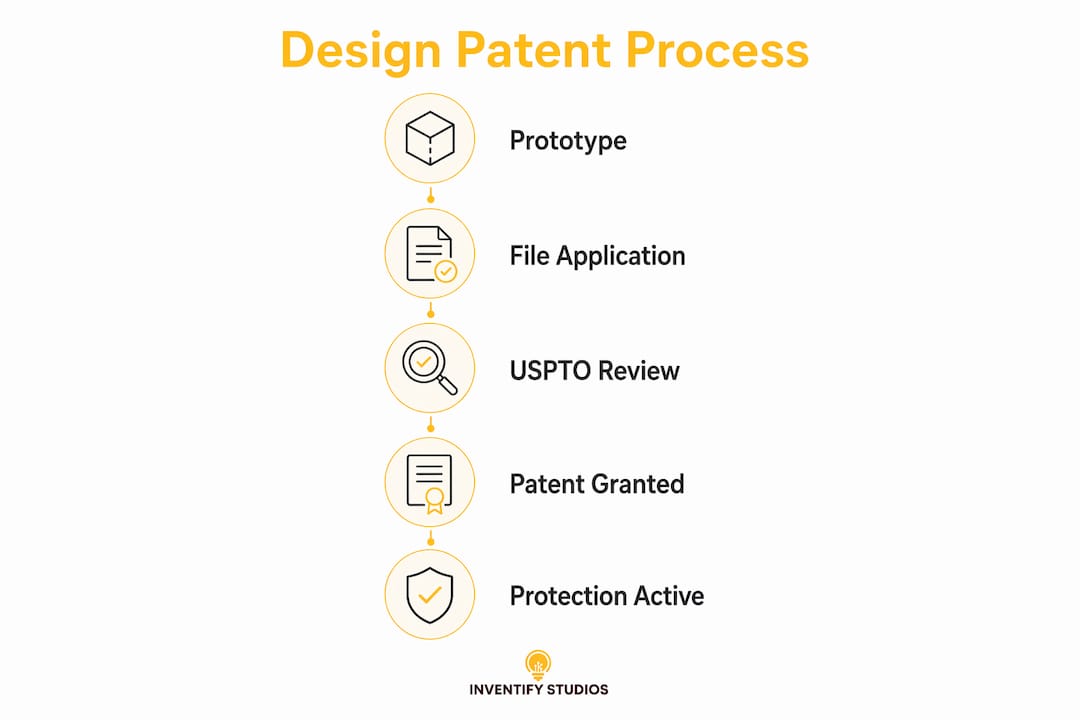
The timeline from filing to grant typically runs 18 to 24 months, though this varies. You can use the label "Patent Pending" from the moment you file, which signals to competitors that protection is in progress.
What are the benefits of a design patent for inventors?
Design patents give inventors exclusive rights to the visual identity of their product. That exclusivity has real commercial value. Competitors cannot legally sell a product that looks substantially the same as your patented design without your permission.
Entrepreneurs frequently undervalue design patents despite their power to prevent competitors from copying the look and feel that defines brand identity. A product's appearance is often the first thing a customer notices. Protecting that appearance protects your brand recognition at the market level.
Key benefits include:
- Market exclusivity. You can block competitors from selling products with a confusingly similar appearance, protecting your market share.
- Brand differentiation. A patented design signals to customers and investors that your product's look is original and legally protected.
- Licensing revenue. You can license your design patent to other manufacturers, creating a revenue stream beyond direct sales.
- Complementary protection. Design patents work alongside utility patents to give inventors comprehensive IP coverage. One protects the look; the other protects the function.
Understanding why inventors need patent protection early in the product development cycle is critical for entrepreneurs who want to build defensible businesses.
Common misconceptions and pitfalls with design patents
The biggest misconception is that a visually unique product automatically qualifies for design patent protection. Uniqueness alone is not enough. The design must be ornamental, not functional, and it must be new relative to all prior designs.
"Design patents are underutilized tools that protect the visual identity critical to brand recognition." — KPPB Law
Several pitfalls trip up inventors during the application and enforcement process:
- Confusing ornamental and functional features. Inventors often try to patent shapes that exist because of how the product works. The USPTO will reject these claims. Separate the visual from the functional before you file.
- Poor drawing quality. The drawings define the patent scope. Blurry, inconsistent, or incomplete drawings produce patents that are difficult to enforce and easy for competitors to work around.
- Ignoring design patents when filing utility patents. Many inventors file only a utility patent and leave the product's appearance completely unprotected. This is a missed opportunity, especially for consumer products where appearance drives purchase decisions.
- Misunderstanding infringement standards. Design patent infringement is judged by the ordinary observer test. A court asks whether an ordinary buyer would find two designs substantially similar in overall appearance. This is a visual, not technical, comparison. Enforcement requires strong, clear drawings that show exactly what you claimed.
Avoiding these mistakes starts with understanding what design patents actually cover. Reviewing common invention misconceptions before you file saves time and money.
Key Takeaways
A design patent protects the ornamental appearance of a manufactured product, not its function, and grants 15 years of exclusive rights from the date of grant.
| Point | Details |
|---|---|
| Design patent definition | Protects the ornamental appearance of a product under 35 U.S.C. § 171, not its function. |
| Drawings are the patent | The USPTO drawings define the exact scope of protection; poor drawings produce weak patents. |
| Design vs. utility patent | File both when your product has a unique look and a novel function for full IP coverage. |
| Enforcement standard | Infringement is judged by whether an ordinary observer finds two designs substantially similar. |
| Strategic timing | File early in product development to use "Patent Pending" status and deter competitors. |
Why design patents deserve more attention from founders
Most founders I talk to have heard of utility patents. Very few have seriously considered a design patent until a competitor copies their product's look. By then, the window to establish priority has often closed.
The real opportunity is filing a design patent before you launch. Your product's visual identity is a competitive asset from day one. A competitor can reverse-engineer a function and build around a utility patent. Copying a protected appearance is a direct infringement. That is a harder legal line to cross.
What surprises many entrepreneurs is how affordable design patents are relative to utility patents. The application is shorter, the drawings do the heavy lifting, and the filing fees are lower. For a consumer product where packaging and form factor drive purchase decisions, a design patent often delivers more immediate market protection than a utility patent alone.
The combination of both is the strongest position. Protect the function with a utility patent. Protect the look with a design patent. Competitors then face two separate legal barriers, not one. Startups that patent early stage ideas consistently build stronger IP portfolios than those who wait until the product is already on shelves.
One more thing: the ordinary observer test in infringement cases actually favors well-crafted design patents. If your drawings are precise and your claimed design is visually distinctive, an infringer has very little room to argue their product looks different enough. That is the kind of protection worth building into your product strategy from the start.
— Hua
How Inventifystudios helps you protect your product's appearance
Protecting a product's visual identity starts with understanding exactly what makes it unique. Inventifystudios gives inventors the tools to define, develop, and document that uniqueness before filing.
With AI-generated 3D prototypes and patent analysis built into the platform, Inventifystudios helps you identify the ornamental features worth protecting and generate patent-ready documentation. You can assess your design's patentability, refine your invention's visual details, and build a stronger application without the cost of traditional consulting. The invention detail service walks you through capturing your design with the clarity and specificity the USPTO requires. From first idea to filing-ready documentation, Inventifystudios keeps the process direct and accessible.
FAQ
What is the design patent definition in simple terms?
A design patent protects the ornamental appearance of a manufactured product, not how it functions. It covers shape, surface ornamentation, and configuration as applied to a physical article.
How long does a design patent last?
A design patent lasts 15 years from the date of grant for applications filed after may 13, 2015. No maintenance fees are required to keep it active during that period.
What is the difference between a design patent vs. utility patent?
A utility patent protects how an invention works or is used. A design patent protects only how it looks. Inventors can hold both types simultaneously for the same product.
What are examples of design patents?
Classic examples include the contoured shape of the Coca-Cola bottle, the distinctive form of Apple's iPhone, and the visual layout of graphical user interfaces. Any manufactured product with a unique ornamental appearance can qualify.
Do I need a lawyer to file a design patent application?
Legal representation is not required, but applications filed without patent knowledge risk rejection or weak protection due to inadequate drawings. Consulting a patent illustrator or attorney for the drawing preparation stage is strongly recommended.