

A patent application is a formal legal and technical request submitted to the United States Patent and Trademark Office (USPTO) that asks the government to grant you exclusive rights over your invention. Filing one means you're asking the USPTO to recognize your invention as your property, giving you the right to exclude others from making, using, offering for sale, selling, or importing it in the United States. That's not just a legal formality. It's the foundation of invention ownership.
A standard utility patent, once granted, provides 20 years of protection from the date you file, subject to maintenance fees. The application itself combines two things: a legal document defining the exact boundaries of your rights through "claims," and a technical document detailed enough that a skilled person in your field could reproduce the invention. Both parts matter equally. Weak claims leave your invention exposed; a vague technical description can get your application rejected outright.
- A patent application is filed with the USPTO, not self-issued.
- It grants the right to exclude others, not the automatic right to manufacture or sell.
- Patent rights are effective only within the United States, its territories, and possessions.
- The USPTO examines your application but does not enforce your patent after it's granted.
- Your application must include claims, a specification, and often drawings.
Inventifystudios was built specifically to help inventors like you navigate this process with clarity and confidence, from validating your idea to preparing patent-ready drafts.
What types of patents and patent applications exist in the US?
The USPTO recognizes three types of patents: utility, design, and plant. Most inventors file for utility patents, which cover new and useful processes, machines, articles of manufacture, or compositions of matter. Design patents protect the ornamental appearance of a product, not its function. Plant patents cover anyone who invents or discovers and asexually reproduces a distinct new variety of plant.

Beyond the patent type, you also choose between two application types: provisional and nonprovisional. Each serves a different purpose and carries different legal weight.
Provisional applications are a low-cost entry point. They establish an early filing date, let you use the "Patent Pending" label, and give you 12 months to develop your invention further before committing to a full filing. They are not examined by the USPTO and do not issue as patents on their own. Think of them as a placeholder with a timestamp.
Nonprovisional applications are the real deal. The USPTO examines them, and if your invention meets all legal requirements, a patent is granted. Most applications filed with the USPTO each year are nonprovisional utility applications, which tells you something about where the serious protection happens.
Design inventions are not eligible for provisional applications. That's a detail many first-time inventors miss.
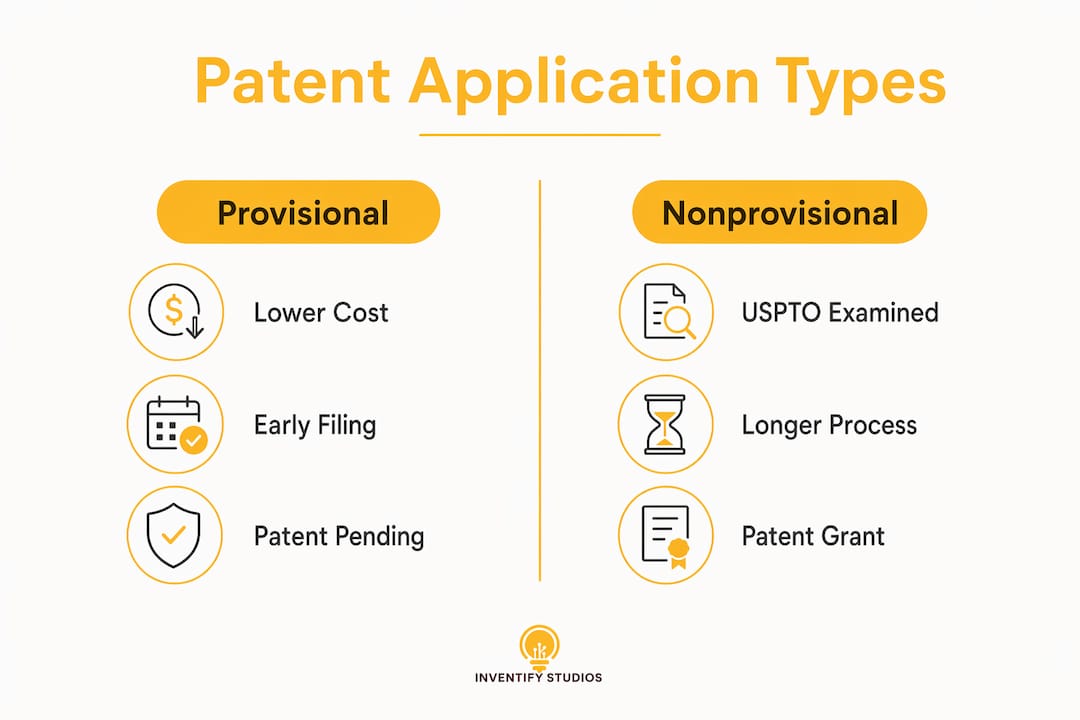
| Feature | Provisional Application | Nonprovisional Application |
|---|---|---|
| Filing cost | Lower | Higher |
| Formal claims required | No | Yes |
| Oath or declaration required | No | Yes |
| Examined by USPTO | No | Yes |
| Issues as a patent | No | Yes |
| Duration | 12 months (then expires) | A term lasting from the filing date, subject to maintenance fees |
| "Patent Pending" authorized | Yes | Yes |
| Design inventions eligible | No | Yes |
For a deeper look at how these two paths compare, the provisional vs nonprovisional breakdown from Inventifystudios walks through the decision criteria inventors face at each stage.
What goes inside a patent application document?
A complete nonprovisional patent application has four required parts, and each one does a specific job. Missing or weakening any of them can delay your application or shrink the protection you receive.
- Specification: The core of the application. It includes a written description of the invention and the claims. The description must be detailed enough that someone skilled in your field could reproduce the invention without extensive experimentation.
- Claims: The legal heart of the application. Claims define the scope of your patent protection. Broad claims protect more ground; narrow claims are easier to defend. Getting this balance right is where most first-time filers struggle.
- Drawings: Required whenever they're necessary to understand the invention. Drawings illustrate the invention's structure, components, and operation. They don't replace the written description; they support it.
- Oath or declaration: A signed statement from the inventor confirming they believe they are the original inventor of the claimed invention.
- Filing, search, and examination fees: Required at submission. Fee amounts vary by entity size. Small entities qualify for a 50% reduction, and micro entities qualify for a 75% reduction under 37 CFR 1.27(a) and 37 CFR 1.29(a) or (d).
- Abstract: A brief summary of the invention, typically 150 words or fewer. It's used for search purposes and appears at the top of the published patent.
The specification is where most of the technical work lives. It typically opens with a background section explaining the problem your invention solves, followed by a summary, a detailed description, and any drawings. The Manual of Patent Examining Procedure (MPEP) sets the standard for what "enabling disclosure" means: your description must teach the invention fully, not just hint at it.
Pro Tip: Write your claims from broad to narrow. Start with the widest possible claim that your invention supports, then add dependent claims that narrow it down with specific features. This layered structure gives you the best chance of surviving examination while preserving maximum protection.
How does the USPTO patent filing and examination process work?
Filing a patent application is a multi-stage process, and knowing what happens at each stage keeps you from being caught off guard by deadlines or office actions.

Step 1: Prepare your documentation
Before you file anything, document your invention thoroughly. Write a detailed description, sketch drawings, and identify every version or variation of your invention you want to protect. Conduct a prior art search to check whether similar inventions already exist. The USPTO's Patent Center and public patent databases are good starting points.
Step 2: File your application
You can file electronically via Patent Center, by U.S. mail, or by hand delivery to the USPTO office in Alexandria, Virginia. Electronic filing through Patent Center is strongly preferred. Filing by mail or hand delivery for a nonprovisional utility application triggers an additional $400 non-electronic filing fee, reduced to $200 for small or micro entities. You'll need to register as an eFiler before you can use Patent Center, which requires a USPTO.gov account and a one-time identity verification.
Step 3: Application review and assignment
After submission, the USPTO assigns your application to a technology center that matches your invention's field. Each technology center is staffed by examiners who specialize in specific areas of technology.
Step 4: Examination
The examiner reviews your application for compliance with legal requirements and searches existing patents, published applications, foreign documents, and technical literature to determine whether your claimed invention is new, useful, and non-obvious. If the examiner finds issues, they issue an "office action" explaining the rejections or objections.
Step 5: Responding to office actions
You have the right to respond to every office action. Responses typically involve amending claims, adding arguments, or providing evidence. Missing a response deadline causes your application to go abandoned, regardless of how strong your invention is.
- Respond to office actions within the set deadline (typically three months, extendable to six months with fees).
- Pay the Notice of Allowance fee within three months of the mailing date. This deadline is not extendable.
- Keep your contact information current with the USPTO throughout prosecution.
- Track all deadlines in a calendar system. One missed date can end your application.
Step 6: Patent grant
If the examiner determines your application meets all legal requirements, you receive a Notice of Allowance. Pay the issue fee on time, and your patent is granted. The USPTO issues electronic patent grants (eGrants) through Patent Center.
The typical timeline from filing to grant takes several years, depending on the technology field and the complexity of examination. Some applications move faster; others go through multiple rounds of office actions before resolution.
For a detailed walkthrough of each filing step, the patent application process guide from Inventifystudios breaks it down for first-time filers.
How do you choose between a provisional and nonprovisional application?
The choice between a provisional and nonprovisional application comes down to where you are in your invention's development and what you need right now.
A provisional application makes sense when your invention is real but not fully refined, when you want to test the market before spending on a full filing, or when you're racing against a competitor to establish an early date. It costs less, requires no formal claims, and gives you the "Patent Pending" label immediately. That label signals to competitors that your invention is in the patent process and may soon be legally protected.
The catch: a provisional application is automatically abandoned after 12 months) if you don't follow up with a nonprovisional. There's no extension. Filing a nonprovisional within 14 months of the provisional's filing date may allow you to restore the priority date, but that's a narrow window and not guaranteed. More importantly, because the patent term is measured from the nonprovisional filing date, filing a provisional first effectively shortens your total protection window.
A nonprovisional application is the right move when your invention is fully developed, your claims are ready, and you want to start the examination clock. It's the only path to an actual patent grant.
- Cost: Provisional is lower upfront; nonprovisional carries higher filing, search, and examination fees.
- Timeline: Provisional buys 12 months; nonprovisional starts the examination process immediately.
- Examination: Provisional is never examined; nonprovisional goes through full USPTO review.
- Patent term: Both tie to the nonprovisional filing date for the 20-year term calculation.
- Claims: Provisional requires none; nonprovisional requires at least one formal claim.
- Design inventions: Provisional is not available; nonprovisional is required.
Pro Tip: Use a provisional filing strategically when you're about to publicly disclose your invention, present at a trade show, or pitch to investors. It locks in your filing date before any public disclosure that could affect patentability, and gives you 12 months to refine the invention and build your nonprovisional application properly.
For inventors weighing this decision in detail, the provisional patent guide from Inventifystudios covers the full picture for 2026 filers.
What do experts recommend for a successful patent application?
Filing a patent application without understanding the process is one of the most common and costly mistakes inventors make. Here's what actually separates successful applications from abandoned ones.
Write for the examiner, not the market
Your application is a technical and legal document, not a product pitch. The specification must teach the invention fully, using language that a person skilled in your field would understand. Avoid marketing language. Describe every component, every step, every variation you want protected. The MPEP's enablement standard requires that your description allow someone to make and use the invention without extensive experimentation. Falling short of that standard is one of the most common grounds for rejection.
Understand the five legal requirements
Patent law sets five requirements your invention must meet: novelty, usefulness, non-obviousness, enablement, and descriptiveness. An examiner will check all five. Novelty means your invention hasn't been publicly disclosed before your filing date. Non-obviousness means it's not an obvious variation of what already exists. Knowing these requirements before you draft your application helps you write claims that hold up under scrutiny.
Get professional help, even if you file pro se
The USPTO allows inventors to file on their own, called "pro se" filing. But USPTO guidance is clear: professional expertise improves both the chances of approval and the scope of protection you receive. A registered patent attorney or agent understands how to draft claims that survive examination and how to respond to office actions effectively. If you file pro se, you handle every response yourself, and missing a deadline causes abandonment regardless of how strong your invention is.
Common rejection reasons and how to address them
- Lack of novelty (35 U.S.C. § 102): The examiner found prior art that anticipates your claims. Respond by amending claims to distinguish your invention from the prior art, or argue why the cited reference doesn't actually apply.
- Obviousness (35 U.S.C. § 103): The examiner argues your invention is an obvious combination of existing ideas. Counter with evidence of unexpected results, commercial success, or long-felt need.
- Insufficient disclosure (35 U.S.C. § 112): Your specification doesn't fully enable the invention. Fix this by adding more technical detail in an amendment, though this can be difficult after filing.
- Indefinite claims: Your claim language is unclear. Amend the claims to use precise, unambiguous terms.
- Missing deadlines: There's no fix for a missed final deadline. Set calendar reminders for every USPTO deadline from day one.
Track deadlines like your patent depends on it
Because it does. The three-month response window for office actions is extendable, but the three-month window to pay the Notice of Allowance fee is not. Missing that payment means your application is abandoned and you don't receive a patent, full stop. Build a deadline tracking system before you file, not after.
Pro Tip: Before drafting your application, use Inventifystudios' AI-powered patent analysis tools to assess your invention's patentability and identify potential prior art. Getting that clarity early means you write stronger claims from the start, rather than discovering problems during examination. Pair that with a registered patent attorney for the final draft, and you're filing from a position of real strength.
For a broader look at the mistakes that trip up first-time inventors before they even reach the filing stage, the common invention misconceptions guide from Inventifystudios is worth reading before you start.
Inventors working in specialized fields like biotech can also benefit from understanding the broader patent landscape. The 2026 biotech patent strategy guide from Innovabiotech covers how patent landscape analysis shapes filing decisions in that sector.
Key Takeaways
A patent application is a formal legal and technical request to the USPTO that, when granted, gives you the exclusive right to exclude others from making, using, or selling your invention in the United States for up to 20 years from your filing date.
| Point | Details |
|---|---|
| Patent application purpose | It's a formal request to the USPTO for exclusive rights to exclude others from using your invention. |
| Three US patent types | Utility, design, and plant patents each protect different aspects of an invention. |
| Provisional vs nonprovisional | Provisional establishes a filing date for 12 months; only nonprovisional applications can issue as patents. |
| Five legal requirements | Your invention must meet novelty, usefulness, non-obviousness, enablement, and descriptiveness to be granted. |
| Professional help matters | USPTO guidance confirms that registered patent attorneys improve both approval chances and protection scope. |
Turn your invention idea into a patent-ready filing with Inventifystudios
Filing a patent application is one of the most important steps you'll take as an inventor. Getting it right from the start saves time, money, and the frustration of a rejected or abandoned application.
Inventifystudios gives you the tools to move faster and smarter. Use the AI-powered patent analysis to check your invention's patentability before you file. Generate 3D prototypes in minutes to visualize and refine your concept. Get tailored drafting insights for your provisional patent narrative so your specification is clear, complete, and built to hold up under examination.
You don't need a big budget or a law firm on retainer to protect your idea. You need the right tools and a clear plan.
Start with your invention details and see exactly where your idea stands today.