

The patent application process is a series of defined legal steps inventors must follow to secure exclusive rights to their inventions. The full process, from initial filing to a granted utility patent, averages about 28 months, with protection lasting 20 years from the filing date. That timeline means every decision you make early carries real weight. A missed deadline, a vague specification, or a skipped prior art search can cost you your rights entirely. This guide walks you through each stage clearly, so you know exactly what to do and when.
What are the patent application process steps?
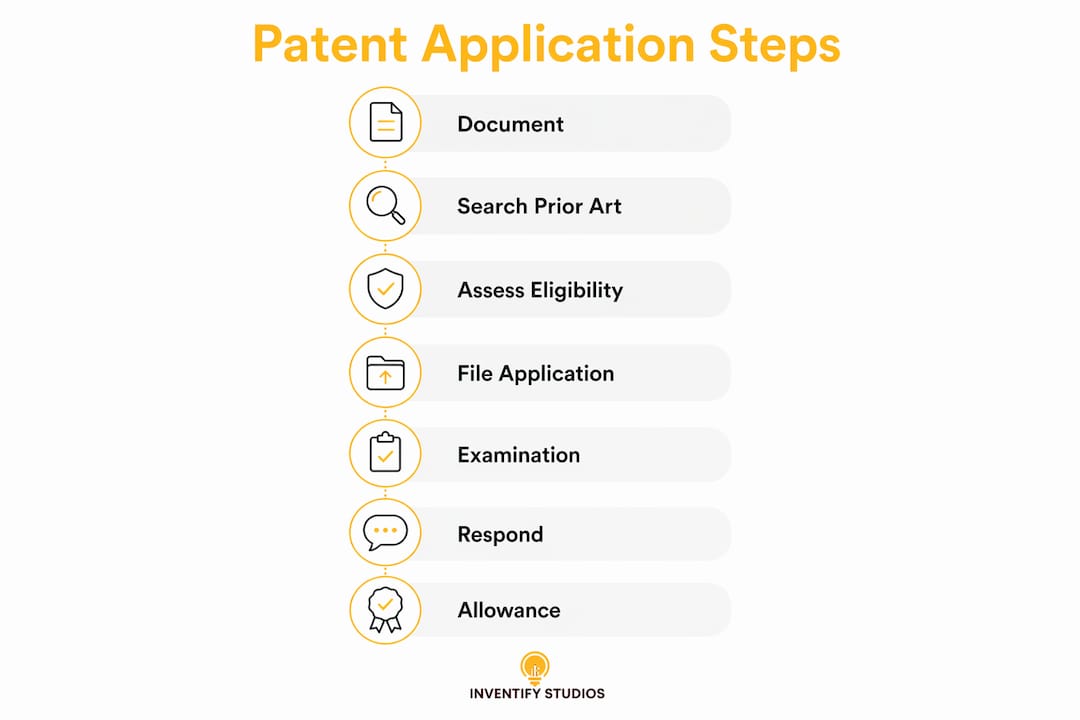
The patent application process steps follow a defined sequence: document your invention, search prior art, file your application, survive examination, and maintain your patent after grant. Each stage builds on the last. Skipping or rushing any one of them creates problems that are expensive or impossible to fix later. The USPTO (United States Patent and Trademark Office) administers this process, and its rules are strict.
Step 1: Document your invention thoroughly
Documentation is the foundation of every successful patent. You need a written record that describes your invention in full, including how it works, what it does, and how it differs from existing solutions. Include dated sketches, test results, and notes on your development process. Courts and examiners treat thorough records as evidence of when and how an invention was conceived.

Step 2: Search prior art before you file
A prior art search tells you whether your invention is novel and non-obvious, the two core requirements for patentability. You search existing patents, published applications, academic papers, and commercial products. The USPTO's Patent Full-Text Database and Google Patents are standard starting points. A solid search saves you from filing an application that will almost certainly be rejected.
Step 3: Assess eligibility and business goals
Not every invention qualifies for a patent. Abstract ideas, natural phenomena, and laws of nature are excluded under 35 U.S.C. § 101. Beyond eligibility, you need to ask whether a patent actually serves your business goals. A patent is a public disclosure. If trade secret protection fits better, filing may not be the right move. Understanding why patent protection matters for your specific situation is a step most first-timers skip.
Pro Tip: Document your invention as if you are explaining it to a skilled engineer who has never seen your product. That level of detail is exactly what the USPTO requires.
How do you file a patent application?
Filing a patent application means submitting a formal package to the USPTO through its Patent Center electronic filing system. You have two primary options: a provisional application or a non-provisional utility application.
Provisional vs. non-provisional applications
A provisional application establishes your filing date and gives you 12 months to develop your invention before committing to the full application. It costs less and requires no formal claims. However, provisional applications must be technically detailed to protect your priority date. A thin provisional that omits key technical details cannot support a later non-provisional that relies on it. New matter added after filing cannot claim the original priority date.
The 12-month deadline to convert a provisional to a non-provisional is absolute. A 14-month restoration petition exists, but it requires proof of unintentional delay and additional fees. It is not a standard extension.
Key components of a non-provisional application
Every non-provisional utility application must include these elements:
- Specification — a written description of the invention that meets the enablement standard
- Claims — the legal boundaries of your patent protection
- Drawings — required when they aid understanding of the invention
- Abstract — a brief summary of the disclosure (150 words maximum)
- Cover sheet — identifies the inventors, title, and application type
- Inventor declaration — a signed statement confirming inventorship
The inventor declaration form is a legal document. Errors in inventorship are difficult to correct after filing.
USPTO filing fees by entity size
| Entity type | Approximate filing fees |
|---|---|
| Micro entity | Starting at $400 |
| Small entity | Starting at $800 |
| Large entity | Starting at $2,000 |
USPTO fees cover three components: the basic filing fee, the search fee, and the examination fee. Qualifying as a micro or small entity cuts costs significantly. Misrepresenting entity status carries legal penalties.
Pro Tip: The specification's enablement standard is the most common rejection trigger. Write it so a skilled practitioner can build and use your invention from the description alone, with no guesswork.
What happens during patent examination?
After you file a non-provisional application, it enters the USPTO examination queue. Examiner review typically begins after 18–24 months, depending on the technology area. Software and business method patents often wait longer than mechanical or chemical inventions. That wait is not idle time. Your application has patent pending status from the moment of filing, which provides meaningful deterrence against copying.
What is an office action?
An office action is a written communication from your USPTO examiner that identifies problems with your application. Most applications receive at least one. Patent prosecution is an iterative process, not a one-shot submission. Common reasons for office actions include:
- Prior art rejections — the examiner finds existing patents or publications that anticipate or render your claims obvious
- Clarity rejections — claims are vague, indefinite, or use inconsistent terminology
- Enablement rejections — the specification does not fully support the claimed invention
- Double patenting — your claims overlap with another patent you own
How to respond to an office action
You have a set deadline to respond, typically three months from the mailing date, with extensions available for a fee up to six months. Your response can include claim amendments, arguments against the examiner's position, or both. Requesting an examiner interview is an underused tactic. A direct conversation often resolves misunderstandings faster than written exchanges alone.
Pro Tip: For complex prior art rejections, consult a registered patent attorney or agent before responding. A poorly drafted response can narrow your claims in ways that permanently limit your protection.
What happens after your patent is allowed?
When the examiner accepts your application, the USPTO issues a Notice of Allowance. You then have three months to pay the issue fee. Missing that deadline abandons your application, though a petition for revival is possible in limited circumstances.
After you pay the issue fee, the USPTO grants your patent and assigns it a patent number. Your protection runs for 20 years from the non-provisional filing date, not from the grant date. That distinction matters because examination time eats into your term.
Maintaining your patent requires paying maintenance fees at three intervals:
- 3.5 years after grant
- 7.5 years after grant
- 11.5 years after grant
Missing a maintenance fee causes your patent to lapse. The USPTO allows a six-month grace period after each deadline, but late fees apply. After the grace period, the patent expires and enters the public domain. Tracking these dates from day one of your grant is non-negotiable. Many inventors use docketing software or patent counsel to manage these deadlines across a growing portfolio.
The design process behind your product can also inform how you structure your patent claims, particularly when your invention has both functional and aesthetic elements worth protecting separately.
Key Takeaways
The most effective approach to the patent application process is sequential preparation: document thoroughly, search prior art, file with a complete specification, respond to office actions strategically, and track maintenance deadlines without exception.
| Point | Details |
|---|---|
| File with full detail | A specification that meets the enablement standard prevents the most common and costly rejections. |
| Provisional deadlines are firm | The 12-month conversion window is absolute; restoration petitions are narrow exceptions, not standard options. |
| Examination takes time | Expect 18–24 months before examiner review begins; use that window to prepare your response strategy. |
| Office actions are normal | Most applications require at least one round of prosecution before allowance. |
| Maintenance fees are mandatory | Pay at 3.5, 7.5, and 11.5 years post-grant or your patent lapses permanently. |
What first-time filers consistently get wrong
The biggest mistake I see from first-time inventors is treating the provisional application as a placeholder. They file a rough sketch of an idea, assume the priority date is locked, and then spend the next 12 months actually developing the invention. When they file the non-provisional, the new technical details cannot claim the provisional's date. They have effectively lost the priority advantage they thought they had.
The second mistake is underestimating how much the specification matters. Inventors focus on the claims because claims define the legal scope. But insufficient specification detail is one of the most common causes of rejection and delay. The examiner cannot allow claims that the specification does not fully support. Writing a strong specification first, then drafting claims from it, produces better results than the reverse.
The third mistake is going silent after an office action. Inventors receive a rejection, feel discouraged, and let deadlines slip. Patent prosecution is a negotiation. The examiner is not your adversary. Engaging proactively, requesting interviews, and making targeted amendments almost always produces a better outcome than abandonment. Inventors who pursue patents without legal representation can succeed, but they need to stay engaged and informed throughout the process.
The one-year grace period after public disclosure is also widely misunderstood. Missing that deadline permanently forfeits your right to patent the invention in the US. Track every public disclosure date from the moment you show your invention to anyone outside a confidentiality agreement.
— Hua
How Inventifystudios helps you prepare to file
Getting your invention details organized before you file is the single biggest factor in application quality. Inventifystudios gives inventors an AI-powered platform to document, validate, and structure their invention details with clarity.
The platform generates AI-assisted prototype visuals, runs patentability assessments, and produces provisional patent drafts that meet the technical detail standard examiners expect. For inventors who want to file with confidence and without paying traditional consulting fees, Inventifystudios removes the barriers that stop most ideas from reaching the USPTO. Start organizing your invention details today and give your application the foundation it needs.
FAQ
What is a patent application?
A patent application is a formal legal document filed with the USPTO that describes an invention and requests exclusive rights to it. It includes a specification, claims, drawings, and an inventor declaration.
How long does the patent application process take?
The full process from filing to grant averages about 28 months for utility patents, though technology area and application complexity affect that timeline.
Can I file a patent application without an attorney?
Yes. Inventors can self-represent in USPTO proceedings, a practice called "pro se" representation. A DIY patent strategy is viable but requires careful attention to specification quality and procedural deadlines.
What is the difference between a provisional and non-provisional application?
A provisional application establishes a priority date and gives you 12 months to file a full non-provisional application. It requires no formal claims but must be technically detailed to protect that priority date effectively.
What happens if I miss the patent maintenance fees?
Missing a maintenance fee causes your patent to lapse. The USPTO provides a six-month grace period with late fees. After that window closes, the patent expires and the invention enters the public domain permanently.