

A provisional patent application is defined as a temporary USPTO filing that secures an early priority date and grants "patent pending" status, but does not itself result in a granted patent. A nonprovisional patent application is the formal filing that triggers examination and can lead to an issued patent with up to 20 years of protection. Understanding the provisional vs nonprovisional patent explained distinction is the single most important decision you will make as an inventor before going public with your idea. The USPTO treats these two filings completely differently, and confusing them costs inventors their rights every year.
What is a provisional patent application and how does it work?
A provisional patent application is an informal filing that establishes your priority date without triggering examination. The USPTO stores it confidentially for 12 months and then lets it expire if you do not follow up with a nonprovisional application. No patent rights come from a provisional alone. What you gain is time, a filing date, and the legal right to label your invention "patent pending."
The provisional patent advantages are real, but they come with conditions. Filing fees for micro-entities run approximately $65–$80, making it one of the most affordable ways to protect an early-stage idea. That low cost lets you file quickly, even before your invention is fully refined. You can then use the 12-month window to test the market, pitch investors, and iterate on your design.
The filing requirements for a provisional are less rigid than for a nonprovisional, but that does not mean you can file anything. Your application must meet the USPTO's enablement standard. That means a person skilled in your field must be able to read your filing and actually build or use your invention. Inventors who submit only slide decks or rough sketches often find their provisional fails to support the claims they later want to make in the nonprovisional stage.
Strategic use cases for a provisional filing include:
- Racing a competitor to market: Filing first establishes your priority date even if your product is not finished.
- Public disclosure timing: You can present at a trade show or publish research without losing your patent rights, as long as you file before going public.
- Investor outreach: "Patent pending" signals seriousness to early-stage investors and partners.
- Unfinished inventions: You can refine the design during the 12-month window before committing to formal claims.
Pro Tip: Draft your provisional with the same care you would give a nonprovisional. Weak documentation at this stage limits the scope of protection you can claim later. See the invention claim drafting guidelines for practical guidance on writing strong disclosures.
What is a nonprovisional patent application and what should you expect?
A nonprovisional patent application is the formal filing that initiates the USPTO examination process and is the only path to an issued patent. It requires a complete specification, formal patent claims, drawings where necessary, and an inventor declaration. The claims section is the most critical part. Claims define the exact legal boundaries of your protection, and every word matters.
The examination process unfolds in several stages:
- Filing and assignment: The USPTO assigns your application to an examiner with expertise in your technology area.
- Initial examination: The examiner searches prior art and evaluates your claims for novelty and non-obviousness.
- First Office Action: The first Office Action arrives 15–18 months after filing. Most first actions include at least one rejection.
- Response period: You typically have 3 months to respond without paying extension fees. Missing this window risks abandonment.
- Claim amendments: You argue patentability, amend claims to overcome prior art, or both.
- Allowance or final rejection: If the examiner accepts your arguments, the application moves toward allowance. If not, you have options including appeal.
The fees involved in a nonprovisional application are substantially higher than a provisional. Attorney costs alone typically run $3,000–$8,000 or more, depending on the complexity of your invention. Beyond filing, you must pay maintenance fees at 3.5, 7.5, and 11.5 years into the patent term. Those maintenance fees range from approximately $430 to over $8,200 depending on your entity size. Large entities may pay over $14,000 in maintenance fees across the full 20-year term.
| Fee Type | Approximate Cost |
|---|---|
| Micro-entity filing fee | $65–$80 (provisional) |
| Attorney drafting (nonprovisional) | $3,000–$8,000+ |
| Maintenance fee at 3.5 years | $430–$1,600+ |
| Maintenance fee at 11.5 years | $3,700–$8,200+ |

Pro Tip: Respond to every Office Action on time. A missed 3-month response window triggers extension fees that add up fast. Set calendar reminders the day you receive any USPTO correspondence.
Key differences between provisional and nonprovisional patents
The core difference between patents of these two types is purpose. A provisional secures a date. A nonprovisional secures rights. Every other difference flows from that distinction.
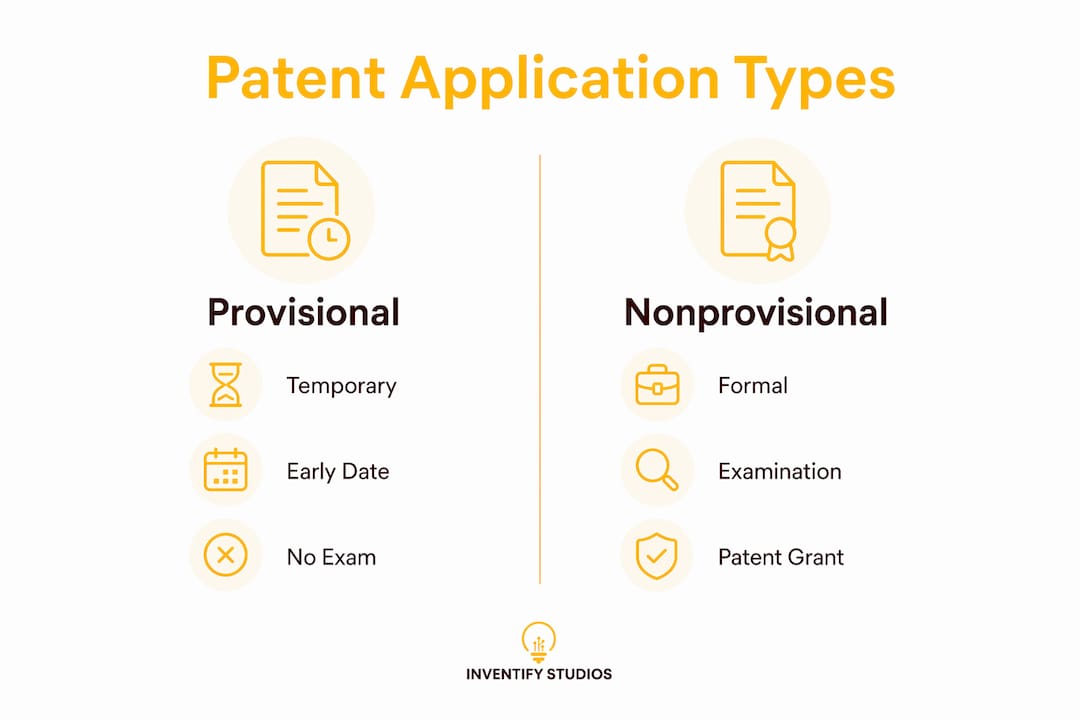
The USPTO does not examine provisional applications at all. They sit in the USPTO's files for exactly 12 months and then expire. No examination means no patent, no legal protection, and no enforceable rights. The provisional only preserves your ability to claim that filing date when you later submit a nonprovisional.
The 12-month deadline is absolute. No extension or grace period exists under USPTO rules. If you miss the deadline, you lose your priority date and all the advantages that came with it. That is not a technicality. Inventors who miss this window have lost the right to patent their inventions entirely, especially if they made public disclosures during the provisional period.
Here is a direct comparison of the two application types:
| Feature | Provisional | Nonprovisional |
|---|---|---|
| Examination | None | Full USPTO examination |
| Duration | 12 months, then expires | 20 years from filing date |
| Patent rights granted | No | Yes, if approved |
| Formal claims required | No | Yes |
| Cost (filing fees) | $65–$80 (micro-entity) | Higher; plus attorney fees |
| "Patent pending" status | Yes | Yes, during examination |
Common misconceptions about provisional patents include:
- "A provisional protects my invention." It does not. It only secures a filing date and patent pending status.
- "I can file anything and be protected." Insufficient disclosure means your nonprovisional cannot claim the priority date from your provisional.
- "I have more than 12 months to decide." The deadline is firm. Plan your nonprovisional filing well before month 12.
How to decide between a provisional and nonprovisional application
The right choice depends on where your invention stands right now. If your invention is fully developed and you have the budget for a complete application, filing a nonprovisional directly is the faster path to actual patent rights. If your invention is still evolving, or you need time to validate the market before committing to attorney fees, a provisional makes sense.
Use these criteria to guide your decision:
- Invention completeness: Can you describe every aspect of your invention clearly enough for someone else to build it? If yes, you are ready for a nonprovisional. If not, a provisional buys you time to finish.
- Budget: Provisional filing costs are a fraction of nonprovisional costs. If cash is tight, a provisional lets you secure your date while you raise funds.
- Market timing: If a competitor is close to filing, speed matters more than cost. File a provisional today and refine later.
- Public disclosure: If you plan to present at a conference or publish research, file before you go public. A provisional filed the day before a presentation protects your priority.
- Investor readiness: "Patent pending" carries weight in pitch meetings. A provisional lets you use that status while you build your business case.
The 12-month provisional window should be used aggressively. Use that time for customer interviews, prototype testing, and refining your claims. Do not treat it as a waiting period. Treat it as a runway.
Pro Tip: Hire a patent attorney to at least review your provisional before you file, even if you draft it yourself. A poorly drafted provisional that fails the enablement standard is money wasted. The risks of self-drafting patents are real and worth understanding before you proceed.
Key Takeaways
A provisional patent secures your priority date and patent pending status, but only a nonprovisional application can lead to an issued patent with enforceable rights.
| Point | Details |
|---|---|
| Provisional purpose | Secures an early priority date and patent pending status; grants no patent rights. |
| Nonprovisional outcome | Only path to an issued patent; provides up to 20 years of protection from filing date. |
| 12-month deadline | The USPTO allows no extension; missing it means losing your priority date permanently. |
| Cost difference | Provisional micro-entity fees start at $65–$80; nonprovisional attorney costs run $3,000–$8,000+. |
| Drafting quality matters | A weak provisional cannot support strong nonprovisional claims; invest in quality documentation from the start. |
What I have learned from watching inventors navigate this decision
Most inventors treat the provisional as a checkbox. They file something minimal, feel protected, and then spend the next 12 months doing nothing with it. That is the single biggest mistake I see repeated across every stage of inventor experience.
The provisional period is not a safety net. It is a head start. The inventors who get the most from it are the ones who treat month one of that window like month one of a product launch. They are talking to customers, testing prototypes, and building the evidence base that makes their nonprovisional claims defensible. By the time they file the nonprovisional, they know exactly what their invention does, who it serves, and why it is different from everything in the prior art.
The other pattern I see is over-reliance on cheap, minimal filings. A $65 filing fee is not the cost of protection. It is the cost of a date. If the documentation behind that date is thin, the date is worthless. I have seen inventors lose their priority claims at the nonprovisional stage because their provisional did not adequately disclose the invention they were trying to protect. That is a painful and avoidable outcome.
My honest advice: spend more time on your provisional than you think you need to. Write it as if it were the nonprovisional. Then use the 12 months to validate, iterate, and build the business case. When you file the nonprovisional, you will have a stronger application and a clearer picture of what you are protecting and why.
— Hua
How Inventifystudios can help you file with confidence
Filing a patent application without the right tools is where most inventors lose time and money. Inventifystudios is built specifically for inventors at this stage.

The platform gives you AI-powered patent analysis, 3D prototype generation, and tailored drafting insights for provisional patent narratives. You can assess your invention's patentability before you spend a dollar on attorney fees. The Invention Detail tool walks you through the documentation process so your provisional is built on solid ground from day one. Whether you are filing your first provisional or preparing to move into the nonprovisional process, Inventifystudios removes the guesswork and gives you a clear path forward.
FAQ
What is the main difference between a provisional and nonprovisional patent?
A provisional patent application secures an early priority date and patent pending status but is never examined and grants no patent rights. A nonprovisional application undergoes full USPTO examination and is the only filing that can result in an issued patent.
How long does a provisional patent last?
A provisional patent application expires after exactly 12 months with no extension available. You must file a nonprovisional application within that window to claim the provisional's priority date.
How much does it cost to file a provisional patent?
Provisional filing fees for micro-entities are approximately $65–$80. Nonprovisional applications require higher filing fees plus attorney costs that typically range from $3,000 to $8,000 or more.
Does a provisional patent protect my invention?
A provisional patent does not protect your invention. It only establishes your filing date and allows you to use "patent pending" status while you prepare the formal nonprovisional application.
Can I file a nonprovisional patent without filing a provisional first?
Yes. Filing a provisional first is optional. You can file a nonprovisional application directly if your invention is fully developed and you are ready to begin the formal examination process.