

A provisional patent application is a temporary filing with the United States Patent and Trademark Office (USPTO) that locks in your priority date and grants you "patent pending" status for exactly 12 months. It is not a granted patent. It does not give you enforceable rights. What it does give you is time, a legal timestamp, and a meaningful head start over any competitor working on the same idea. For first-time inventors and entrepreneurs, understanding what is a provisional patent is the first real step toward protecting your invention without spending tens of thousands of dollars upfront.
What does a provisional patent application actually do?
A provisional patent application is a temporary placeholder filing that secures a priority date and "patent pending" status for exactly 12 months, after which it expires automatically if not converted into a non-provisional application. That priority date is the most valuable thing it creates. Under the U.S. "first-inventor-to-file" system, whoever files first wins. Filing a provisional before you pitch investors, demo at a trade show, or post on social media means your idea is timestamped in the official record.
The provisional application is never examined or published by the USPTO. No patent examiner reviews it. No competitor can read it. Its sole legal function is to establish that priority date and prevent a rival from claiming they invented it first. This is a critical distinction: the provisional does not grant you the right to sue anyone for infringement. That right only comes after a full non-provisional patent is granted.
Here is what the provisional filing period looks like in practice:
- Priority date secured: The moment you file, your invention is timestamped in the USPTO system.
- Patent pending status: You can legally label your product or pitch deck "patent pending" from day one.
- No examination: The USPTO assigns a filing date and application number but does not review the content.
- 12-month clock starts: You have exactly one year to file a non-provisional application or lose the priority date benefit.
- No enforceable rights: You cannot stop a competitor from copying your idea during this period based on the provisional alone.
Pro Tip: Set a calendar reminder for month 10, not month 12. Patent attorneys need time to draft a strong non-provisional application. Waiting until the last week is one of the most expensive mistakes inventors make.
What are the benefits and limitations of a provisional patent?
The biggest benefit is cost. Professional provisional filing costs $1,500–$6,000 with attorney help, while USPTO fees for small and micro entities range from $65–$325. Compare that to a full non-provisional application, which typically runs $10,000–$20,000 or more. That cost gap gives you 12 months to test whether your invention is worth the full investment.

The second major benefit is competitive positioning. A provisional patent places your invention into the official U.S. patent priority system. A Non-Disclosure Agreement cannot do that. As experts at Dipchand LLP point out, this distinction matters enormously when approaching investors. An NDA asks someone to keep a secret. A provisional patent tells the world you filed first, and no NDA can replicate that legal standing.
That said, "patent pending" status carries a common misconception. Rich Goldstein at Goldstein Patent Law cautions that "patent pending" only signals that a step has been taken, not that a patent will issue or that your claims are strong. Investors who know patent law will not be fooled by the label alone. The quality of your disclosure matters.
The numbered list below captures the core tradeoffs every inventor should weigh:
- Low upfront cost lets you validate the market before committing to full patent expenses.
- 12-month development window gives you time to build prototypes, gather feedback, and refine the invention.
- Priority date protection blocks competitors who file after you, even if they file a non-provisional first.
- No enforceable rights means you cannot take legal action against copycats during the provisional period.
- Incomplete disclosure risk is the most dangerous pitfall. If you publicly demo features not described in your provisional, those features lose priority protection entirely.
"The most common pitfall is 'rushed disclosure': filing a sparse provisional and then publicly demoing invention features not fully disclosed, which causes those features to lose the protection of the original priority date." — Patent experts cited by Tran.vc
How to file a provisional patent: steps, costs, and requirements
Filing a provisional patent application requires a written description that is complete enough for a person skilled in your field to make and use the invention. Formal patent claims are not required. Drawings are not required by rule, but they are strongly recommended. The more detail you include, the stronger your priority protection.
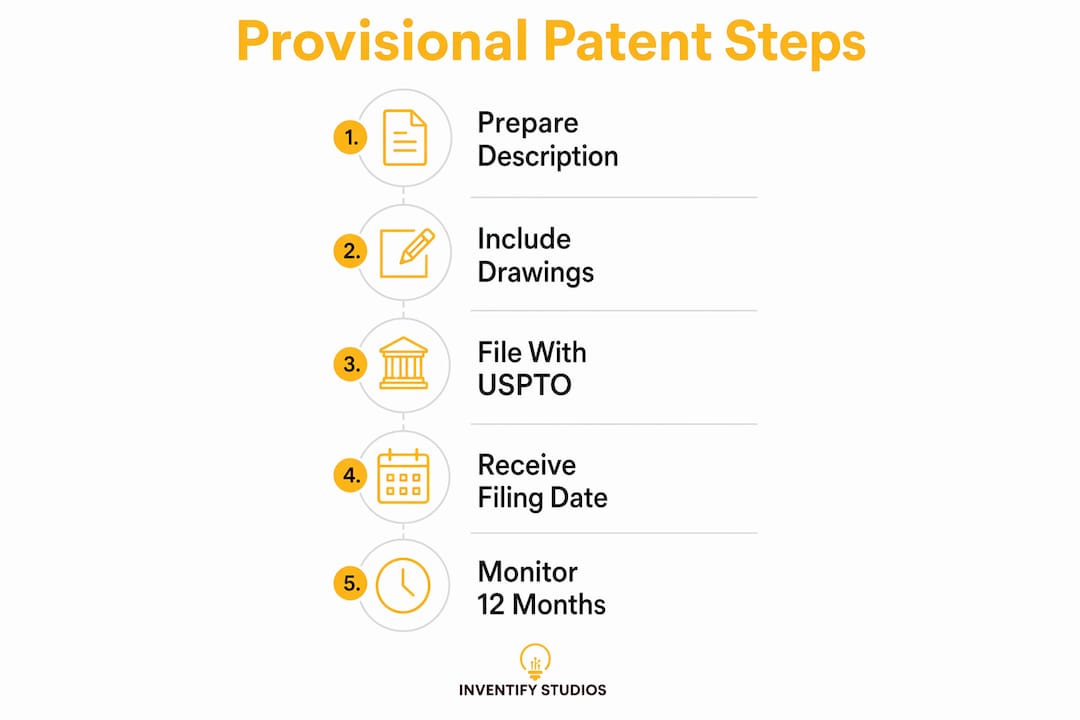
The table below compares provisional and non-provisional applications across the factors that matter most to early-stage inventors:
| Factor | Provisional application | Non-provisional application |
|---|---|---|
| USPTO fee (small entity) | $65–$325 | $800–$1,600+ |
| Professional filing cost | $1,500–$6,000 | $10,000–$20,000+ |
| Formal claims required | No | Yes |
| Examined by USPTO | No | Yes |
| Published publicly | No | Yes (18 months after filing) |
| Patent term | None (expires in 12 months) | 20 years from non-provisional filing date |
| Enforceable rights | No | Yes, upon grant |
The filing process itself follows four clear steps. First, prepare a written description of your invention that covers how it works, what it does, and how to build it. Second, include drawings or diagrams wherever they clarify the description. Third, complete the USPTO's provisional application cover sheet, available on the USPTO website. Fourth, submit everything through the USPTO's Electronic Filing System (EFS-Web) and pay the applicable fee.
Pro Tip: Do not treat the provisional as a rough draft. Every feature you want protected must appear in the description. If you add a new feature to your product after filing and before your non-provisional, that new feature has no priority date protection unless you file a second provisional or include it in the non-provisional with a clear explanation.
Timing matters as much as content. File before any public disclosure, investor pitch, or product demo. Once you publicly disclose your invention, the U.S. gives you a one-year grace period to file. But many other countries offer no grace period at all. If international patents are on your roadmap, file the provisional before you say a word publicly. For a deeper look at patenting early-stage ideas, especially the timing question, the Inventifystudios blog covers the startup-specific tradeoffs in detail.
What happens after filing? Making the most of your 12 months
The 12-month window is not a waiting room. It is your most productive development period. Use it with a clear plan, and you will arrive at your non-provisional filing with a stronger invention, real market data, and a much better case for patentability.
Here is how to use the provisional period strategically:
- Build a working prototype. A physical or digital prototype reveals design flaws you cannot spot on paper. Inventifystudios offers an AI prototype generator that lets you create 3D concepts in minutes, which is a practical way to start this process fast. Learn more about the prototype-to-patent connection to understand how prototyping strengthens your eventual non-provisional filing.
- Test market viability. Run surveys, pre-sell on crowdfunding platforms like Kickstarter or Indiegogo, or pitch to retailers. Real demand data makes your non-provisional application more compelling and helps you decide whether the $10,000–$20,000 investment is justified.
- Gather consumer feedback. Talk to potential users. Their input often reveals new use cases or features worth adding to your non-provisional claims.
- Prepare your non-provisional application. Start working with a patent attorney by month 6, not month 11. The non-provisional must reference your provisional filing date to claim priority. A rushed non-provisional is nearly as dangerous as a rushed provisional.
- Track all public disclosures. Every demo, press release, or social post is a disclosure event. Document the date and content of each one. If a feature was disclosed before it appeared in your provisional, that feature may be unprotected.
Non-provisional applications cost roughly $10,000–$20,000 or more, which makes the provisional period your best opportunity to validate before committing. Failing to file the non-provisional within 12 months means you lose the priority date entirely, and any public disclosures you made during that period could block you from filing at all. The clock is real. Treat it that way.
For inventors still working through the validation phase, the Inventifystudios guide on invention validation steps walks through how to use the provisional window to test your concept before committing to full patent costs.
Key takeaways
A provisional patent application is the most cost-effective way to secure a priority date and enter the U.S. patent system before committing to full filing costs.
| Point | Details |
|---|---|
| Priority date is the core value | Filing a provisional timestamps your invention in the USPTO system before any competitor can claim it. |
| It is not a granted patent | A provisional grants "patent pending" status only; enforceable rights require a full non-provisional grant. |
| Cost advantage is significant | USPTO fees run $65–$325 for small entities versus $10,000–$20,000+ for a full non-provisional application. |
| Complete disclosure is non-negotiable | Any feature not described in the provisional loses priority protection if publicly disclosed before the non-provisional is filed. |
| The 12-month window is strategic time | Use it to build prototypes, test markets, and prepare a stronger non-provisional application. |
Why I think most inventors misuse the provisional patent window
Most inventors treat the provisional patent as a finish line. They file it, breathe a sigh of relief, and go back to building. That is the wrong frame entirely. The provisional is a starting gun, not a trophy.
I have seen this pattern repeatedly: an inventor files a thin, two-page provisional, spends 11 months demoing new features at trade shows, then arrives at month 12 with a product that looks nothing like what they originally filed. The non-provisional attorney then delivers the bad news: half the product has no priority protection because those features were never disclosed in the provisional.
The financial option analogy is the most accurate frame I know. You pay a modest fee to preserve the right to pursue full patent rights later. You are not obligated to exercise that right. But the option is only as valuable as the underlying asset, and the underlying asset is your disclosure document. A thin provisional is a cheap option on a weak position.
My honest advice: spend as much time on your provisional description as you would on a product spec sheet. Describe every feature, every variation, every use case you can imagine. Draw diagrams. Include dimensions. Write it as if you are explaining the invention to a smart engineer who has never seen it. That level of detail is what separates a provisional that actually protects you from one that just gives you a label to put on a pitch deck.
Consulting a patent attorney for at least a review of your provisional, even if you draft it yourself, is worth every dollar. The startup founder's perspective on IP timing is also worth reading if you are building a company around your invention, not just protecting a single product.
— Hua
How Inventifystudios helps inventors move from idea to protected concept
Inventifystudios is built for exactly the moment you are in right now: you have an idea, you want to protect it, and you do not want to spend $20,000 to find out if it is worth pursuing.
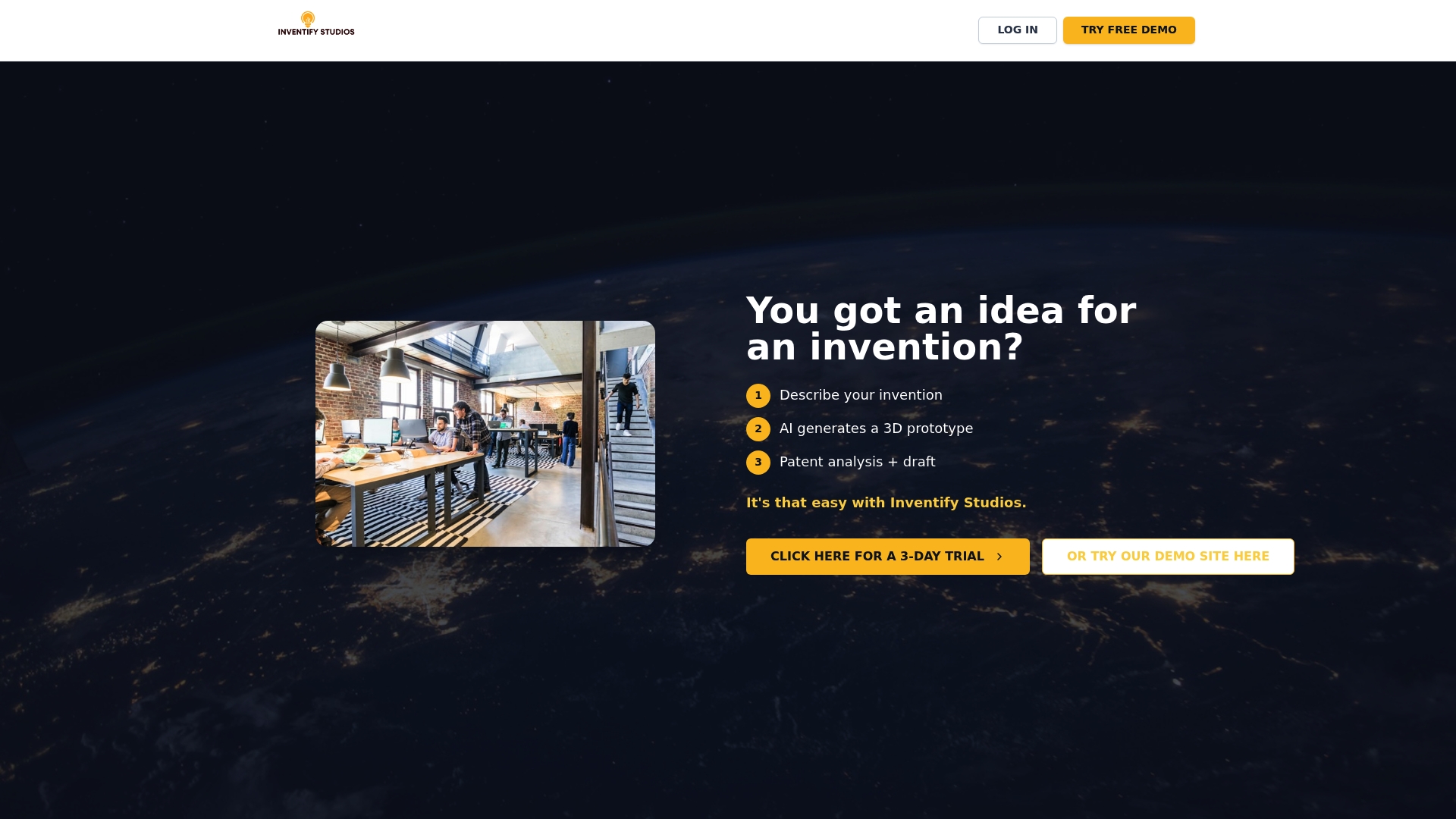
The platform gives you AI-powered tools to generate 3D prototypes, assess patentability, and receive tailored drafting insights for your provisional patent narrative, all without the fees of traditional consulting. You can validate your concept, build a prototype, and get patent-ready documentation in a fraction of the time it would take working from scratch. If you are ready to take your invention from concept to protected, start your invention detail on Inventifystudios and see exactly what your idea needs to move forward.
FAQ
What is the provisional patent definition in simple terms?
A provisional patent application is a temporary USPTO filing that secures your invention's priority date and grants "patent pending" status for 12 months. It is not a granted patent and does not give you enforceable rights on its own.
How much does a provisional patent application cost?
USPTO fees for small and micro entities range from $65–$325. With professional attorney assistance, total costs typically run $1,500–$6,000, compared to $10,000–$20,000 or more for a full non-provisional application.
What does a provisional patent protect?
A provisional patent protects only the features and details described in the filing. Any invention feature not disclosed in the provisional loses priority protection if publicly revealed before the non-provisional application is filed.
How long does a provisional patent last?
A provisional patent application lasts exactly 12 months from the filing date. It expires automatically if you do not convert it into a non-provisional application within that window.
What is the difference between a provisional and nonprovisional patent?
A provisional application is temporary, unexamined, and grants no enforceable rights. A non-provisional application is examined by the USPTO, can result in a granted patent with a 20-year term, and gives you the legal right to enforce your claims against infringers.