
A crowdfunded patent strategy is a coordinated plan to use platforms like Kickstarter or Indiegogo to validate demand and raise funds while actively preserving your U.S. patent rights throughout the campaign. Three actions matter most before you go live: file a provisional application with the USPTO to secure patent-pending status, limit your public technical disclosure to benefits and demos rather than schematics, and earmark a portion of campaign proceeds for your non-provisional filing within 12 months.
- File a provisional application first. USPTO provisional filings establish your priority date and give you 12 months to convert without losing your place in line.
- Control what you show. High-level photos and performance claims are safe. Step-by-step drawings and source code are not.
- Budget for prosecution. Campaign revenue is not just validation money. It is your IP prosecution fund.
Pro Tip: Display "Patent Pending" on your campaign page from day one. Research analyzing 9,184 Kickstarter campaigns found that patent-pending projects are more likely to reach their funding goals than projects with granted patents.
If you are also exploring non-dilutive funding, SBIR/STTR grants can complement your crowdfunding plan and cover prosecution costs without ceding equity or IP ownership.

Table of Contents
- Why does crowdfunding create special patent risks in the U.S.?
- When should you file: provisional vs. non-provisional timing?
- What should you show on your crowdfunding page?
- What should you check before launching your campaign?
- What should you do after your campaign closes?
- What funding alternatives preserve your IP ownership?
- What does research say about patent strategy and crowdfunding?
- What are the most common mistakes inventors make?
- Your pre-launch, campaign, and post-campaign checklist
- Key Takeaways
- Protection and validation work together when you get the order right
- Inventifystudios gives you faster provisional drafts and better campaign materials
- Useful resources and next steps
Why does crowdfunding create special patent risks in the U.S.?
Public disclosure on a campaign page can start or end critical patent timelines. Under U.S. patent law, the USPTO provides a 12-month grace period: if you publicly disclose your invention, you have 12 months from that disclosure date to file a patent application before you permanently lose U.S. patent rights. That grace period sounds generous, but it does not protect you internationally. Most foreign patent systems require absolute novelty, meaning any public disclosure before filing bars you from obtaining patent protection abroad.

Crowdfunding campaigns are built on excitement and transparency, which puts inventors in a difficult position. The more detail you share to attract backers, the more you risk your patent rights.
Specific risks every crowdfunded inventor faces:
- Public disclosure that negates novelty. Posting technical drawings, manufacturing specs, or detailed schematics on your campaign page counts as prior art. It starts your 12-month U.S. clock and immediately bars most foreign filings.
- Unsolicited inventorship claims. Backers who suggest improvements in comments or messages may later claim co-inventorship if those ideas make it into your patent claims. Undocumented proposals create ownership problems that are expensive to untangle.
- Early manufacturing disclosures. Sharing supplier relationships, material specs, or production processes can expose trade secrets and weaken your IP position.
- Platform terms of service. Some crowdfunding platforms include broad license language in their terms. Read them carefully before uploading any proprietary content.
A concrete example: an inventor posts detailed engineering schematics on Indiegogo to build backer confidence. That post is a public disclosure. If they have not yet filed a provisional, their 12-month U.S. window starts that day. More critically, any PCT or European filing is now barred. Filing a provisional before the campaign would have preserved all international options.
When should you file: provisional vs. non-provisional timing?
For most crowdfunded inventors, the rule is straightforward: file a provisional before the campaign launches, then convert to a non-provisional within 12 months if the campaign validates demand. A failed campaign can signal that market demand does not justify expensive prosecution costs, which is useful information before you spend thousands on a full application.
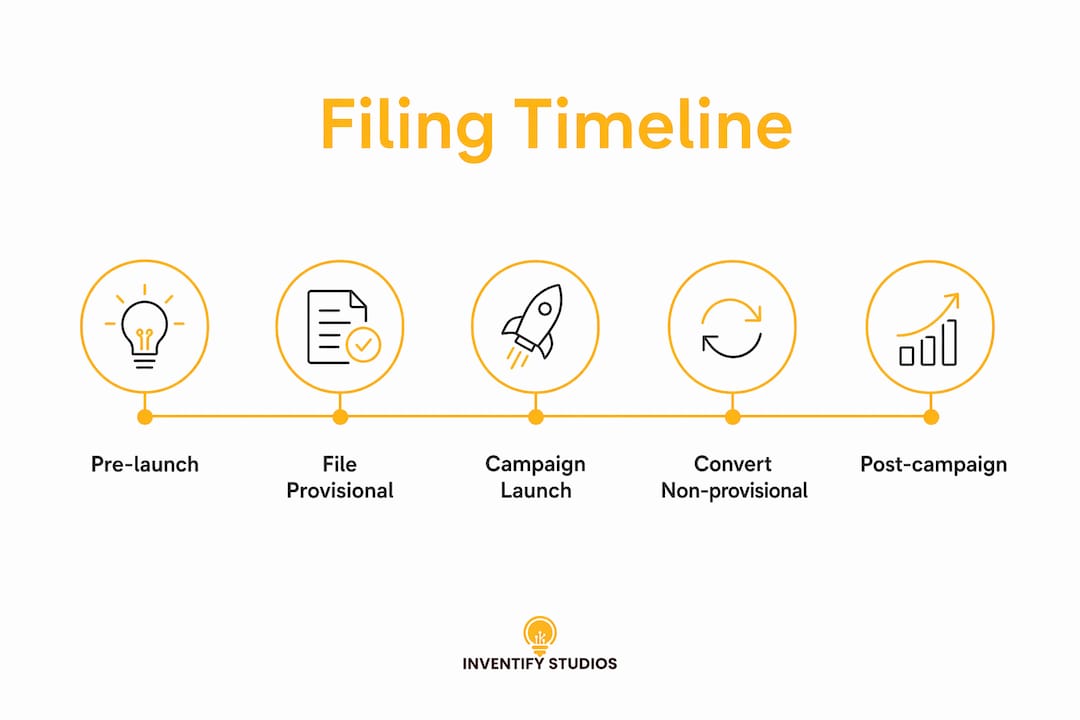
The filing timeline
| Phase | Action | Timing |
|---|---|---|
| Pre-launch | File provisional application | Before campaign goes live |
| Campaign live | Display "Patent Pending" | Day one of campaign |
| Post-campaign | Evaluate demand signals | Within 1–3 months of close |
| Conversion window | File non-provisional | Within 12 months of provisional |
| International options | File PCT application | Within 12 months of provisional |
What each filing actually secures
A provisional application is not examined and never becomes a patent on its own. What it does is lock in your priority date at a lower cost and give you 12 months to test the market. A non-provisional application is the real filing: it gets examined, and if approved, it becomes your granted patent. The provisional buys you time. The non-provisional buys you protection.
Cost matters here. USPTO micro-entity fees for a provisional application are significantly lower than standard fees, and qualifying inventors (those who meet income and prior-filing thresholds) can access these reduced rates. Attorney fees for a provisional typically run lower than for a non-provisional, though costs vary widely by technology complexity. Budget campaign proceeds accordingly: earmark funds for prosecution before you spend on manufacturing or marketing.
Pro Tip: Draft your provisional to emphasize the customer-facing, value-driving features of your invention rather than exhaustive technical specifications. This preserves your priority date while minimizing unnecessary disclosure of details that could help competitors. See claim drafting guidelines for practical framing.
What should you show on your crowdfunding page?
Show benefits, high-level photos, and working demos. Withhold step-by-step technical drawings, schematics, source code, and manufacturing specifics. The goal is to generate excitement without disclosing the inventive details that your patent claims will cover.
Safe to show:
- Photos and videos of your prototype in use
- Performance claims and user benefits ("charges 3x faster," "weighs 40% less")
- Use-case demonstrations that show what the product does, not how it does it
- General descriptions of the problem your invention solves
Do not show:
- Engineering schematics or CAD drawings that reveal internal mechanisms
- Source code or algorithm logic
- Exact dimensions, material compositions, or tolerances
- Supplier names or manufacturing process details
When backers ask technical questions in comments, respond with a template like this: "Thank you for your interest. We are not able to share detailed technical specifications at this stage, but we are happy to answer questions about how the product performs for you." This keeps the conversation going without creating disclosure problems.
Pro Tip: If you ship prototypes to beta backers, require a simple written agreement before delivery. It should include an assignment clause for any feedback or improvements they suggest, and a confidentiality provision covering the technical details they observe. This prevents inventorship disputes before they start.
What should you check before launching your campaign?
Run a focused prior-art search, file at least a provisional if appropriate, draft limited disclosure content, and plan your prosecution budget. These four steps, done in order, eliminate the most common IP failures before your campaign goes live.
Pre-launch checklist
- Run a patent landscape search. Use USPTO Patent Full-Text Database and Google Patents to search for existing patents covering your inventive concept. This is your freedom-to-operate check.
- Identify your inventive features. List the specific technical elements that make your invention novel. These become the foundation of your provisional claims.
- File a provisional application. If your search confirms novelty, file a provisional with the USPTO. Qualify for micro-entity status if you meet the criteria to reduce fees.
- Draft your campaign content with disclosure limits. Write your campaign copy around benefits and outcomes. Have a patent practitioner or patent-ready drafting tool review your page before it goes live.
- Set your prosecution budget. Decide what percentage of campaign proceeds goes to IP costs before you spend anything else.
- Research SBIR/STTR eligibility. If your invention is technology-based, Small Business Innovation Research and Small Business Technology Transfer programs offer non-dilutive grants that can fund prosecution costs without equity.
- Prepare your backer communication templates. Draft responses to technical questions and feedback requests that do not create disclosure or inventorship problems.
Free search tools: USPTO Patent Full-Text Database, Google Patents, and Espacenet (European Patent Office) cover most prior-art searches at no cost. For a more thorough freedom-to-operate analysis, pro bono patent clinics at law schools and USPTO regional offices can provide low-cost professional guidance.
Pro Tip: Keep a dated digital lab notebook from day one. Commit records, prototype photos, and development notes with timestamps. These documents support your priority claims and can resolve inventorship disputes if a backer later claims they contributed a patented feature.
What should you do after your campaign closes?
After a campaign, immediately decide whether to convert your provisional, file priority-based international applications, or focus on U.S. prosecution. The 12-month provisional window does not pause while you celebrate a successful raise.
Post-campaign milestone table
| Timeframe | Action | Notes |
|---|---|---|
| — | File non-provisional or evaluate abandonment | Use campaign revenue to fund prosecution |
| 3–6 months post-close | Prepare PCT or Paris Convention priority filings | Required within 12 months of provisional date |
| 6–12 months post-close | Complete international filing decisions | National phase entries follow PCT filing |
| 12 months from provisional | Hard deadline: convert or lose priority | No extensions available |
| Post-grant | Build enforcement reserve | Budget separately from prosecution costs |
International filing through the Patent Cooperation Treaty (PCT) gives you up to 30 months from your priority date to enter national phases in most countries, buying time to assess which markets matter most. PCT filing fees are significant, so budget your IP line before committing campaign funds to production.
Enforcement is a separate cost category. A granted patent gives you the right to exclude others, but enforcing that right requires litigation resources. Build an enforcement reserve into your financial plan from the start, even if it is modest.
Pro Tip: Tie your IP budget line directly to campaign receipts. A simple rule: allocate a fixed percentage of gross campaign revenue to prosecution and enforcement before any other spending. Document this allocation in writing so it survives co-founder disagreements or investor scrutiny later.
What funding alternatives preserve your IP ownership?
Crowdfunding can be paired with non-dilutive sources, and for technology inventors, SBIR/STTR grants are often the strongest complement. When preserving IP ownership is the priority, non-dilutive funding beats equity financing every time.
Comparing your main options:
-
Crowdfunding (Kickstarter, Indiegogo). Best for consumer products with broad appeal. You retain full equity and IP ownership. Requires a compelling story, a prototype, and careful disclosure management. Timeline: 30–60 days for a campaign. Upfront requirement: campaign preparation and a provisional filing.
-
SBIR/STTR grants. Best for technology-based inventions with commercial or government applications. No equity required. IP typically stays with the inventor or small business. Timeline: 6–12 months from application to award. Upfront requirement: a written technical proposal and business plan.
-
Equity financing (angel investors, venture capital). Fastest path to large capital. Requires giving up ownership and often IP control through licensing or assignment clauses. Not recommended when IP preservation is the primary goal.
-
Small business loans. Preserve equity and IP but require repayment regardless of commercial success. Best used after market validation, not before.
For validating your startup idea before committing to any of these paths, lightweight AI-assisted tools can help you assess market demand without the cost of a full campaign or grant application.
Pro Tip: Apply for small grants before your campaign launches where possible. SBIR Phase I awards can cover provisional filing fees, attorney costs, and prototype development without ceding any IP. This lets you arrive at your crowdfunding campaign with stronger protection already in place.
What does research say about patent strategy and crowdfunding?
Practitioners consistently favor securing patent-pending status before launch, and the empirical data backs that preference. A study analyzing 9,184 Kickstarter campaigns found that patent-pending projects are more likely to reach their funding goals than patented projects. The explanation is counterintuitive: "patent pending" signals active development and forward momentum to backers, while a granted patent can read as a static, older invention.
Key research finding: Patent-pending status outperforms granted patent status as a crowdfunding signal. Backers respond to momentum and novelty, and "patent pending" communicates both. File before you launch, display the status prominently, and let the signal do its work.
Managing backer interactions is where many campaigns go wrong. Unsolicited improvement proposals from engaged backers are common, and if those ideas make it into your patent claims without documentation, you face inventorship disputes that can invalidate your patent entirely. Document every submission. Use dated records to show prior conception. If a backer's suggestion genuinely improves your invention, address it through a formal assignment agreement before incorporating it.
Patent landscape searches are not just a legal formality. They shape which features you claim, which competitors you monitor, and which markets you target. Inventors who skip this step often draft claims around features that are already patented, wasting prosecution budget on unenforceable positions.
Inventifystudios accelerates this process with AI-assisted provisional drafting and rapid prototype generation. The platform helps inventors identify patentable features, generate 3D prototype visuals for campaign pages, and produce patent-ready draft language, all without the upfront cost of traditional consulting. Pair the platform's output with a qualified patent attorney's review for the strongest result.
Pro Tip: Use Inventifystudios to generate your initial provisional draft and prototype visuals, then have a registered patent practitioner review the claims before filing. This combination cuts drafting time and legal spend while maintaining professional-grade protection.
What are the most common mistakes inventors make?
The biggest error is oversharing technical details to build backer excitement before filing anything. The second is failing to document backer interactions. Both are avoidable with a simple pre-launch discipline.
Common mistakes and direct mitigations:
-
Posting schematics or source code on the campaign page. Mitigation: replace technical drawings with benefit-focused photos and demo videos. Have a practitioner review your page before launch.
-
Failing to file a provisional before going live. Mitigation: file at least a basic provisional before the campaign publishes. Even a narrowly scoped provisional locks in your priority date.
-
No documented chain of inventorship for third-party suggestions. Mitigation: document every unsolicited proposal with timestamps. Use dated development records to show prior conception for every claimed feature.
-
Misreading platform terms of service. Mitigation: read the IP and license sections of Kickstarter's and Indiegogo's terms before uploading any content. If terms are ambiguous, consult an attorney.
-
Shipping prototypes without assignment agreements. Mitigation: require beta testers to sign a short agreement before receiving a prototype.
Sample assignment clause for beta testers or manufacturers:
"Recipient agrees that any feedback, suggestions, or improvements relating to the Product provided to [Inventor Name] during the evaluation period are hereby assigned to [Inventor Name] and shall be the sole property of [Inventor Name]. Recipient agrees to maintain the confidentiality of all non-public technical information observed during evaluation."
This language is a starting point, not a substitute for attorney-drafted agreements. It establishes the assignment principle and confidentiality expectation in plain terms.
Pro Tip: Create a timestamped digital evidence folder before your campaign launches. Store all campaign materials, backer communications, prototype photos, and development notes in one place with automatic date stamps. Cloud storage with version history works well for this.
Your pre-launch, campaign, and post-campaign checklist
A crowdfunded patent strategy only works if the steps happen in the right order. Use this checklist as your operational guide across all three phases.
Pre-launch
- Run a prior-art search using USPTO Patent Full-Text Database and Google Patents.
- Identify the specific inventive features that make your product novel.
- File a provisional application with the USPTO before the campaign goes live.
- Confirm micro-entity or small-entity status to access reduced USPTO fees.
- Draft campaign content around benefits and demos, not technical specifications.
- Have a patent practitioner or IP-aware reviewer check your campaign page.
- Set your IP budget line: allocate a fixed percentage of projected campaign revenue to prosecution.
- Research SBIR/STTR eligibility if your invention qualifies.
During the campaign
- Display "Patent Pending" prominently on your campaign page.
- Respond to technical questions with benefit-focused answers only.
- Document all backer suggestions and unsolicited improvement proposals with timestamps.
- Require assignment and confidentiality agreements before shipping any prototypes.
Post-campaign
- Decide within 3 months whether to convert your provisional to a non-provisional.
- Evaluate PCT or Paris Convention filings if international markets matter.
- Fund prosecution from earmarked campaign revenue before any other spending.
- Build an enforcement reserve into your ongoing IP budget.
Pro Tip: Complete steps 1 through 3 before anything else. Skipping the prior-art search and provisional filing is where most crowdfunded patent strategies fail. Everything else on this list is easier to fix than a missed priority date.
Key Takeaways
A crowdfunded patent strategy works when you secure patent-pending status before launch, control technical disclosure throughout the campaign, and budget campaign proceeds for prosecution from the start.
| Point | Details |
|---|---|
| File before you launch | A provisional application locks in your priority date and lets you display "Patent Pending" from day one. |
| Control your disclosure | Show benefits and demos; never post schematics, source code, or manufacturing specs on your campaign page. |
| Budget for prosecution | Earmark a fixed percentage of campaign revenue for non-provisional filing and enforcement costs before spending elsewhere. |
| Document backer interactions | Timestamp all unsolicited proposals and require assignment agreements from beta testers to prevent inventorship disputes. |
| Inventifystudios accelerates the process | AI-assisted provisional drafting and 3D prototype generation from Inventifystudios reduce upfront legal spend and produce campaign-ready materials. |
Protection and validation work together when you get the order right
The conventional advice in most inventor communities is to choose between moving fast and protecting your IP. That framing is wrong, and it leads inventors to make avoidable mistakes in both directions.
Some inventors over-lawyer the process: they wait for a granted patent before launching, spend 18–24 months in prosecution, and miss the market window entirely. Others go the opposite direction: they launch with no filing, share every technical detail to build excitement, and discover six months later that they have permanently barred themselves from foreign markets and handed competitors a roadmap.
The provisional application exists precisely to resolve this tension. It is not a compromise. It is a tool designed for exactly this situation: you need to move fast, you need to test the market, and you need to preserve your rights while you do it. A well-drafted provisional, filed before your campaign goes live, gives you 12 months to validate demand, raise funds, and make an informed decision about full prosecution. That is not a shortcut. That is the correct sequence.
What most articles miss is the disclosure discipline required during the campaign itself. Filing a provisional does not protect you from yourself. If you post detailed schematics on your Kickstarter page after filing, you have still disclosed inventive details publicly. Your U.S. rights may survive the grace period, but your international options are gone. The provisional buys you time. Disclosure discipline is what preserves your options.
The other underappreciated risk is backer engagement. A highly engaged campaign is a good problem to have, but it generates unsolicited suggestions, improvement ideas, and technical questions at scale. Every one of those interactions is a potential inventorship claim if you are not documenting and managing them. Treat your campaign comments section like a legal record, because in a dispute, it is.
Inventifystudios gives you faster provisional drafts and better campaign materials
Protecting your IP while running a crowdfunding campaign means producing two things quickly: a solid provisional draft and campaign visuals that show your invention's value without exposing its technical core. Most inventors spend weeks and significant legal fees getting both right. Inventifystudios cuts that timeline dramatically.
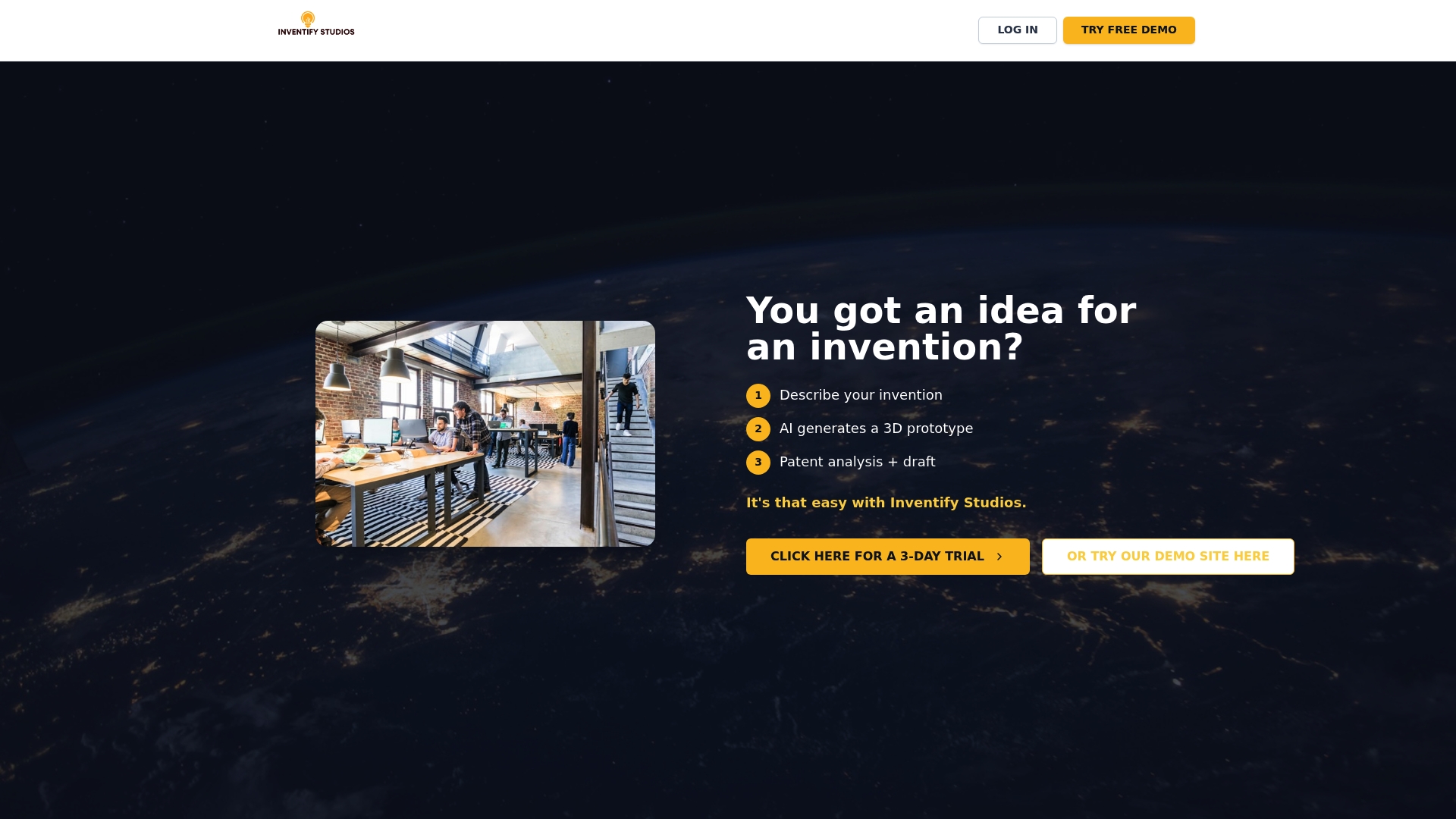
The platform's AI-powered tools generate patent-ready provisional draft language based on your invention's key features, produce 3D prototype visuals you can use directly on your campaign page, and run a patentability assessment so you know where your strongest claims are before you file. The result: you arrive at your campaign launch with "Patent Pending" status, professional prototype imagery, and campaign copy that highlights benefits without over-disclosing technical details.
For inventors who want to develop their invention concept without the upfront cost of traditional consulting, Inventifystudios provides the tools to move from idea to provisional-ready draft in a fraction of the time. Visit inventifystudios.com to assess your invention's patentability and generate your first provisional draft today.
Useful resources and next steps
Use these official and authoritative resources to move forward with your crowdfunded patent strategy.
- USPTO Patent Full-Text Database: Run your prior-art and freedom-to-operate search here before filing anything. Also check USPTO's fee schedule for current micro-entity and small-entity provisional filing rates.
- USPTO Provisional Application Guide: Official guidance on what a provisional must include, how to file, and the 12-month conversion deadline.
- Kickstarter Terms of Use: Read the IP and license sections before uploading campaign content. Understand what rights the platform claims over your materials.
- Indiegogo Terms of Use: Same recommendation as Kickstarter. Platform terms vary and affect how you should structure your campaign content.
- SBIR/STTR Program: The official portal for Small Business Innovation Research and Small Business Technology Transfer grants. Check eligibility before your campaign launches. Awards are non-dilutive and IP typically stays with the grantee.
- USPTO Pro Bono Program: Connects qualifying inventors with free patent legal assistance. Useful for provisional drafting review and freedom-to-operate analysis.
- Why patent early-stage ideas: Inventifystudios guide on the trade-offs of early filing for startup founders.
Immediate next steps: Consult a registered patent practitioner or use a USPTO pro bono clinic to review your provisional before filing. Preserve all development evidence with timestamps. Set your IP budget line before your campaign goes live. The sequence matters more than the speed.
This article provides general information about U.S. patent strategy and crowdfunding. It is not legal advice. Confirm current USPTO rules, fees, and filing requirements with a qualified patent attorney or agent for your specific situation.