

Invention consulting fees are high because they reflect a layered cost structure built on specialized expertise, firm overhead, and billing models that reward time spent rather than results delivered. The industry term for this work spans patent strategy consulting, IP advisory, and invention development services. Most inventors encounter fees ranging from a few thousand dollars for basic advice to well over $200,000 for full patent portfolio development. Understanding what drives those numbers is the first step toward spending your budget where it actually counts.
Why are invention consulting fees high?
The high cost of invention consulting comes from four compounding factors: brand premiums, specialized expertise, structural overhead, and lifecycle patent costs. Each one adds to your invoice independently, and together they can push fees far beyond what the underlying work actually requires.
Brand premium is the single largest hidden cost. Large strategy consulting firms charge 40–60% more than boutique specialists, primarily because of brand overhead rather than superior outcomes. That premium funds expensive offices, recruiting infrastructure, and administrative staff. None of those costs improve the quality of advice you receive.
Specialized expertise is a legitimate cost driver. Patent attorneys and IP strategists spend years developing niche knowledge in patent law, USPTO procedures, and commercial licensing. That depth commands a premium, and in most cases it is worth paying for. The problem is that brand premium and genuine expertise often get bundled together on the same invoice.

Structural lifecycle costs are the fees most inventors never see coming. A full utility patent application from a patent attorney typically costs $10,000–$20,000 just for the initial filing. Office action responses add $2,000–$5,000 each. Prosecution, maintenance, and foreign annuities push total costs well above $50,000 per patent over its lifetime. That is before any consulting strategy work is added on top.
| Fee Component | Typical Cost Range | Key Driver |
|---|---|---|
| Initial utility patent filing | $10,000–$20,000 | Attorney hourly rate + USPTO fees |
| Office action responses | $2,000–$5,000 each | Hourly billing complexity |
| Brand premium (large firms) | 40–60% markup | Overhead, not expertise |
| Maintenance fees (20-patent portfolio) | Up to $260,000 | USPTO schedule over patent lifetime |
| Foreign annuities | Varies by country | International filing strategy |
Pro Tip: Ask any consultant to separate their professional fee from the pass-through costs like USPTO filing fees. That one question reveals how much you are paying for expertise versus overhead.
Boutique specialists vs. large firms: which costs more?
The difference between boutique and large consulting firms is not just price. It is who actually does your work. Most companies overpay 3–8x by selecting big brand firms over boutique specialists. The reason is structural. Large firms assign junior analysts to billable work while senior partners handle client relationships. Boutique firms assign experienced partners directly, which means you get more strategic insight per dollar spent.
A $40,000 boutique engagement can deliver more commercial value than a $200,000 large firm engagement. That is not a theoretical claim. Boutique specialists deliver comparable or better work at 30–50% lower cost by minimizing overhead and keeping senior talent on execution. The deliverable quality also differs. Large firms produce lengthy, academic-style reports. Boutique firms produce concise, execution-ready roadmaps you can act on immediately.
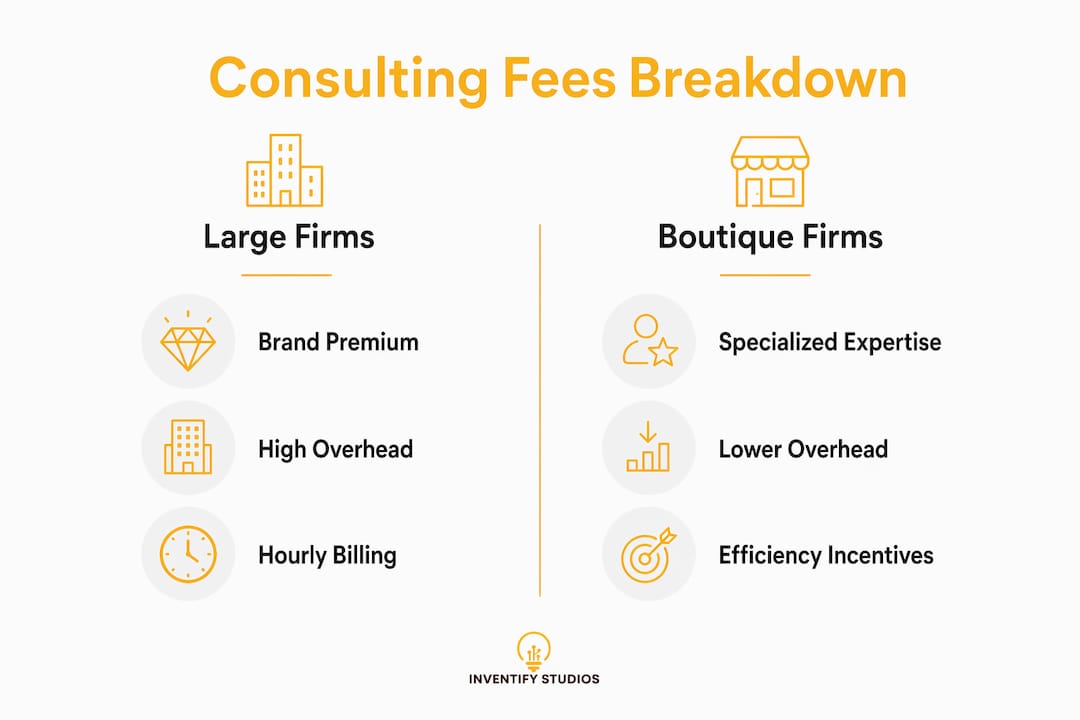
| Factor | Large Consulting Firm | Boutique Specialist |
|---|---|---|
| Typical cost premium | 40–60% above market | At or below market rate |
| Team composition | Senior partner + junior analysts | Experienced partner directly |
| Deliverable type | Extensive academic reports | Concise, actionable roadmaps |
| Overhead included in fees | High (offices, admin, recruiting) | Low |
| Outcome alignment | Brand reputation focused | Execution focused |
The practical implication for inventors is clear. If you are paying for a name on a letterhead, you are funding someone else's office lease. If you are paying for a boutique specialist with a track record in your technology category, you are funding actual strategic work.
Pro Tip: Before signing any consulting agreement, ask for two or three examples of past client deliverables. A firm confident in its work will share redacted samples. One that refuses is selling you the brand, not the output.
How does billing structure inflate invention consulting costs?
Hourly billing is the primary mechanism that inflates invention consulting pricing beyond what the work justifies. Hourly billing incentivizes complexity and lengthening work, increasing costs rather than rewarding efficient commercial outcomes. A consultant paid by the hour has no financial reason to finish quickly or keep your scope tight.
Here is how billing structure escalation typically plays out for inventors:
- Initial scope agreement sets an hourly rate with an estimated range, often $5,000–$15,000 for a strategy engagement.
- Scope creep begins when the consultant identifies additional research, filings, or analysis that were not in the original estimate.
- Office actions arrive during patent prosecution, each requiring a response billed at $2,000–$5,000 per action.
- Revisions and rework accumulate because hourly billing does not penalize inefficiency.
- Final invoice arrives at two to three times the original estimate, with no clear link between cost and commercial outcome.
Fixed-fee arrangements solve this problem directly. They realign consultant incentives toward efficiency rather than billable hours. When a consultant agrees to a fixed fee, finishing faster and delivering a cleaner result is in their financial interest too.
Consultants who refuse success-fee components and insist on pure hourly billing may be signaling a lack of confidence in the project's commercial potential. That is a warning sign worth taking seriously before you commit your budget.
Ask these questions before signing any consulting agreement:
- Is the fee fixed or hourly?
- What triggers additional charges beyond the base agreement?
- Is any portion of the fee tied to a commercial outcome or milestone?
- How many office action responses are included before additional billing begins?
What are the commercial risks of overpaying for consulting?
The biggest risk in invention consulting is not paying too much. It is paying a lot and getting nothing commercially useful in return. Many inventors pay $80,000–$200,000 for patent portfolios that generate zero licensing revenue because the claims are too narrow and the strategy lacks commercial grounding. This is what patent strategy experts call the "patent attorney trap."
The trap works like this. A patent attorney files a technically valid patent with narrow claims that protect a specific implementation. The filing is legally sound. The USPTO grants it. But the claims are so narrow that a competitor can design around them in six months. You have spent $50,000 or more on a document that does not block competition or generate licensing income.
The patent attorney trap involves paying high fees for filings that lack business strategy. Patent attorneys are trained in law, not market positioning. Without a commercial strategist involved early, your IP portfolio can become an expensive collection of legally valid but commercially useless documents.
Watch for these warning signs before committing to a large consulting budget:
- The consultant focuses on filing volume rather than claim breadth and competitive positioning.
- No market analysis or competitor landscape review is included in the scope.
- The engagement starts with drafting rather than a research-first validation phase.
- Fee structure is entirely hourly with no milestone-based checkpoints.
- The consultant cannot explain how your patent claims would block a specific competitor's product.
A research-first approach that validates commercial viability before substantial legal spending is the most reliable way to avoid wasted fees. Validate the market, map the competitive IP space, and confirm your invention has defensible claim territory before spending $10,000 on a utility application.
Understanding why inventors skip professional consultation entirely often comes down to sticker shock from these exact cost structures. The irony is that skipping early-stage guidance usually leads to larger expenses later.
Key takeaways
Invention consulting fees are high because brand premiums, hourly billing models, and lifecycle patent costs compound into totals that rarely align with commercial outcomes.
| Point | Details |
|---|---|
| Brand premium inflates fees | Large firms charge 40–60% more than boutique specialists without delivering better outcomes. |
| Hourly billing rewards inefficiency | Fixed-fee arrangements better align consultant incentives with your commercial goals. |
| Lifecycle costs are underestimated | Maintenance fees across a 20-patent portfolio can reach $260,000 over the patent's lifetime. |
| Boutique firms deliver more per dollar | A $40,000 boutique engagement can outperform a $200,000 large firm engagement in strategic value. |
| Commercial risk is the real danger | Paying $80,000–$200,000 for narrow-claim patents that generate no licensing revenue is the costliest mistake. |
What i've learned about consulting fees after watching inventors overpay
Most inventors I've worked with focus on the hourly rate. They compare $350 per hour to $500 per hour and feel like they made a smart choice by going with the lower number. That is the wrong calculation entirely.
The real question is: how many hours will this take, and what will I have at the end? A $350-per-hour consultant who bills 200 hours costs $70,000. A $500-per-hour specialist who delivers in 60 hours costs $30,000 and gives you a cleaner, more defensible result. Hourly rate comparison is a trap that the billing structure itself sets for you.
The other pattern I see repeatedly is inventors treating patent filing as the finish line. Filing a patent is not a commercial strategy. It is a legal document. The inventors who get real value from consulting spend time upfront on market validation and competitive IP mapping before they spend a dollar on prosecution. That sequence matters more than any fee negotiation.
My honest recommendation: find a boutique specialist with direct experience in your technology category, ask for fixed-fee pricing, and require at least one milestone tied to a commercial deliverable before the final payment. If a consultant will not agree to that structure, they are telling you something important about how they view your project's potential. Exploring consulting alternatives before committing to a large engagement is always worth the time.
— Hua
Skip the overhead. start with Inventifystudios.
Traditional consulting fees are high partly because the infrastructure behind them is expensive. Inventifystudios removes that overhead entirely. The platform gives you AI-powered invention validation, 3D prototype generation, patentability analysis, and provisional patent drafting in one place, at a fraction of what a traditional consulting engagement costs.

You do not need a $50,000 engagement to know whether your invention has commercial legs. Inventifystudios lets you validate your concept, map your IP position, and generate patent-ready drafts before you commit to expensive legal filings. See exactly what the platform offers on the Inventify invention detail page and start protecting your idea without the brand premium attached.
FAQ
What makes invention consulting fees so expensive?
Invention consulting fees reflect specialized expertise, firm overhead, and hourly billing models that reward time spent rather than results delivered. Brand premiums at large firms add 40–60% to invoices without improving outcome quality.
How much does a full patent cost from start to finish?
A full utility patent typically costs $10,000–$20,000 for initial filing, with office action responses, prosecution, and maintenance fees pushing total lifetime costs above $50,000 per patent.
Are boutique patent consultants better value than large firms?
Boutique specialists deliver comparable or better strategic work at 30–50% lower cost by assigning experienced partners directly and minimizing overhead. Large firms often layer junior analysts onto billable work, reducing value per dollar.
What is the patent attorney trap?
The patent attorney trap describes paying high fees for technically valid but commercially narrow patent claims that fail to block competitors or generate licensing revenue. It results from filing without a commercial strategy in place.
How can inventors reduce invention consulting costs?
Request fixed-fee pricing, validate commercial viability before legal filings, and choose boutique specialists over large brand firms. Asking for milestone-based payment structures also aligns consultant incentives with your outcomes.