

Most patent applications get rejected at least once. That's not a sign of failure. According to USPTO data, A large majority of original filings receive a first Office Action containing a rejection. The three most common causes are lack of novelty, obviousness based on prior art, and inadequate disclosure. Procedural errors, like incomplete drawings or filing mistakes, add to the list.
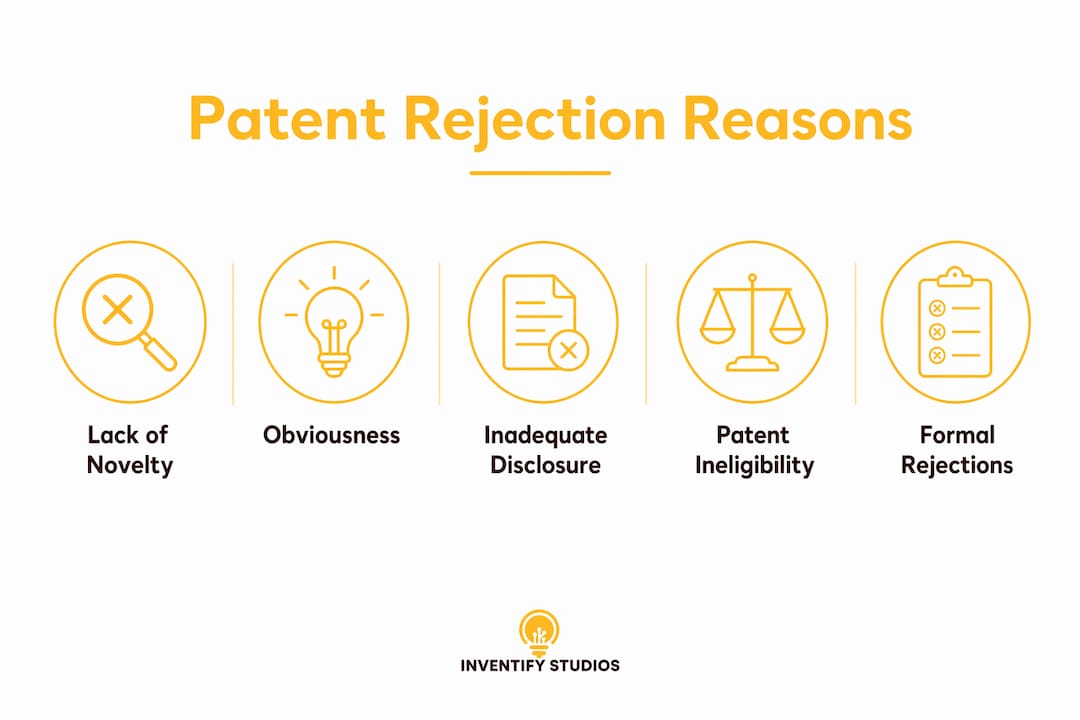
Here's what drives most rejections:
- Lack of novelty (35 U.S.C. § 102): Your invention already exists in prior art.
- Obviousness (35 U.S.C. § 103): Your invention is a predictable variation of existing ideas.
- Inadequate disclosure (35 U.S.C. § 112): Your specification doesn't fully describe or enable the invention.
- Patent ineligibility (35 U.S.C. § 101): The invention covers abstract ideas, laws of nature, or natural phenomena.
- Formal errors: Poor drawings, missing declarations, or incomplete Application Data Sheets.
"Rejections are a normal part of the process. They help define what is patentable and can often be overcome." — USPTO Patent Examination Guidance
Understanding why patents are denied is the first step toward doing something about it. The sections below break down each cause and show you exactly how to respond.
Why patent applications get rejected: the core legal reasons
The USPTO's examination standards require every claim to satisfy novelty, non-obviousness, enablement, and clear description before allowance. Examiners apply these standards under four primary statutes.

35 U.S.C. § 102: Lack of novelty

A claim fails novelty when prior art discloses every element of that claim. The examiner doesn't need to find a single document that's identical to your entire invention. One reference that covers all the claim limitations is enough. This is why a thorough prior art search before filing matters so much.
35 U.S.C. § 103: Obviousness
Obviousness rejections are the most frequent, and they hinge on whether a person of ordinary skill in the art would have been motivated to combine existing references to reach your claimed invention. The examiner must establish four things: the scope of prior art, the differences between prior art and your claims, the skill level in the field, and any secondary considerations like commercial success or long-felt need. If the examiner can't show a clear motivation to combine references, the rejection doesn't hold.
35 U.S.C. § 112: Inadequate disclosure
Two separate requirements live under § 112. The written description requirement means your specification must show you actually possessed the invention at the time of filing. The enablement requirement means a skilled person must be able to make and use the invention based on your disclosure alone. Vague claim terms paired with narrow examples, inconsistent use of terms throughout the application, and describing unclaimed features as "the invention" are all drafting habits that trigger § 112 rejections.
35 U.S.C. § 101: Patent ineligibility
Abstract ideas, mathematical concepts, and natural phenomena aren't patentable on their own. Software and business method claims face this rejection frequently. The examiner applies the Alice/Mayo framework to determine whether your claim adds something significantly more than the abstract idea itself.
Formal and procedural rejections
Beyond the substantive grounds, common procedural errors like poor drawing quality, premature public disclosure before filing, and inadequate prior art searches contribute to delays or outright rejection. Indefiniteness under § 112(b) is another frequent formal rejection, where claim language is too vague for a skilled person to determine the scope of protection.
"By far the most frequent ground of rejection is on the ground of unpatentability in view of the prior art, that is, that the claimed subject matter is either not novel under 35 U.S.C. 102, or else it is obvious under 35 U.S.C. 103." — USPTO MPEP § 706
Pro Tip: Never use the heading "Description of Prior Art" in your specification. That phrasing can be construed as an admission that the described material is prior art, which binds you during prosecution and litigation.
How to respond effectively to a patent Office Action
An Office Action is the examiner's written explanation of every objection and rejection in your application. Receiving one doesn't mean your application is dead. Most utility patent applications get at least one Office Action before allowance, and a well-crafted response often turns a rejection into an allowance.
Here's a practical response sequence:
- Read the entire Office Action carefully. Identify every rejection and objection. Don't skim. Examiners cite specific claim elements and specific prior art passages, and your response must address each one individually.
- Pull the cited references in full. The USPTO advises reading the entire prior art reference, not just the portion the examiner relied on. You may find passages that actually support your position.
- Categorize each rejection by type. Separate § 102 from § 103 from § 112 rejections. Each requires a different response strategy.
- Draft arguments before drafting amendments. Attack the examiner's reasoning first. If the examiner failed to establish a motivation to combine references, say so directly and with specificity.
- Amend claims only when argument alone won't work. Narrowing a claim surrenders scope and can create prosecution history estoppel. Argue first, amend second.
- Respond completely and on time. A partial response or a missed deadline can result in abandonment. The standard response period is three months from the mailing date, extendable up to six months with fees.
- Request an examiner interview when the rejection is complex. A direct conversation often resolves misunderstandings faster than written exchanges.
Pro Tip: When facing an obviousness rejection, focus your argument on the prior art itself rather than your claimed invention. Show that the references teach away from the combination, or that no reasonable expectation of success existed. This approach avoids unnecessary claim narrowing and preserves your scope.
Strategies for amending your patent application to overcome rejections
Amendments are a tool, not a default. Used well, they fix genuine deficiencies. Used carelessly, they shrink your patent's commercial value before it even issues.
Types of amendments and their purposes
- Claim amendments: Narrow or clarify claim language to distinguish prior art or fix indefiniteness.
- Specification amendments: Add clarity to the written description without introducing new matter.
- Drawing amendments: Correct drawing deficiencies flagged by the Office of Patent Application Processing.
- New dependent claims: Add fallback positions that protect valuable embodiments if independent claims are narrowed.
How to draft amendments that comply with USPTO standards
Every claim amendment must be accompanied by a written statement identifying specific support in the original specification. If the support is implicit, an explanation helps. The USPTO's Application Data Sheet guidance also flags a common procedural trap: the "Filing by Reference" section of the ADS should almost always be left blank. Completing it incorrectly is expensive and time-consuming to fix.
The prosecution history estoppel risk
Narrowing amendments made for patentability purposes create a presumption that you've surrendered all equivalents for the narrowed element. That restriction follows the patent into enforcement. A competitor's product that falls just outside your amended claim language may escape infringement liability entirely because of what you gave up during prosecution.
| Amendment Type | Best Use | Key Risk |
|---|---|---|
| Narrowing independent claim | Distinguish specific prior art | Prosecution history estoppel |
| Adding dependent claims | Preserve fallback embodiments | None, if well drafted |
| Specification clarification | Fix § 112 written description issues | Introducing new matter |
| Argument without amendment | Overcome weak obviousness rationale | None if examiner agrees |
Pro Tip: Before finalizing any amendment, confirm that your most commercially valuable embodiments are still covered by the amended claims. If they aren't, reconsider whether argument alone can do the job instead.
When to bring in a patent attorney or agent
Patent prosecution is a legal proceeding. The USPTO itself advises that while you may prosecute an application without professional help, you might not get all the protection you can without an experienced registered patent practitioner. That's a measured understatement.
Patent attorneys and agents bring three things you can't easily replicate on your own. First, they know how to read an examiner's rejection for what it actually says versus what it implies. Second, they craft legal arguments grounded in case law, including decisions like Graham v. John Deere for obviousness and Phillips v. AWH for claim construction. Third, they know when to argue and when to amend, which is the single most consequential judgment call in prosecution.
"The specification is always highly relevant to claim construction analysis. It is the single best guide to the meaning of a disputed term." — Phillips v. AWH, Fed. Cir. 2005 (en banc)
The complex balance between obviousness reasoning and enablement demands nuanced legal arguments to preserve broad claims. Getting that balance wrong in prosecution can leave you with a patent that's technically granted but practically unenforceable.
When should you bring in professional help? Before you file, ideally. If that ship has sailed, bring in a practitioner the moment you receive a non-final Office Action with substantive rejections. Waiting until after a final rejection limits your options significantly.
Pro Tip: If you're handling prosecution yourself and receive an obviousness rejection, don't argue how difficult it would be to make the modification the examiner suggests. That argument can backfire by implying your invention is hard to enable, which opens a § 112 door you don't want opened.
For inventors managing technical documentation alongside their patent filings, understanding how documentation quality affects patent outcomes is worth your attention, particularly in technology-heavy fields.
What Inventifystudios sees in patent rejection patterns
Inventifystudios works with inventors at every stage, from first idea to patent-ready draft, and the patterns in patent application failure are consistent. The allowance rate for patent applications sits at roughly 55–60%, meaning 40–45% of applications are rejected or require amendment. The causes cluster around the same issues every time.
The most common pattern Inventifystudios observes: inventors file before they've done a serious prior art search. They draft claims that are either too broad to survive a novelty challenge or too narrow to provide real commercial protection. The specification doesn't fully support the broadest claim construction, which creates § 112 vulnerability. And when the Office Action arrives, they either over-amend out of anxiety or ignore the examiner's actual reasoning.
A few practical insights from working through these cases:
- Patentability analysis before filing changes the outcome. Knowing where the prior art sits lets you draft claims that are broad enough to matter and narrow enough to survive.
- Provisional patents buy time, not protection. A provisional application establishes a priority date but never becomes a patent on its own. Use that 12-month window to refine your claims, not to delay thinking about them.
- Dependent claims are your safety net. Many patents fail enforcement years after allowance because the independent claim gets invalidated and there are no well-drafted dependent claims to fall back on.
- Examiner interviews are underused. A 30-minute call with the examiner often resolves a rejection that would take months of written exchange to address.
Inventifystudios' AI-powered patentability analysis helps inventors identify prior art conflicts and disclosure gaps before they become rejection reasons. The platform generates patent-ready drafts that align with USPTO disclosure standards, so you're not starting from scratch when the first Office Action arrives.
Pro Tip: Run a patentability check on your invention before drafting a single claim. Knowing what's already out there shapes every drafting decision that follows, from claim scope to specification depth.
Key Takeaways
Understanding why patent applications get rejected, and responding with targeted arguments rather than reflexive amendments, gives inventors the best realistic path to a strong, enforceable patent.
| Point | Details |
|---|---|
| Rejections are routine | 84% of original filings received a first Office Action with a rejection in FY 2019. |
| Obviousness is the top ground | Examiners must show motivation to combine prior art; challenge that premise before amending. |
| Amendments carry legal risk | Narrowing claims for patentability creates prosecution history estoppel, limiting future enforcement. |
| Argue first, amend second | Attacking the examiner's reasoning preserves claim scope better than immediate narrowing. |
| Early legal help changes outcomes | Bringing in a registered patent practitioner before or at the first Office Action protects your broadest viable claims. |
The rejection isn't the end of your invention
Most inventors treat a patent rejection like a verdict. It isn't. It's the examiner telling you, in writing, exactly what they need to see before they'll allow your claims. That's actually useful information.
What concerns me more than the rejection itself is the response pattern I see repeatedly: inventors either panic and over-amend, surrendering scope they didn't need to give up, or they disengage entirely and let the application go abandoned. Both outcomes are avoidable.
A significant share of applications are eventually allowed means a meaningful share of applications that face rejection do eventually get allowed. The difference between the ones that make it and the ones that don't usually comes down to how the first Office Action was handled. Did the applicant read the examiner's reasoning carefully? Did they attack the premise of the rejection before reaching for an amendment? Did they preserve their most valuable embodiments?
There's also a drafting dimension that doesn't get enough attention. Many applications arrive at examination with specifications that were written to describe the invention rather than to support the broadest possible claim construction. Those are two different documents. The specification is the single best guide to claim meaning, as Phillips v. AWH established, and if it's written carelessly, it constrains your claims even when the examiner doesn't raise a § 112 rejection.
My honest view: the inventors who do best through prosecution are the ones who treat the patent process as a conversation, not a one-time submission. They respond to rejections with specific, focused arguments. They keep dependent claims as fallback positions. They don't mistake a narrow allowed claim for a strong patent. And they get professional help before the stakes get too high to recover from a mistake.

Inventifystudios gives inventors the tools to get ahead of rejection before it happens. The platform's AI-powered patentability analysis identifies prior art conflicts and disclosure gaps early, and its patent-ready draft generator aligns with USPTO disclosure standards from the start. Whether you're filing your first provisional or responding to a complex Office Action, explore your invention's potential with Inventifystudios and build from a stronger foundation.