

Self-education is the primary driver of invention for creators who build beyond the boundaries of formal training. Self-directed learning physically rewires neural pathways, sharpening problem-solving and building the intellectual resilience that classrooms rarely teach. Inventors like Benjamin Banneker and Elon Musk prove that the role of self-education in inventing is not supplementary. It is foundational. Banneker taught himself astronomy and engineering without a degree and produced work that lasted generations. Musk taught himself rocket science from textbooks and built SpaceX into a world-leading aerospace company. The benefits of self-education go beyond knowledge acquisition. They include adaptability, creative confidence, and the ability to connect ideas across disciplines.
How does self-education reshape inventing skills compared to formal education?
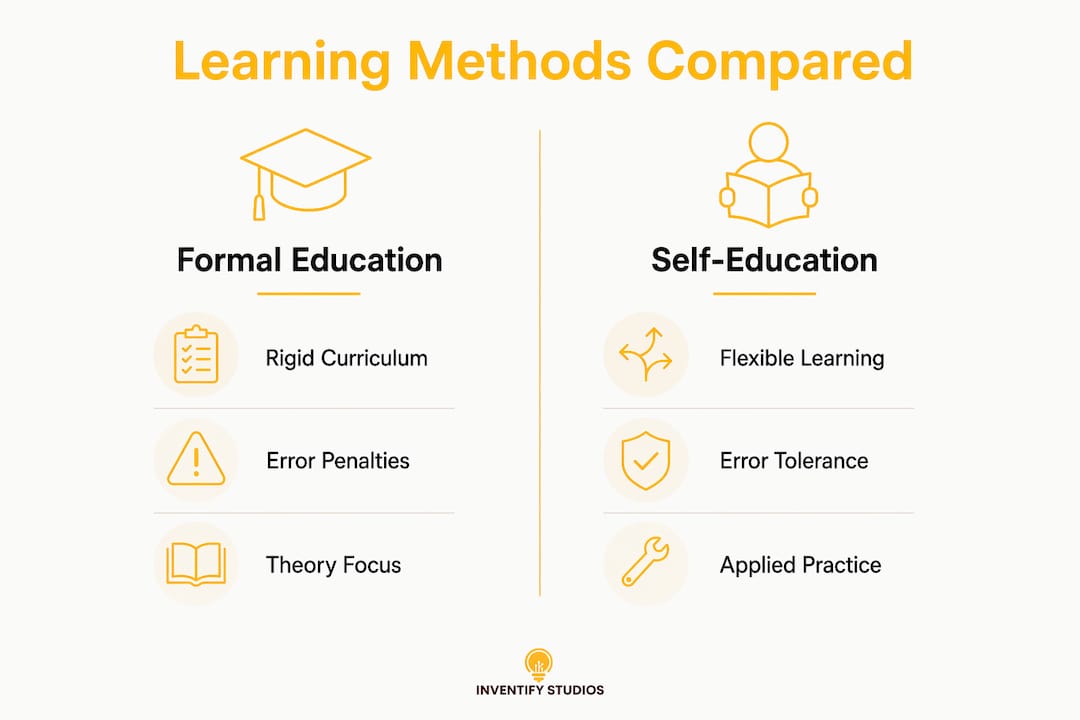
Self-directed learning builds a different kind of inventor than formal education does. Institutional programs teach you to avoid mistakes. Self-education teaches you to use them. Marvin Minsky argued that traditional schooling restricts invention by prioritizing mistake avoidance over exploration, while inventiveness thrives through cross-domain thinking and hands-on projects. That distinction matters enormously for anyone trying to create something new.

Jim Rohn put it plainly: formal education teaches you how to make a living, but self-education can teach you how to make a fortune. For inventors, that gap shows up in real outcomes. A formally trained engineer learns to solve problems within established frameworks. A self-taught inventor learns to question the framework itself.
Neuroscience supports this. Daily independent study habits produce higher career stability and adaptability in technical fields. The brain builds new connections when it encounters unfamiliar problems without a prescribed solution path. That cognitive flexibility is exactly what invention requires.
Pro Tip: Read outside your primary field every week. Inventors who pull ideas from biology, architecture, or economics consistently produce more original solutions than those who read only within their discipline.
| Dimension | Formal education | Self-directed learning |
|---|---|---|
| Error tolerance | Mistakes are penalized | Mistakes are data |
| Knowledge scope | Defined curriculum | Driven by curiosity and need |
| Problem-solving | Within established frameworks | Questions the framework |
| Pace | Fixed by institution | Controlled by the learner |
| Application | Delayed, often theoretical | Immediate, project-based |
What are the best examples of self-taught inventors and their methods?
The most instructive inventor stories are not about genius. They are about method. Each of the following inventors built a repeatable learning system from limited resources, and each produced results that formally trained peers could not replicate.
- Benjamin Banneker taught himself astronomy, mathematics, and mechanical engineering through borrowed books and direct observation. His self-taught inventions lasted over 40 years without formal engineering training. He built a working wooden clock entirely from memory after examining a borrowed pocket watch once.
- Elon Musk read aerospace engineering textbooks cover to cover and consulted directly with scientists to fill gaps. Over 40% of top software developers hold no formal computer science degree yet lead in innovation. Musk applied the same self-taught model to rocket propulsion and outperformed contractors with decades of institutional training.
- Lu Yulong, known as China's "madman of science," dropped out of school early and built low-cost rockets through relentless home experimentation. His electric flame stove company is valued at over $220 million, funding his continued research into affordable space access.
- Suleymaan Khan learned to code through YouTube videos and built award-winning robots from recycled parts as a teenager. His robotic creations earned national innovation awards and led to professional apprenticeships, all without formal training.
- Kelvin Doe built batteries, generators, and a community radio station from scrap materials in Sierra Leone at age 15. His inventions served real community needs and earned him international recognition, including a visit to MIT.
The common thread across all five is not access to resources. It is the method of learning through building. Each inventor identified a specific problem, found targeted information to address it, and tested their understanding immediately through physical construction. You can find more examples of successful first inventions that follow this same pattern.
Which self-education strategies actually improve invention skills?
Effective self-education for inventors is not about consuming more content. It is about applying knowledge faster than you forget it. The strategies below reflect how the most productive self-taught inventors actually learn.
-
Target your resources to a specific problem. Top autodidacts skip general coursework and go directly to university papers, patents, and specialized texts that address their current technical challenge. Generic online courses build familiarity. Targeted reading builds capability.
-
Build a dedicated workspace, even a small one. A home lab, even a makeshift one, is critical for transitioning theory into functional inventions. Lu Yulong built rockets in a converted space. Kelvin Doe worked from a small room with salvaged parts. The physical environment signals to your brain that building, not just reading, is the goal.
-
Use reverse-engineering as a learning method. Self-taught inventors treat failure as feedback and iterate constantly. Take apart existing products. Understand why each component exists. Then rebuild with your own modifications. This method compresses years of theoretical study into weeks of applied learning.
-
Run side projects in parallel with your learning. Theory without application fades within days. Apply every new concept to an active project within 48 hours. The project does not need to be large. A small prototype that tests one idea is more valuable than a detailed plan that tests none.
-
Engage with a learning community. Isolation slows invention. Peer feedback reveals blind spots that solo study never catches. Online forums, maker spaces, and inventor groups provide the kind of critical challenge that accelerates growth faster than reading alone.
-
Build a daily learning habit, not a binge schedule. Self-education is now fundamental for career security, achieved through daily reading, community engagement, and stretch projects. Thirty focused minutes every day outperforms a six-hour weekend session. Consistency builds the neural pathways that make problem-solving automatic.
Pro Tip: Keep a physical inventor's notebook. Write down every failed attempt and what it revealed. Inventors who document failures systematically solve problems faster because they stop repeating the same dead ends.
Understanding how AI shapes the invention development process can also help you decide which parts of your learning to prioritize and which to delegate to digital tools.
How do digital tools and inventor communities support self-education?
Modern technology has removed the biggest barrier to self-education in innovation: access. A self-taught inventor in 2026 can reach the same technical knowledge that once required a university library and a faculty advisor.
The most useful digital resources for inventors fall into three categories:
- Structured learning platforms like MIT OpenCourseWare, Coursera, and Khan Academy provide free or low-cost access to engineering, physics, and design fundamentals. These work best when paired with an active project rather than used as standalone study.
- Rapid prototyping tools including CAD software, 3D printing services, and AI-powered design generators let inventors test physical concepts without expensive manufacturing. The ability to iterate a design in hours rather than weeks changes how quickly you can learn from failure.
- Online inventor communities provide mentorship, collaboration, and real-time feedback. Inventors engaging with online communities show higher adaptability and better project outcomes than those who learn in isolation.
The impact of digital tools on inventing in 2026 goes beyond convenience. These tools change the feedback loop. When you can test an idea the same day you conceive it, learning accelerates dramatically. The gap between "I read about this" and "I built this" shrinks from months to days. That compression is what makes self-directed learning so powerful for modern inventors.
Staying sharp as AI handles more cognitive tasks is a real concern for inventors. The answer is not to avoid AI tools. It is to use them deliberately while keeping your own problem-solving skills active through hands-on building.
Key takeaways
Self-education is the most direct path to invention competence because it builds applied knowledge, cognitive flexibility, and creative confidence simultaneously.
| Point | Details |
|---|---|
| Self-education rewires the brain | Daily independent study builds neural pathways that improve problem-solving and adaptability. |
| Self-taught inventors use targeted learning | Top autodidacts skip general courses and go straight to resources that solve their current problem. |
| A dedicated workspace accelerates progress | Even a small home lab converts theoretical knowledge into functional, testable inventions. |
| Failure is the core learning mechanism | Treating failed prototypes as data, not setbacks, is the defining habit of successful self-taught inventors. |
| Communities multiply individual learning | Engaging with inventor groups and online forums produces faster growth than solo study alone. |
Why self-education is the invention habit worth protecting
I have watched a lot of aspiring inventors get stuck in the same place. They consume content endlessly but never build anything. They finish one online course and immediately start another, waiting to feel "ready." The uncomfortable truth is that readiness never arrives through reading alone.
The inventors who actually produce results treat self-education as a daily practice, not a phase before the real work begins. They read, then they build. They fail, then they document. They ask questions in communities, then they apply the answers the same week. That cycle, repeated consistently, is what separates people who have ideas from people who have inventions.
A growth mindset matters here, but not in the abstract motivational sense. It means specifically that you view each failed prototype as a data point that narrows your next attempt. Benjamin Banneker did not build a perfect clock on the first try. Kelvin Doe did not power his community on the first battery. The iteration was the education.
The biggest risk I see is information overload without a focused goal. Pick one invention challenge. Find the three most relevant resources. Build something that tests your current understanding. Then repeat. That focused loop beats any curriculum.
— Hua
Take your invention from idea to prototype with Inventifystudios
Self-education gives you the knowledge and mindset to invent. Inventifystudios gives you the tools to move from concept to protected product without the cost of traditional consulting.
Inventifystudios offers AI-powered invention development support, including 3D prototype generation, patentability analysis, and provisional patent drafting. These tools complement your self-directed learning by handling the technical and legal complexity that slows most first-time inventors down. You bring the idea and the curiosity. Inventifystudios handles the structure. Visit the invention development page to see how the platform supports inventors at every stage, from initial concept through patent-ready documentation.
FAQ
What is the role of self-education in inventing?
Self-education is the primary method through which inventors develop applied knowledge, creative problem-solving, and the resilience to iterate through failure. It physically rewires neural pathways in ways that formal education rarely replicates.
Can you invent successfully without a formal degree?
Yes. Inventors like Benjamin Banneker, Kelvin Doe, and Elon Musk built world-recognized inventions without formal engineering degrees by combining targeted self-study with hands-on experimentation.
What is the most effective self-education method for inventors?
Targeted learning paired with immediate application is the most effective method. Top autodidacts identify a specific technical problem, find the most relevant resources, and test their understanding through a physical prototype within days.
How do online communities support self-taught inventors?
Online inventor communities provide mentorship, peer feedback, and collaboration that accelerate learning beyond what solo study achieves. Inventors who engage with these communities show higher adaptability and better project completion rates.
How does a dedicated workspace improve invention outcomes?
A dedicated workspace, even a small or makeshift one, creates a controlled environment for iterative building. Inventors who maintain a consistent physical workspace transition from theory to functional prototypes faster than those who work without one.