

Invention marketability analysis is the systematic evaluation of your product idea's demand, competitive landscape, financial viability, and customer interest before you pursue patents or production. Skipping this step is expensive. 85% of consumer-packaged goods fail within 12 months, largely because inventors skip structured validation before manufacturing. This guide walks you through the prerequisites, a step-by-step execution framework, and the most common mistakes that sink otherwise promising ideas. Inventifystudios uses this exact type of analysis to help inventors validate concepts before spending money on patents or prototypes.
What prerequisites and tools do you need for an invention marketability analysis guide?
Effective product viability assessment starts with clean inputs. Before you run any analysis, you need four things: a clear description of your concept, basic market data for your target category, a realistic list of competing products or solutions, and rough financial assumptions including estimated production cost and target price.

Without these inputs, any analysis you produce is guesswork. A concept description does not need to be a finished prototype. A one-page summary of the problem you solve, the customer you serve, and the core mechanism of your solution is enough to start.
Key tool types for market analysis for inventions
Three categories of tools cover most of what inventors need:
- AI-powered analysis platforms: These generate competitor maps, demand signals, and financial models in minutes. Inventifystudios falls into this category, offering AI-generated prototypes, patent analysis, and marketability reports without the cost of traditional consulting.
- Manual research methods: Google Trends, USPTO patent databases, Amazon Best Sellers, and industry trade reports give you raw data. They are free but slow, and they require you to interpret the data yourself.
- Validation checklists: Structured scoring frameworks like the 30-point validation checklist test problem clarity, market size, demand evidence, solution fit, and business model. Scores above 25 indicate a strong go decision. Scores below 18 signal that you need more testing before moving forward.
Pro Tip: Prioritize data quality over data volume. Three verified data points from paying customers beat thirty opinions from friends and family.
The practical application of AI in validating business ideas has matured significantly. AI tools now cross-reference patent databases, market reports, and pricing data simultaneously, which manual research cannot replicate at the same speed.
How do you perform a step-by-step invention marketability analysis?
The core framework for invention profitability evaluation rests on four pillars: opportunity assessment, competitive landscape, financial modeling, and customer validation. Work through them in order.
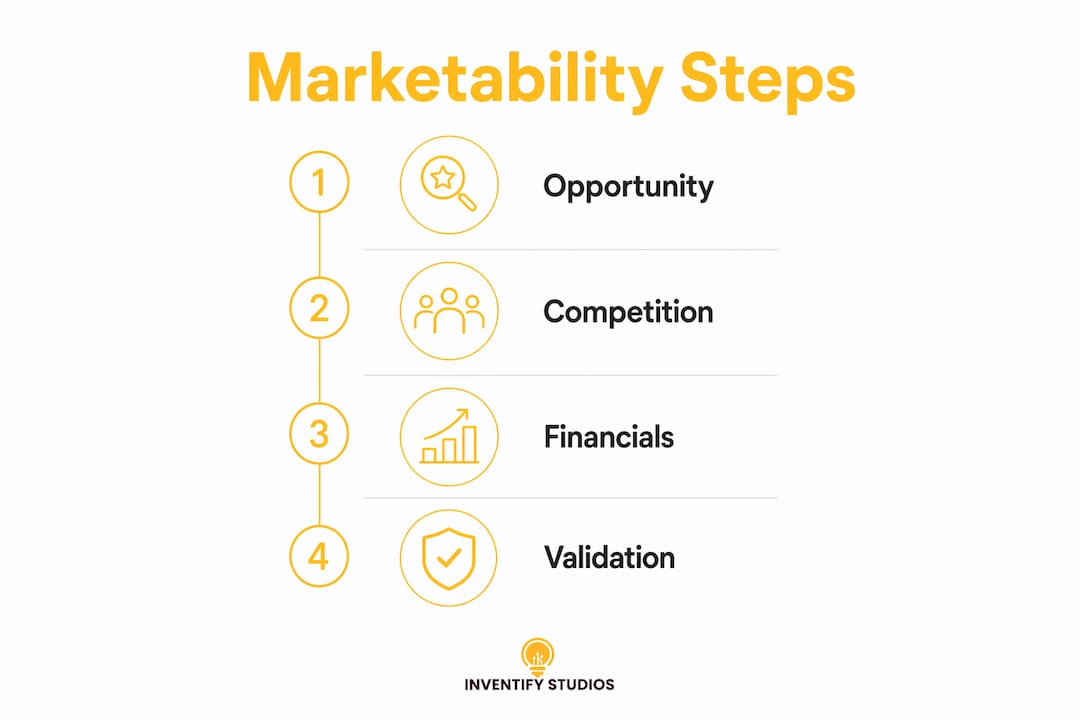
Step 1: Opportunity assessment
Define your total addressable market, your serviceable addressable market, and your Serviceable Obtainable Market (SOM). SOM is the realistic market share your invention can capture within five years. Most inventors skip SOM and anchor on total market size, which produces numbers that impress no one who understands markets. A $10 billion market means nothing if your SOM is $50,000.
Step 2: Competitive landscape
List every existing solution a customer could use instead of your invention. Include direct substitutes and indirect alternatives. For each competitor, note their price, their core weakness, and the customer complaint that appears most often in reviews. That complaint is your opening. If no competitor has a meaningful weakness, that is a signal worth taking seriously before you invest further.
Step 3: Financial modeling
Build a simple unit economics model. Calculate your estimated cost to produce one unit, your target retail price, your gross margin, and the number of units you need to sell to break even. Unrealistic financial projections are a red flag to investors and signal a lack of real market understanding. Use conservative assumptions. If your model only works under the best-case scenario, the model is wrong.
Step 4: Customer validation
Talk to at least ten people who match your target customer profile. Do not ask them if they like your idea. Ask them to describe the last time they experienced the problem your invention solves. Ask how they currently handle it and what they pay for that solution. Genuine market validation requires actionable signals: customer willingness to pay, signed letters of intent, or actual pre-orders. Informal enthusiasm does not count.
Pro Tip: Apply adversarial testing to every assumption you make. Assign someone the role of devil's advocate and ask them to find the three most likely reasons your invention will fail. Confirmation bias is the single biggest threat to self-directed research, and intentionally seeking disconfirming evidence is the most reliable way to counter it.
For inventors using Inventifystudios, the platform's AI analysis covers steps 1 through 3 automatically, generating competitor maps and financial models in minutes. You still need to conduct your own customer conversations. No AI replaces direct customer research.
What are common mistakes in invention marketability analysis you must avoid?
Most inventors make the same errors. Recognizing them before you start saves time and money.
- Relying on informal feedback. Friends and family will not tell you your idea is bad. Only measurable customer commitments, such as pre-orders or signed letters of intent, confirm real demand. Positive reactions from acquaintances do not validate a market.
- Confusing feasibility with desirability. Inventors often confuse feasibility with desirability and viability. You can build something technically impressive that no one wants to buy. These are three separate questions and they require separate answers.
- Treating analysis as a one-time event. Marketability assessment works best as a continuous loop, with feasibility, desirability, and viability validated in parallel as conditions evolve. Markets shift. Competitors launch. Your assumptions from six months ago may no longer hold.
- Ignoring competitive realities. Inventors frequently underestimate how hard it is to displace an existing solution, even a bad one. Switching costs, brand loyalty, and distribution advantages all protect incumbents. Your analysis must account for these barriers.
- Projecting revenue without evidence. A financial model built on assumptions alone is fiction. Anchor every revenue projection to a real data point: a comparable product's sales rank, an industry conversion rate, or a confirmed pre-order.
Continuous iteration is not optional. As you gather new data, update your model. The invention validation steps that work for beginners all share one trait: they build in checkpoints to revisit assumptions before spending more money.
How can AI tools accelerate your invention marketability analysis?
AI-powered validation tools now deliver comprehensive market viability reports, competitor maps, and financial models in approximately five minutes. Traditional research covering the same ground takes three to eight weeks. That time difference changes what is practical for an independent inventor with limited resources.
The specific advantages AI tools bring to market analysis for inventions include:
- Speed: AI cross-references patent databases, market reports, and competitor pricing simultaneously. Manual research does this sequentially, which multiplies the time required.
- Consistency: AI applies the same criteria to every analysis. Human researchers introduce variability based on experience, mood, and available time.
- Depth: AI tools surface patent conflicts, regulatory considerations, and supply chain risks that a first-time inventor would not know to look for.
- Cost: AI-powered platforms cost a fraction of what traditional consulting firms charge for comparable analysis.
Inventifystudios combines AI-generated prototypes with patent analysis and marketability reports in one platform. Inventors can create a 3D prototype, assess patentability, and receive a marketability report without hiring separate specialists for each task.
Pro Tip: Use AI analysis as your first pass, not your final answer. AI tools identify patterns across large datasets, but they cannot replace a conversation with a real customer. Integrate AI insights with direct customer research for the most reliable picture.
The data and AI capabilities available to inventors today would have required an enterprise budget five years ago. That shift has made rigorous invention commercialization strategies accessible to solo inventors and small teams for the first time.
Key Takeaways
Invention marketability analysis is the foundation of every successful commercialization decision, and skipping it is the leading cause of product failure within the first year.
| Point | Details |
|---|---|
| Start with clean inputs | Gather concept details, market data, competitor info, and financial assumptions before any analysis begins. |
| Use the four-pillar framework | Work through opportunity assessment, competitive landscape, financial modeling, and customer validation in sequence. |
| Require actionable signals | Pre-orders, letters of intent, and willingness to pay are the only signals that confirm real demand. |
| Separate feasibility from desirability | Building something is a different question from whether customers want it or will pay for it. |
| Treat analysis as ongoing | Update your assumptions as markets shift, competitors launch, and new customer data arrives. |
What I've learned about invention validation that most guides won't tell you
The most dangerous moment in any invention project is right after you get your first round of positive feedback. That moment feels like confirmation. It is actually when confirmation bias peaks and your analysis becomes least reliable.
I've seen inventors spend $15,000 on a provisional patent based on enthusiastic reactions from ten people, none of whom were asked to commit money. Real validation is uncomfortable. It requires you to ask customers to do something, not just say something. A signed letter of intent from a potential buyer is worth more than a hundred "I love this idea" responses.
The other mistake I see constantly is treating feasibility as the primary question. Inventors are builders by nature. They gravitate toward "can I make this?" because that question has a satisfying technical answer. The harder questions are "will anyone pay for it?" and "can I reach them profitably?" Those questions require market data, not engineering skill.
AI tools have genuinely changed what is possible for independent inventors. The financial planning discipline that used to require a consultant now takes minutes on a platform like Inventifystudios. But the human judgment layer still matters. AI can tell you the market size and the competitive density. It cannot tell you whether your specific customer will change their behavior. That answer only comes from direct research.
My honest advice: run your AI analysis first to get oriented, then go talk to ten real customers before you spend a dollar on patents or production.
— Hua
How Inventifystudios supports your invention analysis
Inventors who complete a thorough marketability analysis before filing a patent dramatically improve their odds of commercial success. Inventifystudios puts the tools for that analysis in one place, at a cost that does not require a consulting budget.
The platform generates AI-powered 3D prototypes, patent conflict assessments, and marketability reports in minutes. You get competitor mapping, financial modeling, and go/no-go analysis without hiring separate specialists. Whether you are evaluating your first idea or your tenth, get your invention analyzed with Inventifystudios and move from concept to validated product concept with clarity and confidence.
FAQ
What is invention marketability analysis?
Invention marketability analysis is the structured evaluation of a product idea's market demand, competitive position, financial viability, and customer interest before pursuing patents or manufacturing investment.
How long does a marketability analysis take?
AI-powered tools complete a full analysis in approximately five minutes. Traditional manual research covering the same scope takes three to eight weeks.
What is the difference between feasibility and viability?
Feasibility asks whether you can build the product. Viability asks whether the business model is sustainable. Inventors who confuse the two often build technically sound products that fail commercially.
What counts as real market validation?
Real validation requires actionable signals: customer willingness to pay, signed letters of intent, or confirmed pre-orders. Positive feedback from friends and family does not confirm market demand.
When should I run a marketability analysis?
Run your analysis before filing a patent or committing to production. Marketability assessment is most valuable as an ongoing process, updated as market conditions and competitive dynamics change.