

AI accelerates patent drafting with real, measurable efficiency gains — but only when structured human-in-the-loop controls govern every claim decision and filing choice. The verdict: use AI to generate first-draft specifications, claim scaffolding, and prior-art summaries, then put a trained practitioner in the seat for every legal judgment call. For inventors who want an integrated prototype-plus-drafting workflow without the overhead of a traditional firm, Inventifystudios is the recommended starting point. The immediate next step: run a single provisional application or inventor disclosure through an AI-assisted pipeline and measure time saved against QC issues caught. USPTO guidance, SOC 2 as the baseline security standard, and Inventifystudios together form the trust anchors that make that pilot worth attempting.
Stat to know: IP commentators and practitioners widely report that AI-assisted drafting can compress a first-draft specification from several hours to under an hour — yet claim quality still depends on human judgment, not model speed.
Key Takeaways
AI-assisted patent drafting delivers real efficiency gains, but claim quality and legal responsibility remain with the practitioner — governance, security verification, and human-in-the-loop controls are what make adoption safe and productive.
| Point | Details |
|---|---|
| AI accelerates drafting, not judgment | Use AI for specifications, abstracts, and claim scaffolding; practitioners must own every independent claim. |
| Security verification is mandatory | Confirm SOC 2 Type II attestation and a signed non-training clause before any client data touches a platform. |
| Provenance records protect you | Log model version, prompt, input hash, reviewer name, and timestamp for every AI-generated draft. |
| Run a scoped 30-day pilot | Test one provisional or office-action response, track time saved and QC issues, and set a clear approval gate before filing. |
| Inventifystudios fits inventor-stage workflows | The platform combines prototype generation, prior-art search, and provisional drafting guidance in one affordable, one-time-payment session. |
Table of Contents
- What can AI actually do across the patent lifecycle?
- What are the real limitations and legal risks of AI patent drafting?
- How to build a human-in-the-loop drafting workflow that actually works
- What should you verify about a vendor's security and data policies?
- How do you evaluate and choose the right AI patent drafting platform?
- A practical example: drafting a provisional with AI in under an hour
- What is the verdict, and how should you run a pilot?
- An honest perspective on AI adoption in patent practice
- Inventifystudios: patent drafting support built for inventors
- Sources
What can AI actually do across the patent lifecycle?
AI covers more of the patent workflow than most practitioners initially expect. The primary capability areas are: drafting full specifications, generating claim trees, producing abstracts, running semantic prior-art searches, supporting office-action responses, and suggesting figure descriptions. Each of these is genuinely useful. None of them is autonomous.
Core capabilities to map to your firm's pain points:
- Specification drafting: Generate a first-draft specification from a structured inventor disclosure in minutes, including background, summary, and detailed description sections.
- Claim scaffolding: Produce an independent claim and a dependent claim tree from a defined inventive concept, with placeholder language flagged for attorney review.
- Abstract generation: Draft a USPTO-compliant abstract from a completed specification, saving a modest amount of mechanical writing time per application.
- Semantic prior-art search: Run concept-level searches across patent databases rather than keyword-only queries, surfacing references a keyword search would miss. See the 2026 patent search tools guide for a breakdown of semantic vs. keyword approaches.
- Office-action drafting: Generate a first-draft response to a non-final rejection, mapping examiner arguments to claim elements for attorney refinement.
- Figure and diagram suggestions: Propose figure descriptions and reference-numeral lists aligned to the specification text.
Features worth verifying in any tool you evaluate:
DOCX and PDF export, native Word integration with tracked changes, automatic claim renumbering, jurisdiction-specific templates (USPTO, EPO, PCT), and version history with reviewer sign-off fields. These are table-stakes features, not differentiators.
The workflow integration point matters too, as AI fits cleanest at the intake-to-draft stage: structured disclosure intake feeds the model, the model returns a draft, and the practitioner takes over for QA, prior-art iteration, and filing decisions. Tools that try to automate the filing decision itself are overreaching. Digital tools in the invention process have matured enough that the intake-to-draft handoff is now reliable; the QA-to-filing handoff is not.
What are the real limitations and legal risks of AI patent drafting?
LLMs can hallucinate, weaken claim scope, or introduce unsupported embodiments. Human oversight is not optional — it is the legal and professional responsibility of the practitioner of record. IP Watchdog's analysis puts it plainly: LLMs will likely never write claims as well as experienced humans, and should be treated as assistants with robust oversight built in.
Claim-quality risks to watch
The most common failure modes are specific and predictable. Functional claiming without structural support triggers §112(f) issues. Antecedent-basis errors — a claim element introduced without a prior "a" or "an" reference — are frequent in AI-generated claim sets. Overbroad language that reads on prior art the model did not surface is another recurring problem. Models also introduce embodiments in the detailed description that have no support in the claims, creating prosecution history traps.
Legal and ethical issues
Inventorship and authorship questions are unresolved in U.S. patent law. The USPTO has confirmed that AI cannot be a named inventor; only natural persons qualify. That means any inventive concept the AI generates must be traced back to a human contributor before it enters a claim. Confidentiality is a second pressure point: submitting client disclosures to a cloud-based LLM without a data-processing agreement may breach privilege and professional responsibility rules. Relying on AI output for a legal opinion — patentability, freedom-to-operate, validity — without independent attorney analysis is not defensible.
Red-flag checklist for practitioner review
Watch for these specific issues in every AI-generated draft:
- Hallucinated prior-art citations (check every reference number against the actual database)
- Inconsistent reference numerals between figures and specification
- Missing antecedent basis in independent claims
- Unsupported technical terms introduced in the detailed description
- Functional claim language without corresponding structural disclosure
- Claim scope that reads on the prior art the AI's own search returned
Pro Tip: Before any AI-generated draft leaves your desk, run a dedicated antecedent-basis check using claim-highlighting software. Tools that map each claim element back to its first introduction in the specification catch errors in seconds that manual review misses for hours.
Baker Botts' 2025 thought leadership on AI patent drafting reinforces this: governance, documentation of AI use, and contractual protections are the non-negotiables for any firm integrating these tools into prosecution workflows. See also the claim drafting guidelines for inventors for a practitioner-facing breakdown of common pitfalls.
How to build a human-in-the-loop drafting workflow that actually works
Adopt a modular pipeline where AI produces drafts and humans control claims, inventive-concept mapping, and all filing decisions. That single principle, applied consistently, is what separates productive AI adoption from liability exposure.
Step-by-step workflow:
- Intake and disclosure: Collect the inventor disclosure using a structured template (technical field, problem solved, solution, preferred embodiments, alternatives, known prior art). Structured input produces dramatically better AI output than free-form descriptions.
- Structured extraction: Have the practitioner or a trained intake specialist extract the inventive concept, independent claim elements, and key embodiments before the AI sees the disclosure. This prevents the model from defining the invention for you.
- Prior-art check: Run a semantic prior-art search against the extracted claim elements. Review results before drafting — not after.
- AI first draft: Feed the structured extraction and prior-art summary to the model. Prompt for specification sections separately (background, summary, detailed description, abstract) rather than asking for a complete application in one pass.
- Claim-author review: The attorney or agent rewrites every independent claim from scratch, using the AI draft as a reference only. Dependent claims can be refined from AI output with tracked changes.
- Technical validation: The inventor reviews the detailed description for accuracy. Every embodiment must trace back to the disclosure.
- Provenance and versioning: Record the model version, prompt used, input file hash, reviewer name, and timestamp before export. This creates an evidentiary record if the application is ever challenged.
- Filing: The practitioner of record signs off. No AI output goes to the USPTO without attorney review and approval.
Reusable prompt templates:
Generate independent claim: Expand embodiments: Produce an abstract: Summarize prior-art relevance: QA checklist for attorneys and technical reviewers:
- Antecedent basis confirmed for every claim element
- All figures referenced in the specification and numbered consistently
- No embodiment in the detailed description unsupported by the claims
- Prior-art search results reviewed and documented
- Examiner's likely §102 and §103 objections mapped to claim language
- Provenance record complete before export
Pro Tip: Set explicit verbosity controls when prompting. Ask the model to limit each specification section to a defined word count and flag when it is extrapolating beyond the disclosure. Models that are not constrained will pad the detailed description with plausible-sounding but unsupported technical content.
PLI's patent office exam courses remain one of the most reliable ways to ensure your team can properly review AI-generated drafts and meet examiner expectations — AI tools are productive only when paired with practitioners trained in office practice.
What should you verify about a vendor's security and data policies?
Use only platforms that provide clear, auditable data-use rules and enterprise-grade protections. That is the starting point, not the finish line.
Vendor security checklist:
- Encryption at rest (AES-256 or equivalent) and in transit (TLS 1.2+)
- SOC 2 Type II attestation or ISO 27001 certification
- On-premises or private-cloud deployment option for sensitive matters
- Data segregation between customer accounts
- Role-based access controls and audit logs
- Data-retention and deletion guarantees in the contract
Model-training commitments to verify:
Ask explicitly whether the vendor uses customer data to train or fine-tune models. "No training on customer data" must appear in the data-processing agreement, not just in marketing copy. Verify the opt-in/opt-out default, the model fine-tune policy for enterprise accounts, and the data-retention period after contract termination.
Questions to ask vendor sales and technical teams:
- Can you provide your SOC 2 Type II report?
- Is our data used to train or improve your models, by default or optionally?
- What is your data-retention period, and how is deletion verified?
- Do you offer on-premises or private-cloud deployment?
- What is your incident-response SLA for a data breach?
- Will you sign a data-processing agreement with a non-training clause?
On privileged communications: Request a carve-out in the contract that explicitly excludes attorney-client communications from any data-use policy. The contract language should state that client data is processed solely to deliver the service and is never used for model improvement, analytics, or third-party sharing. Baker Botts' guidance on AI governance specifically calls out contractual protections as a governance requirement, not a nice-to-have.
How do you evaluate and choose the right AI patent drafting platform?
Pick platforms that balance drafting quality, security, integration, and explicit human-control features. Speed claims from vendors are easy to make and hard to verify; the criteria below are what actually differentiate tools in practice.
| Evaluation Criterion | What to Look For |
|---|---|
| Draft quality controls | Claim-element flagging, antecedent-basis checks, unsupported-embodiment warnings |
| Prior-art integration | Semantic search, database coverage (USPTO, EPO, WIPO), citation traceability |
| Word/DOCX export | Native Word integration, tracked changes, claim renumbering |
| Figure generation | Reference-numeral alignment, figure-description drafting |
| Jurisdiction templates | USPTO, EPO, PCT-compliant section structures |
| Audit logs | Timestamped edits, reviewer sign-off fields, version history |
| Deployment options | Cloud, private cloud, or on-premises |
| Pricing model | Per-file, per-seat, or subscription; no hidden overage fees |
| Support SLA | Response time for critical issues; dedicated account support for enterprise |
On pricing: Per-file pricing suits low-volume practices; per-seat subscriptions favor high-volume teams. Watch for platforms that charge per-file for drafting but separately for prior-art searches — the total cost of a complete workflow can be significantly higher than the headline price suggests.
For inventors and small teams who need prototype generation, patentability analysis, and provisional drafting guidance in a single workflow, Inventifystudios is built for exactly that use case. The platform combines AI-powered 3D prototype generation with automated prior-art search and provisional patent drafting guidance, at a one-time access price that removes the per-filing cost pressure of traditional tools. It is not a full prosecution platform for large firms — it is the right fit for inventors who need to validate and protect an idea without a law firm's overhead. See the inventor support tools overview for context on where this category sits in the broader tooling landscape.
A practical example: drafting a provisional with AI in under an hour
A realistic AI-assisted provisional draft takes 10–15 minutes of model time and 30–60 minutes of practitioner QC. The model handles the mechanical writing; the practitioner handles every legal judgment.
Synthetic step-by-step example (redacted):
- Intake: Inventor submits a two-page disclosure describing a sensor-based wearable device. Practitioner extracts: technical field (wearable health monitoring), problem (existing devices fail in high-humidity environments), solution (hydrophobic membrane + signal-conditioning circuit), two preferred embodiments, three known prior-art references.
- Prior-art check: Semantic search against extracted claim elements returns six references. Practitioner reviews and notes two that anticipate the membrane element. Claim scope adjusted before drafting.
- AI first draft: Model prompted section by section. Background generated in 90 seconds. Summary in 60 seconds. Detailed description in four minutes. Abstract in 45 seconds. Total model time: under eight minutes.
- Claim refinement: Practitioner rewrites the independent claim from scratch, narrowing the membrane limitation to avoid the two anticipating references. Three dependent claims refined from AI output with tracked changes.
- Technical validation: Inventor confirms the detailed description accurately reflects the disclosure. Two unsupported embodiments removed.
- Provenance record: Model version, prompt text, input file hash, practitioner name, and timestamp logged in the document management system.
- Export: DOCX exported with tracked changes visible. Ready for filing review.
Reusable prompt for examiner-aware office-action response:
On provenance: Record the model version and prompt for every draft. If the application is later challenged in an IPR or litigation, a timestamped provenance record showing human review and sign-off at each stage is a meaningful evidentiary asset. Tools that generate version-controlled exports with reviewer metadata built in are worth the premium.

Pro Tip: Iterate prompts in passes, not in one shot. Generate the background first, review it, then prompt for the summary using the reviewed background as context. Each pass catches errors before they propagate into the next section.
For deeper context on AI's role in invention development, including how these workflows apply beyond provisional drafting, the linked resource covers the full invention-to-protection arc.
What is the verdict, and how should you run a pilot?
AI is a force multiplier when governed correctly. Without governance, it is a liability generator.
Three checks before adoption:
- Security: Confirm SOC 2 Type II attestation, a signed data-processing agreement with a non-training clause, and encryption at rest and in transit.
- Human-in-the-loop workflow: Every independent claim must be written or rewritten by a licensed practitioner. No AI output goes to the USPTO without attorney review.
- Provenance and versioning: Every draft must carry a record of model version, prompt, input, reviewer, and timestamp before export.
Pilot plan template:
- Scope: One provisional application or one office-action response
- Duration: 30 days
- Metrics: Time from disclosure to first draft; number of QC issues caught in review; practitioner satisfaction with draft quality
- Approval gates: Practitioner sign-off before filing; security review of vendor DPA before any client data is submitted
- Success threshold: First-draft time reduced by at least 40% with no increase in QC issues per application
Start the pilot with Inventifystudios' Invention Detail workflow — it covers prototype generation, patentability analysis, and provisional drafting guidance in a single session, making it a low-risk entry point for inventors and small teams.
An honest perspective on AI adoption in patent practice
The conversation about AI in patent drafting tends to split into two camps: practitioners who dismiss it as a hallucination machine, and vendors who promise it will replace the drafting attorney. Both are wrong, and both miss the point.
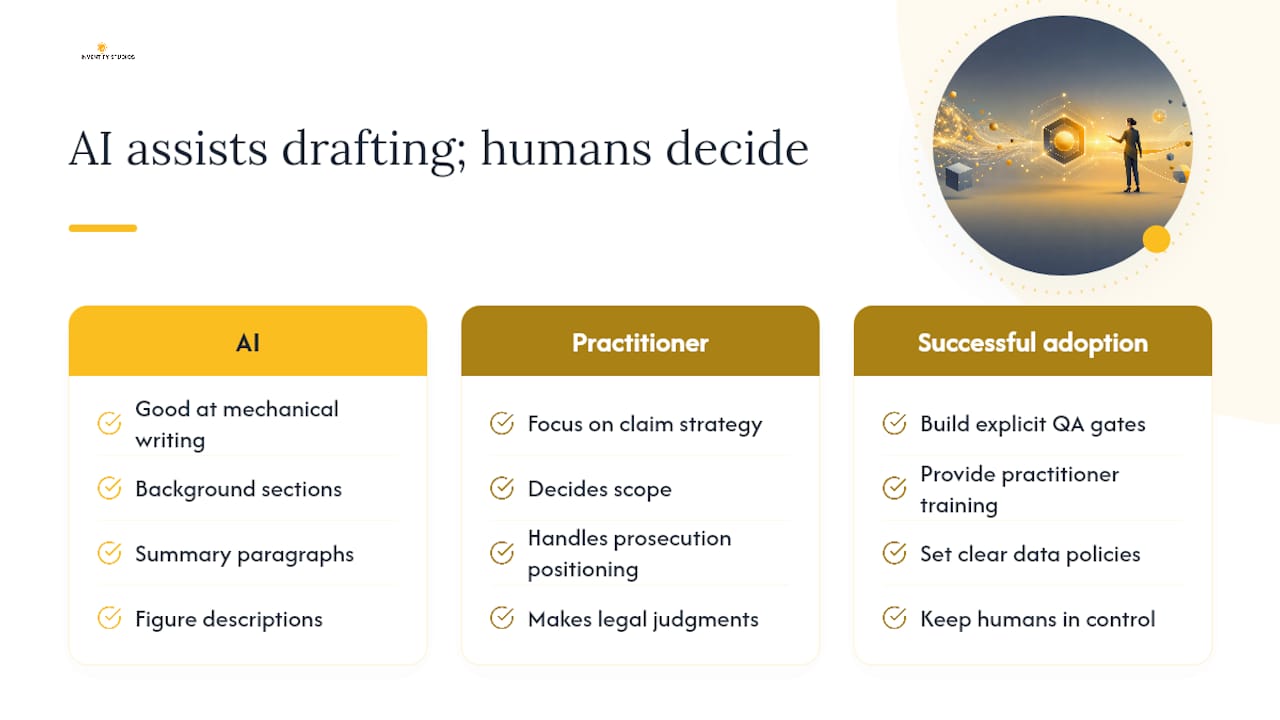
What AI actually does well is compress the mechanical writing phase — the part of drafting that consumes time without requiring legal judgment. Background sections, summary paragraphs, figure descriptions, and first-pass claim trees are all tasks where a well-prompted model produces usable output in minutes. The practitioner's time is then spent where it belongs: on claim strategy, scope decisions, and prosecution positioning.
The cultural shift that matters most is not about the tool. It is about how teams define "done." A first draft from an AI is not a draft — it is a structured starting point. Firms that adopt AI successfully are the ones that build explicit QA gates into their workflow from day one, rather than treating AI output as a shortcut past review. The utility patent application walkthrough is a useful reference for teams building those gates for the first time.
Inventifystudios' position is straightforward: AI-assisted drafting works when it is paired with practitioner training, clear data policies, and a workflow that keeps humans in control of every legal decision. The platform is built for inventors who want to move from idea to protected concept without the cost of a traditional firm, and it is designed to hand off cleanly to a licensed practitioner when prosecution begins.
Inventifystudios: patent drafting support built for inventors
Most AI drafting tools are built for large prosecution teams with enterprise budgets. Inventifystudios takes a different approach: affordable, integrated, and designed for the inventor who needs to validate an idea, generate a prototype, and produce a provisional patent draft without paying law-firm rates for each step.
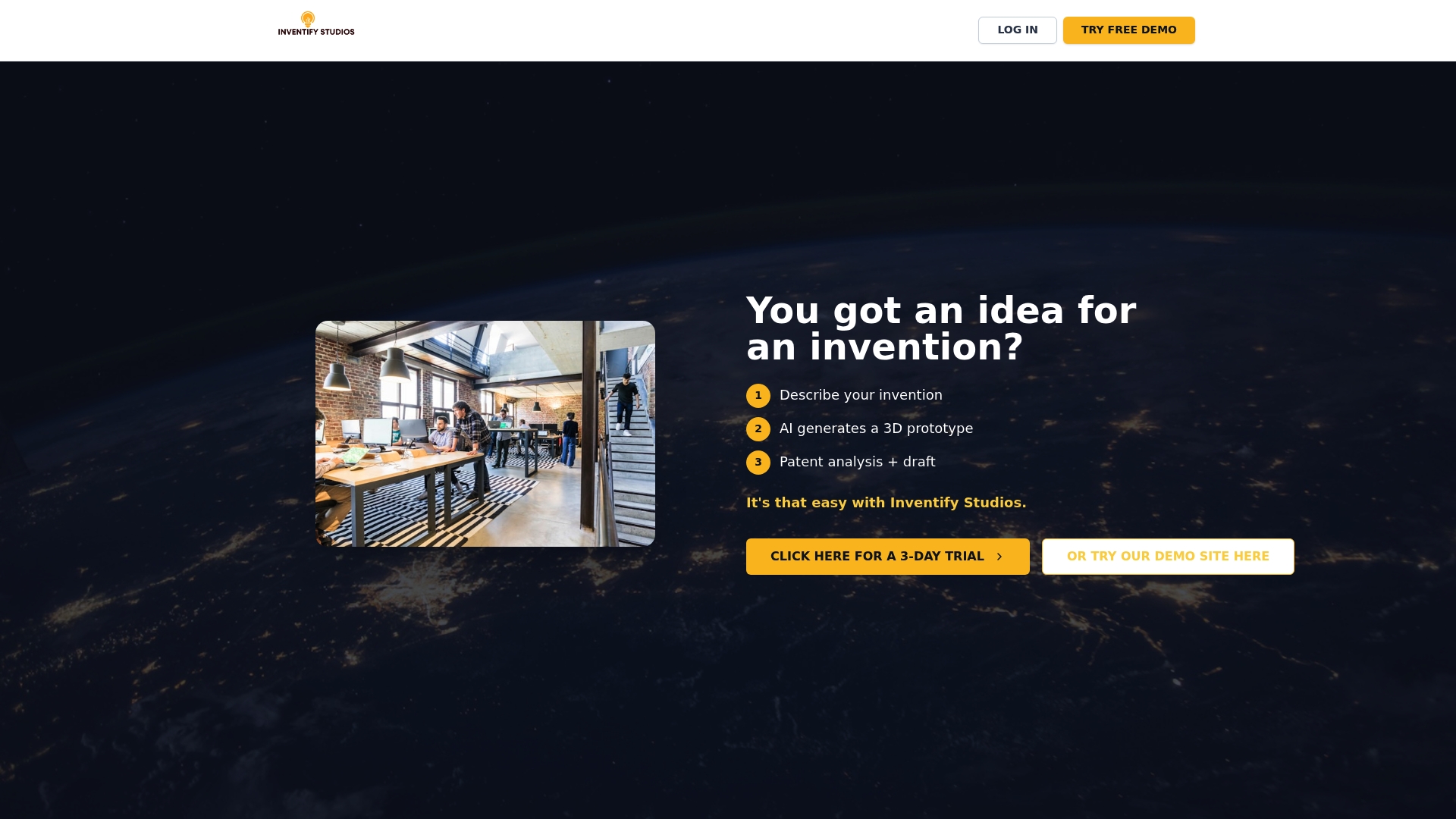
The platform combines AI-powered 3D prototype generation, automated prior-art search, patentability analysis, and provisional patent drafting guidance in a single workflow. You get a clear picture of your invention's novelty, a visual prototype, and a draft you can hand to a practitioner for review — all from one session. There are no per-filing fees and no long-term contracts. Access is a one-time payment for six months of full platform use.
If you are an inventor or a small team ready to test an AI-assisted provisional workflow, start with Inventifystudios' Invention Detail and run your first disclosure through the pipeline today.
Sources
The sources below cover the legal, technical, and procurement dimensions of AI-assisted patent drafting — selected for authority and direct relevance to U.S. patent practice.
- PLI — Patent Office Exam course
- AI Tools for Patent Drafting: LLMs Will Likely Never Write Claims as Well as Humans
This article is general information, not a substitute for advice from a qualified lawyer. Consult a qualified legal professional about your own circumstances before acting on anything here.