

To file a U.S. utility patent, you need five things: an enabling specification, a well-crafted claim set, patent-quality drawings, a completed Application Data Sheet (ADS), and payment of filing, search, and examination fees submitted through USPTO Patent Center. Before you open Patent Center, run a focused prior-art search, decide whether a provisional or nonprovisional filing fits your timeline, and draft at least one strong independent claim. Inventifystudios can automate the prior-art triage and provisional drafting steps so you arrive at that filing screen with a solid foundation, not a blank page.
Table of Contents
- What does the utility patent application walkthrough look like step by step?
- Should you file a provisional or go straight to nonprovisional?
- How do you draft the specification, drawings, and claims?
- What does filing via Patent Center cost and require?
- What happens after you file?
- How do you work with a registered patent attorney or agent?
- Pre-file checklist and common mistakes to avoid
- Inventifystudios gives you a head start on every step
- Key Takeaways
- What actually determines whether a patent application succeeds
- Useful resources for filing and deeper guidance
What does the utility patent application walkthrough look like step by step?
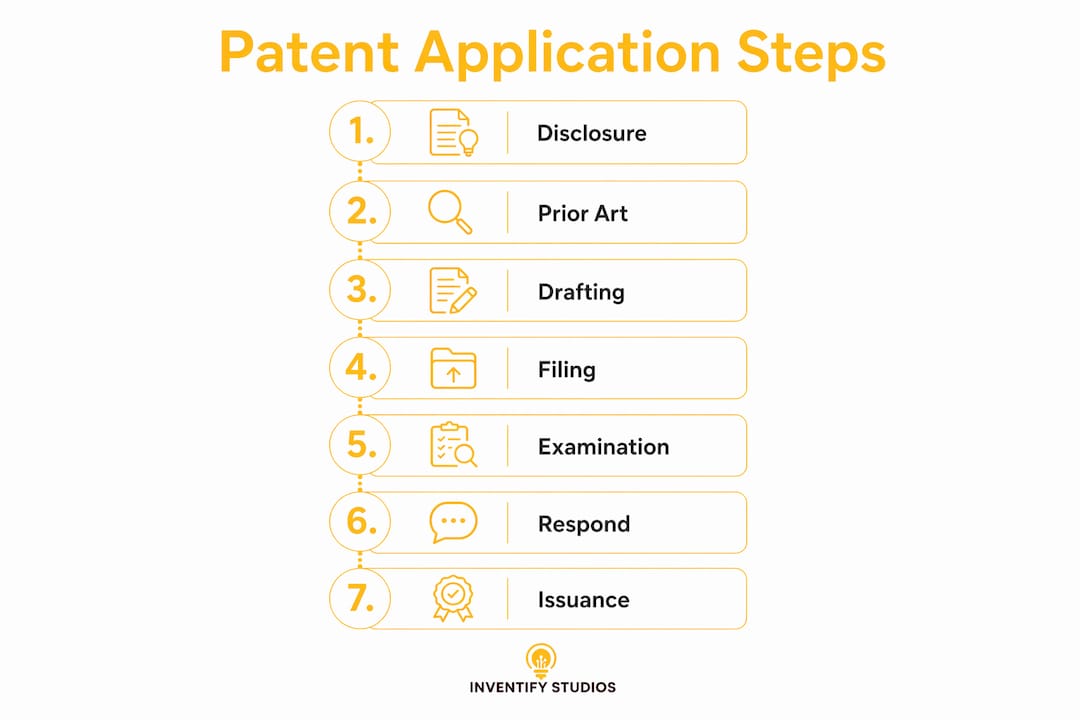
A practical timeline most practitioners follow:
| Stage | What Happens | Estimated Duration |
|---|---|---|
| Disclosure & prior-art search | Document the invention; search USPTO, Google Patents, and literature | several weeks |
| Provisional or nonprovisional drafting | Write specification, claims, drawings | several weeks |
| Filing via Patent Center | Submit documents and pay fees | 1 day |
| Publication | USPTO publishes application | typically about a year and a half after filing |
| First office action | Examiner reviews and responds | usually within 12 to 18 months after filing |
| Prosecution | Respond to rejections, amend claims | Varies (months to years) |
| Allowance and issue | Pay issue fee within 3 months | Total: typically a couple of years |
AI tools compress the drafting stage most dramatically. Platforms like Inventifystudios can generate a provisional draft and prior-art summary in hours rather than weeks. Where AI cannot substitute for human judgment: claim scope strategy, prosecution responses, and enablement review.
Should you file a provisional or go straight to nonprovisional?
File a provisional when you need a priority date fast but your design is still evolving. Provisional applications are not examined and automatically abandon after 12 months, giving you patent-pending status and a year to refine the invention before committing to full filing costs. Skip the provisional and go straight to nonprovisional if your invention is fully defined, you have funding, and you want examination to begin sooner.
Pro Tip: A provisional must contain enough technical detail to support every claim you plan to include in the later nonprovisional. A thin provisional that omits key embodiments cannot be used to claim priority for those features.
Run your prior-art search before committing to a nonprovisional. Search USPTO's patent database, Google Patents, and relevant scientific literature. AI tools can triage hundreds of results quickly, but practitioners recommend a professional search for a final novelty opinion before you invest in full drafting. Pair that with a patentability criteria review covering novelty, non-obviousness, and utility.
How do you draft the specification, drawings, and claims?
The specification is the legal record of your invention. It must include:
- Title and field of the invention
- Background: the problem your invention solves
- Summary: a brief overview of the solution
- Detailed description: step-by-step explanation of every embodiment, written so that a person skilled in the relevant field can make and use the invention without further experimentation
- Best mode disclosure: the inventor's preferred way to practice the invention at the time of filing
- Abstract: a 150-word-or-fewer summary
Missing technical details cannot be added after filing without risking a new-matter rejection. Write the detailed description as if the reader has never seen your prototype.
Claims are the legal boundary of your patent. An independent claim defines the broadest version of your invention. Dependent claims narrow it and provide fallback protection if the independent claim is rejected. Draft at least one broad independent claim, then layer two or three dependent claims that add specific features. Overly narrow independent claims leave competitors room to design around your patent; overly broad ones invite prior-art rejections.
Pro Tip: Use the invention claim drafting guidelines to structure your independent claim in "comprising" language, which is open-ended and broader than "consisting of."
Drawings must show every feature recited in the claims, and adding required drawings after the filing date can be restricted. Use black-and-white line drawings, number each part consistently, and reference every number in the detailed description. The prototype-to-patent connection matters here: a well-documented 3D prototype makes drawing preparation significantly faster.
AI drafting tools can generate a first-pass specification and claim set in minutes. A registered patent practitioner must then review enablement, claim scope, and prior-art alignment before you file.

What does filing via Patent Center cost and require?
Required documents (in order):
- Application transmittal form
- Fee transmittal form
- Application Data Sheet (ADS)
- Specification (DOCX format preferred)
- Drawings (PDF)
- Executed oath or declaration (form PTO/AIA/01 or PTO/AIA/08)
Patent Center requires the specification in DOCX format; submitting in another format triggers a non-DOCX surcharge. Regular nonprovisional applications must be filed electronically to avoid a $400 non-electronic filing fee.
Baseline fee estimates by entity type:
| Entity Type | Approx. Filing + Search + Exam Fees |
|---|---|
| Micro entity | ~$400 |
The base filing fee covers up to 3 independent claims and 20 total claims; additional claims require extra fees. Budget for attorney fees ($3,000–$15,000+ depending on complexity), professional drawings ($300–$1,000), along with maintenance fees due periodically after grant.
Oath or declaration pitfalls: The declaration must state you believe yourself to be the original inventor. A declaration does not require notarization; an oath does. Most applicants use the declaration (form PTO/AIA/01) filed alongside the ADS.
What happens after you file?
Your application publishes approximately 18 months after the earliest priority date. A patent examiner then reviews it and issues a first office action, typically within 12–18 months of filing.
Common rejection grounds:
- 35 U.S.C. § 102 (anticipation): a single prior-art reference discloses every element of your claim
- 35 U.S.C. § 103 (obviousness): a combination of references renders the invention obvious
- 35 U.S.C. § 112 (indefiniteness or lack of enablement): claims are unclear or the specification does not fully support them
You or your counsel must respond to each office action within the set deadline (typically three months, extendable for a fee). After allowance, the USPTO issues a Notice of Allowance. You have a non-extendable three-month window to pay the issue fee; missing it abandons the application with no routine extension available.
How do you work with a registered patent attorney or agent?
Once you retain a registered patent attorney or agent, the USPTO communicates only with that representative, not with you directly. Plan your communication strategy with counsel before filing.
To brief counsel efficiently, prepare:
- A one-page invention summary (problem, solution, key differentiators)
- Prior-art search results and any AI-generated draft
- Prototype images or 3D exports
- Desired claim scope (broad vs. narrow, product vs. method)
- Any public disclosures or foreign filings already made
Ask counsel for a written fee estimate, a prosecution strategy memo, and ownership or assignment documentation if co-inventors or employer agreements are involved.
Pro Tip: Handing counsel an AI-generated draft and a prior-art summary cuts billable hours significantly. Inventifystudios exports both in formats attorneys can work with directly.
Pre-file checklist and common mistakes to avoid
The most expensive patent mistake is filing too thin. An application that lacks enablement, omits key drawings, or uses vague claim language cannot be fixed after the filing date without triggering new-matter issues. Get it right before you submit.
Pre-file checklist:
- Specification complete (all sections, best mode disclosed)
- At least one independent claim drafted and reviewed
- Drawings show every claimed feature, numbered consistently
- ADS completed with correct inventor and assignee data
- Oath or declaration signed
- Information Disclosure Statement (IDS) prepared if you are aware of relevant prior art
- Correct fee amount calculated for your entity size and claim count
- Files in DOCX (specification) and PDF (drawings) format
Common avoidable mistakes:
- Insufficient enablement: leaving out how the invention actually works
- Adding new matter after filing to fix gaps in the specification
- Claims that are too narrow to provide real protection
- Missing or incomplete drawings for claimed features
- Failing to file an IDS when you know of material prior art
- Missing the three-month issue-fee window after a Notice of Allowance
Public disclosures (demos, publications, crowdfunding campaigns) before filing can trigger a one-year grace period in the U.S., but they eliminate patent rights in most foreign markets immediately. File before you disclose publicly whenever possible.
Inventifystudios gives you a head start on every step
Inventors who arrive at Patent Center with a complete, well-structured draft file faster and spend less on attorney revisions. Inventifystudios handles the preparation work: AI-powered prior-art triage, patent-ready provisional drafts, 3D prototype generation, and documentation management, all in one platform.
You can export your prior-art summary and provisional draft directly to share with a registered patent attorney, along with prototype visuals that feed directly into your drawing preparation. The platform also tracks your invention pipeline so nothing falls through the cracks during the 12-month provisional window. If you are ready to move from idea to a filing-ready package, start your invention on Inventifystudios and compress weeks of preparation into hours.
Key Takeaways
Filing a utility patent successfully comes down to claims quality, complete enablement, and hitting every USPTO deadline without exception.
| Point | Details |
|---|---|
| Claims define your protection | Independent claims set the broadest legal boundary; draft them carefully before filing. |
| Provisional buys 12 months | A provisional is not examined and expires after 12 months; it must fully support later nonprovisional claims. |
| Base fee claim limits | The base filing fee covers up to 3 independent claims and 20 total claims; extra claims cost more. |
| File in DOCX via Patent Center | Submitting the specification in any other format triggers a non-DOCX surcharge. |
| Notice of Allowance: 3-month hard deadline | The issue fee must be paid within three months of allowance; there is no routine extension. |
| Inventifystudios accelerates preparation | The platform automates prior-art triage, provisional drafting, and prototype exports to reduce prep time. |
What actually determines whether a patent application succeeds
The conventional wisdom says "file early, file often." That advice is incomplete. Filing early with a weak specification or vague claims is often worse than waiting another two weeks to get the disclosure right. The applications that sail through examination share one trait: the inventor understood exactly what made the invention different before drafting a single claim. Prior-art knowledge is not a formality. It shapes every word in the independent claim and every argument you will make during prosecution.
AI tools have genuinely changed the preparation phase. A well-prompted AI can surface relevant prior art, generate a structured specification outline, and flag enablement gaps before a practitioner ever reviews the draft. The risk is over-reliance: AI-generated claims tend to be either too broad (inviting anticipation rejections) or too narrow (leaving competitors room to design around). A practitioner's job is to calibrate that scope, and no tool replaces that judgment yet.
The inventors who get the most out of AI-assisted drafting treat the AI output as a first draft, not a final answer. They use it to move faster through the preparation phase, then invest the time saved into a thorough prior-art review and a focused conversation with counsel about claim strategy. That combination, speed on the front end and rigor on the back end, is what actually produces granted patents.
Useful resources for filing and deeper guidance
| Resource | Best Used For |
|---|---|
| USPTO Applying for Patents | Overview of patent types, filing options, and Patent Center access |
| USPTO Nonprovisional Filing Guide | Specification requirements, drawings rules, oath/declaration details |
| USPTO Nonprovisional Checklist (PDF) | Pre-file document checklist to verify completeness before submitting |
| Shannon Warren Patent Attorney Guide | Practitioner timeline and prosecution strategy overview |
| Inventifystudios Patent Application Guide | Beginner-friendly overview of required application parts |
For idea validation steps before you commit to a nonprovisional filing, the startup idea validation checklist covers market-fit testing that can sharpen your invention brief before you engage counsel.
This article is general information, not legal advice. Confirm current USPTO rules, fees, and deadlines with the USPTO directly or with a registered patent attorney or agent for your specific situation.