
Embodiments are the backbone of any strong patent application. In US patent law, an embodiment is a tangible, specific implementation of an abstract invention concept. Think of the invention as the idea living in the inventor's mind. The embodiment is what that idea looks like when it takes physical form. The role of embodiments in patent writing goes far beyond description. They define how broadly your claims can reach, whether your application satisfies 35 U.S.C. §112 requirements, and how well your patent holds up under litigation or examination.
Here is what strong embodiment drafting accomplishes:
- Demonstrates that the inventor actually possesses the invention, satisfying the written description requirement
- Enables a person skilled in the art to practice the invention without undue experimentation, meeting the enablement standard
- Provides the specification support needed to amend claims during USPTO prosecution
- Establishes a factual record courts use when interpreting claim scope
- Prevents competitors from designing around your patent through minor variations
How embodiments differ from examples in patent specifications
Patent drafters often use "embodiment" and "example" interchangeably. That is a mistake with real legal consequences.
Embodiments carry legal weight in claim interpretation. They are detailed, legally significant implementations of the invention that directly support claim scope. Courts and patent examiners treat embodiment descriptions as the boundaries within which claims operate. Examples, by contrast, illustrate practical scenarios or use cases. They show how the invention might be applied in a specific context, but they do not define protection scope.
| Feature | Embodiment | Example |
|---|---|---|
| Legal significance | Directly supports claim scope and prosecution | Illustrative only; does not define protection |
| Specificity | Detailed implementation with materials, configurations, and features | Scenario or use case showing one application |
| Claim relationship | Provides written description support for claim amendments | Does not substitute for embodiment disclosure |
| Risk if omitted | Narrows claim scope; limits prosecution flexibility | Reduces clarity but does not invalidate claims |
| USPTO treatment | Required for enablement and written description compliance | Optional; useful but not legally mandatory |
Conflating the two creates a specific danger. If you describe only an example without a corresponding embodiment, you may fail the written description requirement under §112. The USPTO examiner will look for embodiment descriptions, not just illustrative scenarios. Examples complement embodiments well, but they cannot replace them.
Why including multiple embodiments strengthens patent protection
A single embodiment is a single target. Competitors can study it, make one small change, and avoid infringement entirely. Multiple embodiments close those gaps by covering alternative materials, configurations, and methods within the same application.
Consider the classic WIPO teaching example. An inventor creates a red clay mug with a handle. If the patent agent claims only "a red clay mug with a handle," a competitor can sell a blue plastic cup with a handle and avoid infringement entirely. The correct claim is "a cup comprising a handle." The red clay version appears as one embodiment. Blue plastic, ceramic, and stainless steel versions appear as alternatives. Each one closes a potential workaround.
The strategic benefits of multiple embodiments extend well beyond the original filing:
- Continuation applications: Broader embodiment disclosures support future continuation or continuation-in-part applications, letting you pursue new claim sets as the market evolves.
- Claim amendments: During prosecution, claims can only be amended if the original specification supports the new language. More embodiments mean more amendment options.
- Design-around prevention: Describing alternative mechanisms, materials, and configurations forces competitors to work much harder to avoid your patent.
- Litigation resilience: If one claim is invalidated, alternative embodiments may still support other claims in the set.
- Examination advantages: Examiners are more likely to allow broader claims when the specification demonstrates the inventor understood the full scope of the invention.
Key insight: The Detailed Description of the Embodiments section is the most critical part of the application at filing. Claims can only be amended if supported by the original disclosure, and new matter cannot be added after filing. Every variation you anticipate at the start is a door you keep open for the life of the patent.
Pro Tip: Draft your embodiment section before you draft your claims. The embodiment descriptions reveal the full scope of what you actually invented. Claims written after a thorough embodiment section tend to be broader, better supported, and harder to design around.
How to draft embodiments effectively in US patent applications
The most effective approach follows a layered structure: broad concept first, preferred embodiment second, alternative embodiments third. Strong patent specifications describe the invention at the concept level before narrowing into specific implementations.
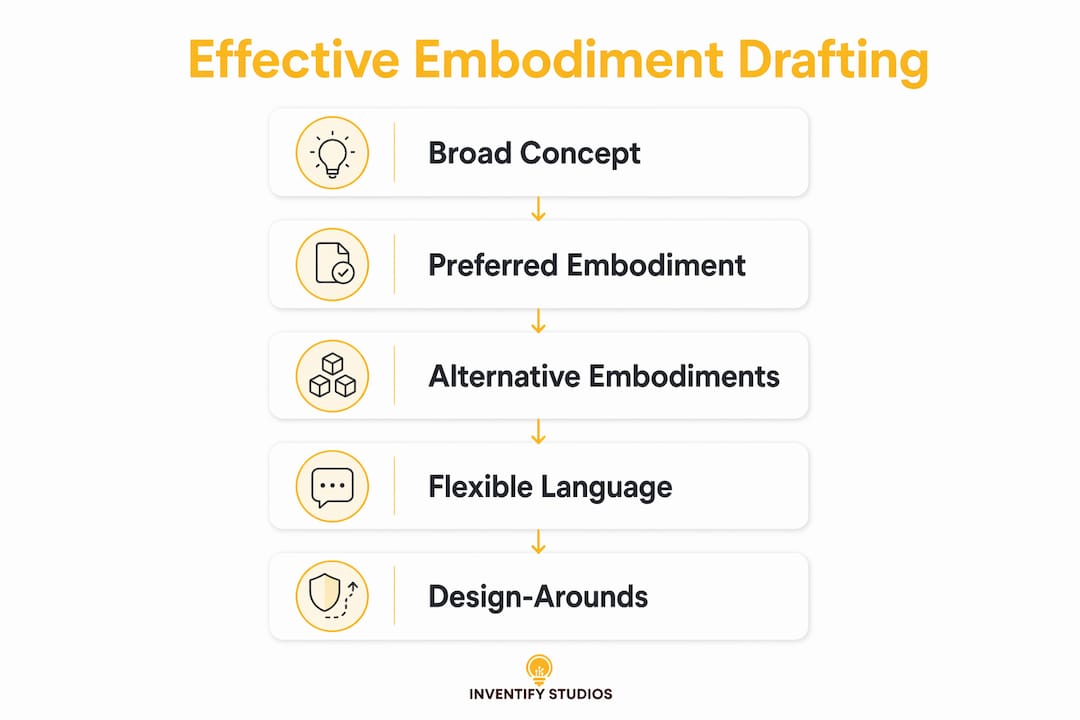
Start broad, then narrow
Open the Detailed Description with a broad statement of the invention that does not tie it to any single configuration. Then introduce the preferred embodiment, which is the version the inventor believes works best. Follow with alternative embodiments that vary materials, dimensions, mechanisms, or methods. This structure gives you the widest possible claim support while still satisfying the best mode requirement under 35 U.S.C. §112.

Use flexible language deliberately
Phrases like "in one embodiment," "in an alternative embodiment," and "alternatively" do specific legal work. These language cues signal to courts and examiners that the description is not limiting the invention to a single form. They also create independent claim defenses. If one embodiment is challenged during litigation, the alternative embodiment language can support a different claim construction.
Anticipate design-arounds before filing
Pro Tip: Think like a competitor when drafting. Ask yourself: what is the minimum change someone could make to avoid each embodiment? Then describe that variation explicitly. Patent drafters who do this systematically produce specifications that are far harder to design around.
Common mistakes to avoid
- Describing only the prototype: Limiting descriptions to a single prototype risks competitors avoiding infringement through minor variations. Describe the concept, not just the object on your workbench.
- Calling embodiments "the invention": Describing an embodiment as "the invention" rather than "an embodiment of the invention" can cause courts to limit claim scope to that specific version.
- Omitting material and configuration alternatives: Specify that components "may be made from metal, plastic, ceramic, or composite materials" rather than naming only one.
- Skipping method embodiments: If your invention can be practiced as both a device and a method, describe both. Method claims often survive when device claims do not.
- Assuming post-filing amendments are easy: New subject matter cannot be added after filing. Whatever you do not describe at filing, you cannot claim later.
Understanding self-drafting risks is especially relevant here. Inventors who draft their own applications often describe only what they built, not what they invented. That distinction is where protection gets lost.
How embodiment descriptions shape claim interpretation and enforcement
Courts do not interpret claims in a vacuum. They read the claims against the specification, and the embodiment descriptions are the most influential part of that specification. This is where embodiment drafting decisions made years before litigation determine whether a patent holds or falls.
The Federal Circuit has consistently held that when a patent describes only one embodiment, courts may read the limitations of that embodiment into the claims, even if the claim language appears broader. This doctrine, sometimes called "reading in" from the specification, is one of the most common ways patents lose scope during enforcement.
"The claims protect at least one embodiment, but the best patent claims protect the invention — that is, the inventor's embodiment and all other possible embodiments of the invention." — WIPO Patent Claim Drafting Manual
A well-documented case pattern illustrates this clearly. A patent claiming "a fastening mechanism" supported by a specification describing only a screw-based embodiment may find courts limiting "fastening mechanism" to screws, even though the claim language could cover clips, adhesives, or magnetic systems. Had the drafter described those alternatives as embodiments, the claim would have retained its broader scope.
Courts may read limitations from a single embodiment into claims when only one is described. Multiple embodiments reduce that risk by showing the inventor understood the invention broadly. The claim drafting guidelines that experienced patent attorneys follow consistently emphasize this point.
Enablement and written description requirements under §112 also ground claim validity during enforcement. If a competitor challenges your patent's validity, they will look for gaps between what the claims cover and what the specification actually describes. Thorough embodiment documentation is the primary defense against that challenge.
Key Takeaways
Multiple, well-drafted embodiments are the single most effective tool for building broad, enforceable patent protection under US law.
| Point | Details |
|---|---|
| Embodiments vs. examples | Embodiments carry legal weight in claim interpretation; examples illustrate but do not define protection scope. |
| Multiple embodiments prevent design-arounds | Describing alternative materials, configurations, and methods closes gaps competitors exploit to avoid infringement. |
| Layered drafting structure | Start with the broad concept, then the preferred embodiment, then alternatives to maximize claim support. |
| No new matter after filing | Every variation must appear in the original specification; post-filing additions are prohibited under 35 U.S.C. §112. |
| Single embodiments risk scope loss | Courts may read limitations from a single embodiment into claims, narrowing enforcement even when claim language is broad. |
Inventifystudios makes this process accessible for inventors at every stage. Whether you are validating a new concept or preparing a provisional patent draft, the platform's AI-powered tools help you document your invention's full scope, from preferred configurations to alternative implementations, before you file. Start building your patent draft with the embodiment depth your invention deserves.