
The fastest path to a failed product is building before you know anyone wants it. The most reliable product demand testing strategies, ranked by signal strength: preorders and paid pilots (someone hands you money), landing-page smoke tests (someone clicks and converts), fake-door tests (someone clicks a feature that doesn't exist yet), concierge MVPs (someone uses a manual version of your service), and structured customer interviews (someone describes a painful, urgent problem with a budget attached). Behavioral signals beat stated preferences every time — what people do with their wallet or their time tells you far more than what they say in a survey.
Use this as your decision rule before picking a test:
- Need proof of willingness to pay? Run a preorder or paid pilot via Stripe.
- Need fast message validation? Build a landing page, drive traffic with Google Ads or Meta Ads, and measure paid conversion.
- Need feature-level workflow intent? Add a fake-door button inside your product and track clicks.
- Need deep problem confirmation? Run 1:1 structured interviews with 10–30 target customers.
- Need ease-of-use proof? Deliver the service manually as a concierge MVP and watch what users actually do.
For a quick patentability and market fit check before any of these tests, Inventifystudios' AI prototype generator and patentability analysis tools let you build a visual proof-of-concept in minutes, not weeks.
Table of Contents
- Which test should you run first?
- How do you run customer discovery interviews that actually reveal demand?
- How do you test pricing and willingness to pay before launch?
- What metrics tell you whether demand is real?
- A 30-day playbook to validate demand fast
- Key Takeaways
- The trap most founders fall into before they've built anything
- Inventifystudios cuts prototype time so you can test faster
- Useful sources for deeper reading
Which test should you run first?
Choosing the wrong test wastes time and produces a signal you can't act on. Pick the cheapest test that answers the specific decision you face — not the most thorough one.
| Situation | Best First Test | Typical Cost | Typical Timeline |
|---|---|---|---|
| B2C, no audience, need message fit | Landing page + Google/Meta Ads | moderate budget | about one week |
| B2C, small audience exists | Waitlist + email preorder | low budget | a few days |
| B2B, 1–3 target companies identified | Structured interviews + LOI request | low budget | up to two weeks |
| B2B, need willingness-to-pay proof | Paid pilot (invoice or Stripe deposit) | small setup cost | a few weeks |
| Hardware/physical product | Concierge MVP or 3D prototype demo | modest budget | one to two weeks |
| Complex workflow, existing users | Fake-door test inside product | low cost | a few days |
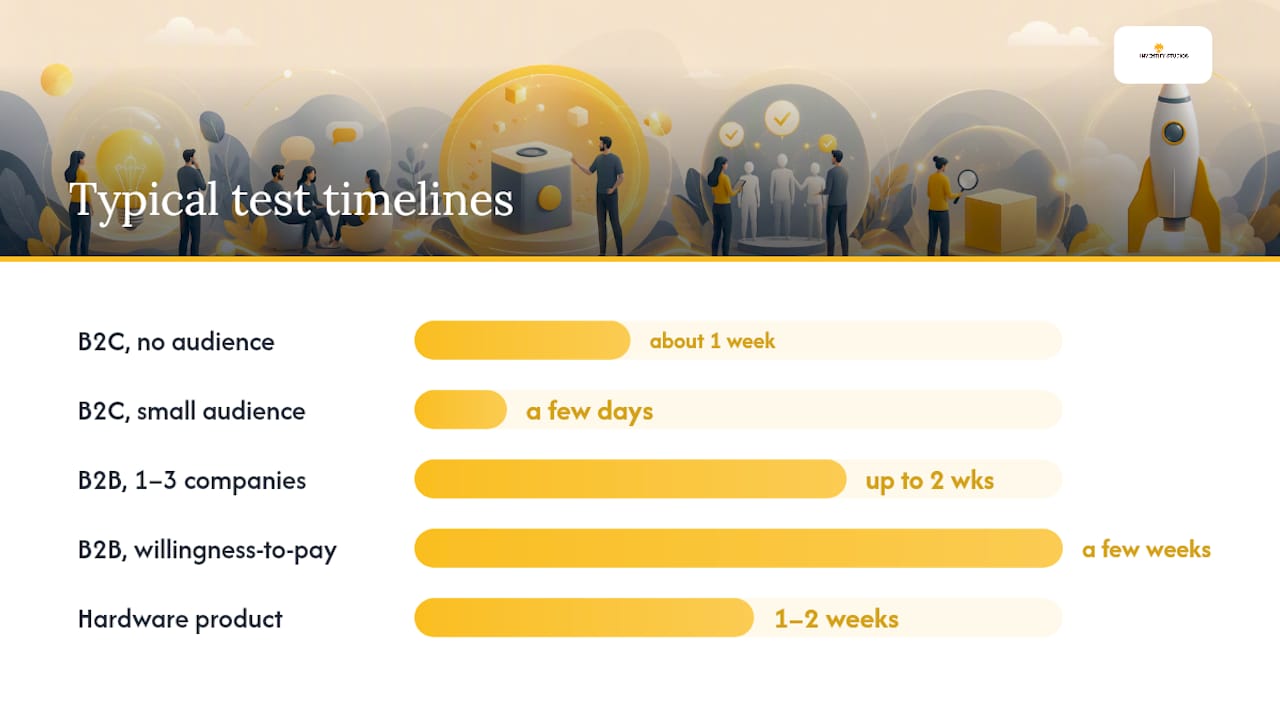
The table above maps your context to a starting point. Budget and timeline are rough ranges for an indie founder — a small startup with a team can compress timelines further.
Pro Tip: Set your success threshold before you launch the test, not after. Write it in one sentence: "If X% of visitors convert to paid within 14 days, we proceed." Typical early thresholds: several paid commitments for B2B, or a notable paid conversion rate from targeted paid traffic for B2C consumer offers. Sharing that threshold with a co-founder or advisor before you start prevents you from moving the goalposts when results disappoint.
For a detailed cost comparison across validation approaches, the invention development cost comparison on the Inventifystudios blog breaks down what each method actually costs at different stages.
How do you run customer discovery interviews that actually reveal demand?
Interviews are the foundation of demand validation, but most founders run them wrong. They ask "Would you use this?" and get a polite yes that means nothing. The goal is to surface urgency, current workarounds, budget access, and decision authority — not opinions about your idea.
Start with a clear hypothesis: what do you need to learn from this conversation? Write it down before you schedule a single call. Your hypothesis might be: "Small e-commerce founders spend more than two hours per week on inventory reconciliation and would pay for a tool that cuts that to 20 minutes."
Running a landing-page smoke test
A smoke test answers one question: does your message resonate enough to generate a conversion? Build a single-page site with a clear headline (the problem you solve), a short description of the outcome, and one call to action — a signup, a waitlist, or a preorder button. Keep it under 300 words. Drive traffic with Google Ads or Meta Ads targeting your exact ICP. Set a moderate test budget and run the campaign for about a week.
Track two numbers: click-through rate on the ad (message resonance) and conversion rate on the page (offer resonance). A reasonably high paid conversion rate from targeted traffic is a meaningful early signal for a consumer offer. Low conversion rates suggest revisiting the message or the audience before spending more.
Market validation methods cluster into demand signals, customer insight, and sizing — a landing-page smoke test covers demand signals, but it tells you nothing about why someone converted or whether they'd use the product repeatedly. Pair it with two or three follow-up interviews with people who signed up.
Fake-door tests and concierge MVPs
A fake-door test places a button or feature link inside an existing product or prototype. When a user clicks it, they see a "coming soon" message or a short survey. The click rate on that button, compared to other features, tells you which workflows users actually want to access — not which ones they say they want.
A concierge MVP goes further: you deliver the service manually for a small set of customers. No automation, no code. You do the work by hand. The signals to watch are repeat usage (do they come back?), referrals (do they tell someone else?), and engagement depth (do they ask for more?). Those three behaviors are stronger demand signals than any survey score.
For taking preorder deposits, Stripe is the standard tool. Set up a simple payment link, charge a small refundable deposit ($25–$100), and capture the customer's email and use case in the checkout form. State clearly in the checkout copy that the product is in development and the deposit is refundable if you don't launch. That transparency protects you legally and filters out casual interest.
Running a usability test
- Define 3–5 tasks that represent the core workflow (e.g., "Find the pricing page and start a trial").
- Set a success criterion for each task (completed without assistance, under 90 seconds).
- Observe without helping. Note where users pause, backtrack, or express confusion.
- After each session, ask: "What was confusing? What would you expect to happen instead?"
- Track time-on-task and task completion rate across 5–8 sessions.
Five usability sessions typically surface the majority of critical friction points. Beyond eight, you start seeing diminishing returns on new findings.
Inventifystudios' AI prototype generator produces visual 3D proof-of-concept assets in minutes. Pair those with the platform's patentability analysis to confirm your concept has a clear market position before you invest in a physical prototype or a full engineering sprint. That combination — fast visual asset plus IP check — is particularly useful for hardware founders running concierge demos with early customers.
For a broader look at concept testing methods and how to interpret early user reactions, Veridata Insights covers the evaluation frameworks in detail.
How do you test pricing and willingness to pay before launch?
Most founders set a price by guessing, then discount when sales stall. A better sequence: test pricing before you finalize the product.
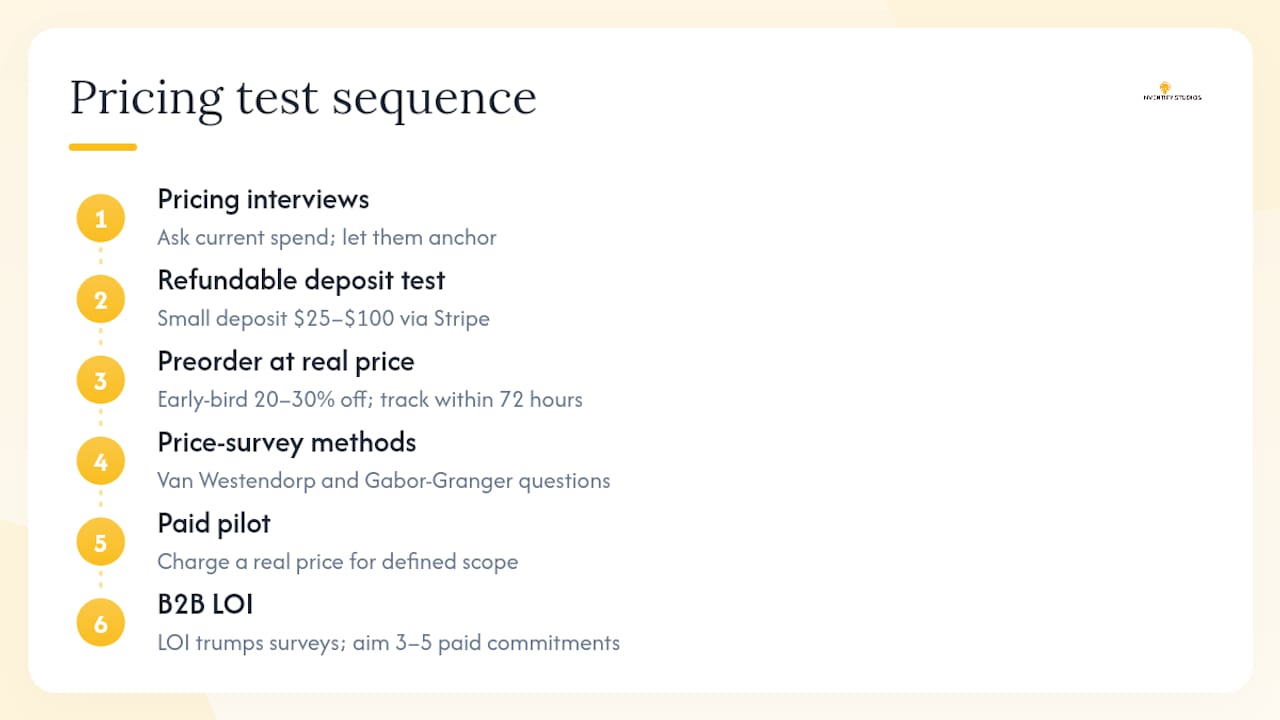
Step 1 — Pricing conversations in interviews. Ask: "What do you currently spend on this problem?" and "What would make this a no-brainer purchase?" Let them anchor first.
Step 2 — Refundable deposit test. Offer early access for a small deposit ($25–$100 via Stripe). The act of paying, even a small amount, filters out polite interest from real intent.
Step 3 — Preorder at a real price. Set an early-bird price (typically 20–30% below your planned launch price) and offer it to your waitlist or interview participants. Track how many convert within 72 hours of the offer.
Step 4 — Van Westendorp or Gabor-Granger questions. Van Westendorp asks four price-point questions ("too cheap," "cheap but acceptable," "expensive but acceptable," "too expensive") to identify an acceptable price range. Gabor-Granger tests a sequence of prices to find the point where conversion drops sharply. Both can be run as a short Typeform or SurveyMonkey survey sent to your waitlist.
Step 5 — Paid pilot. Charge a real price for a defined scope of service or product access. This is the strongest willingness-to-pay signal available before full launch.
For B2B, a letter of intent (LOI) from a named company carries more weight than a survey response but less than a paid invoice. Aim for at least 3–5 paid commitments from your ICP before treating B2B demand as confirmed.
Stripe checkout copy matters. State the price, what's included, the refund policy, and the expected delivery timeline. Ambiguity at checkout kills conversions and creates support problems later.
What metrics tell you whether demand is real?
PMF measurement requires both qualitative and quantitative indicators — no single number answers the question definitively. Use this set together.
| Metric | What It Indicates | Conservative Benchmark | Ambitious Benchmark |
|---|---|---|---|
| Ad → landing page conversion | Message resonance | 2–3% | 5%+ |
| Landing page → signup conversion | Offer resonance | 10–15% | 25%+ |
| Signup → paid conversion | Willingness to pay | 3–5% | 10%+ |
| % "very disappointed" (PMF survey) | Product-market fit strength | 25–30% | 40%+ |
| 30-day retention | Habit formation | 20–30% | 40%+ |
| Paid pilot renewal rate | Sustained willingness to pay | 50% | — |
| CAC-to-LTV ratio | Unit economics viability | 1:3 | 1:5+ |
The Sean Ellis PMF benchmark — 40% of surveyed users saying they'd be "very disappointed" if your product disappeared — is a useful north star, but it requires context. A niche B2B tool with 15 power users hitting 40% is more meaningful than a broad consumer app with 500 casual users hitting the same number. Weight the signal by how closely those respondents match your ICP.
Signal weighting rule: Money (preorder, deposit, paid pilot) outweighs a signed commitment (LOI), which outweighs enrollment (waitlist, email signup). Never treat a high signup count as proof of demand if no one has paid.
Sample size matters for statistical confidence, but for early-stage validation, you're not running a controlled trial. You're looking for a directional signal strong enough to justify the next investment. Three to five paid B2B pilots from named ICP companies, or 10+ paid preorders from a targeted consumer audience, are meaningful enough to proceed.
Avoiding the most common experiment biases
Selection bias: If you only interview people who already follow you on social media, you're sampling advocates, not the market. Recruit from cold outreach, communities, or paid panels.
Leading questions: "Don't you think this would save you time?" is not a question. It's a prompt for agreement. Use open-ended, past-tense questions about real behavior.
Confirmation bias: Pre-register your threshold with someone else before you start. If you hit 4% conversion against a 5% threshold, that's a miss — not a "near miss that shows promise."
Moving thresholds: The threshold you set before the experiment is the only one that counts. Adjusting it after seeing results turns a test into a rationalization.
Keep raw data — ad spend, click logs, conversion records, interview transcripts — in a shared folder. Auditability matters when you're making a significant investment decision based on the results.
A 30-day playbook to validate demand fast
This plan works for an indie founder with a $300–$500 test budget. A small startup can compress timelines; a funded team can run multiple tracks in parallel.
Week 1: Define and build
- Write your hypothesis in one sentence. Share it with someone who will hold you to it.
- Identify your ICP: job title, company size, behavior, or demographic.
- Build your landing page: headline (the outcome you deliver), three supporting points, one CTA.
- Set up tracking: Google Analytics or a simple UTM parameter on your ad link.
- Write your interview invite: two sentences explaining what you're researching and a Calendly link.
Ad copy template: "[Problem statement]. [Your product] [specific outcome] in [timeframe]. [CTA: Join the waitlist / Pre-order now / Book a demo]."
Week 2: Launch and listen
- Launch your Google Ads or Meta Ads campaign. Set a daily cap of $30–$50.
- Send your interview invites to 20–30 target contacts via LinkedIn, email, or community posts.
- Run 5–8 interviews. Code themes after each day.
- Check ad performance at day 5. If CTR is below 1%, rewrite the headline.
Week 3: Test pricing and run the concierge
- Send a preorder or deposit offer to everyone who signed up in week 2.
- Run your concierge MVP for 2–3 early customers. Deliver manually.
- Send a short Van Westendorp pricing survey (4 questions) to your waitlist via Typeform or SurveyMonkey.
- Track who pays, who opens the email but doesn't pay, and who doesn't open at all.
Week 4: Analyze and decide
- Compare results against your pre-registered threshold.
- Segment by cohort: who converted, who didn't, and what they have in common.
- Apply the decision rule: Launch if you hit the threshold. Iterate if you're within 50% of it and have a clear fix. Kill or pivot if you're below 50% with no obvious lever.
Budget allocation:
- Indie founder: $150–$300 on ads, $0–$50 on tools (Typeform free tier, Stripe free to set up).
- Small startup: $500–$1,500 on ads, $50–$150 on tools and incentives.
- Funded team: $2,000–$5,000 across multiple parallel test tracks.
For low-budget validation tactics that go beyond ads, the low-cost invention validation methods guide covers DIY approaches that work at every budget level.
Key Takeaways
Behavioral signals — payments, repeat usage, and signed commitments — are the only demand evidence worth building on; everything else is a hypothesis until money changes hands.
| Point | Details |
|---|---|
| Prioritize payment signals | Preorders and paid pilots outweigh signups and survey responses as demand evidence. |
| Set thresholds before testing | Write your success threshold in one sentence before launching any experiment to prevent post-hoc rationalization. |
| Match the test to the decision | Use smoke tests for message fit, paid pilots for willingness to pay, and interviews for problem depth. |
| 40% PMF benchmark | Sean Ellis' "very disappointed" benchmark of 40%+ is a useful north star when weighted by ICP match, not raw count. |
| Inventifystudios accelerates validation | The platform's AI prototype generator, patentability analysis, and marketability tools reduce the time from idea to first customer signal. |
The trap most founders fall into before they've built anything
The conventional wisdom says "talk to customers first." That's right, but incomplete. The trap isn't skipping interviews — it's running interviews and then treating polite enthusiasm as demand. Every founder I've seen build a product nobody wanted had a folder full of positive interview notes. The notes weren't wrong. The interpretation was.
The real discipline in demand testing is designing experiments that can fail. If your test is structured so that any result looks encouraging, it's not a test — it's a confidence ritual. The threshold you set before you start is the only one that counts. A 4% conversion rate against a 5% threshold is a miss, not a near-miss. Treating it as a near-miss is how you spend six months building something for a market that doesn't exist.
The second trap is measuring the wrong thing. Signups feel like traction. They're not. A waitlist of 500 people who gave you their email to get a free checklist tells you almost nothing about whether they'll pay $49 a month. Money is the signal. Repeat usage is the signal. A customer who comes back unprompted and asks for more is the signal. Everything else is noise until proven otherwise.
One more thing: don't wait until you have a finished product to run a pricing test. The best time to learn what someone will pay is before you've built anything, when you still have the flexibility to change the offer, the scope, or the price point. Once you've shipped, pricing conversations feel like negotiations. Before you've shipped, they're research.
Inventifystudios cuts prototype time so you can test faster
Skip the weeks-long wait for a physical prototype or a costly design agency. Inventifystudios gives inventors and product creators AI-generated 3D prototypes, automated patentability checks, and market analysis tools in a single platform — for a fraction of what traditional consulting charges.
With a 6-month access subscription (one-time payment), you get the full toolkit: prototype generator, prior art search, provisional patent drafting guidance, marketability analysis, and a funding preparation assistant. That's everything you need to run a credible preorder campaign, a concierge MVP demo, or an investor pitch — without hiring a patent attorney or a product design firm on day one.
If you're ready to move from idea to first paying customer, start your invention on Inventifystudios and generate your first prototype today.
Useful sources for deeper reading
The sources below informed this guide. Each one adds a specific layer of depth for founders who want to go further on a particular test or metric.
- Validating product-market fit in the real world
- How to measure product-market fit
- Market Validation in 2026: 11 Methods + Examples | Waveup
- Pre-launch demand validation: Pick the test that answers the right question | Inkly
- The Complete Guide to Product-Market Fit Research in 2026 | Blog | Perspective AI
- Product-market fit: How do you measure product-market fit? | Salesforce
For step-by-step templates hosted on the Inventifystudios platform, the invention marketability analysis guide and the market size estimation guide cover the sizing and commercial potential analysis that rounds out a complete validation plan.