

An obviousness rejection is a 35 U.S.C. § 103 determination that your claimed invention would have been obvious to a person of ordinary skill in the art at the time of filing. The USPTO issues these rejections under the framework established in Graham v. John Deere Co. and refined by KSR Int'l Co. v. Teleflex Inc., with procedural guidance in MPEP 2141 and MPEP 2144. When you receive one, your first moves matter.
Immediate actions on receipt of an obviousness rejection:
- Read the Office action in full and identify every prior art reference the examiner cited
- Locate the examiner's stated reason to combine the references and note whether it is specific or conclusory
- Check whether the examiner articulated a reasonable expectation of success for the proposed combination
- Note your reply deadline (three months for a small/micro entity without extension fees; up to six months with fees)
- Flag any secondary considerations (commercial success, long-felt need, copying by competitors) you can document
Table of Contents
- What does U.S. law actually require to find a claim obvious?
- How does an examiner build a prima facie obviousness case?
- What are the most common examiner rationales in Section 103 rejections?
- How do you respond to an obviousness rejection step by step?
- What timeline and costs should you expect after an obviousness rejection?
- How do you draft claims and specs to reduce obviousness risk upfront?
- What traps do patent applicants fall into when fighting obviousness?
- Key Takeaways
- The part of obviousness rejections most inventors underestimate
- Inventifystudios can help you organize your rebuttal from day one
- Useful sources and primary reading
What does U.S. law actually require to find a claim obvious?
Obviousness under U.S. patent law is a legal conclusion built on four factual inquiries, first articulated by the Supreme Court in Graham v. John Deere Co., 383 U.S. 1 (1966), and still the controlling framework today.
| Graham Factor | What It Asks | Key Sources |
|---|---|---|
| 1. Scope and content of the prior art | What does the relevant prior art actually teach? | 35 U.S.C. § 103; MPEP 2141 |
| 2. Differences between prior art and the claims | Where does the claim go beyond what the art shows? | MPEP 2141; Graham |
| 3. Level of ordinary skill in the art (PHOSITA) | What would a skilled practitioner in this field have known? | MPEP 2141; KSR |
| 4. Secondary considerations (objective indicia) | Does real-world evidence suggest nonobviousness? | MPEP 2141; MPEP 2144 |

KSR Int'l Co. v. Teleflex Inc., 550 U.S. 398 (2007), expanded how examiners may establish a reason to combine references. Before KSR, the teaching-suggestion-motivation (TSM) test was applied rigidly. After KSR, the USPTO may draw on common sense, ordinary creativity, and market forces as sources of motivation. The catch: post-KSR Federal Register guidance makes clear that flexible reasoning cannot be merely conclusory. The examiner must still articulate a fact-based explanation grounded in the record.
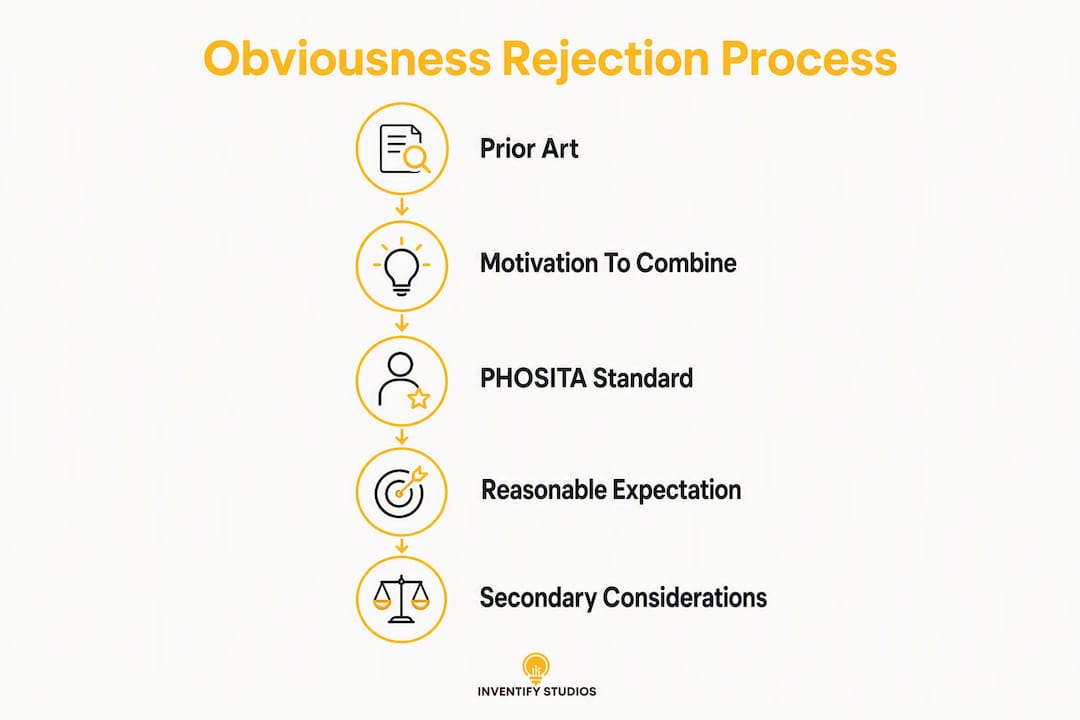
The PHOSITA standard is the analytical anchor. The examiner must step back to the time of the invention and assess obviousness through the eyes of a skilled practitioner in that field, not through the lens of the applicant's own disclosure. MPEP 2142 describes this as the "prima facie" framework: once the examiner establishes a prima facie case, the burden shifts to the applicant to submit rebuttal evidence. Understanding that shift is the foundation of every effective response.
For a sharper look at how novelty and nonobviousness differ in practice, the patentable vs. unpatentable ideas guide on the Inventifystudios blog walks through concrete examples.
How does an examiner build a prima facie obviousness case?
The examiner carries the initial burden. To establish a prima facie case, the USPTO requires three specific showings:
- Analogous prior art: The cited references must be from the same field of endeavor as the invention, or reasonably pertinent to the problem the inventor was solving. Art from an unrelated field that a PHOSITA would not have consulted is not analogous and cannot support the rejection.
- Motivation or suggestion to combine: The examiner must explain why a skilled practitioner would have combined the references. A bare assertion that "it would have been obvious to combine" is not enough.
- Reasonable expectation of success: The examiner must show that the combination would have been expected to work, not merely that it was possible.
When any of these three elements is missing or only asserted in conclusory terms, the prima facie case is vulnerable. That gap is your primary target.
Checklist for spotting a weak prima facie case:
- Does the examiner identify the field of each reference and explain why it is analogous to your invention?
- Is the reason to combine tied to a specific teaching in the prior art, or does it rely on hindsight reconstruction using your own disclosure?
- Does the examiner address whether the combination would have been expected to succeed, or does the Office action skip that step entirely?
- Are the factual findings stated as facts, or are they legal conclusions dressed up as facts?
Pro Tip: Examiners sometimes copy-paste boilerplate motivation language across rejections. Compare the examiner's stated reason to combine against the actual text of the cited references. If the motivation language does not map to a specific passage in those references, you have a record-based argument that the prima facie case is conclusory and therefore legally insufficient under post-KSR guidance.
What are the most common examiner rationales in Section 103 rejections?
Knowing the playbook helps you respond faster. Most Section 103 rejections fall into a handful of recurring patterns.
- Combination of references for missing elements: A primary reference discloses most of the claim, and the examiner pulls one or two elements from a secondary reference. The stated motivation is often that it would have been "obvious to modify" the primary reference to include the secondary reference's feature. This is the most common pattern by far.
- Routine optimization or predictable variation: The examiner argues that adjusting a parameter (temperature, concentration, timing) within a known range is routine experimentation. This rationale is strongest when the prior art already discloses the parameter and the claimed range overlaps.
- Overlapping numeric ranges: When a claimed range overlaps with a prior art range, examiners often treat the overlap as presumptively obvious. The rebuttal requires showing that the claimed range produces unexpected results compared to the prior art range.
- Design choice or aesthetic variation: For mechanical or consumer product inventions, examiners sometimes argue that a structural difference is a mere design choice with no functional consequence. Showing a functional benefit tied to the structural distinction defeats this rationale.
Post-KSR, the Federal Circuit has accepted rationales based on market demand, known solutions to known problems, and ordinary creativity. It has rejected rationales that rely on the applicant's own disclosure to supply the missing motivation, a form of impermissible hindsight. If the examiner's reason to combine only makes sense because your application revealed the problem and solution, that is a hindsight argument you can attack directly.
Art unit practices vary. Technology centers handling software and business methods (TC 3600) tend to apply KSR flexibility broadly and often rely on common sense as motivation. Mechanical and chemical art units typically require closer reference-to-claim mapping. Biotech and pharmaceutical art units scrutinize the reasonable expectation of success element most carefully, particularly for unpredictable biological systems.
How do you respond to an obviousness rejection step by step?
A focused, evidence-backed response outperforms a broad denial every time. Work through this sequence.
Model argument pattern for attacking motivation to combine:
Pro Tip: The motivation-to-combine element is the most productive attack point in most rejections. The 2024 Federal Register guidance reiterates that examiners cannot rely on conclusory reasoning. If the examiner's motivation statement does not cite a specific passage in the prior art or a recognized principle of ordinary skill, challenge it directly and preserve that argument for a potential PTAB appeal.
Procedural options and sequencing:
- Request for Continued Examination (RCE): — Reopens prosecution; costs a USPTO fee; resets the examiner's review; useful when new evidence or claim language needs full consideration
What timeline and costs should you expect after an obviousness rejection?
Prosecution after a Section 103 rejection rarely resolves in a single exchange. Here is a realistic sequence.
- First response (months 1–3): Drafting a substantive reply with arguments or amendments; attorney time is the primary cost driver at this stage
- Examiner review (months 3–9): The examiner issues a second Office action, which may be a final rejection, a new non-final rejection, or an allowance
- After-final stage (months 9–12): If a final rejection issues, you have limited amendment rights; an interview or after-final consideration request can sometimes resolve the matter without an RCE
- RCE (months 12–18+): Filing an RCE resets prosecution; expect another 6–12 months for the examiner to issue a new Office action
- PTAB appeal (18–36+ months from filing): Appeals are slower and more expensive; briefing alone can take several months; PTAB decisions add another 12–18 months on average
Cost drivers include the complexity of the declaration or experimental evidence needed, the number of references the examiner cited, and whether the case goes to appeal. Declarations from independent experts and comparative testing are the most expensive evidence to prepare but often the most persuasive.
Critical deadline reminders:
- Missing a reply deadline without an extension request results in abandonment; understanding why inventors lose patent rights starts with missed deadlines
- RCE must be filed before the application goes abandoned
- Evidence submitted after a final rejection may not be entered without an RCE
How do you draft claims and specs to reduce obviousness risk upfront?
The best response to an obviousness rejection is a prosecution record that makes it hard to issue one. These practices reduce exposure from the start.
- Document unexpected results during development. Lab notebooks, dated test reports, and comparative data showing your invention outperforms the prior art are far easier to use in a declaration if they were created contemporaneously, not reconstructed after the rejection.
- Include comparative examples in the specification. A specification that shows side-by-side performance data between your invention and the closest prior art gives you a built-in foundation for a § 1.132 declaration later.
- Draft fallback claim sets. Include independent claims at multiple levels of specificity. If the broadest claim faces an obviousness rejection, narrower claims with specific structural or functional limitations give you amendment options that do not require reopening prosecution.
- Claim the nonobvious feature explicitly. If your invention's key advance is a specific combination of parameters, a particular sequence of steps, or an unexpected structural relationship, claim it directly. Vague functional language invites broad interpretation and makes the nonobvious distinction harder to articulate.
- Map claim language to specification support. Every limitation you might add in response to an obviousness rejection must have written description support in the specification. Gaps in support force you into an RCE rather than a simple amendment.
Pro Tip: Draft your specification so that a future declaration is commensurate in scope with the claims. If your broadest claim covers a genus of compounds, your comparative data must cover the genus, not just one species. Examiners and PTAB will discount evidence that only supports a narrow subset of what is claimed.
For more on provisional patent documentation practices that protect your evidence trail, the common provisional patent mistakes guide covers the most frequent gaps first-time applicants leave in their records.
What traps do patent applicants fall into when fighting obviousness?
Experienced prosecutors see the same mistakes repeatedly. Avoiding them is straightforward once you know what to watch for.
- Arguing from the inventor's narrow claim interpretation. Examiners apply the Broadest Reasonable Interpretation standard during examination. If your reply assumes a narrower reading than the examiner is applying, your argument misses the target entirely. Reverse-engineer the examiner's claim construction first, then respond to that reading.
- Submitting only conclusory arguments. "The combination would not have been obvious" is not an argument. It is a conclusion. Every assertion needs a factual basis tied to the record.
- Failing to address the examiner's specific reasoning. If the examiner stated three reasons to combine and your reply addresses only one, the other two remain on the record and can support a final rejection.
- Waiting too long to gather evidence. Comparative test data and expert declarations take time to prepare. Starting that process after a final rejection limits your options significantly.
- Ignoring secondary considerations. Commercial success, long-felt need, and copying by competitors are legally recognized rebuttal tools. Many applicants overlook them because they feel like business metrics rather than legal arguments. They are both.
Interview preparation checklist:
- Identify the single factual finding in the rejection that, if corrected, would resolve the rejection
- Prepare a proposed claim amendment and confirm it has written description support before the interview
- Know which passages in the cited references the examiner relied on and be ready to address them specifically
- Secure agreement on any interview summary points in writing immediately after the call
For a broader look at why patent applications get rejected beyond obviousness, the Inventifystudios blog covers the full range of common prosecution pitfalls.
Key Takeaways
An obviousness rejection under 35 U.S.C. § 103 requires the examiner to show analogous prior art, a specific motivation to combine, and a reasonable expectation of success — and each element is a distinct target for rebuttal.
| Point | Details |
|---|---|
| Three-part prima facie burden | The examiner must show analogous art, motivation to combine, and reasonable expectation of success — attack whichever element is weakest. |
| Graham factors are your framework | Address all four Graham factors in every response: prior art scope, claim differences, PHOSITA level, and objective indicia. |
| Evidence beats argument alone | Declarations and comparative test data are more persuasive than conclusory denials; evidence must be commensurate in scope with the claims. |
| Interview before extensive amendment | An examiner interview often resolves or narrows the dispute faster and cheaper than a full written response. |
| Inventifystudios for evidence prep | Inventifystudios's patentability analysis and prior-art tools help inventors organize rebuttal materials and identify claim distinctions before filing a response. |
The part of obviousness rejections most inventors underestimate
Most inventors read an obviousness rejection and immediately think about amending claims. That instinct is understandable but often backward. The examiner's factual findings are the actual battlefield, and most rejections have at least one factual gap that a well-targeted argument can expose without touching the claims at all.
The motivation-to-combine element is where examiners most often overreach. Post-KSR flexibility gave examiners more room to assert common sense as motivation, and many use that room too broadly. A rejection that says "it would have been obvious to combine Reference A and Reference B to achieve the claimed result" without citing a specific passage in either reference is legally insufficient under the 2024 Federal Register guidance. That kind of conclusory reasoning is not a minor procedural defect. It is a substantive failure to carry the prima facie burden, and it is worth challenging directly.
The other underestimated tool is secondary considerations. Commercial success, long-felt need, and copying are not soft arguments. Courts and PTAB take them seriously when they are supported by real evidence tied to the specific claimed features. The problem is that most inventors do not start documenting these facts until after a rejection issues, which means the evidence is thin or reconstructed. Starting that documentation at the time of invention, not the time of rejection, changes the quality of what you can present.
One more thing: the Broadest Reasonable Interpretation standard means the examiner may be reading your claims more broadly than you wrote them. Before drafting any response, confirm what claim scope the examiner is actually applying. Responding to a narrow reading while the examiner is working from a broad one wastes time and leaves the rejection intact.
Inventifystudios can help you organize your rebuttal from day one
Preparing a strong response to an obviousness rejection means having your prior art organized, your claim distinctions documented, and your evidence ready to support a declaration. That preparation is where most inventors struggle, not because the law is unclear, but because the workflow is scattered across emails, notebooks, and half-finished drafts.
Inventifystudios gives you a structured workspace to pull that together. The Invention Detail workflow lets you run an automated prior-art search, document your invention's distinguishing features, and generate patent-ready drafts that map your claims to specification support. When an obviousness rejection arrives, you already have the organized record you need to build a targeted response, rather than starting from scratch under deadline pressure.
This is not legal advice, and Inventifystudios is not a substitute for a licensed patent attorney. For jurisdictional legal strategy, consult a registered patent practitioner. What Inventifystudios does is give you the organized foundation that makes your attorney's work faster and your evidence stronger. Start with the Invention Detail page to see how the platform fits your current stage.
Useful sources and primary reading
The sources below are the authoritative references for every legal standard discussed in this article.
| Source | What It Covers |
|---|---|
| 35 U.S.C. § 103 | Statutory basis for obviousness rejections; PHOSITA timing standard |
| MPEP 2141 | USPTO examination guidelines for obviousness; Graham factor application |
| MPEP 2142 | Prima facie obviousness framework; burden-shifting during prosecution |
| MPEP 2144 | Supporting a Section 103 rejection; specific rationale categories |
| 2024 Federal Register guidance | Post-KSR flexibility requirements; articulated reasoning standard |
| USPTO 103 rejection guidance | Prima facie criteria; objective indicia admissibility |
Recommended next reading:
- Graham v. John Deere Co., 383 U.S. 1 (1966): the foundational four-factor framework
- KSR Int'l Co. v. Teleflex Inc., 550 U.S. 398 (2007): the flexible obviousness standard
- MPEP 2144.01–2144.09: specific rationale categories the USPTO recognizes as supporting a Section 103 rejection
- MPEP 716: guidance on affidavits and declarations, including what evidence qualifies as objective indicia and how to structure a § 1.132 declaration