

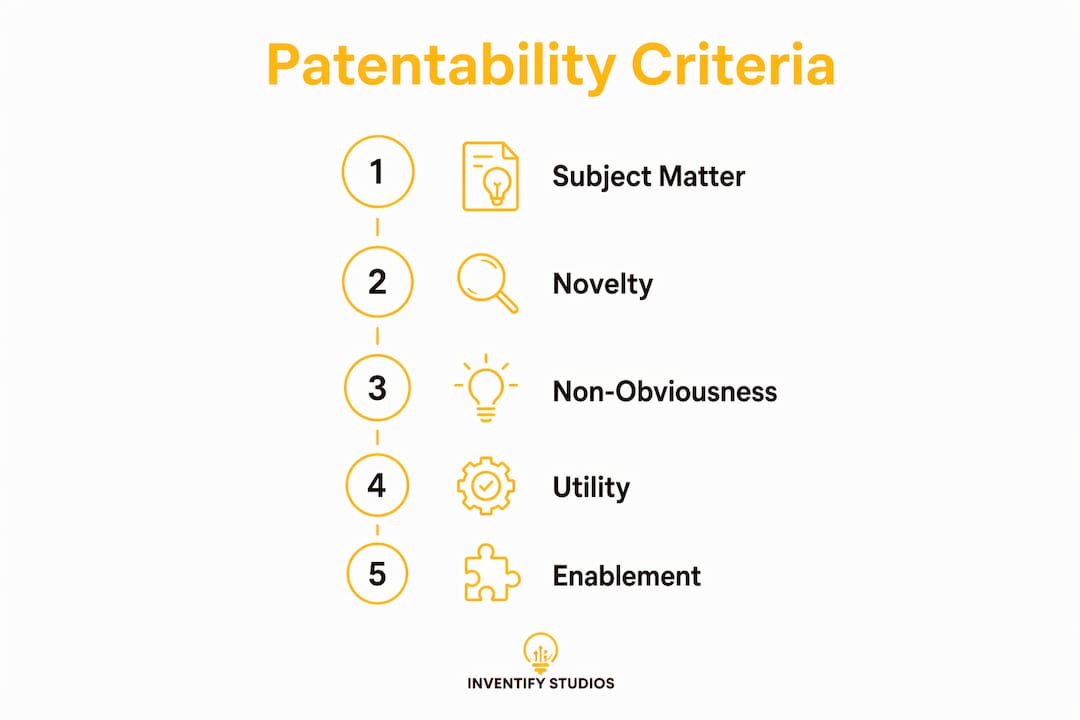
To qualify for a patent in the United States, your invention must clear five core legal standards. These patentability criteria are not suggestions. They are the gatekeeping requirements that the USPTO and WIPO use to decide whether an invention deserves exclusive legal protection. Miss any one of them, and your application fails regardless of how original your idea feels.
The essential criteria are:
- Patent eligibility (subject matter): The invention must fall within a recognized category of patentable subject matter.
- Novelty: The invention must be new and not previously disclosed to the public before the filing date.
- Inventive step (non-obviousness): The invention must represent a non-trivial advancement over what already exists.
- Industrial applicability (utility): The invention must be useful in a practical, real-world sense.
- Sufficiency of disclosure (enablement): The patent application must describe the invention clearly enough for a skilled person to reproduce it.
Under 35 U.S.C. §101–103, novelty, non-obviousness, and utility form the backbone of U.S. patent law. Subject matter eligibility and enablement add the threshold and transparency layers that complete the full patentability assessment criteria list. Knowing all five before you file is the difference between a strong application and a costly rejection.
Table of Contents
- What patentability criteria actually require from your invention
- How novelty determines whether your invention qualifies for a patent
- Why non-obviousness is the hardest patentability standard to clear
- How to demonstrate utility and meet the industrial applicability standard
- What the enablement requirement demands from your patent application
- How the patent examination process applies these criteria
- Inventifystudios gives inventors a faster path to patent readiness
- Key Takeaways
What patentability criteria actually require from your invention
Understanding the full scope of patentability criteria starts with subject matter. Before the USPTO even evaluates novelty or utility, it asks a threshold question: does this invention belong to a category that Congress has authorized for patent protection?
The four statutory categories
35 U.S.C. §101 defines four categories of patentable subject matter:
- Process: A series of steps or acts, including methods of manufacturing or doing business.
- Machine: A concrete device or apparatus with moving or functional parts.
- Manufacture: An article produced from raw or prepared materials.
- Composition of matter: Chemical compounds, mixtures, or biological compositions.
If your invention fits one of these four categories, it clears Step 1 of the eligibility analysis. But clearing Step 1 does not end the inquiry.
What gets excluded and why
Patent law excludes laws of nature, physical phenomena, abstract ideas, and purely aesthetic creations. These exclusions exist because allowing patents on fundamental scientific principles would block entire fields of research. You cannot patent gravity, a mathematical formula in isolation, or a naturally occurring gene sequence.
The practical impact is significant. An inventor who discovers that a specific protein causes a disease cannot patent the protein itself. But a novel method of using that protein to deliver a drug to targeted cells may well be patentable, because the method adds a concrete technical application on top of the natural phenomenon.
For patentable vs. unpatentable ideas, the line often comes down to whether the claim adds something specific and practical beyond the excluded concept.
Software, AI, and the Alice test
Software and AI inventions face a harder road. The Alice two-step test requires that any claim touching an abstract idea must include additional elements that amount to "significantly more" than the abstract idea itself. Step 2A asks whether the claim is directed to a judicial exception. Step 2B asks whether additional elements provide an inventive concept beyond that exception.
A software patent that merely automates a longstanding business practice on a generic computer will fail Step 2B. A software patent that describes a specific technical improvement to computer processing, network security, or data compression has a much stronger case. Subject matter eligibility for AI and software continues to evolve as the USPTO engages with new judicial decisions and stakeholder input.
Pro Tip: Evaluate subject matter eligibility before investing in a full patent search. If your invention falls into an excluded category without a clear technical application, restructuring the claims early saves weeks of wasted effort.
How novelty determines whether your invention qualifies for a patent
Novelty is the most straightforward of the patentability standards, but it is also the one that catches inventors off guard most often. An invention is novel if it has not been publicly disclosed before the filing date in any form, anywhere in the world.

What counts as prior art
Prior art is any public disclosure that predates your application. It includes:
- Published patents and patent applications (domestic and international)
- Academic journal articles, conference papers, and technical reports
- Products already on sale or in public use
- Public demonstrations, trade show exhibits, and online postings
- Your own prior disclosures, in most cases
The "public" threshold is low. A single blog post, a product listing on a retail website, or a presentation at a conference can all constitute prior art that destroys novelty. The USPTO examiner will search databases including the USPTO's own patent records, Google Patents, and scientific literature to find any prior disclosure that matches your claims.
Grace periods and time bars
U.S. patent law provides a one-year grace period under the America Invents Act. If you publicly disclosed your own invention, you have 12 months from that disclosure to file a patent application before your own disclosure becomes prior art against you. Most other countries offer no grace period at all. A public disclosure before filing in Europe, Japan, or China typically destroys novelty permanently in those jurisdictions.
This asymmetry matters if you plan to seek international protection. Filing a provisional patent application before any public disclosure is the standard way to establish a priority date while preserving global options.
How novelty is evaluated in practice
The USPTO examiner compares your claims, element by element, against prior art references. If a single prior art document discloses every element of your claim, the claim lacks novelty and will be rejected under 35 U.S.C. §102. The rejection is not a death sentence. Inventors can amend claims to distinguish their invention from the prior art, provided the amended claims still describe what was originally disclosed in the application.
Why non-obviousness is the hardest patentability standard to clear
Non-obviousness, called inventive step outside the United States, is where most patent applications face their toughest scrutiny. An invention can be completely new and still fail this requirement if the differences between it and the prior art would have been obvious to a person of ordinary skill in the relevant field at the time of filing.
The "person skilled in the art" standard
The legal benchmark is not a genius inventor and not a complete novice. It is a hypothetical skilled practitioner who has average knowledge and ability in the relevant technical field and is aware of all common general knowledge in that field at the time of filing. This person is presumed to know everything in the prior art, even references that no real engineer would have combined on their own.
Non-obviousness is judged from this perspective, asking whether the skilled practitioner would have had a reasonable expectation of success in combining existing knowledge to arrive at your invention. If the answer is yes, the invention is obvious and not patentable.
Factors that support non-obviousness
Patent examiners and courts consider several factors when assessing inventive step:
- Unexpected results: The invention produces a result that is surprising or counterintuitive compared to what the prior art would predict.
- Long-felt need: The problem your invention solves has existed for years without a solution, suggesting the solution was not obvious.
- Failure of others: Others in the field tried and failed to solve the same problem.
- Commercial success: The invention achieved commercial success attributable to its novel features, not just marketing.
None of these factors is individually decisive, but together they build a case for non-obviousness that can overcome an examiner's rejection.
A practical example
Suppose you invent a new type of bicycle brake that uses a polymer composite instead of rubber. If the prior art already shows polymer composites used in automotive brakes, and a skilled bicycle engineer would naturally consider applying that material to bicycle brakes, your invention is likely obvious. But if your composite produces a significant reduction in stopping distance under wet conditions, a result that prior art did not predict or suggest, that unexpected performance improvement supports a non-obviousness argument.
Pro Tip: Run a thorough prior art search before drafting your claims. Knowing exactly what exists lets you frame your invention around the genuine differences, rather than discovering those differences for the first time in an office action.
How to demonstrate utility and meet the industrial applicability standard
Utility is the requirement that your invention must actually work and provide a real, practical benefit. Under U.S. patent law, a claimed invention must have utility that is specific, substantial, and credible. Vague or speculative usefulness does not satisfy this standard.
What "specific, substantial, and credible" means
- Specific: The utility must be tied to the particular invention, not a general class of compounds or methods. Claiming that a new molecule "may have pharmaceutical applications" without identifying a specific use fails this test.
- Substantial: The utility must provide a real-world benefit, not a trivial or purely theoretical one. A method that produces a chemical with no known use does not qualify.
- Credible: The claimed utility must be believable based on what is known in the field. An invention claiming to cure all cancers with no supporting data will be rejected as lacking credible utility.
What fails the utility test
The clearest examples of utility failures are inventions that cannot work as described. Perpetual motion machines are the classic case: they violate the laws of thermodynamics, so no examiner will accept a credible utility claim for one. Abstract ideas with no technical effect also fail. A mathematical formula that calculates a result but produces no physical output, no process improvement, and no practical application does not meet the utility requirement.
Under European Patent Convention standards, industrial applicability requires the invention to solve a tangible, technical problem. A purely business-related method with no technical character fails this standard in Europe even if it might survive a U.S. utility analysis.
Demonstrating utility during examination
Inventors demonstrate utility through the patent specification itself. Working examples, experimental data, and clear descriptions of the practical application all contribute to a credible utility showing. For pharmaceutical inventions, in vitro data can support utility claims, but examiners may require a reasonable association between laboratory results and the claimed therapeutic effect. The stronger and more specific the data in the specification, the less likely the examiner is to raise a utility rejection.
What the enablement requirement demands from your patent application
Sufficiency of disclosure is the requirement that your patent application must teach a skilled person how to make and use your invention without requiring them to conduct undue experimentation. This requirement is separate from novelty, non-obviousness, and utility. An invention can be novel, non-obvious, and useful and still be rejected or invalidated for failing to enable the claimed invention.
The legal basis and what it covers
Under 35 U.S.C. §112, a patent specification must satisfy three distinct requirements:
- Enablement: The specification must describe how to make and use the invention fully enough that a skilled person can do so without excessive trial and error.
- Written description: The specification must demonstrate that the inventor actually possessed the claimed invention at the time of filing, not just a general concept.
- Best mode: The inventor must disclose the best version of the invention known to them at the time of filing.
Enablement and written description enforce transparency. They ensure that the public receives real technical knowledge in exchange for the temporary monopoly a patent grants.
What "undue experimentation" means in practice
A reasonable amount of trial and error is acceptable. What is not acceptable is leaving a skilled person to essentially reinvent the invention from scratch. WIPO guidance states that the enablement requirement is not met when the description sets forth only a task or a wish without providing the technical means to carry it out. Courts and patent offices consider factors like the breadth of the claims, the complexity of the technology, and the amount of guidance provided in the specification when deciding whether enablement is met.
Common enablement failures
Broad claims are the most frequent source of enablement problems. If your specification describes one specific embodiment of a drug delivery device but your claims cover every possible drug delivery device using any material and any mechanism, the specification likely does not enable the full scope of what you are claiming. The fix is either to narrow the claims to match what the specification actually teaches, or to add more detailed disclosure covering the broader scope.
Pro Tip: Draft your specification before your claims, not after. When you write the technical description first, you naturally discover the limits of what you can actually enable, and your claims will reflect those limits accurately rather than overreaching.
How the patent examination process applies these criteria
Filing a patent application is the beginning of a structured examination process, not the end of the patentability assessment. The USPTO examination process applies all patentability criteria systematically, and understanding each stage helps you prepare a stronger application from the start.
The steps from filing to decision
- Filing: You submit a patent application including claims, a specification, drawings (if applicable), and an abstract. A provisional application can establish a priority date without formal claims, giving you 12 months to file a non-provisional application.
- Formal examination assignment: The USPTO assigns your application to an examiner with technical expertise in your field.
- Prior art search: The examiner searches patent databases, scientific literature, and other public sources to identify prior art relevant to your claims.
- Office action: The examiner issues a written office action either allowing the claims or rejecting them under one or more patentability criteria. Most applications receive at least one rejection.
- Response: You have the opportunity to respond to the office action by amending claims, arguing against the rejection, or both.
- Final action or allowance: After your response, the examiner issues a final office action or a notice of allowance. If allowed, you pay an issue fee and the patent is granted.
What examiners actually look for
Examiners evaluate claims under each statutory requirement in sequence. They begin with subject matter eligibility under §101, then assess novelty under §102, then non-obviousness under §103, and finally check the specification for compliance with §112. A rejection under any one of these sections requires a response before the application can advance.
The prior art search is the most time-consuming part of examination. Examiners use tools including the USPTO's Patent Full-Text Database, the European Patent Office's Espacenet, and Google Patents. They also consider non-patent literature, which means academic papers and technical standards are fair game as prior art references.
Preparing for a stronger outcome
Inventors who conduct their own prior art search before filing arrive at examination with a clearer picture of where their invention stands. Knowing the prior art lets you draft claims that are genuinely distinguishable from day one. It also helps you anticipate the arguments an examiner is likely to make and prepare responses in advance.
For inventors navigating this process without a law firm, resources like invention protection guides and AI-powered patent analysis tools can make the process more manageable. Understanding patent pending status and what it means for your protection during examination is also worth knowing before you file.
One distinction worth keeping in mind: passing the patentability assessment is a legal determination, not a commercial one. The MIT Technology Licensing Office notes that commercial viability assessment is a separate process that considers market needs, licensing potential, and technology maturity. An invention can be fully patentable and still face a difficult road to market. Knowing the difference keeps your expectations grounded and your strategy clear.
For inventors who want to understand how patents compare to other forms of intellectual property protection, a clear overview of patent vs. trademark vs. copyright differences is a useful next step before filing. And for those concerned about protecting software or hardware innovations during the patent process, IP protection tools like Sidenty's anti-piracy solutions offer an additional layer of security while your application is pending.
Inventifystudios gives inventors a faster path to patent readiness
Most inventors spend weeks trying to piece together patentability information from legal documents, USPTO guidance, and expensive attorney consultations. Inventifystudios cuts that process down to hours.
The platform was built specifically for creators who want to move fast without sacrificing accuracy. With Inventifystudios, you get an AI-powered patentability analysis that checks your invention against the core criteria covered in this article, including subject matter eligibility, novelty signals, and utility. You also get AI-generated 3D prototypes and provisional patent drafts, all without the retainer fees that traditional IP firms charge. Whether you are a first-time inventor trying to figure out if your idea is even patentable, or an experienced innovator preparing a provisional application, Inventifystudios gives you the clarity and the tools to move forward with confidence. Start your patentability assessment today and find out exactly where your invention stands before you spend a dollar on legal fees.
Key Takeaways
Patentability criteria are the five legal standards every invention must satisfy to receive patent protection in the United States, and failing even one of them results in rejection.
| Point | Details |
|---|---|
| Five core criteria | Subject matter eligibility, novelty, non-obviousness, utility, and enablement all must be satisfied for a patent to be granted. |
| Subject matter threshold | Laws of nature, abstract ideas, and natural phenomena are excluded; software and AI face additional scrutiny under the Alice two-step test. |
| Novelty and prior art | Any public disclosure before your filing date, including your own, can destroy novelty and invalidate your application. |
| Enablement is separate | A patent can be rejected under 35 U.S.C. §112 for insufficient disclosure even when novelty, non-obviousness, and utility are all met. |
| Inventifystudios | The platform provides AI-powered patentability analysis and provisional patent drafts, helping inventors assess criteria before spending on legal fees. |