
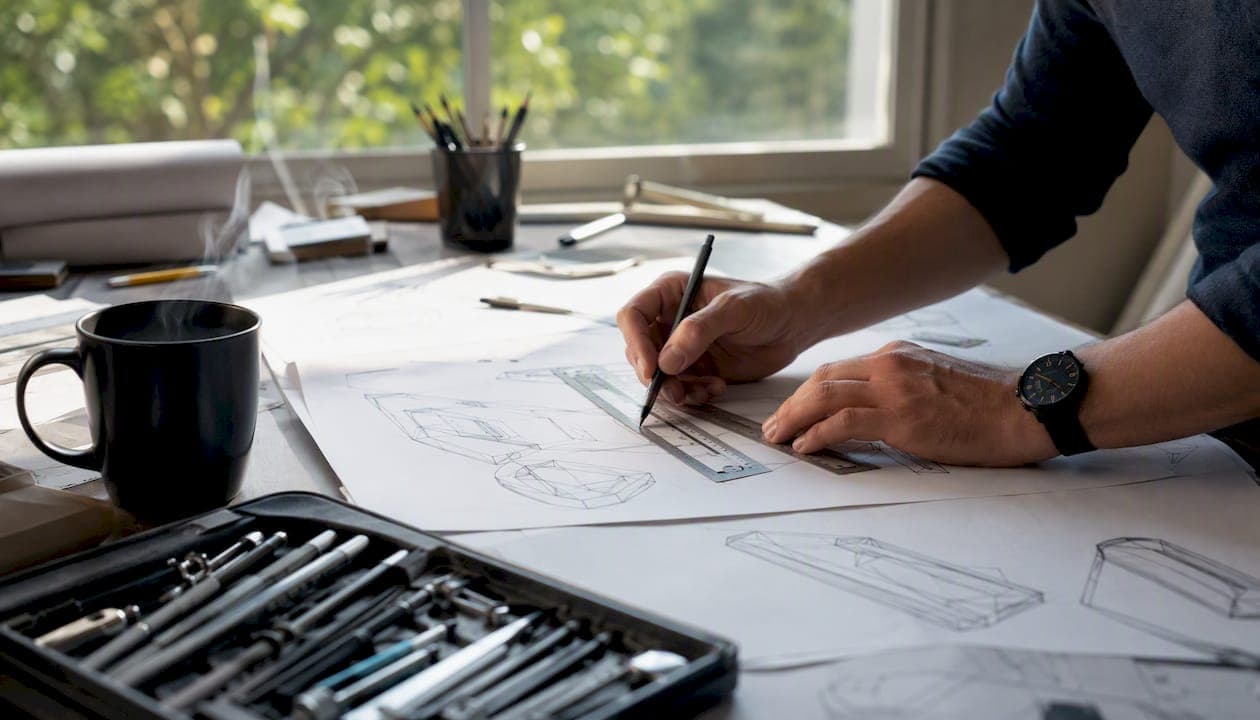
A patent coaching service is professional guidance that helps inventors evaluate patentability, build a technically complete invention disclosure, and prepare a strong provisional or nonprovisional filing for counsel or self-filing. It sits between "I have an idea" and "I have a patent application," combining hands-on documentation help with practical knowledge of how the United States Patent and Trademark Office (USPTO) evaluates filings. Platforms like Inventify Studios build this process around AI tools, while the underlying rules, including the provisional priority window under 35 U.S.C. §111(b), stay the same no matter who guides you through it.
Coaching benefits three kinds of people most:
- First-time inventors who need help turning a rough concept into a written disclosure that actually teaches someone how the invention works.
- Entrepreneurs racing a deadline who want a provisional application filed correctly before a trade show, investor meeting, or product launch.
- Serial inventors who want a faster, cheaper way to screen ideas for patentability before committing legal budget to any single one.
If you already have a signed engagement letter with a patent attorney handling your claims, you may not need coaching. If you are still staring at a sketch and a half-written description, this is exactly the stage where a coach earns their fee.
Key Takeaways
A patent coaching service turns raw invention ideas into filing-ready disclosures by combining patentability screening, prior-art research, and provisional drafting support under non-legal advisory guidance.
| Point | Details |
|---|---|
| Coaching bridges technical and legal gaps | It turns your working knowledge into a written disclosure an attorney or examiner can actually use. |
| Timing protects your provisional window | Engage a coach before rushing a filing so the 12-month priority period isn't wasted on a thin disclosure. |
| Enablement is the make-or-break factor | Include a working example, drawings, and alternative embodiments to meet the §112(a) standard. |
| Coaching has real limits | It cannot replace an attorney for claim drafting, litigation, or international filings. |
| Inventify Studios offers an integrated option | Its platform combines prototyping, patentability analysis, and provisional drafting guidance in tiered packages for independent inventors. |
Table of Contents
- What Does a Patent Coaching Service Actually Include?
- When Should You Bring In a Patent Coach?
- How a Provisional Application Fits Into Coaching
- What Happens in a Typical Coaching Engagement
- What to Bring to Your First Coaching Session
- How to Choose a Patent Coach
- What Patent Coaching Can't Do (and When You Need an Attorney)
- How Inventify Studios Structures Patent Coaching
- When Coaching Is the Right First Move
- Start Your Patent Journey with Inventify Studios
- Sources
What Does a Patent Coaching Service Actually Include?
Most coaching engagements bundle six core services, though the depth of each varies by provider and package tier.
- Invention-disclosure coaching: structured interviews and templates that turn your technical knowledge into a written record covering how the invention works, what problem it solves, and how it differs from existing solutions.
- Prior-art and patentability guidance: searches through patent databases and public products to flag whether something similar already exists, plus a plain-language summary of the risk.
- Provisional drafting support: help writing the technical narrative, defining claims informally, and organizing drawings so the filing meets basic disclosure standards.
- Prototype feedback: review of physical or 3D models to spot design gaps or feature clarifications the description needs to cover.
- Filing-readiness checklist: a final pass confirming drawings, working examples, and alternative embodiments are all present before submission.
- Documentation management: version control on dated notes, sketches, and drafts so nothing gets lost between sessions.
A completed invention-disclosure document, an annotated drawing set, a prior-art search summary, and draft provisional text are typical deliverables. Recorded coaching sessions often get bundled in too, since a transcript can clarify inventorship questions later.
Here's the distinction that trips people up: disclosure coaching, prior-art research, and drafting support are non-legal advisory services. Filing an application with the USPTO, arguing claims during examination, or representing you in a dispute requires a registered patent attorney or agent. A structured provisional drafting strategy ties early disclosure work to your business roadmap, but it stops short of legal representation.
Pro Tip: Ask any coach upfront which deliverables are "advisory" and which require attorney sign-off. A provider who can't answer that clearly in one sentence probably hasn't thought it through either.
When Should You Bring In a Patent Coach?
Timing determines whether coaching saves you money or wastes it. The right window opens earlier than most inventors assume.
- Concept sketching stage: you have an idea on paper but haven't tested it. Coaching here focuses on prior-art checks so you don't sink months into something already patented.
- Pre-prototype stage: you know roughly how it works but haven't built anything. This is often the sweet spot for disclosure coaching, since the invention record can capture your reasoning before you forget the alternatives you considered.
- Ready-to-prototype stage: you're building or have built a working model. Coaching now folds prototype photos and test data directly into the disclosure.
- Pre-provisional filing stage: you're weeks from filing. Coaching here is a final enablement check, confirming the draft has a working example, drawings, and enough technical depth to hold up later.
Before spending money on any of this, invest a few hours documenting and searching to confirm nobody already built your idea. That preliminary legwork often determines whether a provisional filing is even worth pursuing.
Pro Tip: File a technically solid provisional, not a rushed one. A self-imposed deadline (a pitch competition, a trade show) is not a good reason to submit a thin disclosure that fails to enable your invention. A weak provisional can cost you the priority date it was supposed to protect.
How a Provisional Application Fits Into Coaching
A provisional application does three specific things: it locks in an official U.S. filing date, lets you use "Patent Pending" for a limited time, and starts your priority window under the Paris Convention. It does not get examined, and it does not become a patent on its own. You have 12 months to file a nonprovisional application claiming that same priority date, or the provisional simply expires.
| What a Provisional Does | What a Provisional Does Not Do |
|---|---|
| Establishes an official U.S. filing date | Get examined by a USPTO patent examiner |
| Permits "Patent Pending" marking for 12 months | Grant enforceable patent rights on its own |
| Starts the 12-month Paris Convention priority window | Guarantee a later nonprovisional will be approved |
| Offers a lower-cost first filing step | Substitute for a complete claims analysis |
Coaching earns its value here by targeting enablement under 35 U.S.C. §112(a). A strong provisional explains how the invention works, includes at least one clear working example, and pairs that explanation with drawings a stranger could follow. Skip any of that, and you risk the single most common provisional failure.
Thin provisionals that lack diagrams, performance benchmarks, or alternative embodiments often fail the enablement standard, meaning a later nonprovisional may not get the earlier filing date it was supposed to inherit.
- Write the technical description as if teaching a competent stranger, not pitching an investor.
- Include at least one full working example, not just a conceptual overview.
- Add drawings for every distinct component or step you describe in words.
- List at least one alternative embodiment (a variation that would still work) to widen your later claim options.
Pro Tip: If your provisional draft doesn't answer "how would someone else build this from scratch," it's not ready. That's the enablement test in plain language.
What Happens in a Typical Coaching Engagement
Most engagements follow a predictable arc, though the pace depends on how prepared you walk in.
- Discovery call (30 to 60 minutes): the coach learns what you've built, what stage you're at, and what outcome you want.
- Inventor interview (1 to 2 hours, often recorded): structured questions extract the technical detail needed for a disclosure.
- Invention-record draft (a few days): the coach turns interview notes into a written record covering structure, operation, and variations.
- Prior-art scan (2 to 5 days): a search through patent and product databases flags conflicts or gaps in novelty.
- Draft provisional or filing packet (1 to 2 weeks): technical narrative, drawings, and working examples get assembled into filing-ready form.
- Final review and handoff (a few days): a checklist pass, then either self-filing guidance or a package ready to send to a patent attorney.
- Discovery and interview stages usually run in hours.
- Drafting and search stages usually run in days.
- Full engagements from first call to filing-ready packet typically span two to four weeks, longer if prototype iterations are still in progress.
| Stage | Deliverable | Typical Timing |
|---|---|---|
| Discovery call | Scope summary | Same day |
| Inventor interview | Recorded session, raw notes | 1 to 2 hours |
| Invention-record draft | Written disclosure document | 3 to 5 days |
| Prior-art scan | Search summary report | 2 to 5 days |
| Provisional draft | Filing-ready narrative and drawings | 1 to 2 weeks |
What to Bring to Your First Coaching Session
Walking in prepared cuts engagement time significantly and gives your coach real material to work with instead of a verbal description.
- Dated sketches or notes, even rough ones, showing when you first conceived the idea.
- Photos of any prototype, at every build stage, not just the finished version.
- Any prior art you've already found, competitor products, patents, or similar solutions.
- Technical specs: dimensions, materials, tolerances, power requirements, whatever applies.
- Test data or performance results, even informal ones from a garage test.
- Notes from any manufacturing partner or lab, especially design-for-manufacture feedback.
An effective invention record dates every entry, describes the primary embodiment in full, and lists at least one alternative version that would still function. If your invention is a folding tool, for example, your working example should describe one specific hinge mechanism in detail, then note that a spring-loaded variant would also work. That second sentence alone can widen your later claim scope. Working with a manufacturing partner that signs NDAs and offers design-for-manufacture feedback protects your idea while you gather this evidence.
Pro Tip: Record your inventor interview and save every draft with a date in the filename. If a dispute over inventorship or timing ever comes up, that paper trail is worth more than memory.
How to Choose a Patent Coach
Not every coaching provider is built the same, and the wrong pick can waste both your budget and your provisional window.
- Confirm technical domain experience. A coach who has drafted disclosures in mechanical devices may not be the right fit for a software or biotech idea.
- Ask how prior-art searches are conducted and what tools they use. A vague answer here usually means a vague search later.
- Ask for an example of a completed invention disclosure (with identifying details removed) to gauge writing quality and depth.
- Ask directly what happens at handoff. Does the coach prepare a packet for your attorney, or leave you to figure out the next step alone?
- Get pricing and deliverables in writing before the first paid session.
- Does the coach record inventor interviews, and do you keep a copy?
- What's included in each package tier, specifically?
- Have they worked with inventions in your general category before?
- What does the handoff to a patent attorney look like, step by step?
Watch for red flags: anyone promising legal representation without being a licensed attorney or registered patent agent, vague deliverable lists that dodge specifics, no described prior-art process, or a suspiciously low flat rate that seems to cover everything with no scope defined. Successful inventors build a thorough invention record before filing, and that record should be the centerpiece of any coach's process, not an afterthought.
What Patent Coaching Can't Do (and When You Need an Attorney)
Coaching has real limits, and understanding them protects you from an expensive misunderstanding.
- Coaches provide non-legal advisory guidance. They cannot file or prosecute a patent application on your behalf with legal authority.
- No attorney-client privilege applies to coaching conversations, meaning those records could be discoverable in a future dispute.
- Coaching does not replace formal claims drafting, which requires precise legal language an attorney or registered patent agent is trained to construct.
Hire an attorney when your situation involves complex claim drafting with multiple dependent claims, any litigation or infringement dispute, licensing negotiations with another company, disagreements between co-inventors, or international patent prosecution under treaties like the PCT. This distinction matters procedurally too: coaching typically wraps up before or during the provisional stage, while an attorney becomes essential once you're preparing for USPTO examination of a nonprovisional application. None of this is legal advice. Confirm your specific situation with a licensed patent attorney or the USPTO's own resources.
How Inventify Studios Structures Patent Coaching
Inventify Studios built its platform around the gap most independent inventors hit: technical clarity without a legal budget. The platform combines AI-generated 3D prototyping, patentability analysis, and provisional drafting guidance with automated prior-art search and documentation management, all in one place instead of scattered across separate consultants.
Package tiers typically scale with how much support an inventor needs:
- Bronze-style tier: disclosure template, basic patentability screening, and a prior-art summary, suited to inventors still validating an idea.
- Silver-style tier: adds 3D prototype generation and a more detailed prior-art report, suited to inventors ready to visualize and refine their design.
- Gold-style tier: adds provisional drafting guidance and documentation handoff support, suited to inventors preparing to file or hand a packet to counsel.
The workflow mirrors what independent coaches do manually: an inventor interview, a shared invention-record template, a draft provisional narrative, recorded sessions for reference, and a final packet built for handoff to a patent attorney. Invention disclosure coaching that produces a finished document counsel can use directly tends to reduce attorney hours during claim drafting, since the technical groundwork is already done.
Pro Tip: Use the AI patentability check before you sink time into a full prototype. It's faster to redirect a design at the sketch stage than after you've built three physical versions of the wrong concept.
When Coaching Is the Right First Move
Coaching earns its keep at the disclosure stage, before legal fees start accumulating. That's the honest read: an inventor who shows up to an attorney's office with a dated invention record, a prior-art summary, and a draft provisional narrative saves that attorney hours, and those hours translate directly into your legal bill. Skip the disclosure work, and you're paying attorney rates to do what a coach or a well-structured platform could have handled for less.
Where I'd push back on conventional wisdom: too many inventors treat coaching and legal counsel as either/or choices. They're sequential. Coaching handles the technical translation problem, attorneys handle the legal enforceability problem, and conflating the two wastes money in both directions. The inventors who do best treat the invention record as a living document from day one, not something they scramble to assemble the week before filing.
If you want to go deeper on the mechanics, Provisional Patent Protection: What Inventors Need to Know and the Invention Disclosure Document Components breakdown are worth reading before your first coaching call.
Pro Tip: Start your invention record the day you have the idea, not the day you decide to pursue a patent. Timing disputes are almost always solved by whoever has the earliest dated evidence.
Start Your Patent Journey with Inventify Studios
Inventify Studios gives independent inventors an integrated path from raw idea to filing-ready packet, without the hourly rates that make traditional patent consulting inaccessible to first-timers. Instead of hiring separate providers for prototyping, patentability screening, and provisional drafting, the platform bundles AI-powered 3D prototype generation, patentability analysis, and drafting guidance into one flow built specifically for people who don't have a law firm on retainer.
This fits readers who came through this article for one reason: you have an idea worth protecting, and you need a clear, affordable next step before committing to attorney fees. Whether you're at the sketch stage or already holding a working prototype, the platform's invention detail tools let you check patentability, generate a prototype, and start building your invention disclosure today. Visit the invention detail page to see which package tier matches where your idea stands right now.
Sources
- Provisional application for patent (USPTO)
- An inventor's guide to strong provisional patent applications (The Thornton Firm)
- A simple step-by-step guide to turning your idea into a patent in the US (Menlo Park Patents)
- Beware the pitfalls of provisional patents (WHGC Law)
- I have an invention — what do I do first? (iInvent)
This article is general information, not a substitute for advice from a qualified lawyer. Consult a qualified legal professional about your own circumstances before acting on anything here.