

A patent attorney is a licensed lawyer who can do everything a patent agent can do, plus litigate, draft contracts, and deliver formal legal opinions. A patent agent is a USPTO-registered technical specialist authorized to prepare, file, and prosecute patent applications before the Office — nothing more, and often nothing less than what an early-stage inventor actually needs.
The practical verdict: hire an agent for cost-sensitive USPTO prosecution. Hire an attorney when enforcement, licensing deals, investor due diligence, or federal court representation enters the picture.
Three regulatory anchors define this distinction:
- USPTO registration and the Patent Bar: Both roles require passing the USPTO Registration Examination and holding a qualifying technical degree. Attorneys add a J.D. and state bar license on top.
- 37 C.F.R. § 11.5: This federal regulation defines "practice before the Office" and sets the boundary of what any registered practitioner may do at the USPTO.
- Patent Trial and Appeal Board (PTAB): Both agents and attorneys can represent clients in PTAB proceedings, since PTAB is an administrative tribunal within the USPTO, not a federal court.
Table of Contents
- What does a U.S. patent agent actually do?
- What can a U.S. patent attorney do that an agent cannot?
- How do you become a patent agent vs. a patent attorney?
- Side-by-side scope: what each practitioner can and cannot do
- Where patent agents and attorneys do the same work
- What do patent agents and attorneys typically charge?
- When should you hire a patent agent vs. a patent attorney?
- How do you vet and choose the right practitioner?
- A practical lifecycle strategy for inventors
- Common myths that cost inventors money
- Key Takeaways
- The case for starting lean and scaling up
- Inventifystudios gives inventors a stronger starting position
- Authoritative sources and further reading
What does a U.S. patent agent actually do?
A patent agent is a registered patent practitioner who has passed the USPTO Registration Examination (commonly called the Patent Bar) and holds a qualifying technical degree in science or engineering. USPTO rules authorize agents to prepare, file, and prosecute patent applications and to represent inventors in USPTO proceedings — including responding to examiner office actions and handling PTAB appeals.
What agents cannot do is equally clear. They are not licensed to practice law. That means no legal advice outside the scope of USPTO patent prosecution, no contract drafting, no infringement opinions, and no court representation.
A typical agent engagement looks like this: an inventor brings a working prototype and a disclosure document; the agent conducts a prior art search, drafts a provisional application, files it with the USPTO, then follows up with a non-provisional application and handles any office-action responses from the examiner. That full prosecution cycle is squarely within an agent's authority.
Key permitted activities for a patent agent:
- Drafting and filing provisional and non-provisional patent applications
- Responding to USPTO examiner office actions
- Conducting prior art searches and patentability assessments
- Representing clients in PTAB proceedings (inter partes review, post-grant review)
- Managing USPTO correspondence and prosecution timelines
Agents are not authorized to give general legal advice. Asking an agent to interpret a licensing clause or a non-compete agreement leaves you without legal protection — that work requires an attorney.
What can a U.S. patent attorney do that an agent cannot?
A patent attorney holds everything a patent agent holds — qualifying technical degree, Patent Bar, USPTO registration — plus a J.D. and an active state bar license. That combination unlocks a significantly broader scope of practice.
Under USPTO rules, attorneys can provide formal legal opinions on infringement and validity, draft and negotiate licensing and assignment agreements, and represent clients in federal district court for patent litigation. They can also advise on IP strategy beyond prosecution: trade secret protection, employment agreements with IP clauses, and investor-facing legal documents.
Attorney-client privilege is another meaningful difference. Communications with a licensed attorney generally carry full attorney-client privilege in federal proceedings. Communications with a patent agent are protected under a narrower privilege recognized in USPTO proceedings, but that protection does not extend uniformly to federal court litigation.
37 C.F.R. § 11.5 defines "practice before the Office" as including preparing and prosecuting patent applications, consulting with or giving advice to a client in contemplation of filing, and conducting proceedings before the USPTO. Attorneys operate within this definition and beyond it. Agents operate only within it.
Additional attorney capabilities:
- Drafting licensing, assignment, and co-development agreements
- Providing freedom-to-operate (FTO) and validity opinions for investor due diligence
- Representing clients in federal court patent litigation and ITC proceedings
- Advising on IP portfolio strategy, M&A due diligence, and technology transactions
- Broader legal counseling on matters adjacent to patent prosecution
How do you become a patent agent vs. a patent attorney?
The credential pathways diverge at law school. Both roles share the same technical foundation and the same USPTO exam.
Patent agent path:
Patent attorney path:
The USPTO Registration Examination is the same test for both roles. The attorney distinction is a legal licensing difference, not a test difference. Both practitioners demonstrate the same technical competency to practice before the USPTO.
One practical note: many law firms and IP boutiques use patent agents under attorney supervision. The agent handles drafting and prosecution; the supervising attorney provides legal strategy and client counseling. This hybrid model keeps costs lower for clients while keeping legal oversight in place.
Pro Tip: Before engaging any practitioner, verify their USPTO registration number through the OEDCI database. It takes under two minutes and confirms active registration status and any disciplinary history.
Side-by-side scope: what each practitioner can and cannot do
| Dimension | Patent Agent | Patent Attorney |
|---|---|---|
| USPTO prosecution (drafting, filing, office actions) | ✓ Yes | ✓ Yes |
| PTAB proceedings (IPR, PGR, appeals) | ✓ Yes | ✓ Yes |
| Prior art searches and patentability analysis | ✓ Yes | ✓ Yes |
| Formal infringement / validity opinions | ✗ No | ✓ Yes |
| Freedom-to-operate (FTO) opinions | ✗ No | ✓ Yes |
| Licensing and assignment agreement drafting | ✗ No | ✓ Yes |
| Federal court patent litigation | ✗ No | ✓ Yes |
| Broader legal counseling (contracts, trade secrets) | ✗ No | ✓ Yes |
| Full attorney-client privilege (federal court) | Limited | ✓ Yes |
| Investor due diligence legal opinions | ✗ No | ✓ Yes |
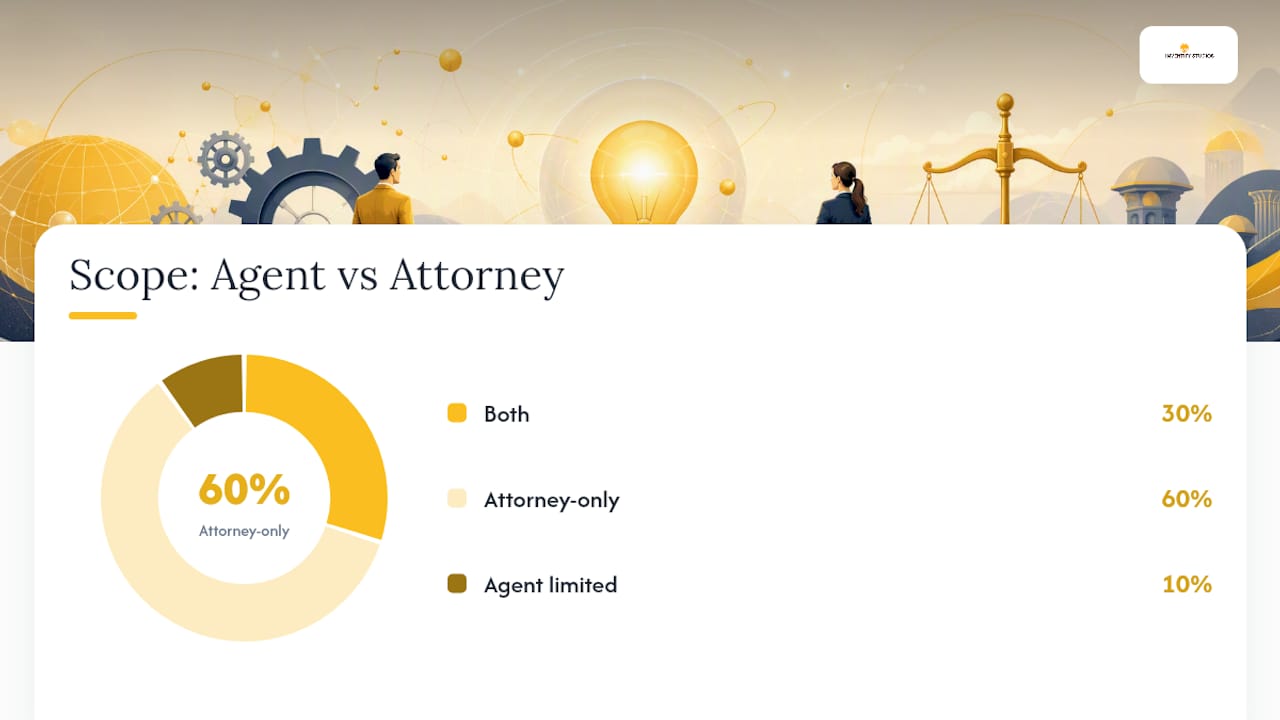
Only licensed attorneys can represent clients in federal court for patent litigation. That single column drives most of the cost and hiring decisions inventors face.
A few caveats worth noting:
- State practice rules vary. Some states impose additional requirements on who can advise on IP-adjacent matters (trade secrets, employment law). Always confirm local rules.
- Dual engagement is common in litigation-adjacent matters: an agent handles prosecution while an attorney manages legal strategy and client communications.
- PTAB is the one major proceeding where agents and attorneys are functionally equivalent, since PTAB is an administrative body within the USPTO.
Where patent agents and attorneys do the same work
The overlap is larger than most inventors expect. For pure USPTO prosecution, the agent/attorney distinction often matters less than the practitioner's technical background in your specific field.
Both agents and attorneys routinely handle:
- Prior art searches and patentability assessments
- Drafting provisional and non-provisional patent applications
- Responding to examiner office actions and rejections
- Filing continuation, divisional, and continuation-in-part applications
- PTAB appeals and inter partes review proceedings
- Patent portfolio management tied to USPTO prosecution
Claim drafting quality depends heavily on technical domain expertise. An agent with a Ph.D. in organic chemistry will typically draft stronger claims for a pharmaceutical invention than a generalist attorney with a mechanical engineering background. The title matters less than the match between the practitioner's technical training and your invention's field.
Many firms use this to their advantage: agents draft the claims and handle prosecution while attorneys manage client relationships, legal strategy, and any transactions that arise. For inventors, this means you can often get high-quality prosecution work from an agent at a lower rate, then bring in an attorney when the legal complexity increases.
For a deeper look at what the patent enablement requirement demands from a well-drafted application, that technical precision is exactly where a domain-matched agent or attorney earns their fee.
What do patent agents and attorneys typically charge?
Cost is where the agent/attorney distinction becomes most concrete for inventors on a budget.
Patent agents generally charge less than attorneys for identical USPTO prosecution tasks. Hourly rates for agents commonly run lower than attorney rates, and flat-fee prosecution packages from agents tend to undercut comparable attorney packages. Starting with an agent can save thousands on straightforward filings, but attorneys are necessary for litigation, licensing, and investor-grade legal opinions.
Ranges reflect common practitioner norms and vary by technology complexity, geography, and firm size. Always request a written fee estimate before engaging.
Why do attorney fees run higher? Law school debt, malpractice insurance, state bar dues, and the broader range of services attorneys provide all factor in. A solo practitioner attorney in a mid-sized market charges differently than a partner at a major IP firm.
The lifecycle cost trap is real. Starting with an agent for prosecution, then needing an attorney for a licensing deal or enforcement action, can mean paying two practitioners to get up to speed on the same invention. If your business model depends on licensing from day one, or if you expect enforcement to be necessary, starting with an attorney often costs less over the full lifecycle than switching later.
For inventors exploring lower-cost filing paths, the invention protection without a law firm guide covers additional options worth reviewing before committing to either route.
When should you hire a patent agent vs. a patent attorney?
Your business stage and intended use of the patent drive this decision more than any other factor.
Hire a patent agent when:
- You need a provisional or non-provisional application filed and your primary goal is securing a filing date
- Cost is the binding constraint and litigation or licensing is not on the near-term horizon
- Your invention is technically complex and you want a domain-matched specialist for drafting
- You are an independent inventor or early-stage startup with no immediate investor conversations
Hire a patent attorney when:
- You are raising venture capital or seeking institutional investment (investors expect attorney-grade FTO opinions and due diligence support)
- You plan to license your technology to third parties and need licensing agreements drafted
- A competitor is infringing and enforcement is likely
- Your business model is built around IP transactions rather than product sales
Common scenario matrix:
- Solo inventor filing a provisional: A patent agent is the right call. Lower cost, same USPTO authority, and a provisional buys 12 months to assess commercial viability before committing to full prosecution costs.
- Startup seeking Series A funding: Bring in an attorney. VCs and their counsel will request FTO opinions and validity assessments that only a licensed attorney can provide. Startup founders can read more about what investors expect in terms of IP documentation in this startup funding overview.
- Company planning to license technology: Attorney required. Licensing agreements are legal contracts; an agent cannot draft or negotiate them.
- Inventor anticipating a competitor challenge: Attorney from the start. If enforcement is likely, you need someone who can represent you in federal court.
Transition rules: When moving from agent to attorney representation, file a new power of attorney with the USPTO, transfer all prosecution files and correspondence, and brief the incoming attorney on prior art already cited. Continuity matters — gaps in prosecution history can create vulnerabilities.
For early-stage founders specifically, the startup patent strategy guide covers when to prioritize filing speed versus legal depth.
How do you vet and choose the right practitioner?
Credentials are the floor, not the ceiling. After confirming USPTO registration, the real vetting happens in the conversation.
Questions to ask any candidate:
- What is your technical background, and have you prosecuted applications in my specific field?
- How many office actions have you handled in the past two years, and what was your allowance rate?
- Can you share a sample claim set or redacted prosecution history from a comparable case?
- How do you structure fees — hourly, flat, or hybrid — and what triggers additional charges?
- Who will actually work on my application, and will I have direct access to that person?
Red flags to watch for:
- No USPTO registration number or unwillingness to provide it
- Claims to offer services outside their authorized scope (an agent offering to draft licensing agreements, for example)
- Vague pricing with no written estimate
- Inability to explain their prosecution strategy in plain language
- No familiarity with your technology field
Verification steps:
- Search the OEDCI database for active registration status and any disciplinary actions
- For attorneys, confirm state bar admission through the relevant state bar's public directory
- Request references from clients in your technology sector
Minimum engagement terms to put in writing: scope of work, fee estimate with triggers for overages, confidentiality agreement, ownership of work product, and a clear process for file transfer if you change practitioners.
Pro Tip: Ask specifically whether the practitioner has experience with your technology class at the USPTO. An examiner's art unit specialization can significantly affect prosecution strategy, and a practitioner who has worked in that unit's territory will know the common rejection patterns.
A practical lifecycle strategy for inventors
The most cost-effective approach for most inventors is staged: start lean, add legal depth when the stakes justify it.
For an inventor with a working concept and no immediate commercialization plan, a qualified patent agent handling the provisional and non-provisional filing is a sound starting point. The agent secures the priority date and builds the prosecution record. Before any investor conversation, licensing negotiation, or enforcement action, bring in a patent attorney to review the portfolio, provide an FTO opinion if needed, and handle any legal transactions.
When to retain an attorney from day one:
- Your business model is licensing-first (you plan to sell rights, not products)
- You have identified a likely infringer before filing
- Institutional investors are already in the conversation
- The invention is in a field with active litigation (pharmaceuticals, semiconductors, software)
Practical continuity steps when adding an attorney:
- Compile all prosecution correspondence, prior art cited, and examiner communications into a shared folder
- File an updated power of attorney with the USPTO naming the new or additional attorney
- Brief the attorney on any oral interviews with examiners and any informal communications
- Confirm the attorney has reviewed the full file wrapper before taking any new prosecution steps
Pro Tip: Keep a running invention disclosure document from day one — dates, sketches, test results, and version notes. This record supports both prosecution and any future litigation, and it makes the handoff between practitioners far cleaner.
Common myths that cost inventors money
Myth: An attorney always writes better patent claims. Claim quality depends on technical domain expertise, not the J.D. An agent with deep experience in your field will typically outperform a generalist attorney on claim drafting. The attorney distinction is a legal licensing difference, not a measure of drafting skill.
Myth: A patent agent can be treated like a lawyer. Agents are not licensed to practice law. Asking an agent to interpret a licensing agreement, advise on a non-compete clause, or assess litigation risk leaves you without legal protection. The scope boundary is real and regulated.
Myth: Starting with an agent means you won't need an attorney later. Most commercially successful inventions eventually require attorney involvement — licensing, enforcement, or investor due diligence will trigger it. Starting with an agent is a cost-control strategy for the prosecution phase, not a way to avoid legal fees permanently.
Fine print worth knowing:
- Attorney-client privilege with a patent agent is recognized in USPTO proceedings under In re Spalding Sports Worldwide, but its scope in federal court litigation is narrower and less settled than full attorney-client privilege.
- PTAB representation is one area where agents and attorneys are functionally equivalent; both can file petitions, respond to grounds, and appear in oral hearings before the Board.
- "Practice before the Office" under 37 C.F.R. § 11.5 covers a defined set of activities. Work that falls outside that definition — contract drafting, court appearances, formal legal opinions — requires an attorney regardless of how the practitioner markets their services.
Key Takeaways
A patent attorney covers every service a patent agent offers, plus litigation, contracts, and formal legal opinions — the right choice depends on where your invention is in its commercial lifecycle.
| Point | Details |
|---|---|
| Agents vs. attorneys scope | Agents handle USPTO prosecution; attorneys add litigation, licensing, and formal legal opinions. |
| Same Patent Bar exam | Both roles pass the same USPTO Registration Examination — the difference is legal licensing, not technical competency. |
| Cost tradeoff | Agents typically charge less for prosecution; switching to an attorney mid-lifecycle can increase total spend. |
| Investor due diligence | VCs require attorney-grade FTO and validity opinions; agents cannot provide them. |
| Inventifystudios | Inventifystudios helps inventors prepare organized disclosures and patentability analyses before engaging either practitioner, reducing upfront professional fees. |
The case for starting lean and scaling up
The conventional advice is to hire an attorney from the start. That advice serves law firms well. For most independent inventors and early-stage founders, it is not the right call.
A qualified patent agent with strong technical credentials in your field will draft claims that are just as defensible as those from a generalist attorney — often better, because the agent's entire practice is prosecution. The attorney premium is justified when legal complexity enters the picture: licensing negotiations, enforcement threats, investor scrutiny. Before that point, paying attorney rates for work an agent is fully authorized to do is a cost that rarely pays off.
The smarter approach is to treat the agent/attorney decision as a lifecycle question, not a one-time choice. File with an agent. Build a clean prosecution record. Then bring in an attorney the moment your invention moves from "protected" to "monetized." That transition point is predictable, and planning for it from the start — keeping organized files, maintaining a clear invention disclosure, and choosing an agent who works well with outside counsel — makes the handoff smooth and the total cost manageable.
What inventors underestimate is how much the quality of their pre-filing documentation affects both the prosecution outcome and the attorney's ability to provide useful legal advice later. A well-organized disclosure with dated records, prior art notes, and a clear technical description gives any practitioner a better foundation to work from.
Inventifystudios gives inventors a stronger starting position
Before you spend a dollar on prosecution, the quality of your invention disclosure determines how efficiently any practitioner can work. Inventifystudios cuts that preparation cost significantly.
The platform gives inventors AI-powered patentability analysis, automated prior art search, and provisional patent drafting guidance — the exact groundwork that agents and attorneys bill hourly to develop from scratch. You arrive at your first practitioner meeting with a structured disclosure, a prior art summary, and a clear articulation of your invention's novel features.
That preparation translates directly into lower professional fees and a cleaner prosecution record. When you do need an attorney for licensing or investor due diligence, your organized documentation makes the handoff faster and less expensive. Inventifystudios also supports 3D prototype generation and market analysis, so you can validate commercial viability before committing to full prosecution costs.
Ready to build a stronger foundation for your patent filing? Start your invention analysis on Inventifystudios and arrive at your first practitioner meeting prepared.
Authoritative sources and further reading
The following official and practitioner sources were used to build this article. Use them to verify rules, confirm practitioner registration, and dig deeper into specific regulations.
- Patent and Trademark Practitioners | USPTO Official Gazette
- USPTO registration examination source material (Patent Bar) — USPTO
- OEDCI — Office of Enrollment and Discipline Case Inquiry | USPTO
- 37 C.F.R. 11.5: Register of attorneys and agents in patent matters; practice before the Office (BitLaw)
- Patent Agent vs. Patent Attorney: How to Decide | MadePatents
- Patent Attorney vs. Agent: Key Differences & Which You Need (2026) | Michael Meyer Law
- Choosing the Right Patent Professional: Patent Agent or Registered Patent Attorney? — Innovent Law
This article is general information, not legal advice. Patent law and USPTO registration requirements can change; confirm current rules with the USPTO directly or consult a qualified patent practitioner before making filing or hiring decisions.