
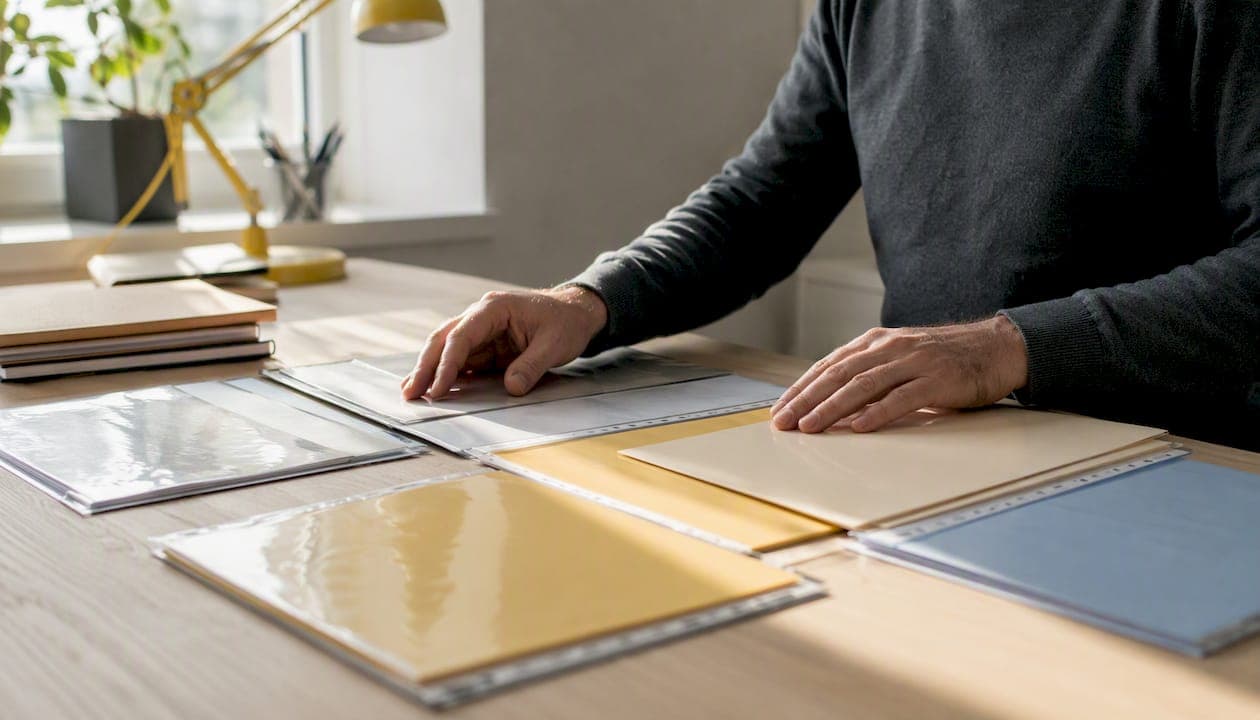
You can file a patent application yourself with the USPTO. This is called "pro se" filing, and it's a legitimate path for independent inventors and small business owners. The USPTO allows self-representation and runs a Pro Se Assistance Program for procedural education, though its staff cannot give you legal drafting advice. That distinction matters from day one.
Your first four moves:
- Run a prior-art search using Google Patents or WIPO PATENTSCOPE before you write a single word of your specification.
- Decide: provisional or nonprovisional. A provisional buys you 12 months of "patent pending" status at a lower cost. A nonprovisional starts the formal examination clock.
- Create a USPTO.gov account and verify your identity with ID.me. This is now required for electronic filing access.
- Self-enroll in Patent Center as an Independent Inventor and prepare your specification before you open the filing portal.
The entities you'll interact with: the USPTO (the federal agency that examines and grants patents), Patent Center (the exclusive online filing portal), ID.me (the identity verification service required for portal access), the Pro Se Assistance Program (procedural education and outreach), and the Patent Electronic Business Center (technical and procedural support by phone and email).
Key Takeaways
The self-filing patent process is accessible to any independent inventor, but the quality of what you file determines the quality of the protection you get.
| Point | Details |
|---|---|
| Pro se filing is allowed | The USPTO permits self-representation; use the Pro Se Assistance Program for procedural help, not legal advice. |
| Provisional buys 12 months | A micro entity pays $65 for a provisional; file the nonprovisional within 12 months or permanently lose the priority date. |
| Electronic filing saves $400 | Filing a nonprovisional utility application through Patent Center avoids the $400 non-electronic surcharge. |
| Thin provisionals create real risk | A provisional accepted by the USPTO may still fail to support later claims if it omits alternatives or enablement detail. |
| Inventifystudios prepares stronger drafts | The platform's Invention Detail flow generates provisional-ready specifications with AI-assisted prior-art search and document organization. |
Table of Contents
- What self-filing (pro se) means and your filing options
- Step-by-step checklist: how to prepare and file a patent application yourself
- Pre-filing essentials you must have ready
- Practical USPTO filing logistics: Patent Center, ID.me, self-enrollment, fees, and contacts
- Top pitfalls of self-filing and specific ways to reduce risk
- What happens after you file: examination flow, office actions, allowance, and maintenance
- Costs of self-filing: USPTO fees, entity-size discounts, and a realistic cost comparison
- When to hire a patent attorney or agent and how to choose limited-scope help
- Using DIY tools, templates, and invention platforms safely
- The practical case for limited self-filing
- Inventifystudios helps you build a stronger filing from the start
- Sources
What self-filing (pro se) means and your filing options
Pro se filing means you represent yourself before the USPTO without a registered patent attorney or agent. The USPTO will process your application the same way it processes any other, but its examiners and staff are prohibited from advising you on how to draft claims, structure your specification, or respond strategically to office actions. They can answer procedural questions. Legal strategy is yours alone.
Types of patents. Most independent inventors file for a utility patent, which covers how something works or is used. A design patent covers ornamental appearance only. A plant patent covers new asexually reproduced plant varieties. The vast majority of DIY filings are utility applications.
Provisional vs. nonprovisional. A provisional application is not examined and never becomes a patent on its own. It establishes an early effective filing date for 12 months, requires no formal claims, no oath, and no information disclosure statement. It's a placeholder. A nonprovisional application is the real filing: it gets assigned to an examiner, goes through substantive review, and can result in an issued patent. You must file the nonprovisional within 12 months of the provisional or permanently lose that priority date.
For a deeper comparison of these two paths, the provisional vs. nonprovisional breakdown covers the decision in full detail.
| Factor | Provisional | Nonprovisional |
|---|---|---|
| Examination | None | Full substantive review |
| Formal claims required | No | Yes |
| Cost (micro entity) | $65 filing fee | Filing + search + examination fees |
| Duration | 12 months, then lapses | Can lead to issued patent |
| Best for | Securing a priority date fast | Starting the formal patent process |
| Risk | Thin filing won't support later claims | Weak claims limit enforceability |
Step-by-step checklist: how to prepare and file a patent application yourself
The self-filing patent process has a clear sequence. Skipping steps creates problems that surface months or years later, often at the worst possible moment.
-
Confirm ownership and assignment. If you developed the invention as part of a job or with a co-inventor, clarify ownership in writing before filing. Employment agreements often assign IP to employers automatically.
-
Conduct a prior-art search. Use Google Patents and PATENTSCOPE to search for existing patents and publications. Log every search query and the closest references you find. This shapes your claims and your specification.
-
Document the invention thoroughly. Dated lab notes, photos, sketches, and test results establish your conception date and support enablement. Keep originals.
-
Draft your specification. Write a full description of the invention: what it is, how it works, how to make it, and how to use it. Include alternative embodiments. For a nonprovisional, add formal claims. For a provisional, write as completely as you can even without formal claims.
-
Prepare drawings. Label every component with a reference number. Use those same numbers consistently throughout the specification. Drawings are required when they are necessary to understand the invention.
-
Choose your entity status. Determine whether you qualify as a micro entity, small entity, or large entity before calculating fees. Incorrect certification carries legal consequences.
-
Complete required forms. For a provisional: cover sheet SB/16 (or equivalent in Patent Center). For a nonprovisional: an Application Data Sheet (ADS), oath or declaration (form AIA/01 or AIA/08), and any required transmittal forms.
-
Calculate and pay fees. Use the current USPTO fee schedule. Pay filing, search, and examination fees for a nonprovisional; the filing fee only for a provisional.
-
Submit via Patent Center. Upload your documents, attach forms, pay fees, and confirm submission. You'll receive a filing receipt with your application number and filing date.
-
Calendar the 12-month deadline immediately. If you filed a provisional, set a hard reminder for the nonprovisional deadline. The USPTO does not send reminders, and the deadline for filing a corresponding nonprovisional cannot be extended.
Pro Tip: Draft your full specification in a word processor before you open Patent Center. The portal is for submission, not drafting. Switching between the two mid-process leads to version errors and missed sections.
Pre-filing essentials you must have ready
Filing is easy. Filing something that actually protects your invention is harder. The USPTO accepts a provisional application if it has a specification, a cover sheet, and the fee. That low bar is exactly the problem.

Enablement and written description. Your specification must enable a person skilled in your field to make and use the invention without undue experimentation. It must also describe the invention with enough detail that a reader can confirm you actually possessed it at the time of filing. These are legal standards, and they apply to provisionals too, even though the USPTO doesn't check them at filing. Courts and examiners check them later, when it counts.
Prior-art search workflow. Start with Google Patents: search by keyword, then by classification code (CPC codes appear on similar patents). Move to PATENTSCOPE for international coverage. Log every search string you run, the date you ran it, and the three to five closest references you found. This log becomes part of your invention file and informs how you distinguish your invention in the specification. For a structured approach to search tools, the patent search tools guide covers the full workflow.
Documents to have ready before filing:
- Dated lab notes or inventor's notebook entries
- Photographs or sketches with dates
- Labeled technical drawings (numbered consistently)
- A written description of at least two alternative embodiments
- A list of the closest prior-art references you found and how your invention differs
- Any test data or performance results that demonstrate the invention works
A provisional that omits material alternatives or technical details often fails to support broader claims in a later nonprovisional application. Courts and examiners trace claim support directly to what the provisional actually disclosed, not what you intended to disclose.
Practical USPTO filing logistics: Patent Center, ID.me, self-enrollment, fees, and contacts
Getting registered to file electronically takes about 30 minutes if you follow the steps in order. Patent Center replaced EFS-Web in November 2023 and is now the exclusive portal for electronic patent filings.
Registration steps:
- Go to USPTO.gov and create an account.
- Verify your identity through ID.me. This is now required for all Patent Center access.
- Log into Patent Center and select the self-enrollment option.
- Choose "Independent Inventor" as your role.
- Associate or create a customer number. The USPTO's self-enrollment guide walks through each screen, including how to verify an existing customer number or generate a new one.
- Confirm registration and test access before your filing date.
Why electronic filing matters financially. Filing a nonprovisional utility application on paper triggers a $400 non-electronic filing surcharge. That surcharge disappears when you file through Patent Center. For a micro entity already paying reduced fees, $400 is a significant addition.
Where to get help:
- Patent Electronic Business Center: Call 866-217-9197 or email EBC@uspto.gov for technical and procedural questions about Patent Center, account issues, and fee payments.
- Pro Se Assistance Program: Provides educational materials, outreach events, and one-on-one assistance at USPTO headquarters. Staff cannot give legal advice, but they can walk you through procedural requirements.
Top pitfalls of self-filing and specific ways to reduce risk
The gap between a filing being accepted and a filing being enforceable is where most DIY problems live. The USPTO accepts your application if the required components are present. Whether those components actually protect your invention is a separate question entirely.
Common mistakes and their consequences:
- Thin provisional. Filing a two-page description to "lock in a date" without enablement detail. Result: the later nonprovisional can't claim priority to the provisional for broader claims because the provisional never disclosed them. See MPEP §601 for the standard.
- Poor claim scope. Claims too narrow protect only one specific version of your invention. Claims too broad get rejected or invalidated. Both outcomes leave you exposed.
- Missing the 12-month deadline. The provisional lapses and the priority date is permanently lost. The USPTO does not extend this deadline under any circumstances.
- Incorrect entity certification. Claiming micro or small entity status when you don't qualify is a serious error. It can affect patent enforceability and requires correction with potential fee adjustments.
- Inconsistent reference numbers. A drawing that uses "12" for a component and a specification that calls it "element 14" creates ambiguity that examiners flag and courts notice.
- No alternative embodiments. Describing only one version of your invention limits the scope of protection you can claim later.
Mitigation strategies:
- Treat your provisional as a technical document, not a rough draft. Include every variation you can foresee.
- Get a time-boxed attorney review of your claims before filing the nonprovisional, even if you drafted everything else yourself.
- Keep a written log of your invention documentation with dates. This supports priority disputes and enablement arguments.
- Use the common provisional patent mistakes guide to audit your draft before submission.
USPTO staff can answer procedural questions. They cannot tell you whether your claims are drafted correctly or whether your specification enables the invention. That line is firm.
What happens after you file: examination flow, office actions, allowance, and maintenance
Filing is the beginning, not the end. Here's what the process looks like after your application number arrives.
Timeline overview:
- Assignment to an examiner: Typically within a few weeks of filing, your application is assigned to a technology center and then to a specific examiner.
- First office action: For most utility applications, the first substantive office action arrives 12–18 months after filing, though this varies by technology area and USPTO backlog.
- Response window: You typically have 3 months to respond to an office action without extension fees, up to 6 months with fees.
- Allowance or final rejection: After one or more rounds of office actions and responses, the examiner either allows the application or issues a final rejection.
- Issue fee and publication: Once allowed, you pay an issue fee and the patent publishes and issues.
- Maintenance fees: Utility patents require maintenance fees at 3.5, 7.5, and 11.5 years after issuance to keep the patent in force.
Types of office actions you may receive:
- Non-final rejection: The most common first action. You respond by amending claims, arguing against the rejection, or both.
- Final rejection: Limits your response options. You can file a Request for Continued Examination (RCE) to reopen prosecution.
- Restriction requirement: The examiner determines your application covers multiple distinct inventions and requires you to elect one for examination.
- Notice of Allowance: Your application is approved. Pay the issue fee within 3 months.
When to call in professional help: A complex office action citing multiple prior-art references with detailed claim rejections is a strong signal to bring in a registered patent attorney or agent, at least for that response. Responding poorly to a final rejection can close off claim scope permanently.
Accelerated examination options exist (Track One prioritized examination, for example) but carry additional fees. For most self-filers, standard examination is the practical path.
Costs of self-filing: USPTO fees, entity-size discounts, and a realistic cost comparison
Entity status determines how much you pay. The USPTO recognizes entity categories with corresponding fee reductions. Qualifying as a micro entity requires meeting income limits and prior-application limits set by the USPTO.
Representative fee examples (micro entity):
- Provisional filing fee: $65
- Nonprovisional utility filing fee (electronic): reduced from the large entity rate
- Non-electronic filing surcharge (nonprovisional utility): $400, avoided entirely by filing through Patent Center
- Search fee and examination fee: apply at nonprovisional stage; micro entity rates apply if eligible
DIY vs. attorney cost comparison:
- DIY provisional only: USPTO fee ($65 micro entity) plus your time
- DIY nonprovisional: USPTO filing, search, and examination fees at your entity rate, plus any drawing costs
- Attorney-drafted provisional: Typically $1,500–$3,500 in professional fees, plus USPTO fees
- Attorney-drafted nonprovisional utility: Typically $5,000–$15,000 in professional fees for a moderately complex application, plus USPTO fees
Practical advice on entity status:
- Verify micro entity eligibility before every fee payment, not just the first one. Status can change if your income or prior-application count changes.
- Keep documentation of your gross income and prior applications filed. If the USPTO audits your certification, you need records.
- Never certify micro entity status based on an assumption. The USPTO fee schedule page lists the current income thresholds and eligibility criteria.
The cost savings from DIY filing are real, but they only hold if the application is filed correctly. A weak provisional that requires significant rework before the nonprovisional deadline can cost more in attorney time than a well-drafted original would have.
When to hire a patent attorney or agent and how to choose limited-scope help
Self-filing makes sense in specific situations. It stops making sense when the stakes outgrow the risk tolerance.
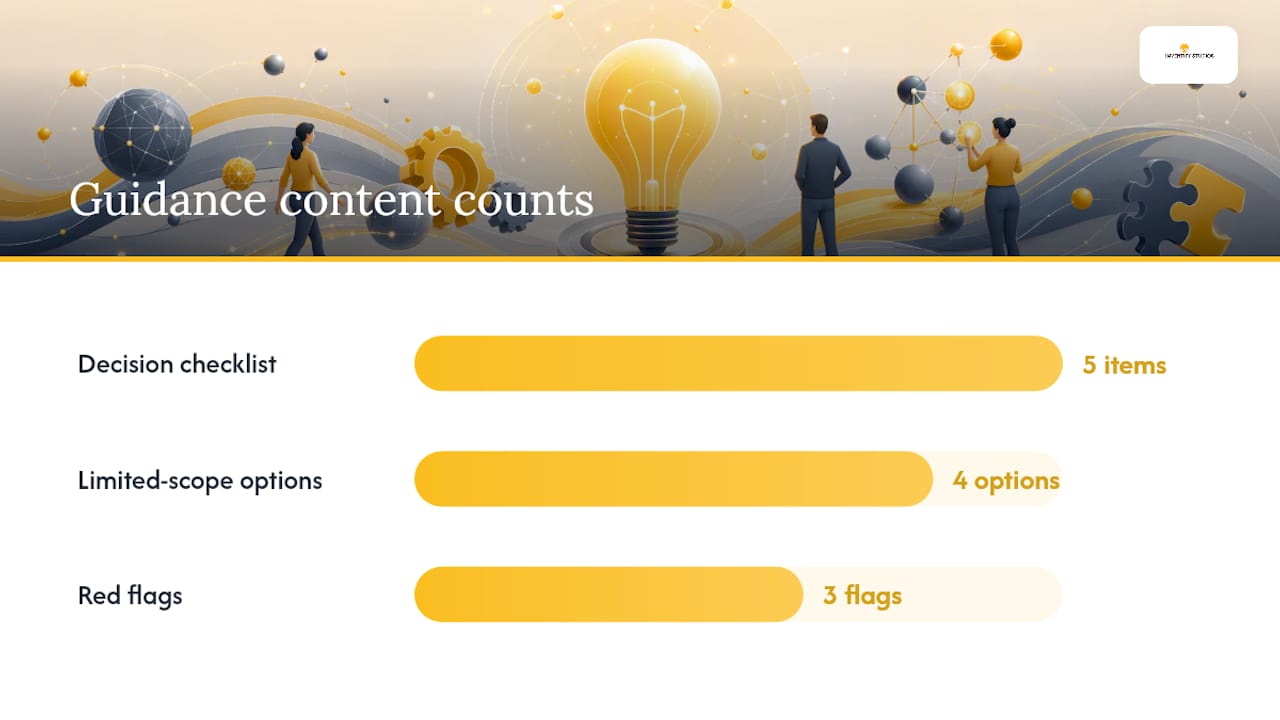
Decision checklist:
- Is your technology complex (biotech, software with multiple interacting components, chemical compositions)? Complexity increases the likelihood of claim drafting errors.
- Do you need broad claim scope to protect a commercial product? Broader claims require more precise drafting.
- Are you planning to license or enforce the patent? Enforceability depends heavily on how claims were written.
- Have you received a complex office action with multiple rejections across multiple claims? This is a high-stakes moment.
- Do you have a competitor who might design around a narrow patent? Claim scope matters more in competitive markets.
Options for limited-scope engagements:
- Claims-only review. You draft the specification; an attorney reviews and rewrites only the claims. This is often the highest-value intervention for a self-filer.
- Provisional review before filing. An attorney reviews your provisional for enablement gaps and missing embodiments before you submit. Costs less than a full drafting engagement.
- Office action response drafting. You handle the filing; an attorney drafts the response to a specific rejection. Useful for complex prior-art rejections.
- Freedom-to-operate analysis. Before commercializing, an attorney reviews whether your product infringes existing patents. This is separate from your own filing but equally important.
Red flags when hiring:
- Services that promise a "patent" for a flat fee without any attorney review of claims.
- Providers who are not registered to practice before the USPTO. Only registered patent attorneys and patent agents can legally represent you in USPTO proceedings.
- Fixed-price "black box" services that deliver a document but no explanation of claim scope or strategy.
For a broader look at protecting your invention without full law-firm representation, the invention protection without a law firm guide covers the options in detail.
Using DIY tools, templates, and invention platforms safely
Automated tools can genuinely help with the early stages of a self-filing. They have real limits, and knowing where those limits are keeps you from over-relying on them.
Where DIY tools add real value:
- Prior-art scoping: automated searches across patent databases surface relevant references faster than manual keyword searches alone.
- Drafting scaffolds: structured templates prompt you to cover the sections a specification needs (background, summary, detailed description, claims, abstract).
- Drawing assistance: some platforms help format and label technical drawings to USPTO standards.
- Document organization: keeping your invention disclosure, prior-art log, and specification drafts in one place reduces version confusion.
Where they fall short:
- Legal claim strategy: no automated tool can reliably determine the optimal claim scope for your commercial situation.
- Enforcement advice: a tool cannot assess whether your claims would hold up in litigation.
- Office action responses: automated responses to USPTO rejections are not a substitute for legal analysis.
A practical workflow that reduces risk:
- Use an AI-assisted prior-art tool to scope the field and identify the closest references.
- Use a drafting template or platform to build your specification and organize your disclosure.
- Before filing the nonprovisional, get a time-boxed attorney review focused specifically on: claim scope relative to the prior art, enablement gaps in the specification, and missing alternative embodiments.
Pro Tip: When you hire an attorney for a limited claims review, give them your three closest prior-art references upfront. A focused review against specific references is faster and cheaper than a general review from scratch.
The workflow above is what many practitioners endorse: do a DIY provisional to secure an immediate filing date if you face imminent public disclosure, then bring in counsel before the 12-month deadline to prepare a nonprovisional that matches your commercial claim scope.
The practical case for limited self-filing
Self-filing is a reasonable choice in two clear situations: you're facing imminent public disclosure and need a priority date fast, or your budget genuinely cannot support full attorney fees at this stage. In both cases, a well-prepared provisional buys you 12 months to raise funds, validate the market, or find a licensing partner before committing to the full cost of a nonprovisional.
What concerns me more than the filing itself is the false confidence a filed application can create. The USPTO's acceptance of your provisional tells you almost nothing about whether your invention is protectable or whether your later claims will hold up. The acceptance bar is procedural. The protection bar is legal and technical, and it's much higher.
The most cost-effective path for most independent inventors isn't purely DIY or purely attorney-driven. It's a hybrid: use automated tools and templates to prepare a thorough provisional, then invest in a narrow attorney engagement before the nonprovisional deadline. That single claims review, done well, is worth more than any amount of additional self-filing work on the specification. The specification describes your invention. The claims define what you own. Those are not the same thing, and treating them as equivalent is the most expensive mistake a self-filer can make.
Inventifystudios helps you build a stronger filing from the start
Preparing a filing-ready provisional on your own is possible. Preparing one that actually supports the claims you'll need 12 months later is harder, and that's exactly where most self-filers lose ground.
Inventifystudios gives independent inventors the tools to close that gap without paying attorney rates for every step. The platform runs AI-assisted prior-art searches, generates structured provisional patent drafts, organizes your invention disclosure documents, and flags enablement gaps before you file. You get a clearer, more complete specification, and you go into any attorney review with a document that's already done the heavy lifting.
The Invention Detail flow is the right starting point: walk through your invention's technical details, generate a provisional-ready specification, and export a document you can file directly or hand to counsel for a focused claims review. Start with the Invention Detail tool to build your provisional the right way.
Inventifystudios helps you prepare and organize patent documents. It is not a law firm and does not provide legal advice. For claim strategy and USPTO representation, consult a registered patent attorney or agent.
Sources
These are the primary USPTO resources for self-filers. Each link goes directly to the official page.
- Filing a patent application on your own | USPTO
- Provisional application for patent | USPTO
- Utility patent application filing guide | USPTO
- MPEP guidance on provisional applications | USPTO (MPEP §601)