

AI reduces inventing costs by cutting the computational, operational, and personnel expenses tied to research, design, and validation. This shift is measurable. The cost per million tokens for capable AI models dropped from roughly $60 in 2020 to as low as $1–3 in 2026. That collapse in price is why AI reduces inventing costs so dramatically for solo founders and small teams. Platforms like Inventifystudios now give everyday inventors access to AI-powered prototyping and patent analysis at a fraction of what traditional consulting once charged. The economics of invention have fundamentally changed.
Why AI reduces inventing costs: the technical drivers
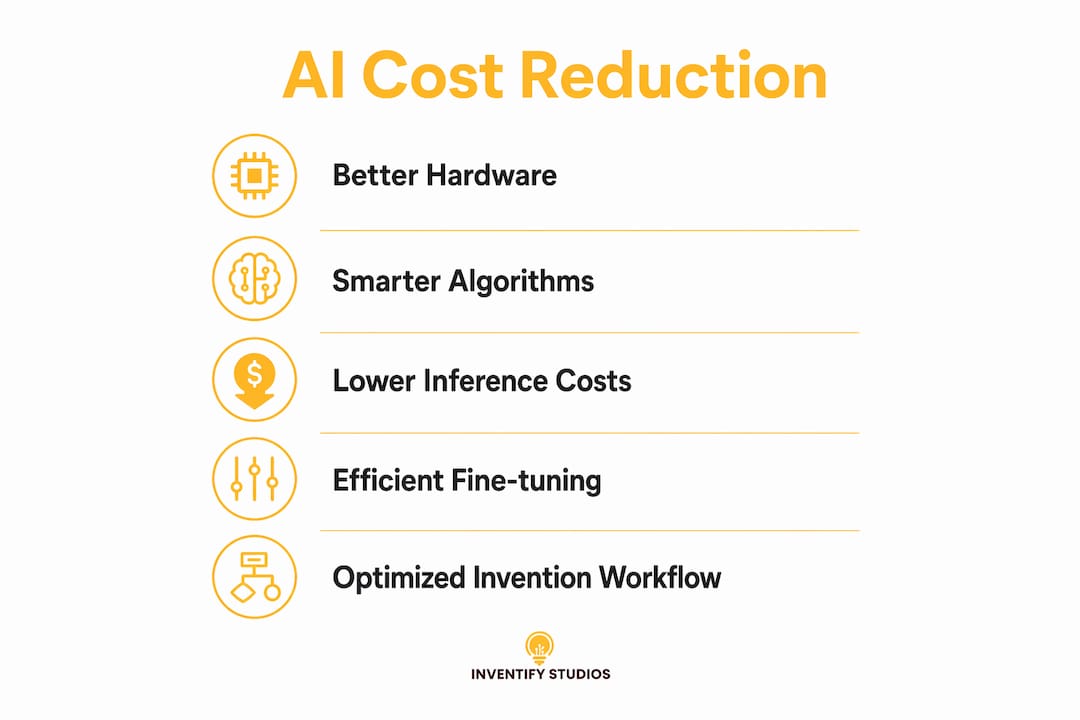
The cost drop in AI is not accidental. It comes from two parallel advances: better hardware and smarter algorithms.
On the hardware side, custom ASICs (application-specific integrated circuits) replaced general-purpose GPUs for many AI inference tasks. These chips run AI models faster and at lower energy cost. On the algorithm side, techniques like quantization, knowledge distillation, and efficient fine-tuning shrink model size without gutting performance. Together, these advances produced a 10–20x reduction in inference costs by mid-2026. That magnitude means a task that once cost $200 to run now costs $10–20.

For inventors, this matters at every stage. Running simulations, generating design variants, and testing product concepts with AI are now affordable enough to do repeatedly. You no longer need to pick one simulation and hope it works. You can run dozens.
| AI Cost Factor | 2020 Baseline | 2026 Level |
|---|---|---|
| Cost per million tokens | ~$60 | $1–3 |
| Inference cost reduction | Baseline | 10–20x lower |
| Solo founder code output | Baseline | 10x higher |
| Seed capital needed | Baseline | 50–70% less |
Pro Tip: Before choosing an AI model for your invention workflow, check whether a smaller, quantized model handles your task. Lightweight models cost a fraction of frontier models and often perform just as well for structured tasks like patent claim drafting or feature comparison.
The algorithmic improvements also enable cost-effective fine-tuning. Instead of training a model from scratch, inventors can adapt an existing model to a specific domain, such as materials science or consumer electronics, at a low cost. This makes AI in product design far more targeted and affordable than general-purpose consulting.
How does AI reshape the invention process to reduce overall costs?
AI changes not just what inventors can afford, but how they work. The traditional invention process runs in a straight line: idea, prototype, test, revise, file. Each stage is expensive, and mistakes discovered late cost the most. AI breaks that linear model.
The principle is "fail early, fail cheap." AI simulations let you stress-test an invention concept before spending money on physical prototypes or patent attorneys. Early AI-driven failure saves thousands by catching flawed assumptions before they reach expensive late-stage development. A concept that would have failed after $50,000 in development can now fail after a $5 AI simulation session.
Here is how AI reshapes each stage of the invention process:
- Ideation. AI generates hundreds of concept variations in minutes. You evaluate them quickly and discard weak ideas before investing time or money.
- Prototyping. AI-powered tools produce 3D models and functional mockups without requiring a design engineer on staff. Inventifystudios offers this directly through its AI prototype generator.
- Validation. AI analyzes market data, prior art, and competitive products to assess whether an idea has commercial potential. This replaces weeks of manual research.
- Patent preparation. AI drafts provisional patent narratives and flags patentability risks early, reducing attorney hours and filing errors.
- Iteration. Because each cycle costs less, inventors can run more iterations. More iterations mean better products before launch.
Pro Tip: Use AI to run a "kill test" on your invention before any other step. Feed your concept into an AI tool and ask it to identify the top five reasons it will fail. This takes minutes and can save months of wasted effort.
One structural shift worth understanding is the "Dispatcher-First" architecture. This approach routes simple AI tasks, like formatting a patent claim or summarizing prior art, to low-cost models. It reserves expensive frontier models for complex reasoning tasks. Deploying a dispatcher to balance tasks between cheap and expensive AI models can save up to 90% of inference costs while maintaining quality. For inventors running multiple AI tools simultaneously, this approach makes the difference between a sustainable workflow and a runaway budget.
What economic shifts come from AI's cost reduction in invention?
AI lowering the cost of ideation creates a new economic reality for inventors. The good news is that seed capital requirements drop significantly. A solo founder using AI in 2026 can produce 10x more output than in 2020, with seed capital needs reduced by 50–70%. That means you can get further with less funding before needing outside investment.
The less obvious news is that AI raises the bar for what counts as a genuine invention. When AI can generate thousands of ideas cheaply, raw ideation becomes less valuable. Patent offices and investors now expect a higher "inventive step," meaning your idea must demonstrate non-obvious creativity beyond what AI alone would produce. The bottleneck shifts from coming up with ideas to proving they are truly novel and commercially viable.
The economic shifts for inventors include:
- Lower entry costs. Inventors need less capital to reach a validated prototype, opening the field to people who previously could not afford to participate.
- Faster market fit. Rapid AI-driven iteration compresses the timeline from concept to market-ready product.
- Downstream challenges. Savings at the ideation stage do not eliminate costs. Manufacturing, distribution, and commercial validation remain expensive and require reinvestment.
- Reinvestment imperative. Entrepreneurs who treat AI savings as pure profit miss the bigger opportunity. Reinvesting AI efficiencies into product expansion and market growth produces far greater returns than cost-cutting alone.
The inventors who win are not those who simply spend less. They are those who redeploy savings into the stages where human judgment and market relationships still matter most.
How can inventors maximize cost efficiency with AI?
Not all AI spending delivers equal returns. Targeted domain-specific AI applications yield faster returns and more invention output per dollar than broad, unfocused AI use. The practical implication: pick the right tool for each task rather than defaulting to the most powerful model available.
The table below shows how to match AI model tiers to invention tasks:
| Task type | Recommended model tier | Why |
|---|---|---|
| Patent claim formatting | Lightweight (e.g., small LLMs) | Structured, rule-based output |
| Prior art search summary | Mid-tier | Requires reading comprehension |
| Novel concept generation | Frontier model | Demands creative reasoning |
| Market viability analysis | Mid-tier | Pattern recognition over large data |
| 3D prototype description | Lightweight to mid-tier | Template-driven output |
Avoiding common pitfalls matters as much as choosing the right model. Many inventors overspend by sending every task to a frontier model like GPT-4 class systems when a smaller model handles it just as well. Others underspend by using only free tools and missing capabilities that would save hours of manual work.
Scripts and cost optimization frameworks that analyze your invention workflow can allocate AI tasks to the right model tier automatically. This approach improves accuracy and cuts costs without requiring you to manually manage every decision. Pairing this with resources like AI productivity tools built for entrepreneurs helps you build a lean, effective invention stack. You can also explore how digital tools in 2026 assess novelty and reduce expenses before patent filing.
Key takeaways
AI reduces inventing costs by collapsing inference prices, automating early-stage validation, and enabling solo inventors to produce output that once required full teams.
| Point | Details |
|---|---|
| Inference costs collapsed | Cost per million tokens dropped from ~$60 in 2020 to $1–3 in 2026, making AI affordable for solo inventors. |
| Fail early, spend less | AI simulations catch flawed concepts before expensive prototyping or patent filing begins. |
| Dispatcher-First saves 90% | Routing simple tasks to lightweight models and complex tasks to frontier models cuts AI spending dramatically. |
| Reinvest savings strategically | AI-driven cost cuts deliver the most value when reinvested into manufacturing, marketing, and scaling. |
| Target AI by task | Domain-specific AI use outperforms broad spending and produces more invention output per dollar. |
The real cost advantage most inventors overlook
I have watched inventors get excited about AI cost savings and then spend those savings on more AI tools they do not need. That is the trap. The actual advantage of cheaper AI is not that you spend less overall. It is that you can afford to be wrong more often, earlier, and at lower stakes.
The inventors I have seen succeed with AI are the ones who treat it as a stress-testing machine. They use it to find the holes in their ideas before committing to anything expensive. They run the kill test. They generate the competing concepts. They check patentability before calling an attorney. By the time they spend real money, they already know their idea survives scrutiny.
The rising inventive step standard is real and worth taking seriously. AI makes ideation cheap for everyone, which means your idea needs to be genuinely non-obvious to stand out. That is not a reason to avoid AI. It is a reason to use it more thoroughly. Stress-test your invention with AI before filing anything. The cost of a few AI sessions is nothing compared to a rejected patent application or a product that fails in market testing.
My honest advice: adopt AI early, deploy it narrowly, and reinvest what you save into the stages where human judgment still wins.
— Hua
How Inventifystudios puts AI cost savings to work for inventors
Inventifystudios gives inventors direct access to the tools that make AI cost reduction practical, not theoretical.
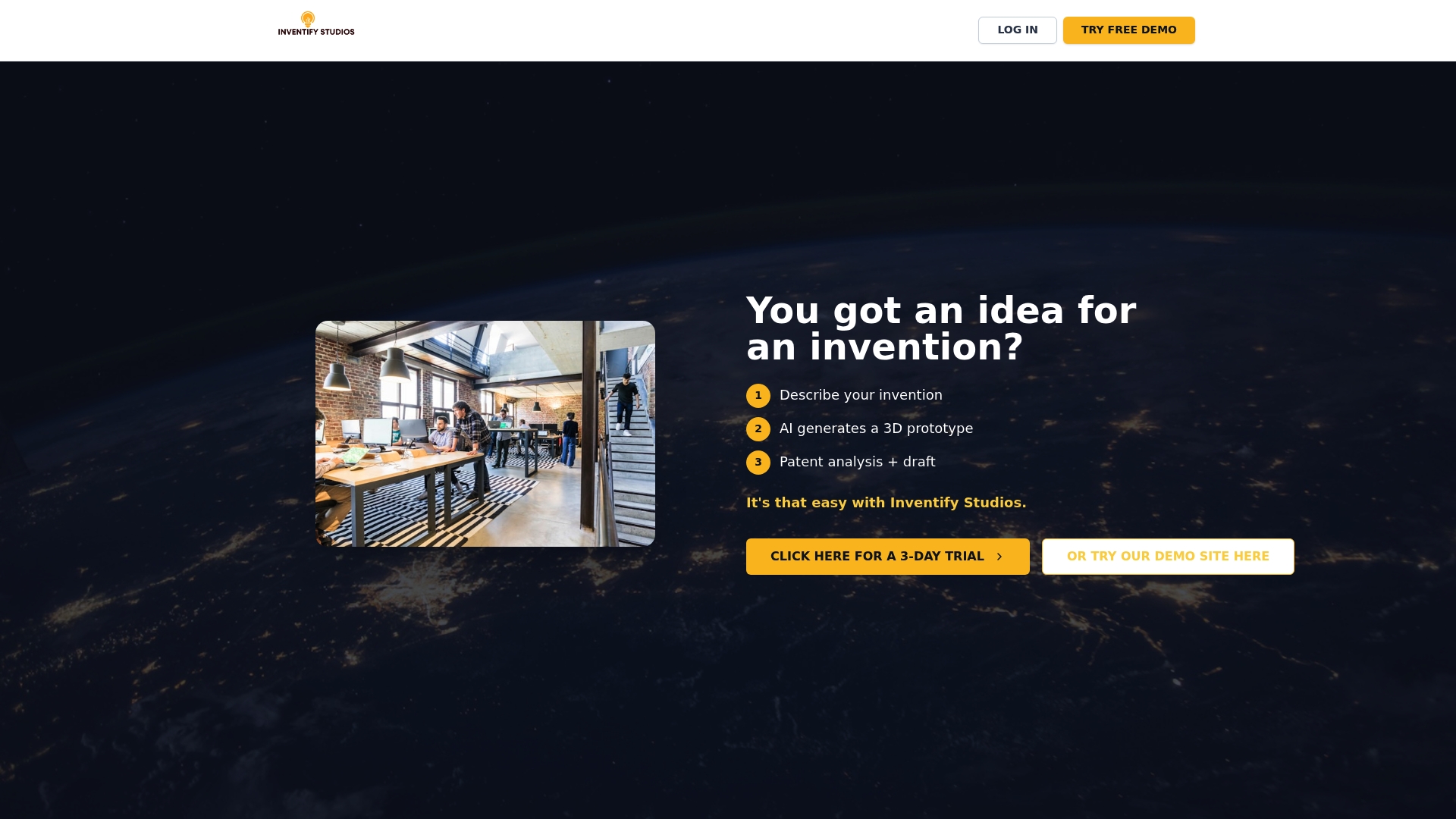
The platform's AI-powered invention tools cover the full early-stage workflow: 3D prototype generation, patentability assessment, and provisional patent drafting. Each tool is built to replace the expensive consulting steps that traditionally blocked first-time inventors. You get a validated concept and a patent-ready draft without paying attorney rates for every iteration. For inventors who want a clear picture of where costs come from and how to plan around them, the invention cost planning guide on the Inventifystudios blog breaks it down step by step. The goal is simple: get your idea further, faster, and at a cost that makes sense for where you are right now.
FAQ
Why does AI reduce inventing costs so significantly?
AI cuts inventing costs by automating research, prototyping, and validation tasks that previously required expensive specialists. Inference costs dropped from roughly $60 per million tokens in 2020 to $1–3 in 2026, making repeated AI use affordable for solo inventors.
How much can AI lower seed capital needs for inventors?
A solo founder using AI tools in 2026 can reduce seed capital requirements by 50–70% compared to 2020, while producing 10x more output. This means inventors can reach a validated prototype with significantly less outside funding.
What is the Dispatcher-First approach to AI cost optimization?
The Dispatcher-First approach routes simple invention tasks to low-cost AI models and reserves frontier models for complex reasoning. This method can save up to 90% of inference costs without reducing the quality of results.
Does AI eliminate all invention costs?
AI reduces early-stage costs dramatically but does not eliminate downstream expenses. Manufacturing, commercial validation, and distribution remain significant cost centers that require reinvestment of AI-driven savings.
How does AI affect patent filing for inventors?
AI raises the standard for what qualifies as a patentable invention by making basic ideation cheap and widely accessible. Inventors should use AI to stress-test novelty and identify prior art before filing, reducing the risk of rejection and wasted attorney fees.